AviationFederal Aviation Administration
The FAA Part 107 test, explained
The FAA Part 107 knowledge test (Unmanned Aircraft General, Small, or UAG) is the exam you pass to get a remote pilot certificate for flying drones for work. It has 60 scored multiple choice questions plus 5 unscored ones, you get 120 minutes, and you need 70% (42 of 60) to pass. You take it at a PSI testing center for about $175, and since September 29, 2025, regulations make up 48% of the test.
FAA Part 107 at a glance
- Official test name
- Unmanned Aircraft General, Small (UAG)2
- Questions
- 60 scored + 5 unscored validation questions2
- Time
- 120 minutes2
- Passing score
- 70% (42 of 60 scored questions)2
- Answer format
- Multiple choice, three options (A, B, C)10
- Test fee
- About $175, paid to PSI6
- Minimum age
- 14 to take the test4
- Minimum age for the certificate
- 163
- Retest after a fail
- Wait 14 calendar days3
- Staying current
- Free online recurrent training (ALC-677) every 24 calendar months1
What the UAG test covers
The FAA’s name for the Part 107 knowledge test is Unmanned Aircraft General, Small, or UAG.2 It pulls from five content areas in the Remote Pilot Airman Certification Standards (ACS), but the share each area gets changed on September 29, 2025, after an industry job task analysis.2 The ACS document still prints the older ranges, so trust the PSI bulletin for the current split.9
- Regulations48%
- Airspace and operating requirements20%
- Weather5%
- Loading and performance2%
- Operations25%
Under the 2021 outline, regulations were 15 to 25% of the test and operations were 35 to 45%. Weather was 11 to 16% and loading and performance 7 to 11%.9 Today, regulations alone are nearly half your score.2 If your study material spends a week on METAR decoding and a day on Part 107 itself, it’s out of balance.
| Area | What the questions actually test |
|---|---|
| Regulations | Registration, visual line of sight, visual observers, the operating limits in §107.51, night rules, the four categories of operations over people, Remote ID, safety event reporting, waivers9 |
| Airspace | Class B, C, D, E and G, when you need ATC authorization, special use airspace, temporary flight restrictions, reading sectional charts9 |
| Weather | METARs and TAFs, density altitude, fronts, thunderstorms, fog9 |
| Loading and performance | Center of gravity, load factor in turns, how weight and density altitude reduce performance9 |
| Operations | Radio phraseology, traffic patterns, emergencies like lost link and battery fires, decision making, crew resource management, physiology, maintenance9 |
The numbers you have to know cold
Many regulation questions turn on a specific number in §107.51. Groundspeed can’t exceed 87 knots (100 mph). Altitude is limited to 400 feet above ground level, unless you’re within a 400 foot radius of a structure and no higher than 400 feet above its top. Flight visibility from the control station must be at least 3 statute miles, and you stay 500 feet below clouds and 2,000 feet horizontally from them.3 Add the §107.9 reporting rule, which gives you 10 calendar days to report serious injury, loss of consciousness, or property damage over $500.3
Where people lose points
The FAA publishes the knowledge codes that test takers miss most. For the year ending June 30, 2025, the UAG code on that list was UA.I.E.K13, the Declaration of Compliance for operations over people, missed 78.58% of the time.8 The idea is simple once it clicks. A Category 2 or Category 3 drone can fly over people only if the manufacturer has an FAA-accepted Declaration of Compliance listing it as eligible, and the drone carries the matching label.3 Category 2 is built around an 11 foot-pound impact limit and Category 3 around 25 foot-pounds.3
The other big trap is the sectional chart. Mixing up altitudes in MSL (above sea level) with AGL (above the ground), misreading a Class B floor, or picking the tower frequency when the question wants the CTAF costs more points than any weather topic. The overall numbers show how much this matters. In 2025, 82.96% of the 73,914 UAG tests were passes, and the average score was 79.31%.7 That average is less than 10 points above the line.
How the test works
You’ll see 65 questions. Sixty count toward your score and 5 are unscored validation questions the FAA is testing for future use.2 They aren’t marked, so treat every question as if it counts. The 120 minute limit already includes time for those extra 5.2 You need 70% of the scored questions, which means 42 of 60.2
Every question is multiple choice with three options and one best answer.10 The FAA’s sample questions show the format, and the PSI site has a free sample test under “Exam Resources.”2
The testing center gives you scratch paper, a pen and the Airman Knowledge Testing Supplement (FAA-CT-8080-2H), which holds the chart excerpts, legends and figures many questions refer to.2 PSI’s software has a built-in four function calculator. You may bring your own plotter, a basic arithmetic calculator, or a plain handheld magnifying glass, which is worth it for chart work.2
Since October 26, 2026, the UAG test also includes image questions built from current FAA sectional charts that are not in the printed supplement.5 The supplement is still handed out at the test center, and the FAA says it will give ample notice before removing it.5
If you need a testing accommodation, choose “yes” on the accommodations screen when you schedule, and PSI’s accommodations team will follow up. PSI may ask for documentation.2
Eligibility, cost and booking
You can take the test at 14.4 To hold the certificate you must be at least 16, read, speak, write and understand English, and not know of any physical or mental condition that would keep you from flying safely.3 No instructor endorsement or written authorization is needed to sit the test.4
The FAA says knowledge testing centers charge about $175 for the initial test.6 You pay PSI when you book.
- Create an IACRA profileRegister at the FAA's IACRA site to get your FAA Tracking Number (FTN). You need it before you book, and it prints on your score report.
- Book with PSIGo to faa.psiexams.com, pick the Unmanned Aircraft General, Small exam, then choose a center, date and time. A confirmation email follows.
- Check your IDYour ID has to show your photo, date of birth, signature and residential address. A P.O. box doesn't count as an address.
- Know the cancel ruleYou can cancel or reschedule if PSI hears from you at least 24 hours before your appointment. A voicemail doesn't count.
The FTN step comes from the FAA’s own process,1 the booking and cancellation details come from PSI’s bulletin,2 and the ID rules from the FAA testing matrix.4 Heads up for anyone booking early in the year. PSI is moving FAA testing to a new scheduling and check-in platform in the first quarter of 2027 and will contact applicants whose appointments are affected.5
If you already hold a Part 61 pilot certificate (other than student pilot) and a current flight review, you can skip the knowledge test and take the free online course ALC-451 instead.1
A three week study plan
Most adults with a job can be ready in about three weeks at an hour a day. Weight your time the way the test does, heavy on regulations and airspace, light on weather and performance.
- Week 1Read 14 CFR Part 107 Subparts A to D, start to finish. Build flash cards for every number in §107.51, §107.29 and §107.9. Learn the four categories of operations over people and what a Declaration of Compliance is.
- Week 2Charts and airspace. Work through Legend 1 in the testing supplement, then the sectional excerpts. Practice finding airspace class, floors and ceilings, obstacle heights, and the CTAF for an airport. Do a set of chart questions every day.
- Week 3Operations, weather and performance, then full timed practice tests of 60 questions in 120 minutes. Review every miss against the regulation or handbook it came from. Book the test once you're scoring well above 70% on questions you haven't seen.
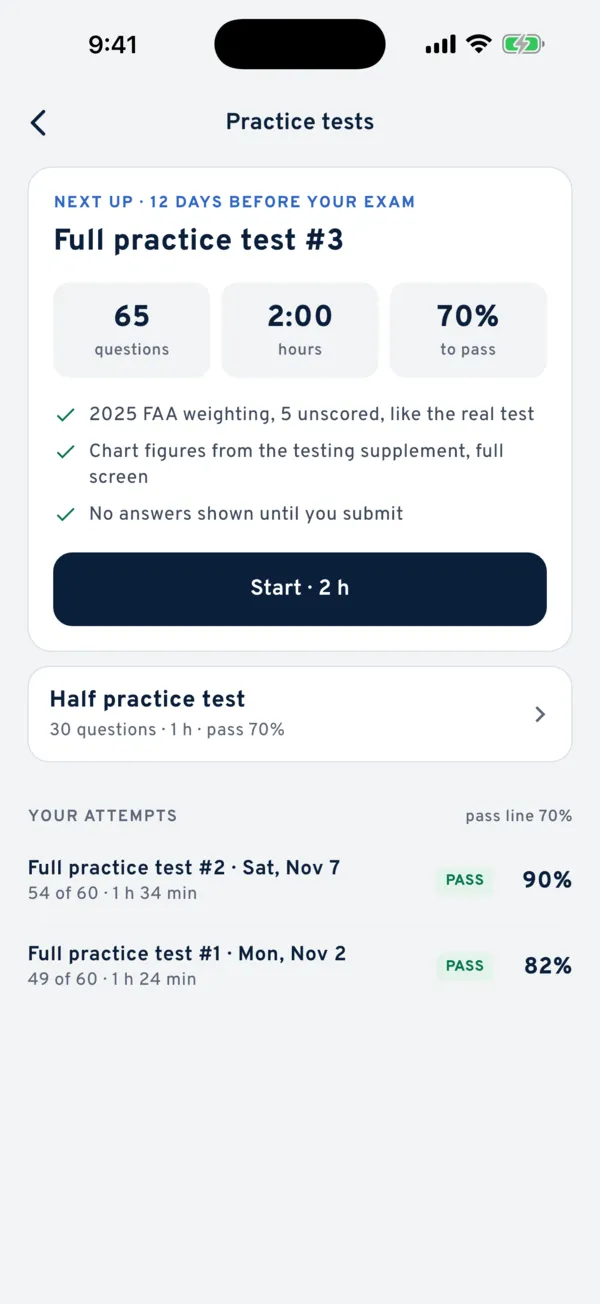
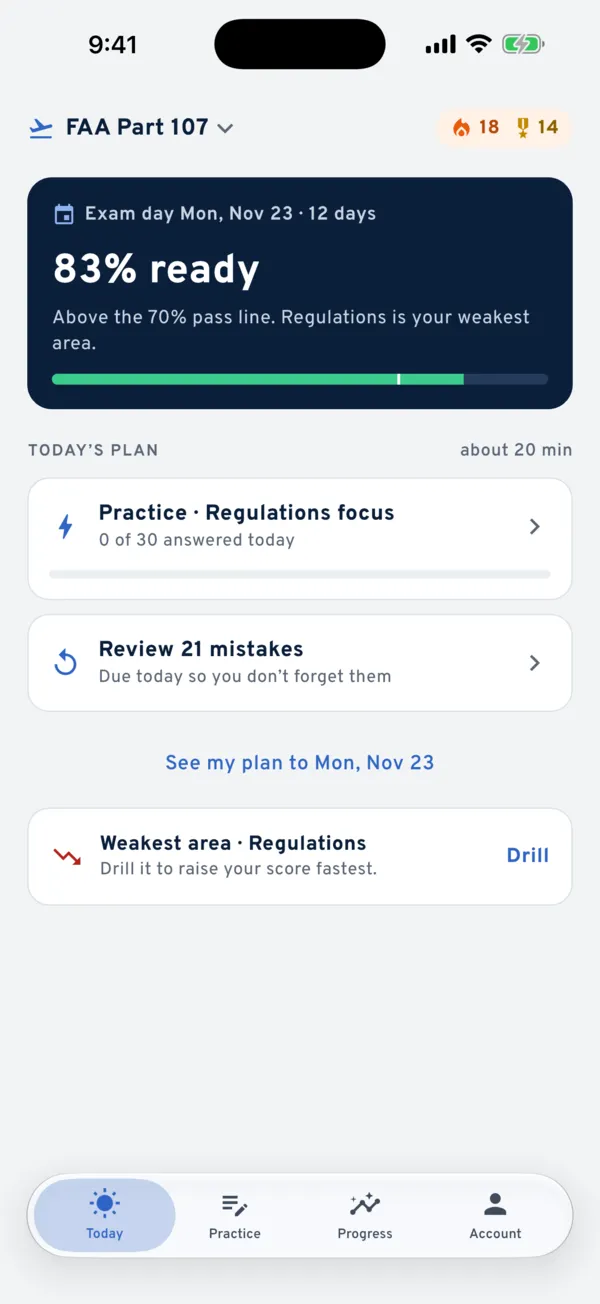
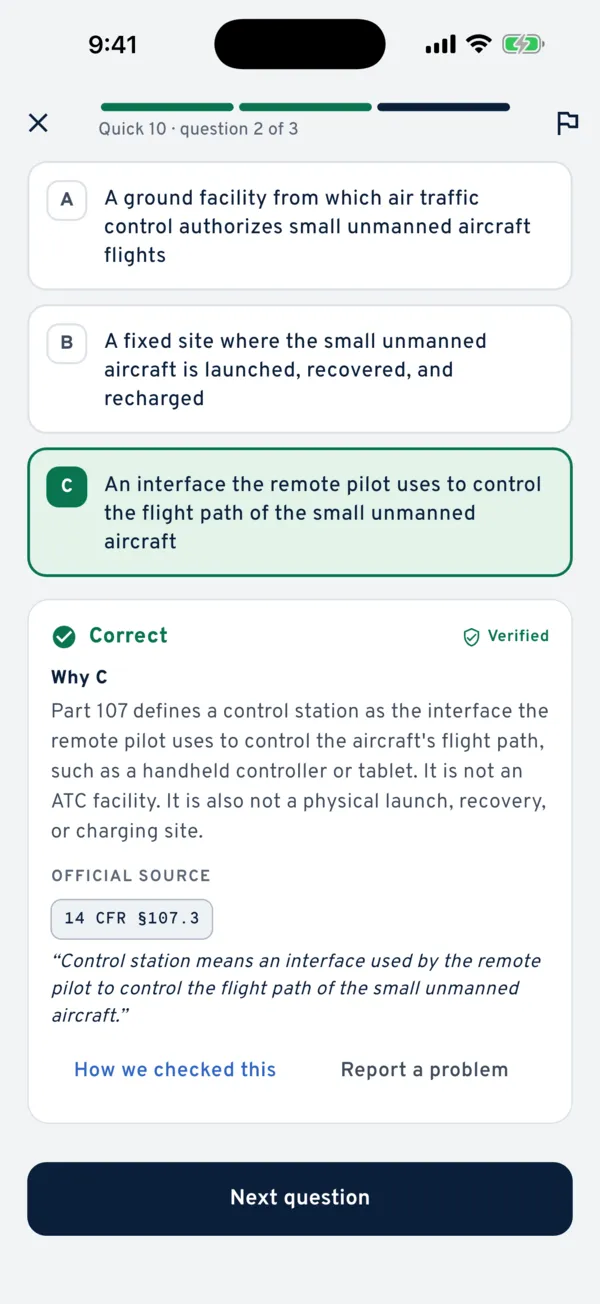
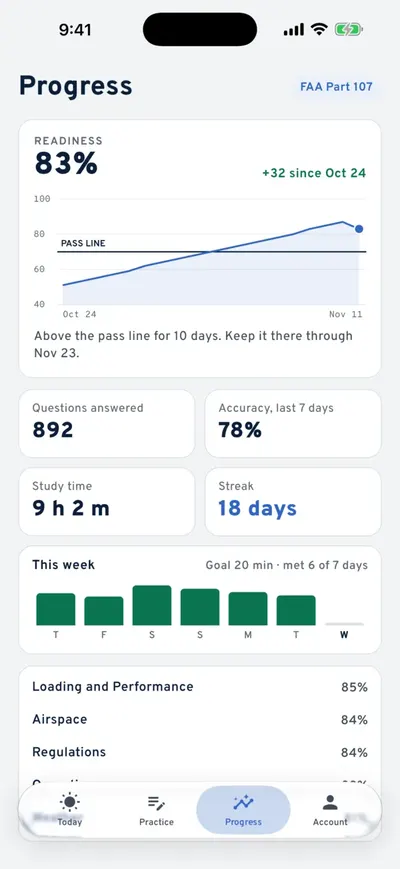
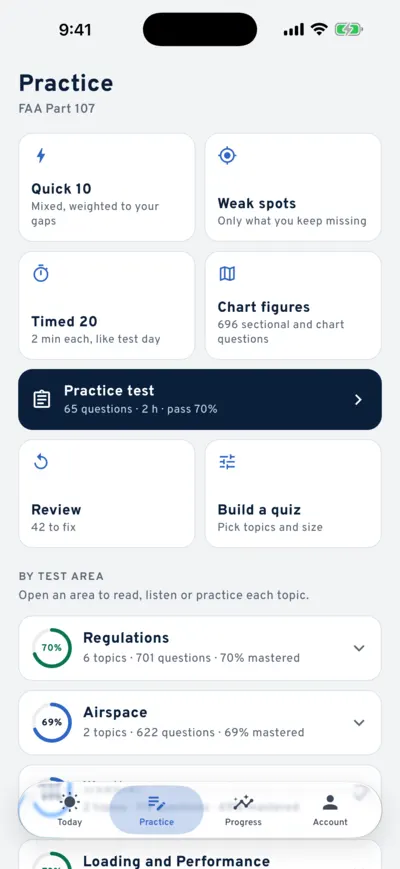
Practice tests are only useful if the questions are new to you. Scoring 95% on a bank you’ve already seen twice tells you about your memory, not about test day. Clinched writes every practice question from the regulations and FAA handbooks and shows the source under each answer, so you can check why a choice is right. For a tighter schedule, see the two week Part 107 study plan.
Test day
Plan to arrive at least 15 minutes early. Late arrivals may be turned away and lose the fee.2
- Government photo ID showing date of birth, signature and residential address
- Your FAA Tracking Number (FTN) from IACRA
- A failed test report, if this is a retest
- Optional: plotter, plain handheld magnifier, basic four function calculator
- Layered clothing without pockets or hoods
Phones, watches, bags, notes and food stay outside. Hats and hooded clothing aren’t allowed, other than religious apparel.2 Calculators are cleared in front of the proctor before and after the test.2 Breaks happen under proctor supervision, one person at a time, and the clock keeps running.2
When you submit, the score comes up right away and the center prints one copy of your Airman Knowledge Test Report (AKTR).2 Keep it. The report lists the ACS codes for every question you missed, even when you pass.4 You can reprint it later from your PSI account.2
After you pass, or if you don’t
Passing the test doesn’t make you a remote pilot yet. You still apply in IACRA on FAA Form 8710-13, entering the 17 digit Knowledge Test Exam ID from your report. It can take up to 48 hours for the result to show up in IACRA.1 The TSA then runs a security check. When it clears, the FAA emails you instructions to print a temporary certificate, and the permanent card comes by mail later.1 A temporary certificate is good for up to 120 days.3 The full sequence, with drone registration and Remote ID, is in what to do after you pass Part 107.
Your certificate doesn’t expire, but you can’t use it unless you’ve passed the test or completed recurrent training within the previous 24 calendar months.3 The FAA’s recurrent course, ALC-677, is free and online.1
If you fail, you have to wait 14 calendar days before retesting.3 You don’t need an instructor endorsement, but you must hand the failed AKTR to the proctor.2 Look up each ACS code on your report in the ACS document,9 study those topics, and book the retest for day 15 or later. You’ll pay the test fee again.
The new current chart questions
The FAA announced in its Airman Testing Community Advisory that UAG questions would start using images from the latest VFR charts on October 26, 2026, and the October 2026 advisory confirmed the change took effect.5 Each image question names the source chart and its effective dates. The FAA’s samples cite the Washington and Las Vegas sectionals dated 12 June 2025 to 7 August 2025.10
One FAA sample shows MILLVILLE MUNI (MIV) and asks what airspace surrounds it and whether ATC authorization is needed. The answer is a Class E surface area, and yes, authorization is required.10 That tracks with §107.41, which requires prior ATC authorization in Class B, C and D airspace and inside the surface area of Class E airspace designated for an airport.3 Another sample asks for the CTAF at GRAND CANYON NTL PARK (GCN) when its tower is closed.10
The skills haven’t changed. What changed is that you can’t memorize the supplement’s few excerpts and expect to recognize every picture. If you can read any airport’s data block and any airspace boundary on any sectional, you’re covered. The sectional chart guide for Part 107 walks through the symbols in the order the test asks about them.
Questions people ask
How many questions are on the Part 107 test?
You see 65 questions. Sixty are scored and 5 are unscored validation questions the FAA is trying out, and nothing on screen tells you which ones those are. Your score is based on the 60, so you need 42 correct to reach the 70% passing mark.
How much does the Part 107 test cost?
The FAA says testing centers charge about $175 for the initial Part 107 knowledge test. You pay PSI when you book. The certificate itself and the FAA's recurrent training are free, and each drone you fly under Part 107 must also be registered with the FAA.
Is the Part 107 test hard?
It's passable, but don't wing it. In 2025, 82.96% of 73,914 tests were passes and the average score was 79.31%, less than 10 points above the line. Give extra time to the operations over people rules, the most missed topic in FAA data, and to reading sectional charts.
What happens if I fail the Part 107 test?
Under 14 CFR 107.71 you must wait 14 calendar days before you can retest. You don't need an instructor endorsement. Bring your failed test report to the testing center, and use the ACS codes printed on it to see exactly which topics you missed.
Do I need a Part 107 certificate to fly a drone for fun?
No. Purely recreational flyers take the free online TRUST test instead and follow the rules in 49 U.S.C. 44809. If any part of the flight supports a business, a client or an employer, you need the Part 107 certificate.
Sources
- Become a Certificated Remote PilotFederal Aviation Administration
- Unmanned Aircraft General, Small (UAG) Applicant Information Bulletin, effective September 29, 2025PSI Services
- 14 CFR Part 107, Small Unmanned Aircraft SystemseCFR, National Archives
- FAA Airman Knowledge Testing Matrix, revised September 25, 2026Federal Aviation Administration
- Airman Testing Community Advisory, October 2026 EditionFederal Aviation Administration
- How much does it cost to get a remote pilot certificate?Federal Aviation Administration
- 2025 Airman Knowledge Tests (annual statistics)Federal Aviation Administration
- Frequently Missed Knowledge Test ACS Codes, 2nd Quarter CY25Federal Aviation Administration
- Remote Pilot, Small Unmanned Aircraft Systems Airman Certification Standards (FAA-S-ACS-10B)Federal Aviation Administration
- Airman Testing Community Advisory, September 2026 Special EditionFederal Aviation Administration
More on FAA Part 107
- Exam guide · FAA Part 107
 Part 107 vs TRUST: Which Drone Certificate Do You Need?TRUST is a free online test for flying purely for fun. Part 107 is a proctored $175 FAA test for everything else. How to tell which one applies to your flight.
- Exam guide · FAA Part 107
 Part 107 Test Changes for 2025 and 2026: What's DifferentSince Sept 29, 2025 the Part 107 test weights regulations at 48% and adds 5 unscored questions. Since Oct 26, 2026 it shows current sectional chart images.
- Topic explainer · FAA Part 107
 Part 107 Airspace Classes and LAANC Authorization ExplainedWhich airspace classes need FAA authorization under Part 107, how LAANC and UAS Facility Maps work, and the airspace traps that show up on the Part 107 test.
- Topic explainer · FAA Part 107
 How to Read a Sectional Chart for the Part 107 TestRead a sectional chart the way the Part 107 test asks: airspace lines, MSL vs AGL, airport data blocks, CTAF, obstacles and the new current chart images.
- Exam guide · FAA Part 107After You Pass Part 107: IACRA, TSA, Registration, Remote IDPassed Part 107? Apply in IACRA with your 17 digit exam ID, clear the TSA check, register each drone for $5, meet Remote ID and stay current every 24 months.
- Study plan · FAA Part 107A Two Week Part 107 Study Plan That Fits the 2025 TestA day by day 14 day plan for the Part 107 test at about 90 minutes a day, weighted to the 2025 split of 48% regulations, 20% airspace and 25% operations.