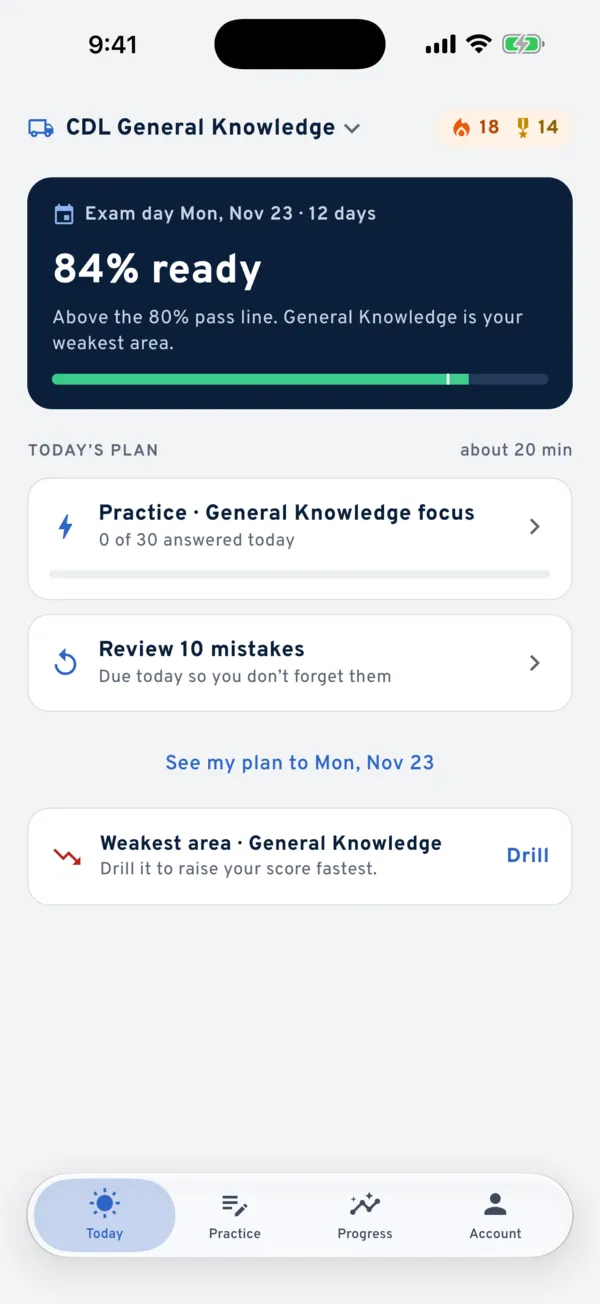
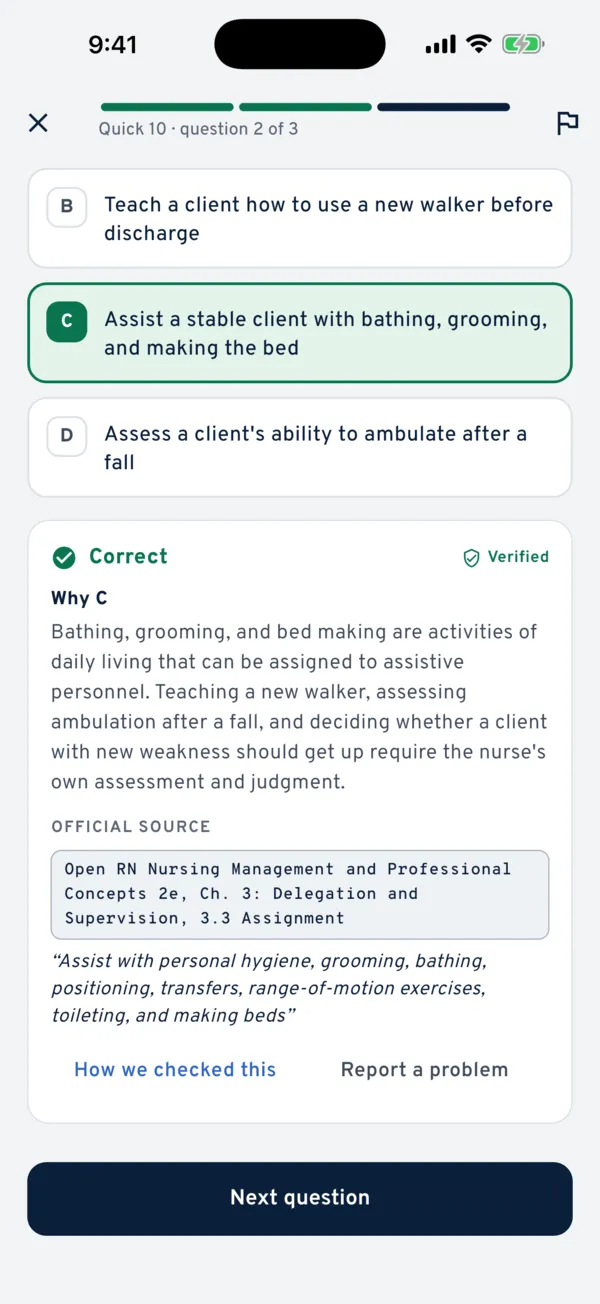
PTCE guideFree practice test
PTCE practice test
15 free PTCE questions from the 351 in Clinched, chosen to match how the real test is weighted. Pick an answer to see the explanation and the official text it comes from. Nothing to sign up for.
-
Question 1 of 15Federal requirements
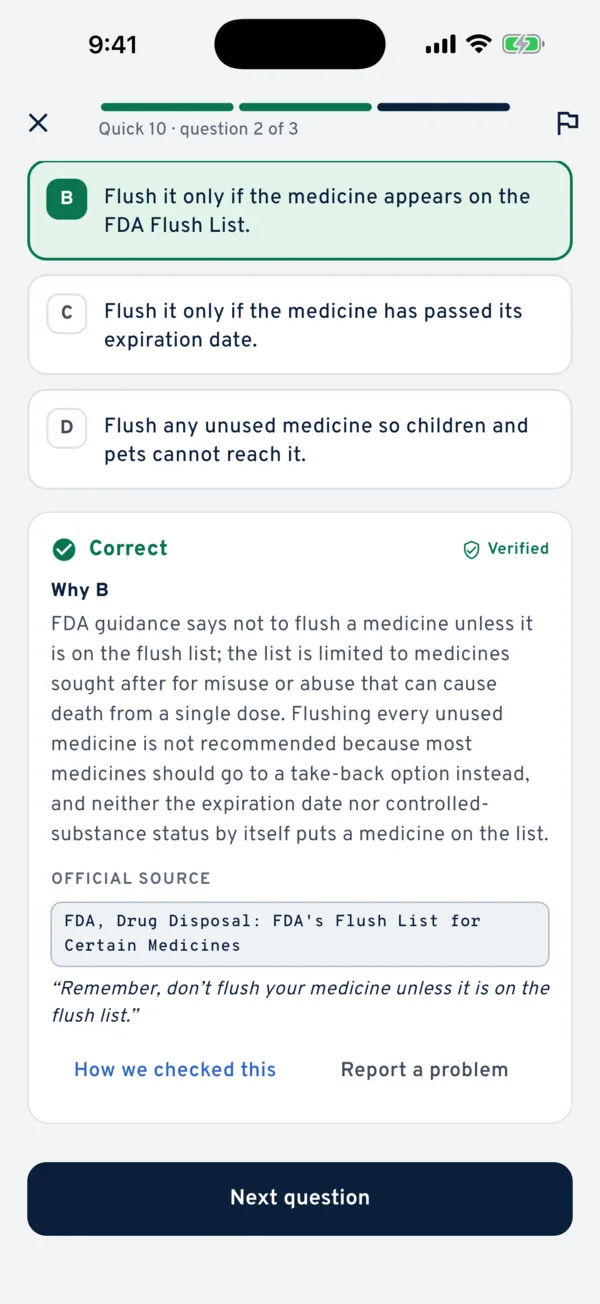
A patient asks you how to dispose of an unused medicine at home. What does FDA guidance say about flushing a medicine down the toilet?
Correct answer D. Flush it only if the medicine appears on the FDA Flush List.
FDA guidance says not to flush a medicine unless it is on the flush list; the list is limited to medicines sought after for misuse or abuse that can cause death from a single dose. Flushing every unused medicine is not recommended because most medicines should go to a take-back option instead, and neither the expiration date nor controlled-substance status by itself puts a medicine on the list.
Official source FDA, Drug Disposal: FDA's Flush List for Certain MedicinesRemember, don’t flush your medicine unless it is on the flush list.
-
Question 2 of 15Federal requirements
A patient asks which medicines are on the FDA flush list. Which statement about the list is correct?
Correct answer A. It lists many opioid products, including oxycodone and methadone.
The FDA Flush List includes many opioids, with entries for any drug containing oxycodone, methadone, buprenorphine, fentanyl, hydrocodone, hydromorphone, meperidine, morphine, oxymorphone, or tapentadol. Fentanyl is one of many opioids listed, and the list is based on misuse potential and possible harm from one dose, not on boxed warnings or controlled-substance schedules.
Official source FDA, Drug Disposal: FDA's Flush List for Certain MedicinesAny drug that contains the word “oxycodone” | CODOXY, COMBUNOX, OXADYDO (formerly OXECTA), OXYCET, OXYCONTIN, PERCOCET, PERCODAN, ROXICET, ROXICODONE, ROXILOX, ROXYBOND, TARGINIQ ER, TROXYCA ER, TYLOX, XARTEMIS XR, XTAMPZA ER
FDA, Drug Disposal: FDA's Flush List for Certain Medicines“Any drug that contains the word “methadone” | DOLOPHINE, METHADOSE” -
Question 3 of 15Federal requirements
A manufacturer notifies your pharmacy that it is removing a lot of a drug from the market. Which statement about how a recall may be started is correct?
Correct answer D. A firm may recall its own product, or FDA may request or order the recall.
Recalls may be conducted on a firm's own initiative, by FDA request, or by FDA order under statutory authority, so a manufacturer can pull its own lot without waiting for FDA. FDA ordering the recall is only one of the three routes, and neither an FDA inspection nor a court order is required to start a recall.
Official source FDA, Recalls Background and DefinitionsRecalls may be conducted on a firm's own initiative, by FDA request, or by FDA order under statutory authority.
-
Question 4 of 15Medications
A prescription is written for Alphagan P ophthalmic solution. Which statement about this medication is correct?
Correct answer A. It is brimonidine, an alpha adrenergic agonist.
Alphagan P contains brimonidine tartrate, an alpha adrenergic agonist eye drop that lowers elevated intraocular pressure in open-angle glaucoma or ocular hypertension. Timolol, latanoprost, and pilocarpine are all real glaucoma eye drops, but each belongs to a different drug class and none of them is brimonidine.
Official source Alphagan P (brimonidine) label, Highlights of Prescribing InformationALPHAGAN P is an alpha adrenergic agonist indicated for the reduction of elevated intraocular pressure (IOP) in patients with open-angle glaucoma or ocular hypertension. (1)
Alphagan P (brimonidine) label, Highlights of Prescribing Information“Ophthalmic solution containing 0.1% (1 mg/mL) or 0.15% (1.5 mg/mL) brimonidine tartrate. (3)” -
Question 5 of 15Medications
A patient is stopping Lexapro and will begin an MAOI antidepressant. How long must elapse after the last Lexapro dose before the MAOI is started?
Correct answer D. At least 14 days
The labeling calls for at least 14 days after stopping Lexapro before an MAOI intended to treat a psychiatric disorder is started, and the same 14-day gap applies in the other direction when an MAOI is stopped first. Seven days is half the labeled interval, 2 days is far too short, and 30 days is longer than the labeling requires.
Official source Lexapro (escitalopram) label, 1 INDICATIONS AND USAGE; 2 DOSAGE AND ADMINISTRATIONConversely, at least 14 days should be allowed after stopping Lexapro before starting an MAOI intended to treat psychiatric disorders
-
Question 6 of 15Medications
A prescription for adalimumab is being checked before dispensing. Which of the following risks is included in the boxed warning for this drug?
Correct answer D. Serious infections that may lead to hospitalization or death
The boxed warning for adalimumab includes serious infections that may lead to hospitalization or death, such as active tuberculosis and invasive fungal infections; the drug is stopped if a serious infection or sepsis develops. Injection-site redness and swelling can occur with injectable medicines but are not what the boxed warning names, and low blood sugar and constipation are effects of other drug classes, not the labeled warning for adalimumab.
Official source Humira (adalimumab) label, WARNING: SERIOUS INFECTIONS AND MALIGNANCYPatients treated with HUMIRA are at increased risk for developing serious infections that may lead to hospitalization or death
-
Question 7 of 15Medications
A prescription is written for tramadol hydrochloride tablets. Which drug class does tramadol belong to?
Correct answer D. An opioid analgesic
Tramadol is an opioid analgesic, labeled for pain severe enough to require an opioid analgesic when other treatments are inadequate. It is not an NSAID, a muscle relaxant or a triptan, so it carries opioid risks such as addiction, misuse and overdose rather than the risks of those other classes.
Official source Ultram (tramadol) label, 1 INDICATIONS AND USAGETramadol hydrochloride tablets are indicated in adults for the management of pain severe enough to require an opioid analgesic and for which alternative treatments are inadequate.
-
Question 8 of 15Order entry and processing
A patient's weight is recorded as 2.5 kg. What is this weight in grams?
Correct answer D. 2,500 g
One kilogram equals 1,000 g, so you multiply: 2.5 kg × 1,000 = 2,500 g. Using 100 g per kilogram gives 250 g, multiplying by a million gives 2,500,000 g (the value in milligrams), and dividing by 1,000 gives 0.0025 g, which goes the wrong direction.
Official source Army MD0802 Pharmaceutical Calculations, PDF p. 62(b) 2.5 kg (c) 2,500,000 mg
-
Question 9 of 15Order entry and processing
A pharmacy has 1 oz (28.4 g) of a bulk drug and will prepare 30-mg doses from it. How many doses can be made?
Correct answer A. 946 doses
One ounce is 28.4 g, or 28,400 mg. Dividing by 30 mg per dose gives 946.67 doses, so 946 whole doses can be made. 1000 doses uses 30 g/oz; 945 doses uses 28.35 g/oz; and 28,400 doses stops at the total milligrams.
Official source Army MD0802 Pharmaceutical Calculations, PDF p. 83How many 30-mg doses can be made from one ounce of a drug?
Army MD0802 Pharmaceutical Calculations, PDF p. 85“15. 946 doses (Remember: Each dose must be a whole dose.)” -
Question 10 of 15Order entry and processing
A master formula for compound senna powder contains senna 180 g, glycyrrhiza 236 g, washed sulfur 80 g, fennel oil 4 g and sucrose 500 g, a total of 1000 g. You must prepare 60 g of the powder. What do you do with each ingredient amount?
Correct answer A. Multiply it by 0.06
The formula totals 1000 g and you need 60 g, so the multiplier is 60 divided by 1000, or 0.06, and every ingredient is multiplied by that same number (senna becomes 180 × 0.06 = 10.8 g). Multiplying by 60 uses the wanted amount itself as the multiplier and gives a batch far larger than the formula, 16.7 is the ratio upside down (1000 ÷ 60), and dividing by 60 shrinks each amount far more than 0.06 does.
Official source Army MD0802 Pharmaceutical Calculations, PDF p. 76Use the formula listed below to calculate the amount of each ingredient that should be used to make 60 g of compound senna powder.
-
Question 11 of 15Order entry and processing
You need to make 2000 mL of a 1:4000 silver nitrate solution from a 1:200 silver nitrate stock solution. Which equation correctly sets up the volume of stock solution, X, that you need?
Correct answer B. X × (1/200) = 2000 mL × (1/4000)
In a dilution, the stock concentration is multiplied by the stock volume and set equal to the final concentration multiplied by the final volume, so X × 1/200 = 2000 mL × 1/4000, which gives X = 100 mL. The second option pairs the stock concentration with the final volume, the third uses the stock concentration on both sides, and the fourth uses the final concentration on both sides, so none of them can give the volume of stock needed.
Official source Army MD0802 Pharmaceutical Calculations, PDF p. 110d. How many milliliters of a 1:200 silver nitrate solution would be needed to make 2000 ml of a 1:4000 solution?
Army MD0802 Pharmaceutical Calculations, PDF p. 110“V C = V1 C1” -
Question 12 of 15Patient safety and quality assurance
Your pharmacy stocks hydrALAZINE and hydrOXYzine on shelves next to each other. Which statement about look-alike and sound-alike drug names is correct?
Correct answer D. They are a recognized error-prone area that FDA targets to prevent errors.
Look-alike and sound-alike drug names are named as one of the error-prone areas of the medication use process that FDA targets to prevent medication errors. Similar names do lead to real wrong-product errors, and both written look-alikes and spoken sound-alikes are a risk that pharmacy staff guard against when selecting and checking stock.
Official source FDA, A Microgram of Prevention is Worth a Milligram of CureDrug names that look-alike or sound-alike, incomplete or confusing drug labels, and lack of proper education about newly approved products are just a few areas of FDA’s initiative to prevent medication errors.
-
Question 13 of 15Patient safety and quality assurance
A patient asks whether a neighbor with the same insulin prescription can use the patient's multi-dose diabetes pen if a fresh needle is put on each time. What do the required label warnings say about these pens?
Correct answer B. The pen must not be shared among patients, even with a new needle
FDA required label warnings prohibiting sharing of multi-dose diabetes pen devices among patients, because the pen itself can carry blood or other material from one person to the next. Changing the needle, wiping the device or matching doses does not make a shared pen safe.
Official source FDA, "FDA Drug Safety Communications for Drug Products Associated with Medication Erro"FDA requires label warnings to prohibit sharing of multi-dose diabetes pen devices among patients
-
Question 14 of 15Patient safety and quality assurance
A patient tells you that her insulin pen does not deliver the full dose and that the carton arrived damaged. Which kinds of problems can be reported to the FDA through MedWatch?
Correct answer B. Serious reactions, product quality problems, therapeutic failure, and product use errors
MedWatch is the FDA program for reporting serious reactions, product quality problems, therapeutic inequivalence or failure, and product use errors with human medical products, which include drugs, biologics, devices, dietary supplements, infant formula and cosmetics. It is not limited to adverse reactions, is not limited to prescription drugs, and accepts voluntary reports from health professionals, patients and consumers as well as mandatory reports from industry.
Official source FDA, Reporting Serious Problems to FDAMedWatch is the Food and Drug Administration's (FDA) program for reporting serious reactions, product quality problems, therapeutic inequivalence/failure, and product use errors with human medical products, including drugs, biologic products, medical devices, dietary supplements, infant formula, and cosmetics.
-
Question 15 of 15Patient safety and quality assurance
A handwritten prescription for insulin reads "1U" for the dose. How should the dose be entered in the pharmacy computer system?
Correct answer A. 1 unit
The abbreviation "U" placed right after a number has caused fatal tenfold insulin overdoses because "1U" can be misread as "10" units, so the word "unit" is spelled out instead. "IU" stands for international units, a different measure that itself can be misread as "IV," and copying the prescription as written keeps the dangerous abbreviation in play. Writing "1.0 unit" adds a trailing zero, which can also be read as 10 units.
Official source FDA, "Other Problematic Abbreviations"There have been cases of fatal tenfold insulin overdoses in people from the misinterpretation of the abbreviation “U” (for units) when the “U” closely follows a number in a written prescription.
Want the other 336?
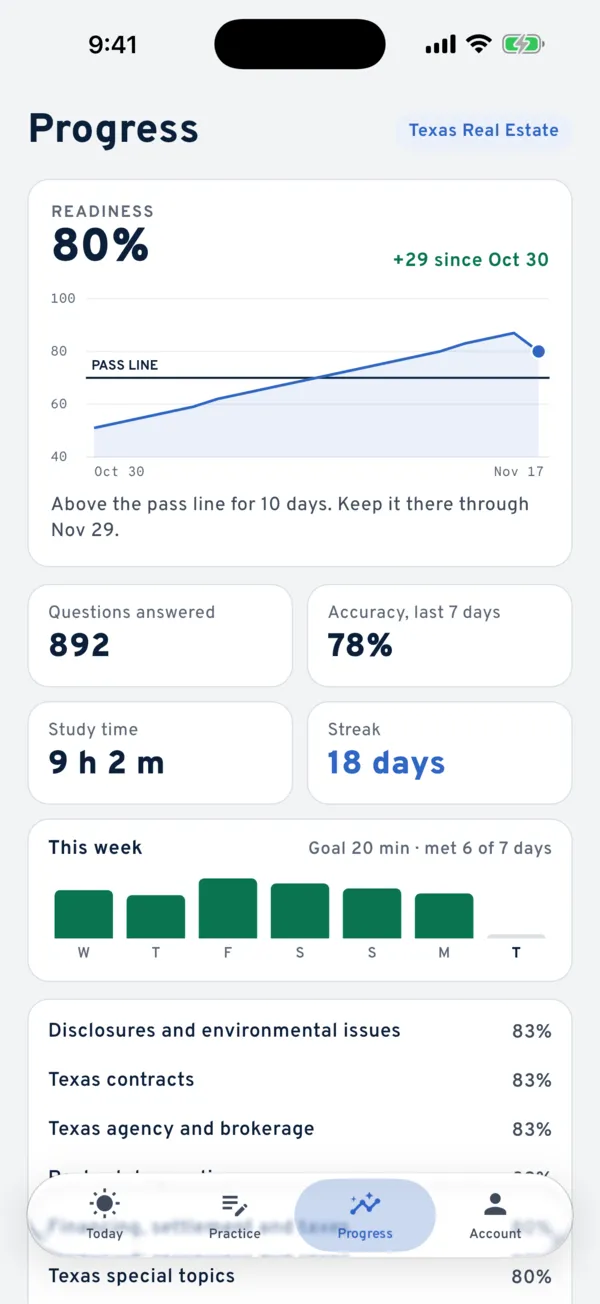
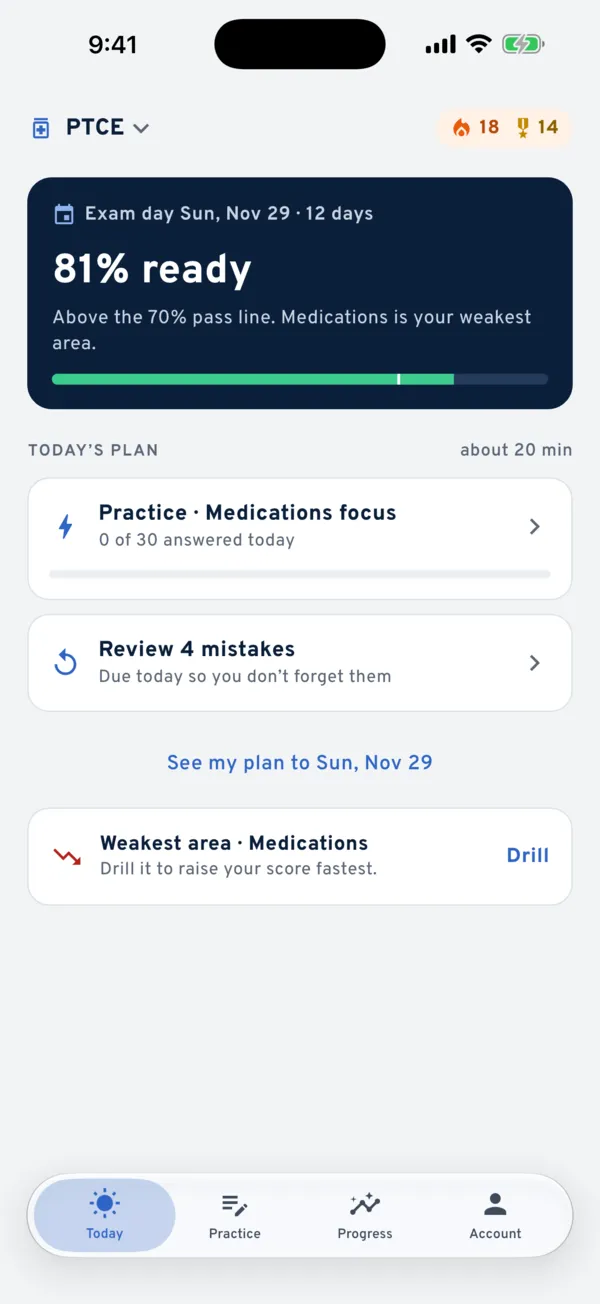
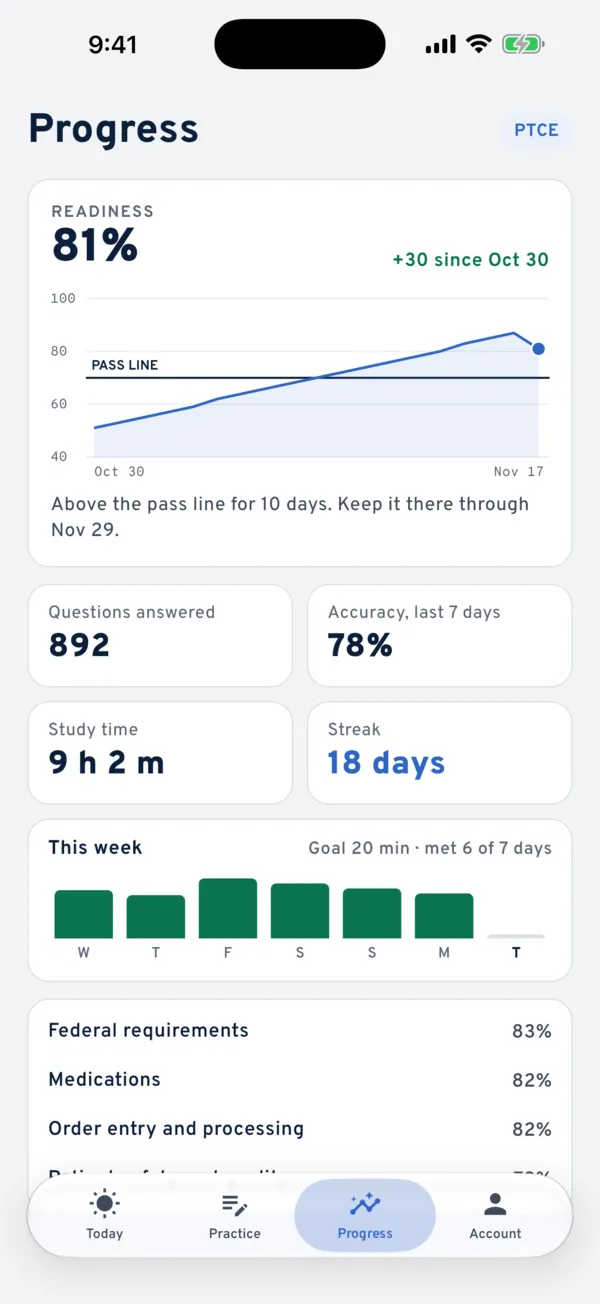
Clinched has every PTCE question in this format, with full practice tests that match the real one, a readiness score by area and a plan to your test date. Free to start with 10 questions a day.
Read the PTCE guide or see how we write and check every question.
Free on the App Store
Your exam, in your pocket.
20 exams ready with questions written from the official sources, timed practice tests in the real format and a readiness score with a pass line.
On your computer?
Scan with your iPhone camera to get Clinched practice in the app.