

Part 107 vs TRUST: Which Drone Certificate Do You Need?
Short answer
If you fly only for fun, you need the free online TRUST certificate and must follow the recreational rules in 49 U.S.C. 44809. If a flight serves any business, job, client or organization, even unpaid, you need a Part 107 remote pilot certificate, which means passing a proctored FAA test that costs about $175 and doing free recurrent training every 24 calendar months.
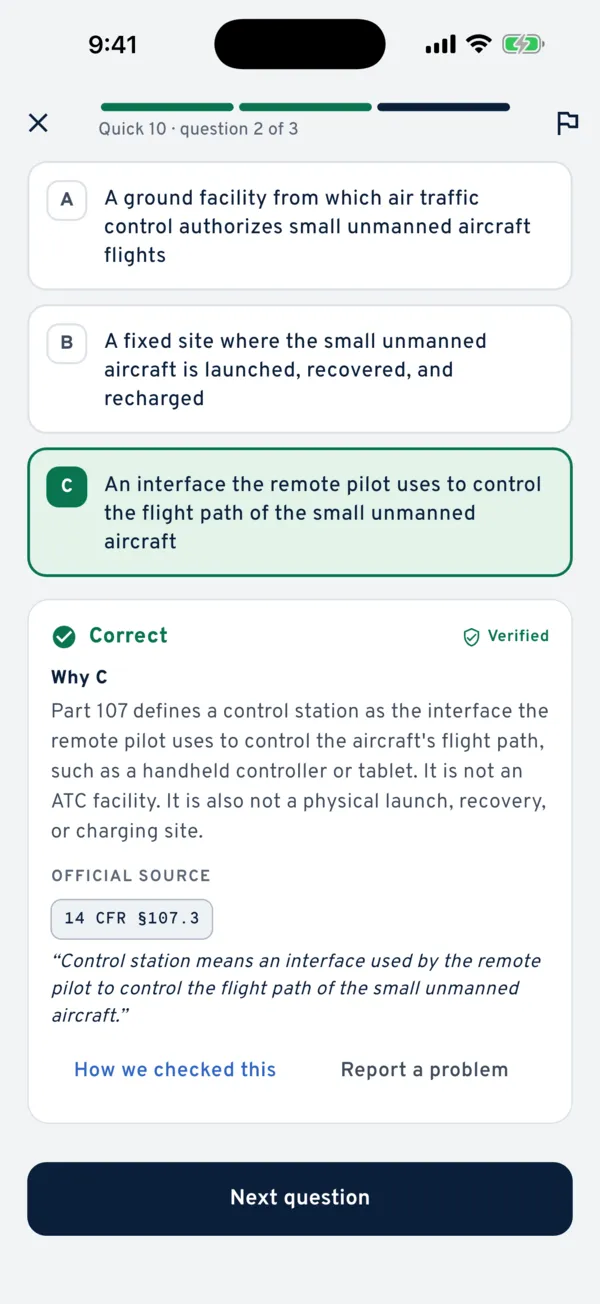
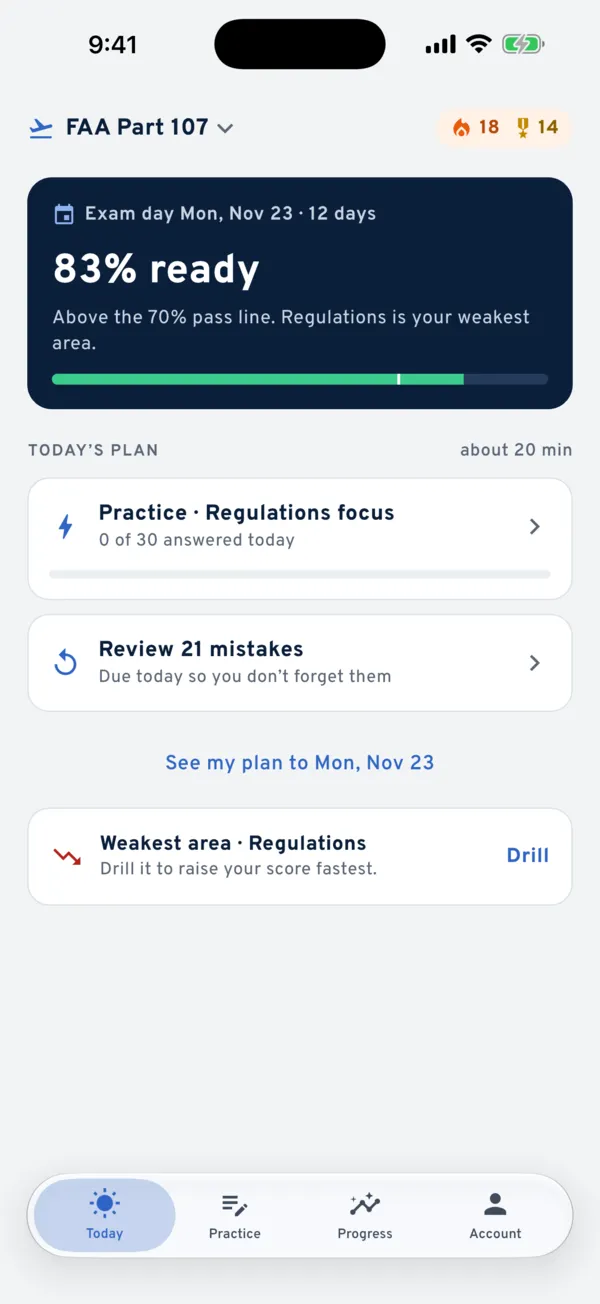
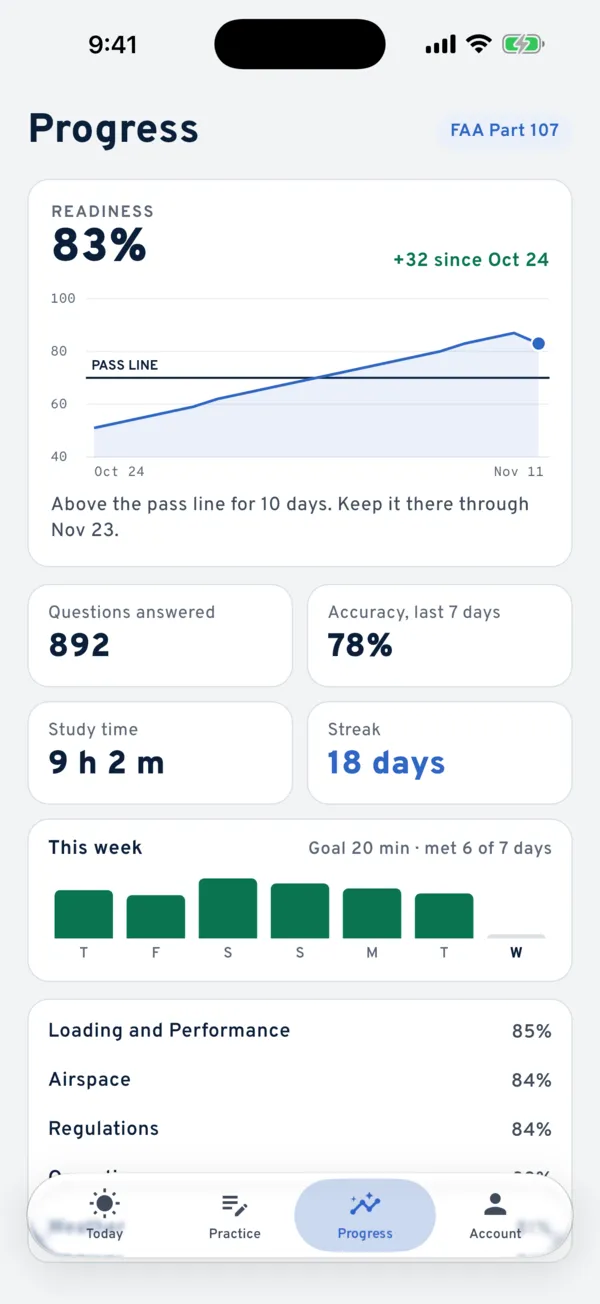
The deciding question is simple. Is this flight purely for your own enjoyment? If yes, you can fly under the recreational exception with a free TRUST certificate. If the flight helps a business, an employer, a client, a nonprofit or anyone else, it’s a Part 107 flight and you need a remote pilot certificate.1 The FAA’s rule of thumb when you’re not sure is to assume Part 107.1
What counts as recreational
Most people assume “recreational” means “unpaid.” The FAA says that’s not correct. Compensation, or the lack of it, isn’t what decides whether a flight was recreational.1 What matters is the purpose.
The FAA gives examples of flights that fall under Part 107 even when they might feel casual.1
- Taking photos to help sell a property or a service
- Roof inspections
- Taking pictures of a high school football game for the school’s website
- Volunteering your drone to survey coastlines for a nonprofit
That last one surprises people. Goodwill flying can still be non-recreational.1 On the other side, flying at the park on a Saturday, shooting your own vacation footage, or flying with a model aircraft club is recreational.
Gray areas people ask about
A few situations come up again and again. Here’s how they line up with the FAA’s test of purpose.
- A real estate agent shooting their own listings. Part 107. The photos help sell a property, which is one of the FAA’s own examples, and it doesn’t matter that nobody paid the agent for the flight.1
- Flying for your own small business’s social media. Part 107. The flight supports a business even if you never invoice anyone.
- Helping a local charity with aerial photos for free. Part 107. The FAA counts goodwill work for an organization as non-recreational.1
- Filming your kid’s soccer game for the family album. Recreational, as long as the footage is just for you. Shooting the same game for the league’s website changes the purpose.
- Flying at a model aircraft club field. Recreational, following that community-based organization’s safety guidelines.1
If you’re arguing with yourself about which side a flight falls on, treat it as Part 107. The FAA can take enforcement action against anyone who breaks these rules or flies in a dangerous way, and “I thought it was recreational” is a weak defense.1
TRUST and Part 107 side by side
| TRUST (recreational) | Part 107 remote pilot certificate | |
|---|---|---|
| Who it’s for | Flying purely for fun under 49 U.S.C. 448091 | Any flight that isn’t purely recreational3 |
| Test | Free online test from an FAA-approved administrator2 | Proctored knowledge test at a PSI center3 |
| Cost | Free2 | About $175 for the test7 |
| Passing | Every question can be corrected to 100% before you get the certificate2 | You must reach the FAA passing score on a timed test |
| Minimum age | None3 | 16 for the certificate6 |
| Recurrent | None, once and done3 | Free online training every 24 calendar months4 |
| Drone registration | $5 for all your drones, 3 years, only if 250 g or more5 | $5 per drone, 3 years, every drone5 |
| Controlled airspace | LAANC near real-time authorization at map altitudes8 | LAANC near real-time plus further coordination up to 400 feet8 |
The Part 107 test format, timing and passing score are covered in the Part 107 test guide.
What flying under TRUST requires
TRUST is the Recreational UAS Safety Test. It meets the legal requirement that every recreational flyer pass an aeronautical knowledge and safety test.2 The FAA writes the content, and approved test administrators, including universities, the Academy of Model Aeronautics and several training companies, give it online for free.2 You take it once.3
After you finish, download or print your completion certificate. Administrators don’t keep a record of it, and if you lose it you’ll have to take TRUST again.2 Carry it when you fly, because law enforcement or the FAA can ask to see it.2
Passing TRUST doesn’t mean anything goes. The recreational rules in the statute still apply.1
- Fly only for recreation and follow the safety guidelines of an FAA-recognized community-based organization
- Keep the drone within visual line of sight, or use a visual observer standing next to you
- Give way to other aircraft
- Fly in Class B, C, D or surface Class E airspace only with prior authorization through LAANC or DroneZone
- Stay at or below 400 feet in Class G airspace
- Register drones of 250 grams or more, mark them, carry proof of registration, and meet Remote ID
What Part 107 requires
The Part 107 path takes more work. To be eligible you must be at least 16, read, speak, write and understand English, and be fit to fly safely.6 You pass the Unmanned Aircraft General, Small knowledge test at a PSI center, apply through the FAA’s IACRA system, and clear a TSA security check before the FAA issues your certificate.4 To keep using it, you complete the free online recurrent course every 24 calendar months.4
What you get in return is flexibility. You can fly for any purpose. You can fly at night and over people when the conditions in Part 107 are met.6 You can ask for further coordination in LAANC to go above the facility map altitude, up to 400 feet.8 And you can apply for waivers of many Part 107 rules.6
This comes straight from the FAA’s registration rules, which say a registration can’t transfer between operation types.5
If you hold both
Plenty of people do. A Part 107 certificate holder can fly for fun, but then that flight is a Part 107 flight and every Part 107 rule applies. To fly under the recreational exception instead, the FAA says the Part 107 pilot must also pass TRUST.3 Since TRUST is free and takes little time, it’s worth having if you fly both ways.
Which one to get
- You only fly for yourselfTake TRUST, register if your drone is 250 grams or more, and follow the recreational rules.
- Any flight helps a business or a groupGet the Part 107 certificate before that flight. Real estate, roof photos, events, content for a business and nonprofit work all count.
- You're not sureFollow the FAA's advice and assume Part 107.
- You fly both waysHold both, and keep track of which rules you're flying under on each flight.
If you’re heading toward Part 107, the two week Part 107 study plan is a realistic way to get ready, and what to do after you pass covers IACRA, TSA, registration and Remote ID.
Questions people ask
Can I fly for fun with a Part 107 certificate?
Yes, but then you're flying under Part 107 and must follow all of its rules for that flight. If you want to fly under the recreational exception instead, the FAA says you also need to pass TRUST, which is free and online.
Is posting drone videos on YouTube recreational?
The FAA says getting paid or not is not what decides whether a flight is recreational. If the flight is purely for personal enjoyment, it can be recreational. If it supports a business, including a monetized channel, the safe reading is Part 107. When in doubt, the FAA's own advice is to assume Part 107.
Does the TRUST certificate expire?
No recurrent test is required. The FAA's Aeronautical Information Manual describes TRUST as once and done. Keep the certificate safe, though, because test administrators don't keep a record and a lost certificate means retaking the test.
Do I need to register my drone for TRUST flying?
Only if it weighs 250 grams (0.55 pounds) or more. Recreational registration costs $5, covers every drone in your inventory and lasts three years. Under Part 107, every drone must be registered individually at $5 each.
Sources
- Recreational Flyers and Community-Based OrganizationsFederal Aviation Administration
- The Recreational UAS Safety Test (TRUST)Federal Aviation Administration
- Aeronautical Information Manual, Chapter 11, Section 5, UAS Pilot Testing, Certification and ResponsibilitiesFederal Aviation Administration
- Become a Certificated Remote PilotFederal Aviation Administration
- How to Register Your DroneFederal Aviation Administration
- 14 CFR Part 107, Small Unmanned Aircraft SystemseCFR, National Archives
- How much does it cost to get a remote pilot certificate?Federal Aviation Administration
- UAS Data Exchange (LAANC)Federal Aviation Administration
ClinchedFAA Part 107
Pass FAA Part 107 on the first try.
Practice questions written from the official sources, full practice tests in the real format and a plan that ends on your test date. Free to start.
Keep reading
- Exam guide · FAA Part 107
 Part 107 Test Changes for 2025 and 2026: What's DifferentSince Sept 29, 2025 the Part 107 test weights regulations at 48% and adds 5 unscored questions. Since Oct 26, 2026 it shows current sectional chart images.
- Topic explainer · FAA Part 107
 Part 107 Airspace Classes and LAANC Authorization ExplainedWhich airspace classes need FAA authorization under Part 107, how LAANC and UAS Facility Maps work, and the airspace traps that show up on the Part 107 test.
- Topic explainer · FAA Part 107
 How to Read a Sectional Chart for the Part 107 TestRead a sectional chart the way the Part 107 test asks: airspace lines, MSL vs AGL, airport data blocks, CTAF, obstacles and the new current chart images.
- Exam guide · FAA Part 107After You Pass Part 107: IACRA, TSA, Registration, Remote IDPassed Part 107? Apply in IACRA with your 17 digit exam ID, clear the TSA check, register each drone for $5, meet Remote ID and stay current every 24 months.