HealthcareNational Registry of Emergency Medical Technicians
The NREMT EMT exam, explained
The National Registry EMT cognitive exam is a computer adaptive test of 70 to 120 items with a 2 hour limit, taken at a Pearson VUE center or online through OnVUE. It costs $104 per attempt, results are reported on a 100 to 1500 scale, and 950 passes. Since April 7, 2025 the questions follow five domains built around patient assessment, with Primary Assessment alone worth 39 to 43% of the test. You pass by drilling assessment priorities and scope of practice, then taking timed practice tests until you're consistently above the line.
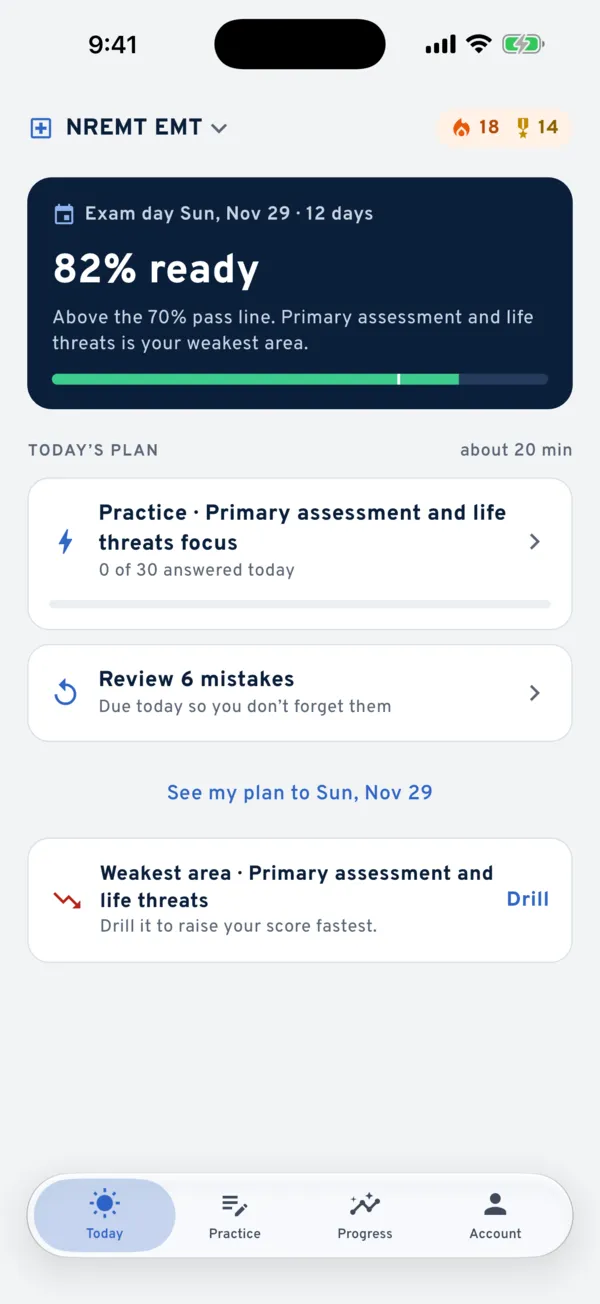
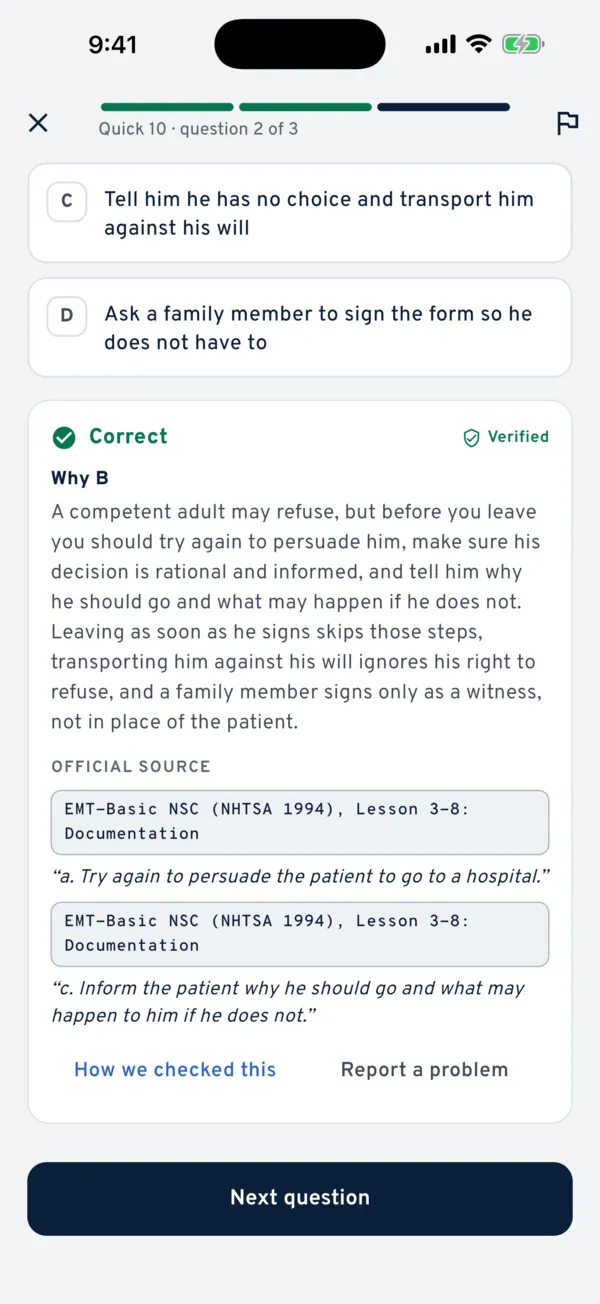
NREMT EMT at a glance
- Format
- Computer adaptive test (CAT)3
- Questions
- 70 to 120, including 10 unscored pilot items2
- Time limit
- 2 hours2
- Passing score
- 950 on a 100 to 1500 scale3
- Fee
- $104 per attempt4
- Where you test
- Pearson VUE test centers or OnVUE online proctoring1
- Retakes
- Wait 15 days, 6 attempts total, remedial education after 3 failures3
- Eligibility window
- Within 2 years of finishing a state-approved EMT course5
- Scene Size-Up and Safety17%
- Primary Assessment41%
- Secondary Assessment7%
- Patient Treatment and Transport22%
- Operations12%
The five domains and where people lose points
Since April 7, 2025, the EMT cognitive exam has been built on a new blueprint.1 The National Registry of Emergency Medical Technicians (NREMT) retired the old topic buckets (airway, cardiology, trauma, medical and OB/GYN, operations) and reorganized the test around the order you actually work a call.1 The new outline came out of the National Registry’s 2023 practice analysis of what entry-level EMTs do on the job.2
| Domain | Share of the test | What it covers |
|---|---|---|
| Scene Size-Up and Safety | 15 to 19% | Planning before arrival, hazards, PPE, finding all patients, triage, calling for resources |
| Primary Assessment | 39 to 43% | General impression, level of consciousness, airway, breathing, circulation, life threats, baseline vitals, the rapid transport decision |
| Secondary Assessment | 5 to 9% | Focused exam, history, reassessment for changes |
| Patient Treatment and Transport | 20 to 24% | Airway and oxygenation, circulation, motion restriction, medication administration, special populations, transport, handoff report |
| Operations | 10 to 14% | Equipment readiness, supplies, documentation, your own and your crew’s well-being |
The percentages and task lists come from the official examination specifications.2 Four things about this blueprint are worth planning around.
Primary Assessment is the whole game. Roughly four of every ten scored items live here.2 Many of them give you a short scenario and ask what you do first or next. The right answer is almost always the one that deals with an immediate threat to airway, breathing or circulation before you get to history, a detailed exam or packaging. If you studied by disease (“everything about asthma”), practice re-sorting what you know by assessment step instead.
Pediatrics is everywhere. There’s no separate pediatric domain. Pediatric patient care is mixed into every part of the exam,1 so a child or an infant can show up in any question. Know how normal pulse and breathing rates and airway anatomy change with age.
Scope of practice decides close calls. Every item is reviewed for alignment with scope of practice and referenced to standard EMS textbooks.2 Answer from the national EMT scope and your textbook, not from your county protocol or what the medic did on your ride-along. A choice that’s correct care but belongs to an AEMT or paramedic is a wrong answer here.
Operations isn’t filler. At 10 to 14%,2 it can be a dozen scored items about equipment checks, documentation and responder wellness. These are some of the easiest points on the test if you read that chapter.
The new question types
The 2025 exam added technology-enhanced items (TEIs).1 Besides standard multiple choice (one right answer out of four), you can see multiple response (pick two of five, or three of six), options tables, build list (put steps in order) and drag-and-drop (sort options into categories).2 Every item is scored right or wrong. There’s no partial credit on a build list where you got four of five steps in order.2 The appendix of the specifications shows a sample of each type, and an untimed tutorial at the start of the exam walks you through them.1 3 For the full rundown of what changed, see NREMT EMT exam changes.
How the adaptive test works
The EMT exam is a computerized adaptive test (CAT).3 After an opening set of items, the computer picks each next question based on how you’re doing, aiming at or slightly above your estimated ability.2 It stops as soon as it’s 95% confident you’re above or below the passing standard. If it can’t decide, it keeps going until you reach the 120 item maximum or the 2 hour limit.2 Everyone answers at least 70 items.2
That design has three practical consequences.
- The test will feel hard. It’s built to find the edge of what you know, so missing questions is normal even on a passing attempt.
- Shutting off at 70 tells you nothing. The computer can be confident in either direction that early.
- Pacing still matters. Two hours for up to 120 items works out to one minute per item. If you burn three minutes on every scenario and run out of time before the computer decides, that’s a bad outcome you can avoid.
Ten of your items are unscored pilot questions that the National Registry is testing for future exams. You can’t tell which ones they are, so treat every question as scored.2 3
Results come back as a scaled score from 100 to 1500, and 950 is the passing point.3 The passing standard was set by the National Registry’s board after a standard-setting study with EMS subject matter experts, and it applies to everyone.1 2
You can test at a Pearson VUE center or from home or an office through Pearson’s OnVUE online proctoring.1 If you need testing accommodations for a documented disability, apply through the National Registry’s ADA accommodations policy well before you plan to test.
Eligibility, cost and booking
To sit for the exam you need to have finished a state-approved EMT course that meets or exceeds the National EMS Education Standards, and your program director has to verify that completion on the National Registry website.5 You also need your state’s approved BLS skills competency, which some states build into the course itself.5 There’s more on that below.
Your course stays valid for two years from the month and year you finished it. A course completed in January 2024, for example, expired January 31, 2026.4 Passed parts of the process, including skills verification, stay good for 24 months as long as you meet the other requirements.5
The exam fee is $104, charged again for every attempt.4 Rescheduling or canceling costs $30 and has to happen at least one business day (24 hours) before your appointment. If you simply don’t show, you lose the $104.3
- Create your National Registry accountUse your legal name exactly as it appears on the government ID you'll bring on test day.
- Submit the EMT initial applicationYour program director then verifies your course completion online.
- Pay the $104 feeIt applies to this attempt only. A retake means a new application and a new fee.
- Get your Authorization to Test (ATT)It appears on your candidate dashboard and is valid for 90 days, or until your course eligibility expires if that comes first.
- Book with Pearson VUEUse the candidate ID from your ATT to schedule at a test center or online through OnVUE.
The ATT details come from the candidate handbook.4 Plan your date with both clocks in mind. If you buy an ATT in the last 90 days of your course eligibility, it ends the day your course expires.4
How states use the exam
The National Registry certifies you. Your state licenses you, and each state wraps its own requirements around the exam. Here’s how five large states handle it.
| State | How the NREMT exam fits | Other requirements to know |
|---|---|---|
| California | NREMT cognitive and psychomotor exams are the standard for initial EMT certification6 | Your county’s local EMS agency certifies you, and NREMT certification alone doesn’t let you work as an EMT there6 |
| Texas | You must show current National Registry certification at the EMT level7 | Age 18 or older, high school diploma or GED, a DSHS-approved course and an FBI fingerprint check7 |
| Florida | Florida uses the NREMT exam as its cognitive exam10 | A Florida DOH-approved EMT course and a CPR card at the healthcare provider or professional rescuer level10 |
| New York | Since September 2024, NREMT is an accepted pathway9 | New York still offers its own state written exam through PSI, with three attempts allowed8 |
Rules change, and counties and regions often add their own steps. Confirm the current process with your state EMS office before you pay for anything.
A six week study plan
Plan to test within a few weeks of finishing your course, while the material is fresh. This plan assumes you passed your course and can give it about an hour a day on weekdays and longer sessions on weekends.
- Week 1Take a timed baseline practice test and sort your misses by the five domains. Reread scene size-up, PPE and triage. Read the item type samples in the National Registry specifications so build list and drag-and-drop don't surprise you.
- Week 2Primary Assessment, part one. Level of consciousness, airway assessment and breathing assessment, with adult, child and infant differences side by side.
- Week 3Primary Assessment, part two. Circulation, bleeding, shock, chief complaint, baseline vitals and the decision to transport now. Do scenario questions that ask what comes first.
- Week 4Patient Treatment and Transport. Airway adjuncts and oxygen delivery devices, the medications an EMT can give or assist with, motion restriction, special populations and the radio or handoff report.
- Week 5Secondary Assessment and Operations. Focused history, reassessment timing, equipment checks, documentation and responder wellness. Redo every question you missed in weeks 1 to 4.
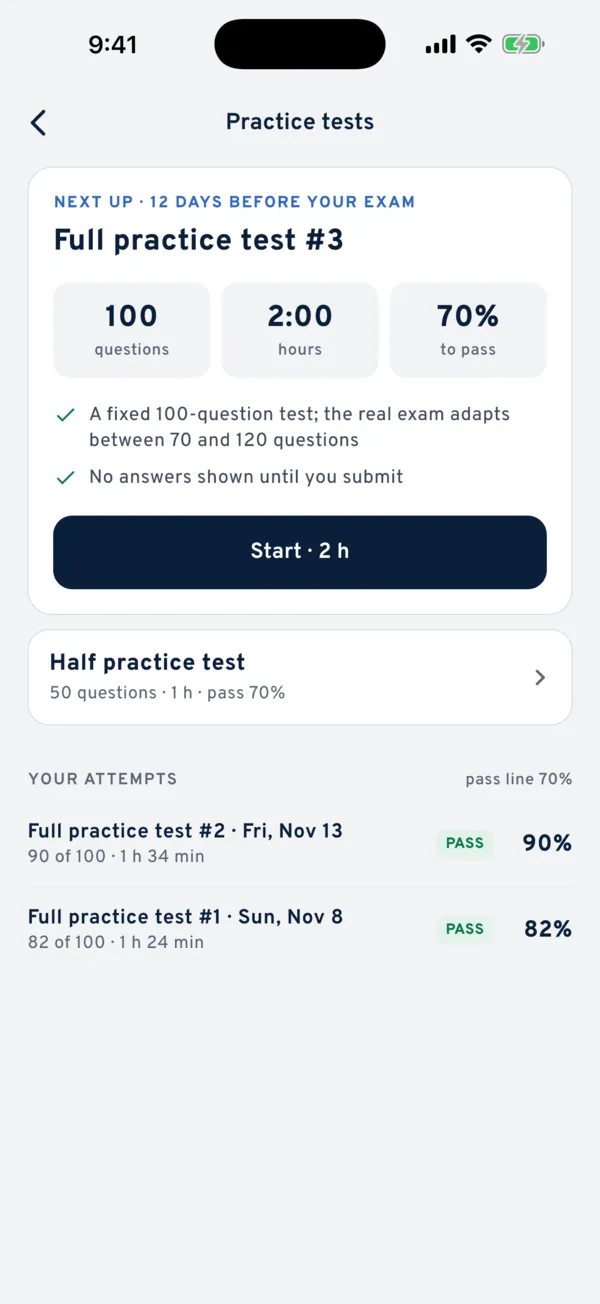
- Week 6Two or three full timed tests of up to 120 items in 2 hours. Review every miss, then rest the day before the exam.
Two things make this plan work. Practice in mixed sets once you’re past week 2, since the real exam doesn’t group questions by topic. And when you miss a question, write down which assessment step you skipped or reversed, not just the right answer. Clinched has an NREMT EMT course with questions tied to the official outline and full practice tests.
Test day
The handbook doesn’t list arrival times, so follow the instructions in your Pearson confirmation and plan to be early.
- Unexpired government-issued photo ID with a name that matches your ATT exactly
- Your National Registry candidate ID and Pearson confirmation
- Arrive early enough to finish check-in before your appointment time
- Phone, watch, notes and bag go in the locker, not in the testing room
- For OnVUE, a private room, a clear desk and a computer that passed Pearson's system test
The ID match requirement is in the candidate handbook.3 Expect security steps at check-in. Depending on the site, that can mean showing ID, digital identity verification, a signature, a photo and audio or video recording during the exam.3 At the computer you’ll go through an untimed tutorial on how the test works, then accept a nondisclosure agreement, which has a five minute limit.3
When the exam ends you won’t get a result at the center. The National Registry posts results to your online account, generally within two business days. If nothing shows after five business days, contact them.3 They won’t email you a pass or fail, so check your dashboard.4
Passing, licensing and retakes
When you pass
Your National Registry certification shows on your account, and a packet with your card, wall certificate and patch arrives by mail within about 30 days. You can also print your card from the My Certification page.4 Then finish your state’s application, since National Registry certification by itself isn’t a license to work (see the state table above).6
You’ll recertify every two years, either with continuing education or by exam.4 Your first expiration date depends on when you certify. Finish between January 1 and June 30 and your certification runs to March 31 two years later. Finish between July 1 and December 31 and it runs to March 31 three years later.5
When you don’t pass
Your account shows your scaled score and a graphic of how close you came to 950.3 Use it with your domain-by-domain sense of where practice tests went wrong. Then follow the retake rules.3
- Wait 15 days from your last exam date before testing again.
- Reapply and pay the $104 fee for each new attempt.
- You have six attempts in total.
- After three failures you must complete remedial education before the fourth attempt.
The remedial options are the EMT 20-credit National Competency Component from the NCCP model, a state or CAPCE-approved EMT refresher course, or 20 credits from any state-approved education program. Some states insist on the traditional refresher, so check with your state EMS office first.3
If you think an item was scored wrong, you can request a rescore within 30 days of your score report for $150. Only the items you name are reviewed, and the passing standard isn’t reconsidered.3
The skills exam is your state’s job
The cognitive exam is only half of initial certification. You also need a skills competency approved by your state EMS office. The National Registry doesn’t name one statewide format. It says some states fold the skills exam into the EMT course and tells you to ask your state EMS office or instructor how yours works.5 The 2025 cognitive update didn’t change this. The skills process stays in its current format as each state approves it.1
The usual reference point is the National Registry’s own EMT skills format, with timed stations such as trauma and medical patient assessment, bag-valve-mask ventilation, oxygen by non-rebreather and cardiac arrest management with an AED. The station list, scoring and retest rules are in our guide to the EMT psychomotor exam.
Questions people ask
How many questions are on the NREMT EMT exam?
You'll answer at least 70 and at most 120 items, and 10 of them are unscored pilot questions you can't identify. The test is adaptive, so it stops as soon as the computer is 95% confident you're above or below the passing standard, or when you hit 120 items or the 2 hour limit.
What score do you need to pass the NREMT EMT exam?
Scores are reported on a scale from 100 to 1500, and the passing point is 950. If you don't pass, the National Registry posts your scaled score and a graphic showing how far you were from the standard to your online account.
How much does the NREMT EMT exam cost?
The National Registry charges $104 for each attempt at the EMT cognitive exam. Rescheduling or canceling with Pearson costs $30, and your state charges its own license or certification fee on top.
How many times can you take the NREMT EMT exam?
You get six attempts. You must wait 15 days after each attempt, and after three failures you have to finish remedial education, such as a state or CAPCE-approved EMT refresher, before the fourth try. All attempts must fit inside the two years after your course completion date.
Did the NREMT EMT exam change in 2025?
Yes. On April 7, 2025 the National Registry launched an updated EMT exam with five new domains (Scene Size-Up and Safety, Primary Assessment, Secondary Assessment, Patient Treatment and Transport, Operations) and technology-enhanced items like build list and drag-and-drop. It's still adaptive, still 2 hours, and the fee stayed at $104.
Sources
- The Updated EMR and EMT Certification ExaminationsNational Registry of Emergency Medical Technicians
- National Registry Emergency Medical Technician Examination SpecificationsNational Registry of Emergency Medical Technicians
- EMT Candidate Handbook, Part 4: About the ExaminationNational Registry of Emergency Medical Technicians
- EMT Candidate Handbook, Part 3: Certification ProcessNational Registry of Emergency Medical Technicians
- EMT Full Education Program PathwayNational Registry of Emergency Medical Technicians
- EMS Agency: EMT Certification and NREMT TestingLos Angeles County Department of Health Services
- 25 Tex. Admin. Code § 157.33, CertificationTexas Department of State Health Services (via Cornell LII)
- NYS EMS Examination InformationNew York State Department of Health, Bureau of EMS
- State of New York to Utilize National Registry of EMTs as Recognized Pathway for EMS CertificationNational Registry of Emergency Medical Technicians
- EMT and Paramedic LicensingFlorida Department of Health
More on NREMT EMT
- Exam guide · NREMT EMT
 NREMT EMT Exam Changes: What's Different Since April 2025The NREMT EMT exam changed on April 7, 2025. New domains, new item types like build list, same adaptive 70 to 120 items, 2 hours and $104 fee.
- Topic explainer · NREMT EMT
 EMT Psychomotor Exam: The 7 Skills and How They're ScoredHow the EMT psychomotor exam works. Who runs it, the seven National Registry skill stations, time limits, minimum points, critical criteria and retests.