HealthcareNational Council of State Boards of Nursing
The NCLEX-PN exam, explained
The NCLEX-PN is the computerized adaptive exam every new LPN or LVN in the US must pass to get licensed. You answer 85 to 150 items, including three six-item clinical judgment case studies and 15 unscored pretest items, within a five-hour limit that includes breaks. There's no percentage score. The exam ends once the computer is 95% certain you're above or below the passing standard, and you either pass or fail. Registration with Pearson VUE costs $200, rising to $350 for anyone who registers on or after February 1, 2027.
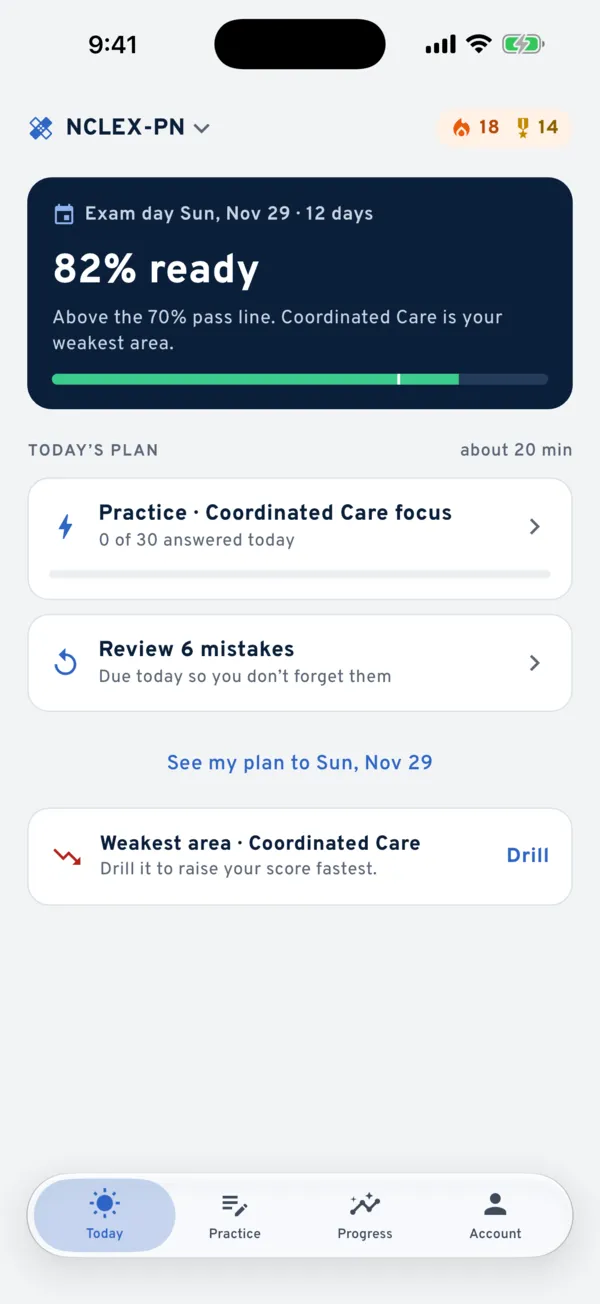
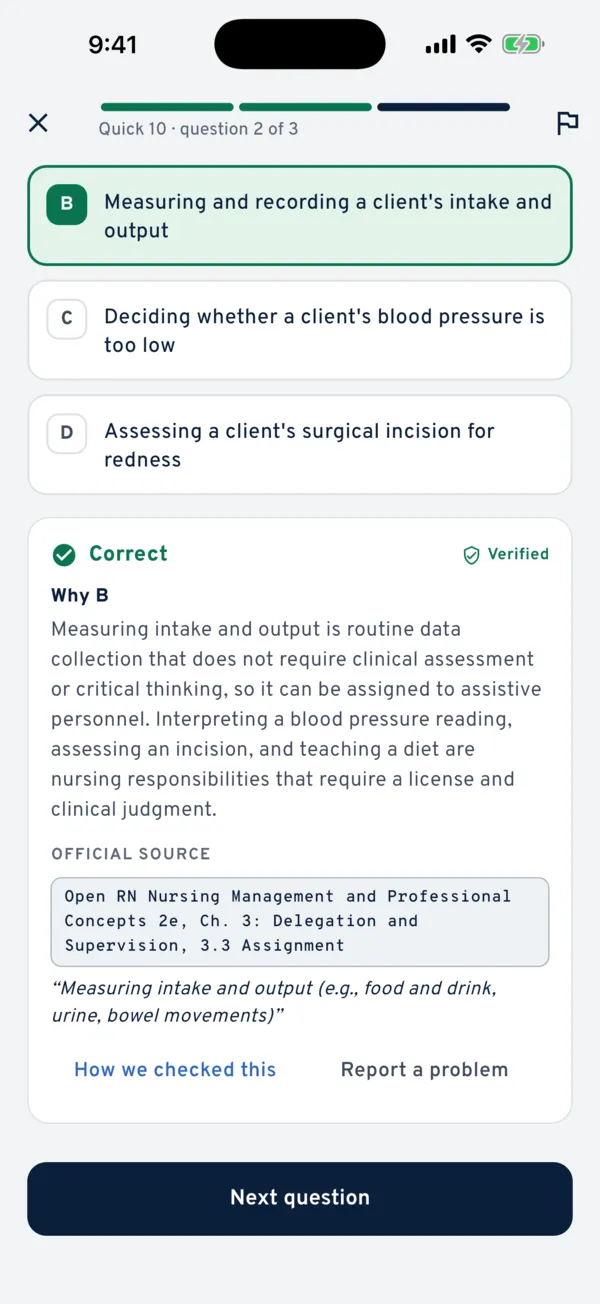
NCLEX-PN at a glance
- Items
- 85 to 150, including 15 unscored pretest items1
- Clinical judgment
- 3 case studies of 6 items each, plus about 10% stand-alone clinical judgment items1
- Time limit
- 5 hours, breaks included1
- Scoring
- Pass or fail, computerized adaptive testing, stops at 95% confidence1
- Passing standard
- -0.18 logits on the NCLEX-PN scale6
- Registration fee
- $200, then $350 for registrations made on or after Feb. 1, 20274
- Where you test
- Pearson VUE test centers, computer only2
- Retakes
- Up to 8 times a year with 45 test-free days between attempts, unless your board is stricter2
- First-time pass rate
- 86.6% for first-time, US-educated candidates in 20255
- Test plan in force
- 2026 NCLEX-PN Test Plan, April 1, 2026 to March 31, 20297
- Coordinated Care21%
- Safety and Infection Prevention and Control13%
- Health Promotion and Maintenance9%
- Psychosocial Integrity12%
- Basic Care and Comfort10%
- Pharmacological Therapies13%
- Reduction of Risk Potential12%
- Physiological Adaptation10%
What the 2026 NCLEX-PN test plan covers
The current blueprint is the 2026 NCLEX-PN Test Plan, in effect from April 1, 2026 through March 31, 2029.7 If you studied from older material, the change is small. NCSBN kept every content percentage from the 2023 plan, renamed the Safety and Infection Control category to Safety and Infection Prevention and Control, and added new activity statements drawn from its 2024 practice analysis of newly licensed practical and vocational nurses.10
Content is organized by Client Needs. There are four major categories, and two of them split into subcategories, for eight content areas in total. Each gets a range, and any single exam can drift up to 3% either way in a category because the test length varies.1
| Content area | Share of items | Examples from the official activity statements |
|---|---|---|
| Coordinated Care | 18 to 24% | Assign tasks to assistive personnel, verify and process provider orders, consent, advance directives, scope of practice |
| Safety and Infection Prevention and Control | 10 to 16% | Client identity, allergies, least restrictive restraints, PPE and isolation, incident reports |
| Health Promotion and Maintenance | 6 to 12% | Antepartum and postpartum care, developmental milestones, immunizations, baseline data collection |
| Psychosocial Integrity | 9 to 15% | Therapeutic communication, substance use and withdrawal, de-escalation, end-of-life care |
| Basic Care and Comfort | 7 to 13% | Mobility, enteral feeding, nonpharmacological pain relief, skin integrity, intake and output |
| Pharmacological Therapies | 10 to 16% | Rights of administration, dosage calculation, IV flow rates, IV piggyback, controlled substance counts |
| Reduction of Risk Potential | 9 to 15% | Lab and diagnostic results, blood pressure and oxygen saturation, NG tubes, urinary catheters, glucose checks, venipuncture |
| Physiological Adaptation | 7 to 13% | Wound care, tracheostomy care, ostomies, basic cardiac strip abnormalities, fluid and electrolyte imbalances |
The ranges and examples come straight from the test plan.1 Coordinated Care is the largest single area, which surprises people who expect pharmacology to dominate.
Where candidates lose points
The first trap is scope. The test plan describes a practical nurse who collects and organizes data, helps identify the client’s problems and contributes to the team’s plan.1 Read the verbs in the activity statements and you’ll see the pattern. The PN plan says “reinforce education,” “collect data,” “assist with,” and “recognize and report.” The RN plan, for comparison, uses “delegate and supervise,” “perform focused assessments” and “initiate, evaluate and update client plan of care.”3 When an answer choice has you doing something on the RN side of that line, slow down.
The second trap is math. Pharmacological Therapies includes dosage calculations and IV flow rates.1 You get an on-screen calculator,2 and NCSBN says to round only at the end of a calculation and to match the format the item asks for, whether that’s a whole number or one or two decimal places.9
The third is assumptions. If an item doesn’t give an age, the client is an adult, and items are written across settings that include long-term care, rehabilitation, home care and acute care, not just a hospital floor.1
How the adaptive exam works
The NCLEX-PN uses computerized adaptive testing. After every answer, the computer re-estimates your ability and picks the next item from the content area that best keeps your exam on the test plan, at a difficulty you’re expected to find challenging.1 That’s why the exam feels hard for almost everyone.
What’s in a minimum-length exam
Every candidate answers at least 85 items, and nobody answers more than 150.1 A minimum-length exam has 52 items from the eight content areas in the test plan percentages, 18 items that make up three clinical judgment case studies of six items each, and 15 unscored pretest items mixed in so you can’t spot them.1
Each case study follows one client through the six steps of NCSBN’s Clinical Judgment Measurement Model, which are recognize cues, analyze cues, prioritize hypotheses, generate solutions, take action and evaluate outcomes.1 Beyond the case studies, about 10% of items are stand-alone clinical judgment items.1 For how the case study screens look and how they’re scored, read NGN case studies explained.
Items come in several formats, including select all that apply and items where more than one key exists. Those can earn partial credit under one of three methods, plus/minus, zero/one or rationale scoring.2 You can change an answer until you click Next, but after that you can’t go back, and you can’t skip an item.1
How it decides you’re done
There are three ways the exam ends.1
- 95% confidence rule. After the minimum, the exam stops once the computer is 95% certain your ability is clearly above or clearly below the passing standard. This is how most exams end.
- Maximum length. If you hover near the standard, you keep going to 150 items, and only your final ability estimate counts.
- Run out of time. If the five hours expire before 150 items, you fail if you haven’t reached 85. If you have, your final ability estimate decides it.
NCSBN’s 2025 data shows how this plays out. Among first-time, US-educated PN candidates, 64.6% stopped at the minimum, 17.7% went to the maximum, the average exam was 100 items and the average testing time was 2 hours 18 minutes.5 Only 0.7% used the full time.5 The full logic is in how the NCLEX shuts off.
Breaks, tools and accommodations
The five hours include the introductory screen and all breaks. Optional breaks are offered after two hours and after three and a half hours, and the clock doesn’t stop.2 You’ll get an erasable noteboard and marker from the test administrator, plus an on-screen calculator.2
Testing accommodations come from your board of nursing, not Pearson. Ask your board about its requirements before you register, and don’t schedule until your Authorization to Test (ATT) email lists what was approved. Candidates approved only for extra time (30 minutes, 1 hour, 2 hours or 3 hours) can book online. Everyone else books through the NCLEX Accommodations Coordinator by phone.2
Eligibility, cost and booking your seat
Your board of nursing decides if you’re eligible, and each board sets its own rules, usually starting with proof that you finished an approved practical or vocational nursing program. Pearson VUE handles registration and scheduling. The order matters, and every step below comes from the 2026 candidate bulletin.2
- Apply to one board of nursingApply for licensure with the board in the state where you want to work, and submit any accommodation request at the same time.
- Register with Pearson VUERegister online at nclex.com or by phone at 866.496.2539 and pay the exam fee. Enter your first and last name exactly as they appear on your ID.
- Get made eligibleYour board must make you eligible within 365 days of your registration, or the fee is forfeited and you start over.
- Read your ATT emailThe Authorization to Test lists your validity dates. Your board sets the window. It averages about 90 days and can't be extended.
- Schedule earlyBook online or by phone. First-time candidates are offered an appointment within 30 days of asking, and seats near the end of an ATT window go fast.
What it costs
The registration fee for US licensure is $200.2 NCSBN’s Delegate Assembly voted to raise it, and for registrations made on or after February 1, 2027, the fee becomes $350. The registration date sets the fee, the exam date doesn’t, and the change applies to retakes too.4
Other charges are smaller but real. Changing your board after registering costs $50, changing between RN and PN costs $50, and testing at an international center adds $150.2 Your board’s licensure application fee is separate and varies by state.2 None of the NCLEX fees are refundable for any reason.2
To move or cancel an appointment, do it at least 24 hours ahead. For a Saturday, Sunday or Monday exam, the change has to be made by the Friday before, at the same time of day. Miss the window or skip the exam and you lose the fee, your ATT is cancelled and your board sees a case report.2
An eight-week NCLEX-PN study plan
Eight weeks works for most graduates studying around a job. Plan on about two hours on weekdays and a longer block on one weekend day. Start with NCSBN’s free NCLEX tutorial and exam preview so the screens are familiar before you need them.
- Week 1Take a timed diagnostic and read the 2026 test plan once, start to finish. Mark the activity statements you can't explain.
- Week 2Coordinated Care. Assignment to assistive personnel, consent, advance directives, reporting duties and what sits inside PN scope.
- Week 3Safety and Infection Prevention and Control, then Health Promotion. Isolation types, restraints, client identification, prenatal and postpartum care, milestones by age group.
- Week 4Pharmacological Therapies. Drug classes by prototype, plus 15 minutes of dosage and IV rate math every day from here on.
- Week 5Reduction of Risk Potential and Physiological Adaptation. Normal lab ranges, trends in blood pressure, pulse and oxygen saturation, NG tubes, catheters, ostomies, trachs and recognize and report situations.
- Week 6Psychosocial Integrity and Basic Care and Comfort, plus at least two full case studies a day.
- Week 7Two full practice exams at 150 items under a five-hour clock. Review every miss by asking which clinical judgment step you got wrong.
- Week 8Short daily sets on your weakest two areas, one last case study session, then stop studying the evening before.
When you review, don’t just read the rationale. Name the content area and the scope reason the right answer was right. That habit carries over to items you’ve never seen. Clinched has NCLEX-RN and NCLEX-PN courses with client situations tied to their sources and full practice tests.
Test day at the Pearson VUE center
Arrive at least 30 minutes before your appointment. If you show up more than 30 minutes late, you can lose the appointment and the fee.2
Your ID must be government-issued, unexpired, physical (not a phone image), and show your name in Roman characters, a recent photo and a signature. If it has no signature, bring a second ID that does. The first and last name have to match your Pearson registration exactly, or you’ll be turned away and have to pay again.2
At check-in you’ll give a digital signature, a palm vein scan and a photo, and go through a security screening. Phones, smart watches and every other electronic device go into a sealed Pearson bag in your locker. Hats, scarves and coats stay out of the testing room. Study materials can’t be accessed at any point, including breaks.2
- Valid, unexpired, government-issued photo ID with a signature
- Exact name match between your ID and your Pearson registration
- Your appointment confirmation email, for the address and start time
- Arrival at least 30 minutes early
- Snack and water for your locker, for break time only
- A plan for where you'll leave your phone, since it stays sealed the whole visit
Earplugs are available from the test administrator, but you can’t bring your own.2 When the exam ends, nobody at the center can tell you the result. Every exam is scored twice, once at the center and again after Pearson receives the record.2
After you pass, or if you don’t
Official results come only from your board of nursing, usually within six weeks, though timing varies by board.2 Most boards participate in Quick Results, which shows unofficial results two business days after the exam for $7.95, charged only if results are available.8 Once your board posts a pass, it issues your license on its own timeline, and the result becomes visible to every other board.2
If you fail, your board sends a Candidate Performance Report. It confirms the result, shows how many items you answered and summarizes your relative strengths and weaknesses across the test plan areas.2 Use it to rebuild your plan around the two or three weakest areas.
NCSBN’s retake rule allows up to eight attempts a year with at least 45 test-free days between them, unless your board limits attempts further. Ask your board for its rule.2 Repeat candidates are offered appointments starting 45 days after the last attempt.2 Each attempt starts fresh, and nothing about your earlier difficulty level carries over.9
The first attempt matters most. In 2025, 86.6% of first-time, US-educated candidates passed the NCLEX-PN, compared with 41.7% of US-educated repeat candidates.5
Thinking like a practical nurse on exam day
The NCLEX-PN is a national exam, but practice acts differ by state, so NCSBN builds the test plan with those variations in mind.1 The safest frame is the one the test plan uses. Compare a few pairs of activity statements.
| The PN test plan says | The RN test plan says |
|---|---|
| Monitor transfusion of blood product | Administer blood products and evaluate client response |
| Maintain and remove peripheral intravenous catheter | Insert, maintain or remove a peripheral intravenous line |
| Assign client care and/or related tasks | Delegate and supervise care of client provided by others |
| Contribute to the development of the client plan of care | Initiate, evaluate and update client plan of care |
The PN statements come from the 2026 PN plan,1 and the RN statements from the 2026 RN plan.3 On the exam, the right answer is usually the one where you collect the data, act within your role and report what you found to the RN or provider. Practical nurses still have to act fast in emergencies, though. “Respond and intervene to a client life-threatening situation” is right there in Physiological Adaptation.1 For a side-by-side of the two exams, see NCLEX-PN vs NCLEX-RN, and for the full category breakdown, read the NCLEX-PN test plan explained.
Questions people ask
How many questions are on the NCLEX-PN?
You'll answer between 85 and 150 items. Fifteen of them are unscored pretest items you can't tell apart from the real ones, and 18 belong to three clinical judgment case studies. The computer stops as soon as it's 95% certain you're above or below the passing standard, so the length alone doesn't tell you whether you passed.
How long is the NCLEX-PN?
You get five hours, and that time includes the short introductory screen and every break. Two optional breaks are offered, after about two hours and again after about three and a half hours, and the clock keeps running during them. In 2025 the average first-time, US-educated candidate finished in 2 hours 18 minutes.
What score do you need to pass the NCLEX-PN?
There's no percentage to hit. NCSBN sets the passing standard as an ability level, currently -0.18 logits on the NCLEX-PN scale, and the adaptive algorithm decides whether your ability is clearly above or below it. You receive a pass or fail result, not a score.
How much does the NCLEX-PN cost?
The Pearson VUE registration fee is $200 for US licensure. For anyone who registers on or after February 1, 2027, it becomes $350, and the registration date, not the exam date, decides which fee you pay. Your board of nursing charges its own separate licensure fee, and NCLEX fees aren't refundable.
How soon can you retake the NCLEX-PN?
NCSBN's policy allows up to eight attempts a year with at least 45 test-free days between them, but your board of nursing can set a stricter limit. Each retake needs a new registration and fee. If you fail, your board sends a Candidate Performance Report showing where you were weak.
Is the NCLEX-PN easier than the NCLEX-RN?
Both exams share the same format, length rules and five-hour limit, and their first-time pass rates are close (86.6% for PN and 86.7% for RN among first-time, US-educated candidates in 2025). The difference is scope. The PN exam tests the practical nurse's role of collecting data, reinforcing teaching and reporting changes, and its content weights differ from the RN exam.
Sources
- NCLEX-PN Test Plan, Effective April 2026National Council of State Boards of Nursing
- NCLEX Examination Candidate Bulletin (April 2026)National Council of State Boards of Nursing and Pearson VUE
- NCLEX-RN Test Plan, Effective April 2026National Council of State Boards of Nursing
- NCLEX Update: Registration Fee Change Effective Feb. 1, 2027National Council of State Boards of Nursing
- 2025 NCLEX Examination StatisticsNational Council of State Boards of Nursing
- Passing StandardNational Council of State Boards of Nursing
- Test PlansNational Council of State Boards of Nursing
- Quick ResultsNational Council of State Boards of Nursing
- NCLEX Frequently Asked QuestionsNational Council of State Boards of Nursing
- 2026 NCLEX-RN and NCLEX-PN Test Plans and Passing Standards (2025 Annual Meeting)National Council of State Boards of Nursing
More on NCLEX-PN
- Topic explainer · NCLEX-RN · NCLEX-PN
 NGN Case Studies Explained: NCLEX Clinical Judgment ItemsEvery NCLEX has 3 case studies of 6 items, one per clinical judgment step, plus stand-alone items. How they're built, how partial credit works, how to answer them.
- Exam guide · NCLEX-PN · NCLEX-RN
 NCLEX-PN vs NCLEX-RN: Format, Content and Pass Rates ComparedThe NCLEX-PN and NCLEX-RN share 85 to 150 items, 5 hours and a $200 fee. They differ in content weights, scope and passing standard. Side by side for 2026.
- Topic explainer · NCLEX-PN
 NCLEX-PN Test Plan 2026: Categories, Percentages and ChangesThe 2026 NCLEX-PN test plan has 8 content areas, from Coordinated Care (18 to 24%) to Health Promotion (6 to 12%). What changed April 1, 2026 and how to use it.
- Topic explainer · NCLEX-RN · NCLEX-PN
 How the NCLEX Shuts Off: The 3 Rules That End Your ExamThe NCLEX ends at 85 to 150 items under 3 rules: 95% confidence, maximum length and running out of time. What a short or long exam does and doesn't tell you.