Real estate, food service and beautyState and local health departments (training providers are accredited by ANSI or approved by the state)
The food handler card test, explained
A food handler card shows you finished an accredited food safety course for kitchen and service staff and passed its test. The common format is 40 multiple choice questions. ServSafe Food Handler needs 75% and has no time limit, while California law sets at least 40 questions and a 70% minimum. California and Illinois give new hires 30 days and their cards last 3 years, Oregon's card costs $10 and lasts 3 years, and Texas cards last 2 years.
Food Handler at a glance
- Typical test
- 40 multiple choice questions1
- Passing score
- 75% on ServSafe Food Handler, at least 70% under California law1
- Time limit
- None on ServSafe Food Handler. California courses run about 2.5 hours3
- California
- Card within 30 days of hire, valid 3 years, ANSI accredited provider2
- Texas
- Valid 2 years, from a DSHS or ANSI accredited program4
- Illinois
- ANSI accredited training within 30 days, renew every 3 years5
- Washington
- First card 2 years, renewals 3 years, 14 day grace with employer training6
- Oregon
- $10, within 30 days of starting work, valid 3 years7
What the test covers
Every food handler course teaches the same core idea. Most foodborne illness comes from a short list of mistakes, and a food worker can stop almost all of them. The rules behind the questions come from the FDA Food Code, the model that states and counties adopt into their own retail food codes.8 California’s law lists the subjects a food handler exam must cover, and they match what the national programs teach.3
| Area | What you need to know |
|---|---|
| Foodborne illness | Why bacteria and viruses grow, which foods carry the most risk, the symptoms that keep you out of work |
| Personal hygiene | When and how to wash your hands, glove use, clean clothes, hair restraints, eating and drinking at work |
| Time and temperature | Cooking, holding, cooling, reheating and thawing temperatures and times |
| Cross contamination | Keeping raw meat away from ready to eat food, storage order, separate cutting boards |
| Cleaning and sanitizing | The difference between the two, sanitizer use, dishwashing steps |
| Allergens | The major food allergens and how to keep them from reaching a guest who can’t eat them |
The numbers that come up most
The test is short, so a handful of numbers carry a lot of points. These come from the FDA Food Code, and they are the values the national programs teach.8
- Wash hands for at least 20 seconds, scrubbing for 10 to 15 of them
- Keep cold food at 41°F or below and hot food at 135°F or above
- Cook poultry and stuffed foods to 165°F, ground beef to 155°F, whole fish and steaks to 145°F
- Reheat food for hot holding to 165°F within 2 hours
- Cool cooked food from 135°F to 70°F within 2 hours, then to 41°F within 4 more hours
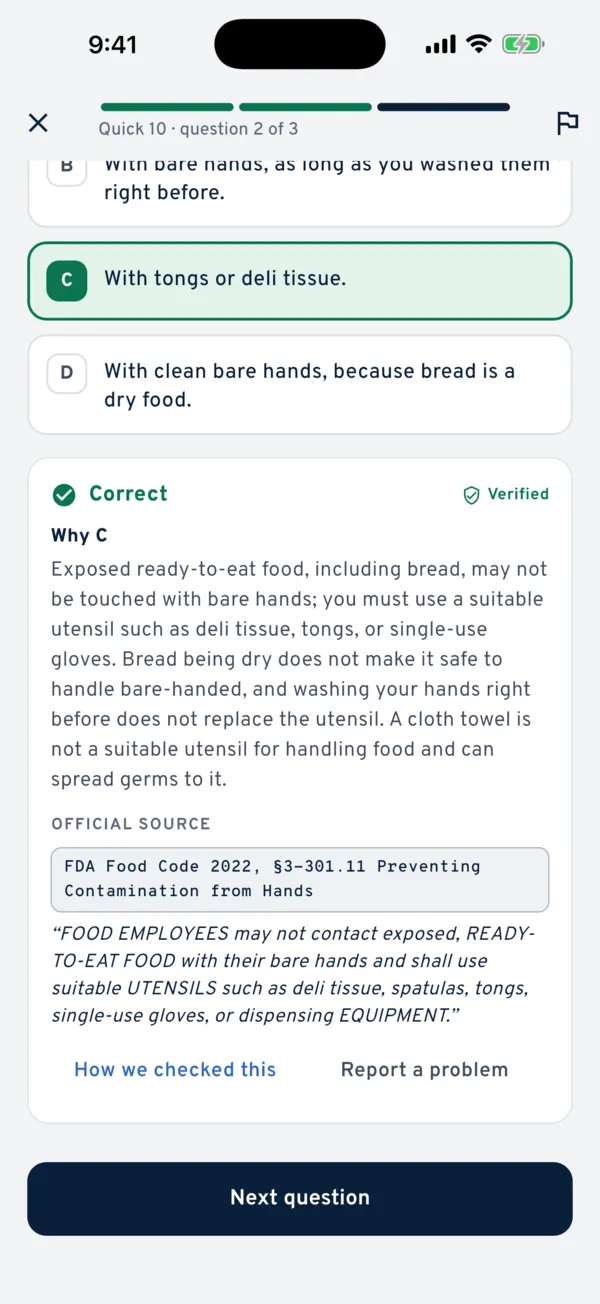
- Never touch ready to eat food with bare hands. Use tongs, deli tissue or gloves
Gloves and handwashing
Gloves are a favorite topic because people trust them too much. A glove is single use. You wash your hands before you put gloves on, and you change them when they tear, when they get dirty, when you switch from raw meat to ready to eat food, and when you’ve been on the same task long enough that they could be contaminated.8 Gloves never replace handwashing. Hands get washed in a handwashing sink, not in a prep or dish sink, and never with a quick rinse under the faucet.8 Expect at least one question that describes a worker doing almost everything right and asks you to spot the one step they skipped.
Allergens
The FDA Food Code treats the major food allergens as their own topic, and so do food handler tests.8 The nine major allergens are milk, eggs, fish, crustacean shellfish, tree nuts, peanuts, wheat, soybeans and sesame. Sesame joined the list most recently, so older study sheets that list eight are out of date. Questions usually describe a guest who says they have an allergy. The right answer involves telling the person in charge or the kitchen, preparing the order with clean utensils and surfaces, and never guessing when you aren’t sure what’s in a dish.
What trips people up
Most wrong answers on a food handler test sound reasonable. “I washed my hands, so I can grab the bread” feels right, and it’s wrong, because ready to eat food still needs a utensil or gloves.8 Another common miss is the temperature danger zone. The test wants 41°F to 135°F, not the 40°F to 140°F you may remember from a home cooking class. Questions about illness are the third trap. If you have vomiting, diarrhea or jaundice, or a doctor diagnoses certain illnesses such as norovirus or hepatitis A, you report it to the person in charge and stay out of food work.8
How the test works
A food handler test is the last step of a short online or classroom course. It isn’t a proctored exam like the food protection manager exam, and you usually take it at home right after the course.
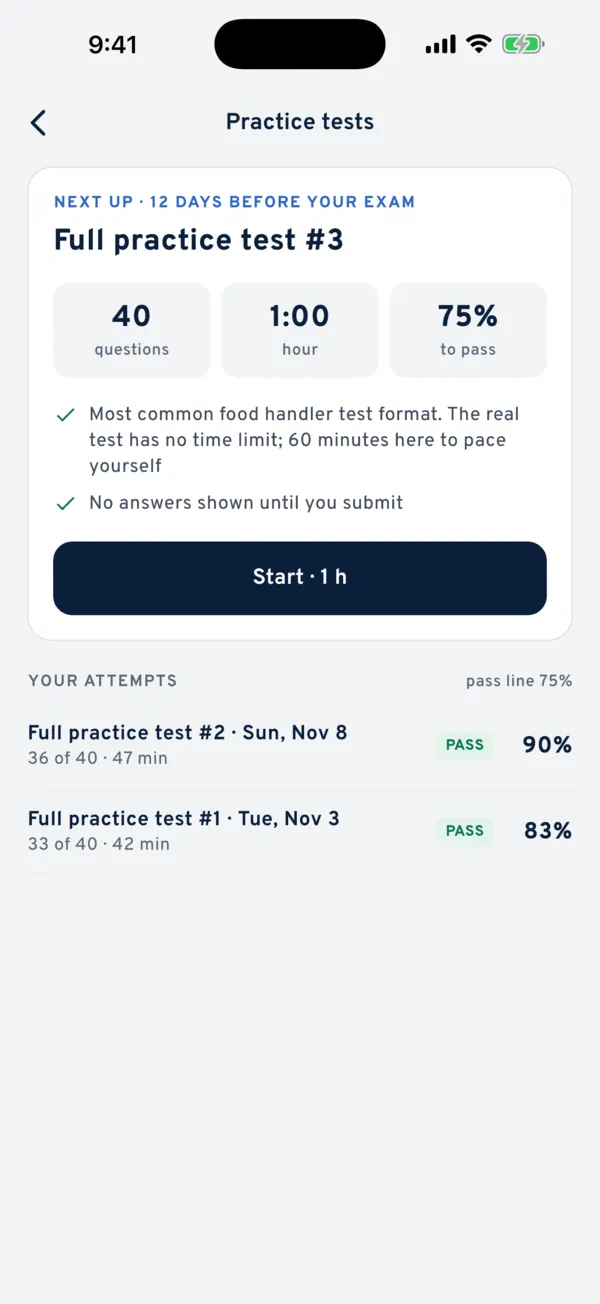
ServSafe Food Handler is the most widely used national program. Its assessment has 40 questions, isn’t proctored and has no time limit, and you need at least 75% to get the certificate, which means 30 correct answers.1 You get three attempts to pass before you have to buy the course again.1
California writes the format into law for cards used in that state. The exam has at least 40 questions on the required subjects, you need at least 70% to pass, and the course and exam are designed to take about two and a half hours.3 At least one accredited course and exam, card included, must cost no more than $15.3
| Program | Questions | Passing score | Time | Validity |
|---|---|---|---|---|
| ServSafe Food Handler | 40 | 75% | No limit | Set by your state or county |
| California card (any accredited provider) | At least 40 | At least 70% | About 2.5 hours with the course | 3 years |
| Oregon card (state program) | Set by OHA | Set by OHA | Online or in person | 3 years |
Who needs a card, what it costs and where to get one
There is no federal food handler card. Each state or county decides whether workers need one, which programs count, and how long the card lasts. Here are the rules in the biggest states that require one.
California
A food handler hired in California must get a card within 30 days of hire and keep a valid card for as long as they work as a food handler.2 The card is valid for three years from the date it’s issued, even if you change employers.2 It must come from an ANSI accredited training provider that meets the ASTM E2659 standard for certificate programs.2 Your employer must keep records showing that each food handler has a valid card.2 A few counties run their own programs, so check with your county health department if you work in one of them.
Texas
Texas accepts cards from programs accredited by the Department of State Health Services or listed by ANSI, and the card must show the program’s name and either its DSHS license number or its ANSI listing.4 A card without a printed expiration date is valid for two years from the date it was issued.4 Online courses from accredited programs count.4
Illinois
Restaurant food handlers in Illinois need ANSI accredited food handler training within 30 days of hire, and the training must be renewed every three years.5 Your employer keeps proof of your training, such as a list with your name, the training and the date.5
Washington
Washington issues its own food worker card. The first card is valid for two years, and renewals are valid for three years.6 You can work for up to 14 days before you get the card if your employer gives you food safety training.6 A five year card is available if you document additional food safety training.6
Oregon
Oregon food service workers must get a food handler card within 30 days of starting work.7 The card costs $10, is valid for three years, and works in every Oregon county.7 Oregon warns that some online courses claim Oregon approval without having it, so use a provider from the Oregon Health Authority’s list.7 Managers who passed an approved manager course don’t need a separate food handler card.7
Everywhere else
Many other states leave the decision to counties and cities, and some employers require a card even where the law doesn’t. If you’re not sure, ask your manager or call the health department that inspects your workplace. Ask which programs they accept and how long the card lasts.
A one week study plan
Most people pass a food handler test with a few hours of study. If English isn’t your first language, or you’ve never worked in a kitchen, give yourself the full week.
- Days 1 and 2Learn the hygiene rules. Handwashing steps and the 20 second rule, when gloves must be changed, what to do when you feel sick, and the symptoms you must report to the person in charge.
- Days 3 and 4Learn the temperatures. Write the danger zone, cooking, holding, cooling and reheating numbers on one card and quiz yourself until you can say them without looking.
- Day 5Cross contamination, storage order in the refrigerator, cleaning versus sanitizing, and the major food allergens.
- Days 6 and 7Take full practice tests of 40 questions. Reread every topic where you missed a question, then take the real test.
Clinched has a Food Handler course built from the FDA Food Code, with the rule behind every answer quoted under the question, practice tests in the 40 question format and a readiness score that tells you when you’re ready.
Test day
Because most food handler tests are online and unproctored, test day is simple. Pick a quiet time, make sure your device is charged, and finish the course before you start the test. With ServSafe there’s no clock, so read every question twice.1
- Finish every lesson in your course first, most programs require it
- A quiet half hour and a charged phone, tablet or computer
- Your one card of temperatures and times, to review right before you start
- Read each answer choice fully before you pick one
- Save or print your certificate as soon as you pass
After you pass, or if you don’t
When you pass
Download or print your card and give your employer a copy, because they have to show it to inspectors.25 Write down the expiration date. California, Illinois and Oregon cards last three years, Texas cards two years, and Washington renewals three years after the first two year card.24567
If you want to move up to shift lead or kitchen manager, the next step is the food protection manager exam. In California and Oregon a valid manager certificate also covers the food handler requirement.7
When you don’t
ServSafe gives you three attempts to pass the Food Handler assessment, and after that you buy the course again.1 Other providers set their own retake rules, and many include at least one free retake. Before you try again, go back to the topics you missed. Temperatures and illness reporting cause most failures, and both are easy to fix with an hour of focused review.
Food handler card or food manager certificate
The two get mixed up all the time. A food handler card is for staff. It’s a short course and an unproctored test, and it usually costs $15 or less in California and $10 in Oregon.37 A food protection manager certificate is for the person in charge. It’s a proctored exam of about 80 to 90 questions, it’s valid for up to five years, and the Food Code expects at least one certified manager per establishment.8 Our food protection manager exam guide covers that one in detail.
Questions people ask
How many questions are on the food handler test?
Most food handler tests have 40 multiple choice questions. ServSafe Food Handler uses 40 questions, and California law requires at least 40 questions for a card that counts in that state. A few local programs use a different number, so check the course you're buying.
What score do you need to pass the food handler test?
ServSafe Food Handler requires 75%, which is 30 of 40 questions. California law sets a minimum of 70% for food handler card exams. Other providers set their own pass mark, usually 70 or 75%, and some counties have their own rules.
How long is a food handler card good for?
It depends on the state. California, Illinois and Oregon cards last three years. Texas cards are valid for two years, and Washington's first food worker card lasts two years with three year renewals. Your card has its expiration date printed on it.
Is a food handler card the same as a food manager certificate?
No. A food handler card is a short, usually unproctored course and test for staff. A food protection manager certificate comes from a proctored exam of about 80 to 90 questions for the person in charge. In California and Oregon a valid manager certificate also covers the food handler requirement.
Can I get a food handler card online?
Yes, in most states. California, Texas and Illinois accept online courses from accredited providers. Oregon and Washington run their own card programs, and Oregon warns that some online courses claiming Oregon approval are not approved, so use the provider list on the state site.
Sources
- ServSafe Food Handler ProgramNational Restaurant Association (ServSafe)
- California Health and Safety Code section 113948California Legislative Information
- SB 476 Food safety: food handlers (2023)California Legislative Information
- Frequently Asked Questions, Food Handler Education or Training ProgramsTexas Department of State Health Services
- Food Handler TrainingIllinois Department of Public Health
- Food Worker CardWashington State Department of Health
- Food Handler CardsOregon Health Authority
- FDA Food CodeU.S. Food and Drug Administration