Securities and insuranceNorth American Securities Administrators Association
Series 63, 65 and 66, explained
The Series 63, 65 and 66 are NASAA state law exams that FINRA administers. The Series 63 (60 scored questions, 75 minutes, 43 correct to pass, $147) registers you as a securities agent in a state. The Series 65 (130 scored, 180 minutes, 92 correct, $187) qualifies you as an investment adviser representative. The Series 66 (100 scored, 150 minutes, 73 correct, $177) combines both but only counts alongside a Series 7. None of them needs a firm sponsor.
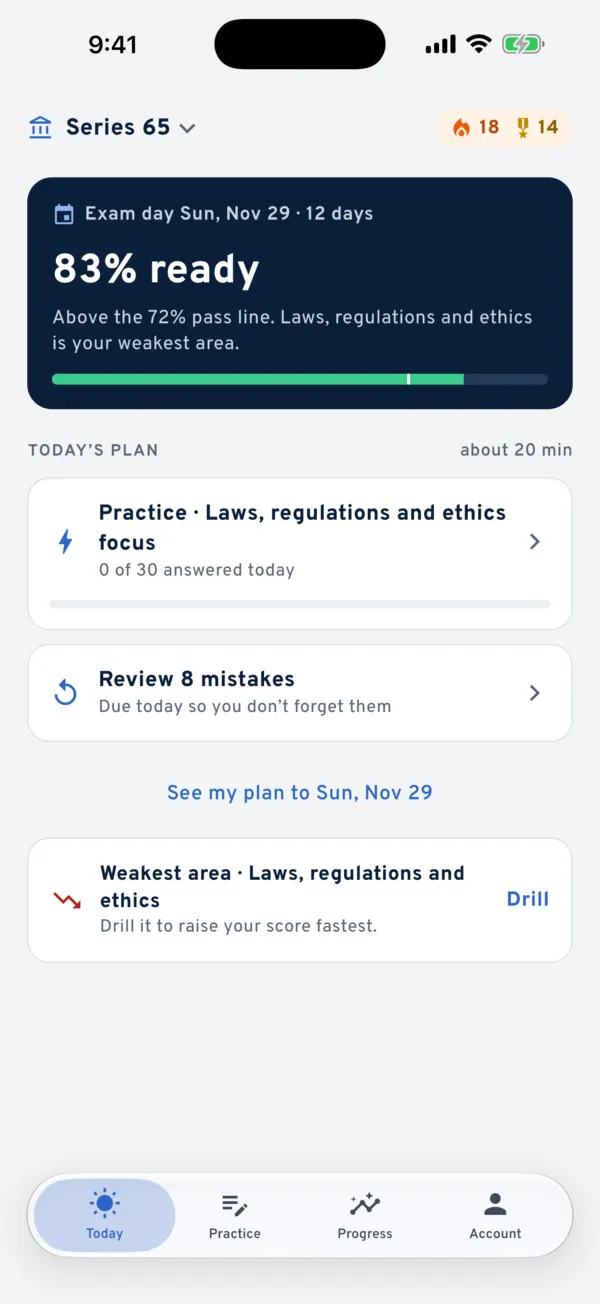
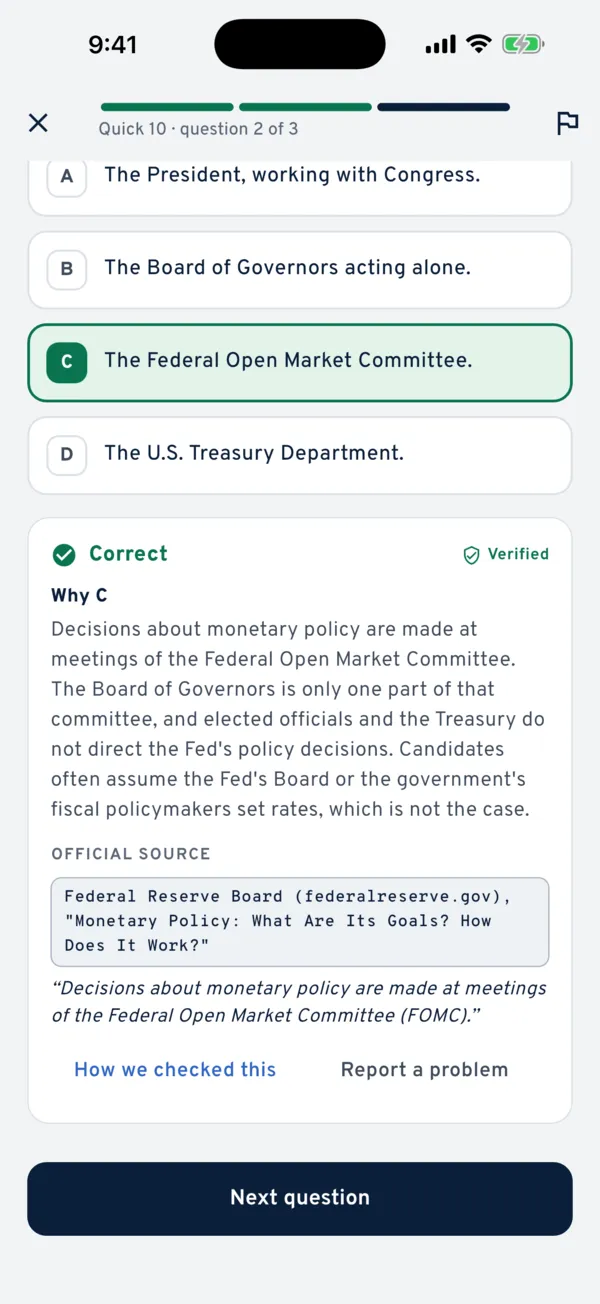
Series 63, 65 and 66 at a glance
- Series 63
- 60 scored + 5 unscored questions, 75 minutes, 43 correct to pass, $1471
- Series 65
- 130 scored + 10 unscored questions, 180 minutes, 92 correct to pass, $1872
- Series 66
- 100 scored + 10 unscored questions, 150 minutes, 73 correct to pass, $1773
- Sponsorship
- Not required for any of the three4
- Co-requisite
- Series 66 counts only with the SIE and Series 7. The 63 and 65 have none.3
- Retake wait
- 30 days after a 1st or 2nd failure. 180 days after a 3rd, falling to 60 days for windows opened on or after January 4, 20275
- Remote testing
- NASAA ends remote testing for all three exams on January 4, 20274
- Series 65 waiver
- CFP, ChFC, CFA, PFS or CIMA can waive the exam in states that follow NASAA's model rule4
What’s on each exam, and which one you need
All three are North American Securities Administrators Association (NASAA) exams that FINRA administers and Prometric delivers.1 They test state securities law and ethics, built on the Uniform Securities Act, plus (for the 65 and 66) the investment knowledge an adviser needs. Here’s how they compare.
| Series 63 | Series 65 | Series 66 | |
|---|---|---|---|
| Scored questions | 60 | 130 | 100 |
| Unscored pretest | 5 | 10 | 10 |
| Time | 75 minutes | 180 minutes | 150 minutes |
| Correct answers to pass | 43 (about 72%) | 92 (about 71%) | 73 (73%) |
| Fee | $147 | $187 | $177 |
| Co-requisite | None | None | SIE and Series 7 |
Figures are from FINRA’s exam pages for each series.123
Which one fits your job
You’ll sell securities for a broker-dealer. You need the Series 7 for FINRA and, in almost every state, the Series 63 for state agent registration.
You’ll give investment advice for a fee at a registered investment adviser. You need the Series 65. Nothing else is required, and the 65 has no co-requisite.2
You’ll do both. Hold the Series 7 and take the Series 66, which covers the agent and adviser roles in one exam.3 The alternative is the Series 63 plus the Series 65, which is two exams and 255 minutes instead of 150. The 66 is useless without a Series 7, so don’t take it on its own.
Our post on Series 65 vs Series 66 goes deeper on that choice, including what happens if you change firms.
Series 63 content
The Series 63 is short and almost all law and ethics. Here are the weights under the specifications NASAA put in effect on June 12, 2023.6
| Section | Weight | Questions |
|---|---|---|
| Regulation of investment advisers | 5% | 3 |
| Regulation of investment adviser representatives | 5% | 3 |
| Regulation of broker-dealers | 12% | 7 |
| Regulation of agents of broker-dealers | 13% | 8 |
| Regulation of securities and issuers | 9% | 5 |
| Remedies and administrative provisions | 11% | 7 |
| Communication with customers and prospects | 20% | 12 |
| Ethical practices and obligations | 25% | 15 |
Ethics and communications are 45% of the exam.6 Expect scenarios about selling away, guaranteeing against loss, unauthorized trading, sharing in customer accounts and misleading advertising. The tricky part is definitions. Who counts as an agent, which securities and transactions are exempt from state registration, and when the administrator can deny or revoke a registration. Words like “exempt,” “excluded” and “federal covered” matter, and the questions are written to punish loose reading.
Series 65 content
The Series 65 is the Uniform Investment Adviser Law Exam, and it’s much broader. It has four sections.7
| Section | Weight | Questions |
|---|---|---|
| Economic factors and business information | 15% | 20 |
| Investment vehicle characteristics | 25% | 32 |
| Client investment recommendations and strategies | 30% | 39 |
| Laws, regulations and guidelines, including prohibition on unethical business practices | 30% | 39 |
70% of the exam is investment content.7 That surprises people who expect a law test. You’ll see time value of money, financial statement basics, risk measures like standard deviation, beta and Sharpe ratio, portfolio theory, retirement plans, trusts and estates, taxation and performance measurement. The law section focuses on investment adviser registration, fiduciary duty, fee disclosures, custody and the line between federal covered advisers and state-registered ones.
Series 66 content
The Series 66 takes the law and ethics from the 63 and adds the adviser material from the 65, minus product depth that the Series 7 already covers. Under the June 2023 specifications, the weights are economic factors 8%, investment vehicles 17%, client recommendations and strategies 30%, and laws, regulations and guidelines 45%.8 That last 45% is why Series 7 holders sometimes find the 66 harder than expected. It’s the densest legal content of the three.
NASAA is also updating exam questions affected by the model rule amendments on investment adviser advertising that it adopted in May 2026, with the changes planned for early 2027 and the exact date still to be announced.7
How the exams work
Each exam is computer-based multiple choice with unscored pretest questions mixed in and not identified.2 The passing standard is a fixed number of correct answers on the scored questions. You need 43 of 60 on the Series 63, 92 of 130 on the Series 65 and 73 of 100 on the Series 66.123 NASAA lowered the Series 65 cutoff from 94 to 92 when the 2023 specifications took effect.7
Timing is comfortable on the 63 (about 69 seconds per question including pretest items) and fine on the 65 and 66 (about 77 to 82 seconds).123 The calculations on the 65 and 66 are short. The time pressure, if any, comes from reading long scenario questions carefully.
You test at a Prometric center. FINRA lists online delivery for the 65 and 66 only for candidates with an approved accommodation, and NASAA’s FAQ says remote testing for all three exams ends on January 4, 2027.24 At the center you get the same provided materials as other FINRA-administered exams, and you see a pass or fail result on screen when you finish.
Eligibility, cost and scheduling
None of the three requires a sponsoring firm. NASAA’s FAQ says unsponsored candidates can enroll and pay through FINRA, and FINRA then opens a 120-day window to take the exam.4 If you’re already with a broker-dealer or investment adviser, ask your firm before you enroll, because it may need to request the exam on your Form U4.4
Fees are $147 for the Series 63, $187 for the Series 65 and $177 for the Series 66.123
- Confirm which exam you needCheck with your firm or the state securities regulator where you'll be registered. Taking the wrong one is an expensive mistake.
- Enroll through FINRAUnsponsored candidates enroll themselves. Sponsored candidates are enrolled by their firm. Either way, a 120-day window opens.
- Schedule with PrometricBook a test center seat. After January 4, 2027, NASAA no longer offers remote testing for these exams.
- Line up the registrationA pass doesn't register you. Your firm files the registration with each state where you'll do business.
Professional designations. Under NASAA’s model rule, holders of the CFP, ChFC, CFA, PFS or CIMA designations who are current and in good standing can have the Series 65 requirement waived. NASAA updated that list in May 2024 and dropped the CIC.49 A designation only waives the adviser exam. It doesn’t excuse the Series 63 if you’re also registering as an agent.4 Each state decides whether to accept the updated list, so check with your state securities regulator.4
A study plan for each exam
The Series 63 is the shortest. Two to three weeks of focused study is common for someone who just passed the Series 7. The Series 65 is a bigger lift, usually five to eight weeks, especially without a finance background. The Series 66 sits in between for Series 7 holders, around four to five weeks. Here’s a six-week plan for the Series 65, the one people underestimate most.
- Week 1Economics and business basics. The business cycle, interest rates, inflation, financial statements, and time value of money. Take a diagnostic test.
- Week 2Investment vehicles. Stocks, bonds, mutual funds, ETFs, options basics, annuities, REITs and limited partnerships, with the risks of each.
- Week 3Client recommendations, part one. Client profiles, risk tolerance, asset allocation, modern portfolio theory, and risk measures like beta, standard deviation and Sharpe ratio.
- Week 4Client recommendations, part two. Retirement plans, ERISA basics, trusts and estates, taxation and performance measurement (time-weighted versus dollar-weighted returns).
- Week 5Laws and ethics. Adviser registration under federal and state law, fiduciary duty, custody, fees, advertising, and prohibited practices. Start daily mixed question sets.
- Week 6Two full timed practice exams of 130 questions in 180 minutes, review every miss, then focus on your weakest section.
For the Series 63, use weeks 5 and 6 of that plan and add a full pass through exemptions and administrator powers. For the Series 66, use weeks 3 through 6 and spend extra time on the law, since it’s 45% of the scored questions.8 Clinched has courses for the Series 63, 65 and 66, with every explanation quoting the statute or rule it’s based on.
Test day
Bring one valid, unexpired government-issued photo ID with a signature, with the name matching your enrollment exactly, and arrive 30 minutes early.10 Phones, watches and wallets go in a locker, and the exam timer doesn’t stop for restroom breaks.10 Check-in includes the NASAA rules of conduct along with Prometric’s security rules.10
- Government photo ID with signature, unexpired, name matching your enrollment
- Arrival 30 minutes before your appointment
- Confirmation of which exam you're sitting (63, 65 or 66) on your appointment email
- A plan to answer every question, since there's no penalty for guessing
After you pass, or if you don’t
Passing doesn’t register you. Your firm (or you, if you’re forming your own advisory firm) files the registration with each state where you’ll do business. Under NASAA’s model rule for investment adviser representatives, states generally want the exam passed within the two years before you apply, unless you’ve stayed registered.9 FINRA notes that NASAA’s Exam Validity Extension Program can keep a Series 63 or 65 valid for up to five years in states that adopt it, as long as you complete annual continuing education.12
If you fail, the wait is 30 days after a first or second attempt.5 After a third failure, the wait has been 180 days. For enrollment windows opened on or after January 4, 2027, NASAA cuts it to 60 days.5 A window opened before that date keeps the 180-day rule, so if you’ve just failed a third time, NASAA’s advice is to wait until January 4, 2027 to open the new window.4 Note that FINRA’s own exams change on a different date, January 19, 2027, and FINRA’s cut is deeper (15 days after a first or second failure).5 Our post on the 2027 retake rule changes puts both side by side.
The 2027 changes in one place
Three NASAA changes land in early 2027, and they affect when and how you test.457 Remote testing ends on January 4, 2027, so if you were counting on taking the exam from home, book a test center instead. The third-failure wait falls from 180 to 60 days for windows opened on or after that same date. And questions tied to NASAA’s May 2026 investment adviser advertising amendments get updated in early 2027, which mostly matters for the Series 65 and 66. If you’re studying now with older materials, check that your prep source covers the current advertising rules once NASAA publishes the date.
If you’re still working out the order of licenses, our post on which securities licenses you need maps the path from the SIE through the Series 7 and the state exams.
Questions people ask
What is the difference between the Series 63, 65 and 66?
The Series 63 covers state law for securities agents who sell for a broker-dealer. The Series 65 qualifies you as an investment adviser representative who gives advice for a fee. The Series 66 combines the two, but states accept it only together with the Series 7.
Do I need a sponsor for the Series 63, 65 or 66?
No. NASAA says unsponsored candidates can enroll and pay through FINRA, which then gives them a 120-day window to test. If you already work for a firm, check with it first, because the firm may need to request the exam on your Form U4.
What is the passing score for the Series 65?
You need 92 correct answers out of 130 scored questions, about 71%. NASAA lowered it from 94 when the current test specifications took effect on June 12, 2023. The 10 unscored pretest questions don't count either way.
Should I take the Series 65 or the Series 66?
If you already have or will get the Series 7, the Series 66 replaces both the 63 and the 65 in one shorter sitting. If you'll only give fee-based advice and won't hold a Series 7, take the Series 65. The 66 does nothing for you without a 7.
How long is a Series 65 pass valid?
Under NASAA's model rule, states generally require that you passed the Series 65 within two years before applying, unless you've stayed registered. States that adopt NASAA's Exam Validity Extension Program let you stretch that to five years with annual continuing education.
Sources
- Series 63, Uniform Securities Agent State Law ExamFINRA
- Series 65, Uniform Investment Adviser Law ExamFINRA
- Series 66, Uniform Combined State Law ExamFINRA
- Exam FAQsNASAA
- NASAA Approves Updated Waiting Period for Series 63, 65, and 66 Exam RetestsNASAA
- Series 63 Test Specifications, effective June 12, 2023NASAA
- Series 65 Exam Content OutlineNASAA
- Series 66 Test Specifications, effective June 12, 2023NASAA
- NASAA Model Rule, Examination Requirements for Investment Adviser Representatives (December 2024)NASAA
- Prepare for Your Test Center AppointmentFINRA
More on Series 63, 65 and 66
- After the exam · SIE · Series 7
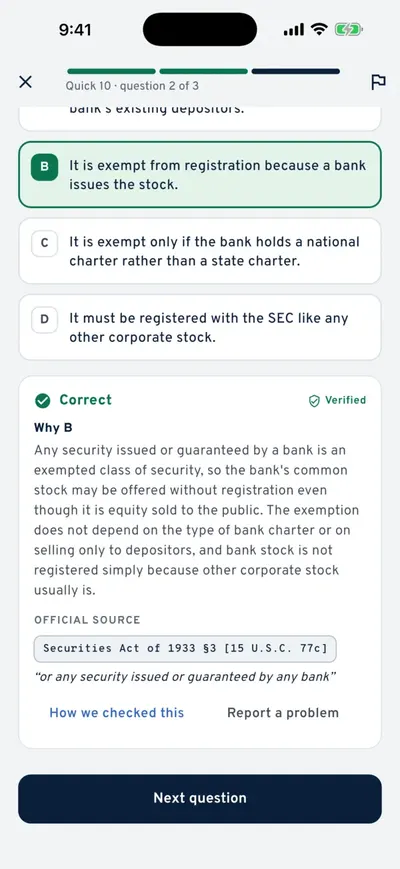 Which Securities Licenses Do You Need, and in What Order?Most brokers need the SIE, Series 7 and Series 63. Advisers need the Series 65. Dual reps add the Series 66. The order, costs and sponsor rules for each license.
- Exam guide · Series 63, 65 and 66
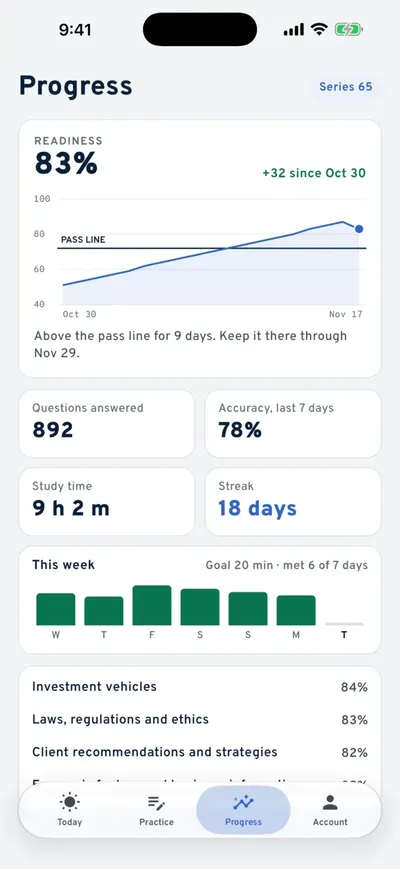 Series 65 vs Series 66: Which One Should You Take?The Series 65 has 130 scored questions and stands alone. The Series 66 has 100 and only counts with a Series 7. How to choose based on your job and where you work.
- Exam guide · SIE · Series 7
 FINRA and NASAA Retake Waiting Periods Change in January 2027FINRA cuts SIE and Series 7 retake waits to 15 and 60 days on January 19, 2027. NASAA cuts the third-failure wait to 60 days on January 4. What changes for you.