FAA Part 107 guideFree practice test
FAA Part 107 practice test
15 free FAA Part 107 questions from the 2,020 in Clinched, chosen to match how the real test is weighted. Pick an answer to see the explanation and the official text it comes from. Nothing to sign up for.
-
Question 1 of 15Waivers
Under part 107, which rule category is listed as waivable by a certificate of waiver?
Correct answer A. Operation in certain airspace
Operation in certain airspace is on the list of regulations a certificate of waiver may cover. Remote pilot certification and aircraft registration do not appear on the waivable list, so a certificate of waiver cannot excuse them.
Official source 14 CFR §107.205Section 107.41—Operation in certain airspace.
-
Question 2 of 15Remote pilot certification
A certificated remote pilot takes a knowledge test on behalf of a friend, and the FAA finds out. Besides the one-year testing ban, what may happen to the pilot's existing certificate?
Correct answer B. It may be suspended or revoked.
Section 107.69(a) lists acts that an applicant for a knowledge test may not commit, and taking any part of a test on behalf of another person is one of them. The person who sits for the test is treated as an applicant, so any certificate or rating that person holds may be suspended or revoked. The certificate is not protected just because the friend's name was on the test, and training does not cancel the violation.
Official source 14 CFR §107.69(a) An applicant for a knowledge test may not:
14 CFR §107.69“(4) Take any part of a knowledge test on behalf of another person;” -
Question 3 of 15Operating rules
A remote PIC has three jobs this week. Which flight requires prior ATC authorization under part 107?
Correct answer B. A roof inspection inside Class C airspace at 80 feet AGL
Class C airspace is on the list of airspace that needs prior ATC authorization, and flying low does not change that. Class G airspace is not on the list. Class E airspace outside an airport's surface area is not on the list either.
Official source 14 CFR §107.41No person may operate a small unmanned aircraft in Class B, Class C, or Class D airspace or within the lateral boundaries of the surface area of Class E airspace designated for an airport unless that person has prior authorization from Air Traffic Control (ATC).
-
Question 4 of 15Operations over people
A remote PIC flying a Category 3 small unmanned aircraft along a public road, which is not a closed- or restricted-access site, wants to hover over a line of cars stopped at a traffic light. Which describes the rule for sustained flight over the people in those cars?
Correct answer B. Sustained flight is permitted only while the cars remain stationary
Category 3 allows sustained flight over non-participants only if they are under a covered structure or inside a stationary vehicle that offers reasonable protection. Once the light turns green and the cars move, the exception no longer applies. Moving vehicles are never covered by this exception. Putting people on notice only matters at a closed- or restricted-access site, and this road is not one.
Official source 14 CFR §107.125(2) The small unmanned aircraft does not maintain sustained flight over any human being unless that human being is—
14 CFR §107.125“(ii) Located under a covered structure or inside a stationary vehicle that can provide reasonable protection from a falling small unmanned aircraft.” -
Question 5 of 15General
What makes an aircraft an unmanned aircraft under part 107?
Correct answer C. It is operated without the possibility of direct human intervention from within or on the aircraft
An aircraft is unmanned when no one can directly intervene from inside or on the aircraft. Where the pilot stands relative to visual line of sight does not define it. Being autonomous or preprogrammed does not define it either, because a remotely controlled aircraft is still unmanned.
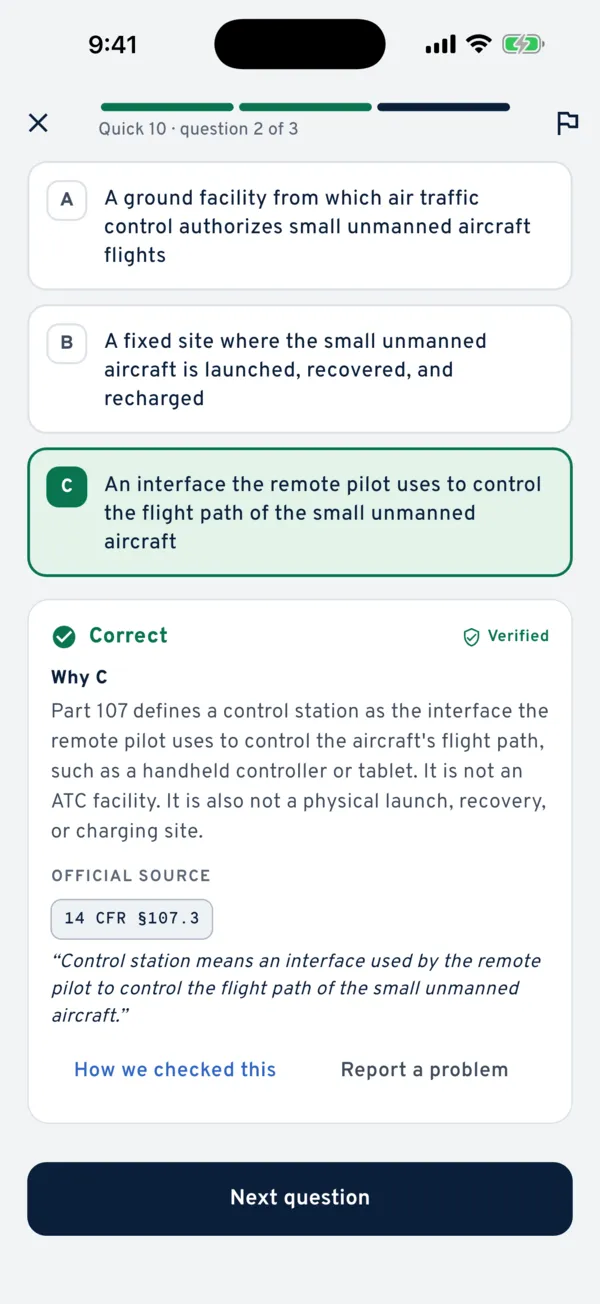
Official source 14 CFR §107.3Unmanned aircraft means an aircraft operated without the possibility of direct human intervention from within or on the aircraft.
-
Question 6 of 15Remote ID
A producer of standard remote identification drones learns of a defect that makes its drones no longer meet the remote identification requirements. How soon must it notify the public and the FAA?
Correct answer B. Within 15 calendar days of becoming aware of it
The producer must keep procedures in place to notify the public and the FAA of such a defect within 15 calendar days after becoming aware of it. A 30-day window is longer than the rule allows. The deadline is tied to awareness of the defect, not to the audit schedule.
Official source 14 CFR §89.515A person responsible for the production of standard remote identification unmanned aircraft must maintain product support and notification procedures to notify the public and the FAA of any defect or condition that causes an unmanned aircraft to no longer meet the requirements of this subpart, within 15 calendar days of the date the person becomes aware of the defect or condition.
-
Question 7 of 15Airspace classification
Why should a remote PIC operating in an active MOA expect fast-moving military traffic at low altitude?
Correct answer B. The Department of Defense is authorized to exceed 250 knots below 10,000 feet MSL there
The Department of Defense holds an authorization to fly faster than 250 knots indicated airspeed below 10,000 feet MSL in active MOAs. Military aircraft can therefore close on a small drone very quickly. The other options mix in speed and altitude values from different rules or the wrong altitude reference.
Official source AIM 3-4-4 to 3-4-7Additionally, the Department of Defense has been issued an authorization to operate aircraft at indicated airspeeds in excess of 250 knots below 10,000 feet MSL within active MOAs.
-
Question 8 of 15Airspace operating requirements
A remote pilot holds a part 107 certificate and wants to begin flying at night. What must the remote pilot complete to receive night operations privileges?
Correct answer A. A knowledge test or recurrent training that covers night physiology and night visual illusions
Night privileges come from completing either a knowledge test with questions on night physiology and night visual illusions, or recurrent training that covers those topics. Under the current rule, a waiver is no longer the path to routine night flight. Logged supervised flights with an instructor are not part of the requirement.
Official source AC 107-2A, p. 5-4A certificated remote pilot receives night operations privileges and may operate at night only after completing either a knowledge test that contains questions on night physiology and night visual illusions, or through completion of recurrent training.
-
Question 9 of 15Airspace operating requirements
A remote PIC is filming from a hilltop. Visibility at the control station is 4 statute miles, while haze near the planned flight area appears thicker. Under part 107, which visibility determines whether the flight meets the minimum?
Correct answer B. The flight visibility observed from the control station
Part 107 measures the 3-statute-mile minimum from where the control station is located, so the 4 miles seen there is the value that counts. The rule does not use visibility at the aircraft's position. It also does not use a report from a nearby airport, which may describe very different conditions.
Official source 14 CFR §107.51The minimum flight visibility, as observed from the location of the control station must be no less than 3 statute miles.
-
Question 10 of 15Weather effects on performance
A forecast shows a warm front approaching an area where a remote PIC has several inspection jobs scheduled. What ceiling and visibility conditions should the remote PIC expect?
Correct answer C. Low ceilings with poor visibility and rain
Warm fronts typically bring low ceilings, poor visibility and rain. Sudden storms, gusty winds and hail are typical of cold fronts. Clearing skies with unlimited visibility usually follow the passage of a cold front.
Official source FAA-H-8083-25C, p. 12-21a strong cold front. Whereas warm fronts bring low ceilings,
FAA-H-8083-25C, p. 12-21“poor visibility, and rain, cold fronts bring sudden storms,” -
Question 11 of 15Loading and performance
Between two flights, a remote PIC moves a heavy camera from the nose mount to a rear mount on a small UA. The total weight stays the same. What should the remote PIC do before the next flight?
Correct answer B. Determine how the CG will shift and its effects
Moving a load item can shift the CG even when total weight is unchanged. FAA guidance says the remote PIC should determine how the CG will shift and how that affects the aircraft. Unchanged weight does not mean unchanged balance, and a compass calibration does not move the center of gravity.
Official source AC 107-2A, PDF page 90As variable load items are shifted or expended, there may be a resultant shift in CG location. The remote PIC should determine how the CG will shift and the resultant effects on the aircraft.
-
Question 12 of 15Physiology
A visual observer (VO) on a Part 107 operation says the alcohol and drug rules do not apply to VOs because only the remote PIC flies. Which statement is accurate?
Correct answer C. The VO must comply with the same alcohol and drug rules as the remote PIC.
Part 107 applies the manned-aviation alcohol and drug rules to the person manipulating the controls, to the remote PIC, and to the visual observer. A VO must therefore meet the same requirements. The rules apply in full and are not limited to certain moments.
Official source 14 CFR §107.27A person manipulating the flight controls of a small unmanned aircraft system or acting as a remote pilot in command or visual observer must comply with the provisions of §§ 91.17 and 91.19 of this chapter.
-
Question 13 of 15Emergency procedures
A remote PIC based in Alaska is planning an evening survey flight and needs to know when civil twilight ends. Where is the definition of civil twilight for Alaska described?
Correct answer B. In The Air Almanac
The civil twilight definition for Alaska differs from the continental United States and is described in The Air Almanac. The 30-minutes-after-sunset rule applies to the continental United States, not Alaska. The Chart Supplement provides airport information, not the civil twilight definition.
Official source AC 107-2A, p. 5-4In Alaska, the definition of civil twilight differs and is described in The Air Almanac.
-
Question 14 of 15Airport operations
A remote PIC reports a large flock of birds to the nearest FSS and gives its geographic location, bird type, and altitude. Which other details does the AIM ask the pilot to report?
Correct answer C. The approximate numbers and the direction of the flight path
The AIM's list for reporting large flocks is geographic location, bird type, approximate numbers, altitude, and the direction of the birds' flight path. Wingspan and airspeed are not on the list and are hard to estimate. Surface wind and visibility are weather details, not part of a bird activity report.
Official source AIM 7-5-1 to 7-5-4Also contact the nearest FAA ARTCC, FSS, or tower (including non−Federal towers) regarding large flocks of birds and report the:
AIM 7-5-5 to 7-5-6“c. Approximate numbers.” -
Question 15 of 15Radio communications
An airline flight with the FAA-authorized call sign Southwest 1422 calls a tower. How should the pilot state the flight number?
Correct answer C. "Southwest Fourteen Twenty-Two"
Air carriers with FAA-authorized call signs say the complete call sign and use group form for the numbers, so 1422 becomes "Fourteen Twenty-Two." Reading each digit separately is the civil registration-number method. The "Tango" prefix is only for air taxi or commercial operators that do not have authorized call signs.
Official source AIM 4-2-4Air carriers and commuter air carriers having FAA authorized call signs should identify themselves by stating the complete call sign (using group form for the numbers) and the word “super” or “heavy” if appropriate.
Want the other 2,005?
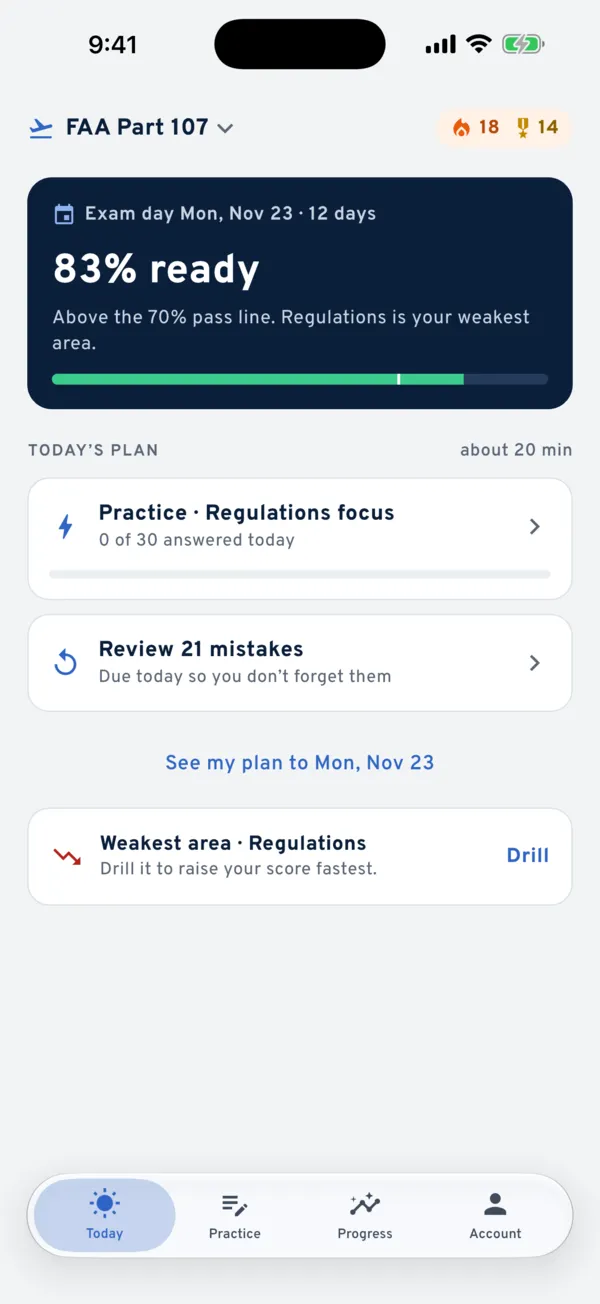
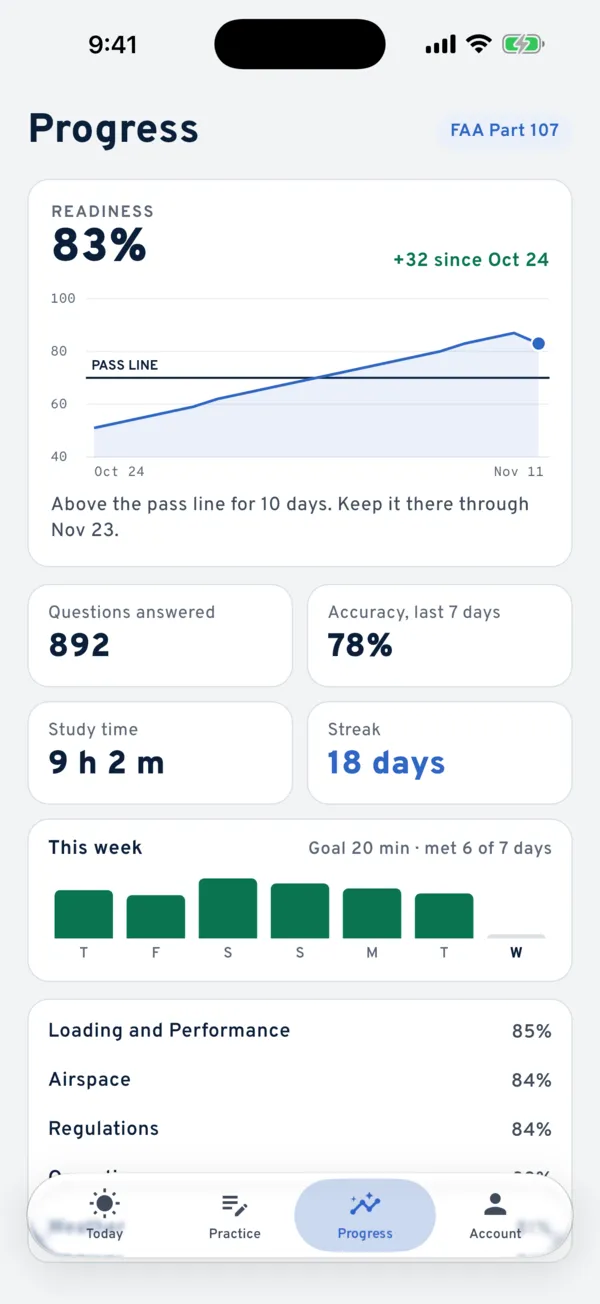
Clinched has every FAA Part 107 question in this format, with full practice tests that match the real one, a readiness score by area and a plan to your test date. Free to start with 10 questions a day.
Read the FAA Part 107 guide or see how we write and check every question.
Free on the App Store
Your exam, in your pocket.
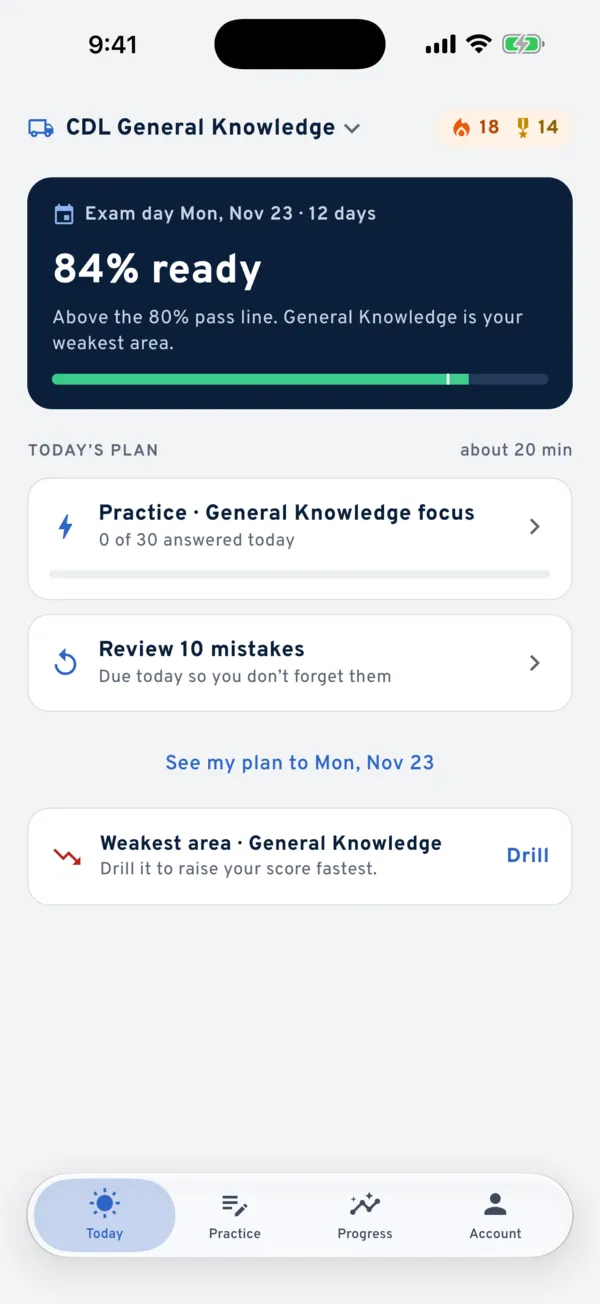
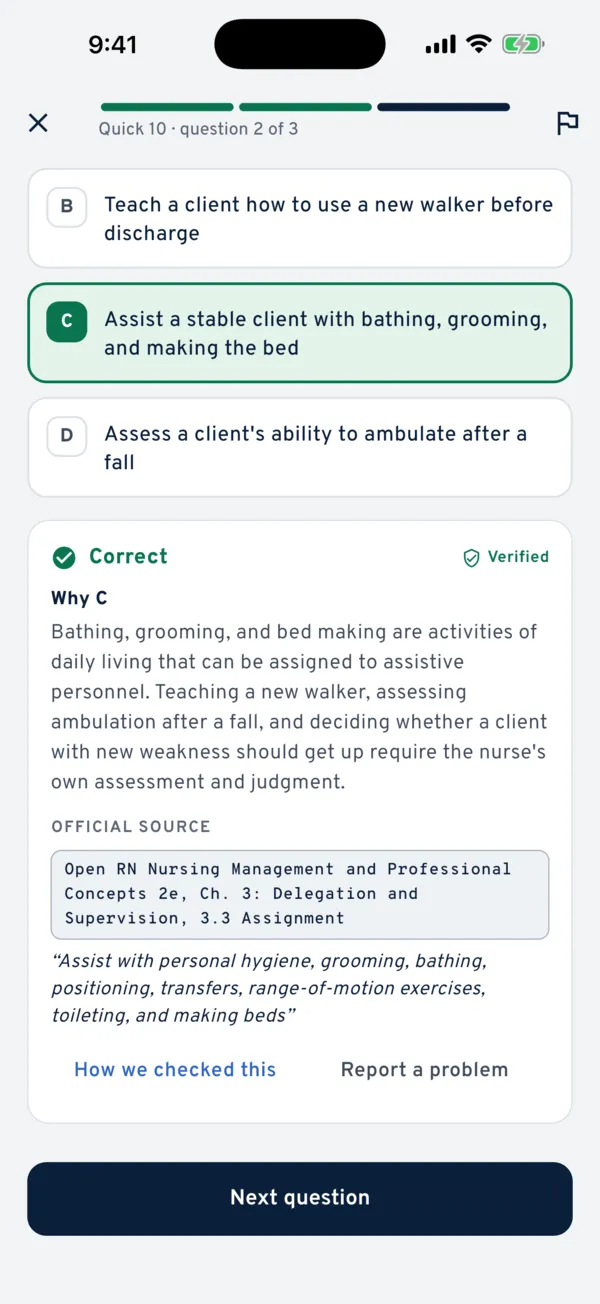
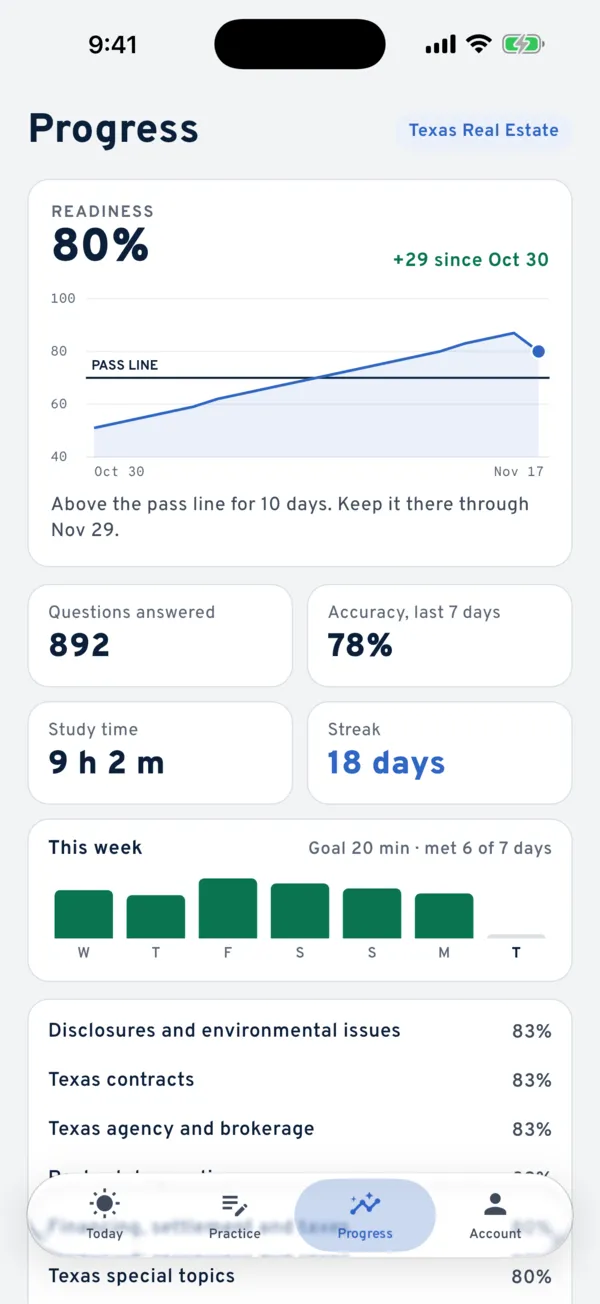
20 exams ready with questions written from the official sources, timed practice tests in the real format and a readiness score with a pass line.
On your computer?
Scan with your iPhone camera to get Clinched practice in the app.