HealthcareNational Healthcareer Association
The NHA CCMA exam, explained
The NHA Certified Clinical Medical Assistant (CCMA) exam has 180 multiple choice questions, 150 scored and 30 unscored pretest items, and you get 3 hours. You pass with a scaled score of 390 or higher on a 200 to 500 scale. Clinical patient care makes up 84 of the 150 scored items, so most of your study time belongs there. NHA charges its exam fee for every attempt, and keeping the credential takes 10 continuing education credits and a renewal fee ($195 outside NHA One) every 2 years.
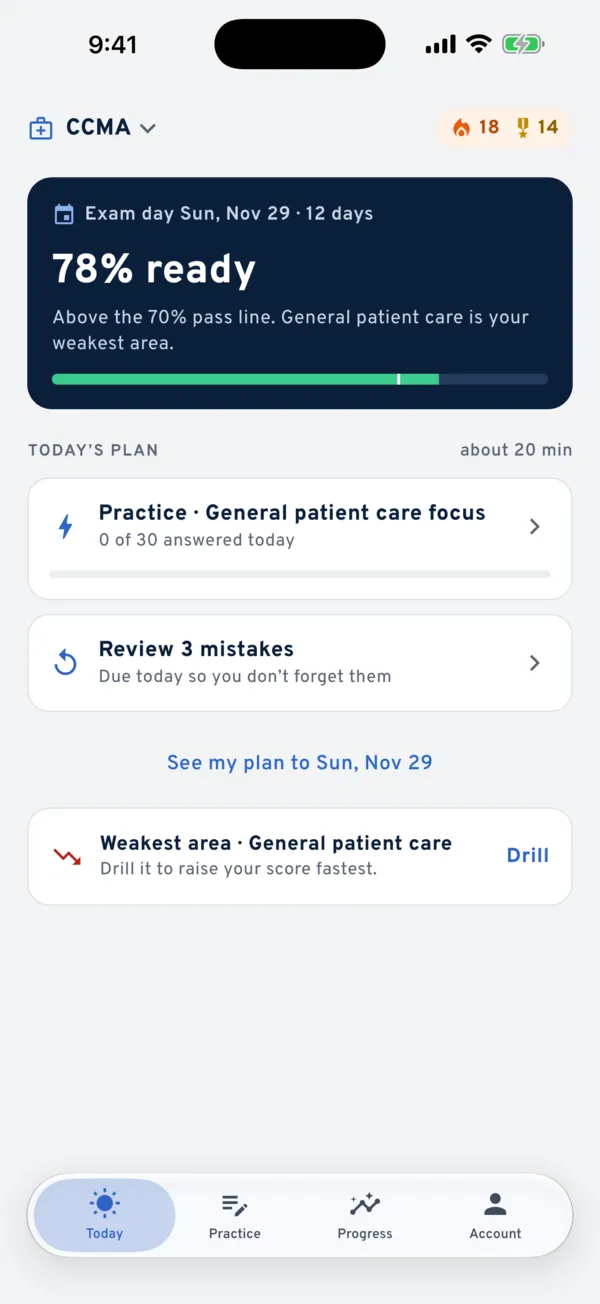
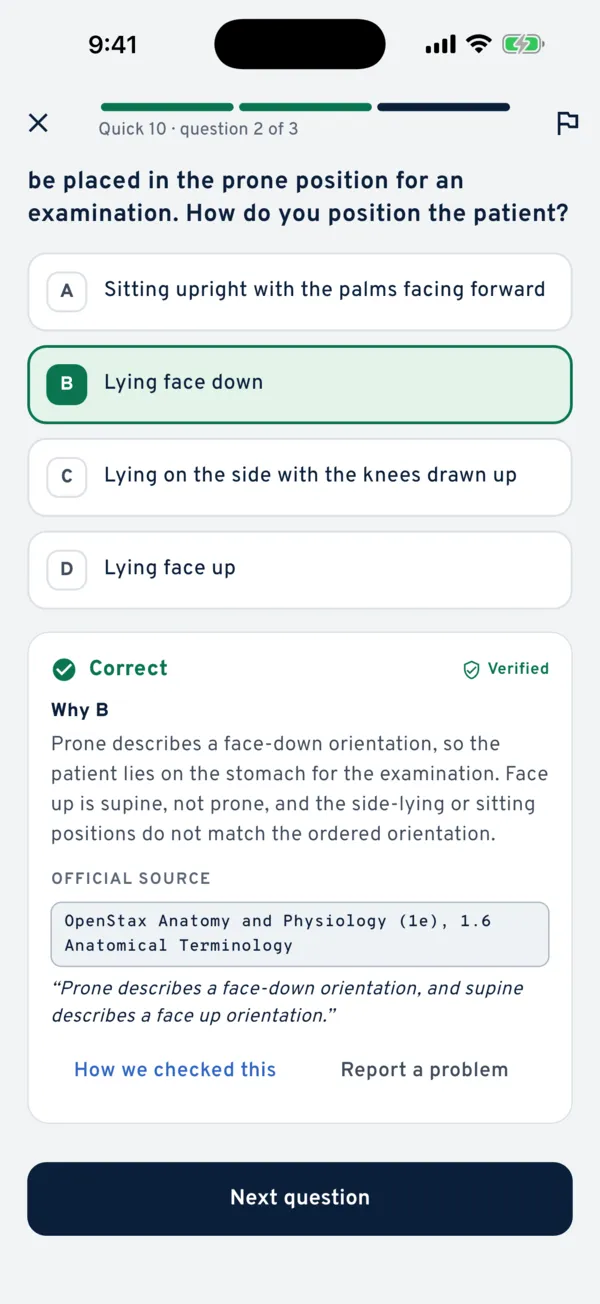
NHA CCMA at a glance
- Questions
- 180 multiple choice (150 scored + 30 unscored pretest)1
- Time limit
- 3 hours, one continuous session1
- Passing score
- 390 scaled (scale runs 200 to 500)2
- Biggest domain
- Clinical Patient Care, 84 of 150 scored items1
- Eligibility
- High school diploma or equivalent, plus a training program in the last 5 years or 1 year of supervised work in the last 32
- Where you test
- Your school, a PSI test center or live remote proctoring2
- Results
- Within 48 hours for PSI exams, right away for school computer exams (preliminary)2
- Retakes
- 30 days between each of the first 3 attempts, then 1 year per extra attempt2
- Renewal
- Every 2 years, 10 CE credits, $195 fee outside NHA One3
- Foundational Knowledge and Basic Science10%
- Anatomy and Physiology5.3%
- Clinical Patient Care56%
- Patient Care Coordination and Education8%
- Administrative Assisting8%
- Communication and Customer Service8%
- Medical Law and Ethics4.7%
What the CCMA test plan covers
NHA builds the CCMA exam from a test plan based on a job analysis it completed in 2022. The plan lists seven domains and the number of scored items in each, 150 in total.1 One domain carries the exam. Clinical Patient Care has 84 of the 150 scored items, which is 56% of your score.1 It’s split into six subdomains.
| Clinical Patient Care subdomain | Scored items |
|---|---|
| Patient intake and vitals | 14 |
| General patient care | 28 |
| Infection control and safety | 15 |
| Point of care testing and lab procedures | 9 |
| Phlebotomy | 12 |
| EKG and cardiovascular testing | 6 |
General patient care alone has 28 items, more than any other full domain on the exam.1 It covers preparing the exam room, sterile technique, positioning and draping, giving medications by routes other than IV, immunization schedules, dosage calculations, wound care, emergencies and CPR, and documenting in the electronic health record, including computerized order entry and telehealth visits.1
The other six domains are smaller. Foundational Knowledge and Basic Science has 15 items, Anatomy and Physiology 8, then Patient Care Coordination and Education, Administrative Assisting, and Communication and Customer Service at 12 each. Medical Law and Ethics has 7.1
What trips people up
The non-clinical half of the job. Care coordination, administrative work, communication and law add up to 43 scored items, close to 29% of the exam.1 People who did a clinical-heavy externship tend to skim these and lose easy points on scheduling, referrals, insurance and HIPAA questions.
Phlebotomy details. The plan names order of draw, tube additives, capillary puncture and specimen processing as tested knowledge.1 Twelve items is a lot to give away on tube colors. Our order of draw guide covers the sequence the way exam questions ask it, and the phlebotomy certification guide goes deeper if you also plan to sit for a phlebotomy credential.
Math without paper. Vitals conversions and dosage calculations are in the plan.1 Since June 1, 2026, NHA exams delivered by PSI don’t allow scratch paper. You get a calculator built into the exam and a whiteboard, a physical one at a test center and a digital one at home.4 Practice your conversions that way so it isn’t new on test day.
Terminology hiding inside clinical questions. Foundational knowledge includes medical word building, abbreviations and The Joint Commission’s “Do Not Use” list.1 Expect them inside clinical scenarios as well as in plain vocabulary questions.
How the exam is built and scored
The CCMA has 180 questions, 150 scored plus 30 pretest items, with a 3-hour limit.1 Every NHA exam is multiple choice and taken on a computer under a proctor.2 The pretest items don’t count, but nothing marks them, so treat every question as live.2 You finish in one continuous session. You can’t stop, leave and come back to review answers later.2
NHA uses scaled scoring. Each exam form is weighted for difficulty, scores run from 200 to 500, and 390 passes on any form.2 Your score report shows the overall result plus a rating for each domain of above, near or below the passing standard. A domain with five or fewer questions on your form gets “N/A” instead of a rating.2 Keep that report if you fail, because it tells you where to spend your retake study time.
Timing works out to exactly one minute per question, pretest items included. Dosage and conversion items take longer than recall items, so bank time on the quick ones.
Accommodations under the Americans with Disabilities Act (ADA) are requested on NHA’s accommodation form. NHA suggests allowing 30 days for review, and some approved accommodations mean you test at a PSI center or your school instead of remotely.2
Eligibility, cost and booking
You need a high school diploma or equivalent, then one of two pathways.2
- Training program. Finish, within the past 5 years, a medical assistant program from an accredited or state-recognized provider. A registered Department of Labor apprenticeship, formal military medical training or an approved employer-based program also counts.2
- Work experience. One year of supervised work in the field in the last 3 years, or 2 years in the last 5.2 California residents using the work route need 2 years of medical assistant work within the 5 years right before the exam date.2
If your school has signed NHA’s pre-externship agreement, you can test once your coursework is done. You then have 90 days to finish the externship and have the school notify NHA, or the passing score is voided.2 Students who don’t have their diploma yet can earn a provisional certification. Starting October 1, 2026, the CCMA provisional certification lasts 18 months from the day you pass, up from 12.4
NHA posts its exam fees in the store on nhanow.com, and you pay the fee for every attempt.2 If you’re in a program, ask before buying anything, because many schools set up the exam for their students and approve them on a roster.5
- Create your NHA candidate accountSign in at nhanow.com and check that your school or employer is listed correctly.
- Apply for the CCMA examAnswer the attestation and prerequisite questions. If you test through a school, it has to approve you on its roster.
- Pick how you'll testChoose a PSI test center or the online proctored option. For home testing, run PSI's system compatibility check first.
- Book your slotEnter your name exactly as it appears on your photo ID. Online slots open 24 hours ahead of the current time.
- Reschedule early if you need toChange the date at least 24 hours before your appointment or you forfeit the exam fee.
An 8-week CCMA study plan
This plan assumes you’ve finished or nearly finished a training program and can study about an hour on weekdays and longer on one weekend day. It follows the item counts, so clinical care gets the most time.
- Week 1Read the full NHA test plan once. Take a timed baseline practice test and sort your misses by domain.
- Week 2Foundational knowledge and anatomy. Medical terminology, abbreviations, the Joint Commission "Do Not Use" list, body systems.
- Week 3Patient intake and vitals plus infection control. Conversions with an on-screen calculator, standard precautions, sterilization, OSHA rules.
- Week 4General patient care, part one. Exam room setup, sterile fields, positioning, medication routes and injection technique.
- Week 5General patient care, part two, plus point of care testing. Dosage math, immunizations, wound care, emergencies, CLIA-waived tests.
- Week 6Phlebotomy and EKG. Order of draw, additives, capillary sticks, lead placement, artifacts and rhythm recognition basics.
- Week 7The non-clinical domains. Care coordination, scheduling and billing basics, communication, HIPAA and scope of practice.
- Week 8Two full timed practice tests, three hours each, with no breaks. Review every miss, then rest the day before.
If your baseline score is strong in a domain, shorten that week and move the time to your weakest area. The CCMA study plan post breaks each week into daily tasks. Clinched has a CCMA course with questions tied to the official test plan and full practice tests in the 150-question format.
Test day at a PSI center or at home
- Government-issued photo ID with your photo, signature and permanent address
- Proof of address, such as a utility bill, if your ID address differs from your registration
- Your PSI confirmation and the name on it matching your ID exactly
- For home testing, a computer that passed PSI's compatibility check and a private room
- Nothing else, since no scratch paper, phones, watches, earbuds or personal calculators are allowed
The proctor checks your ID before you start, in person or on camera.2 Phones, watches, earbuds, AI glasses and personal calculators are banned, and you can’t use your computer’s own calculator either. The exam has one built in.2 At a PSI center you get a whiteboard, marker and eraser, and at home you get a digital whiteboard.2 Food and drink aren’t allowed unless you got an accommodation in advance.2
Breaks are the rule people miss. On a live remote exam you can’t leave the room at all, and no one else may be in the room.2 At a test center the proctor can let you step out only under strict conditions, and the clock keeps running while you’re gone.2 Use the restroom right before you start.
When you submit, results for exams taken at PSI, in person or remote, post to your NHA account within 48 hours. Exams taken on computer at your school show a preliminary score right away.2 If you pass, NHA emails you, and you print your certificate from the “My Achievements” area of your account.2
After you pass, or if you don’t
A CCMA is valid for 2 years. To renew, you complete 10 continuing education credits each cycle and pay a recertification fee.2 NHA counts 2 hours of qualifying education as 1 credit, so plan on about 20 hours.2 Outside NHA One, the fee is $195, plus $65 for each additional NHA certification and the cost of the CE itself.3 NHA gives a one-month grace period. After that, you can reinstate within one year with 15 CE credits and extra fees, and after a year you have to pass the exam again.2
The credential is separate from state law. NHA tells candidates to check the rules for medical assistants in the state where they plan to work.2 California CCMA holders who train other medical assistants need 60 CE hours every 5 years.2
These retake rules come from the NHA Candidate Handbook.2 Use the per-domain ratings on your score report to plan the next 30 days, and don’t skip domains marked “above,” since that rating covers a range.2 If you think a score is wrong, a hand rescore request has to reach NHA within 60 days of the exam, and a formal appeal within 30 days.2
CCMA, CMA (AAMA) or RMA (AMT)
The CCMA isn’t the only medical assistant credential. The CMA (AAMA) mostly requires a program accredited by the Commission on Accreditation of Allied Health Education Programs (CAAHEP) or the Accrediting Bureau of Health Education Schools (ABHES).7 Its exam is 200 questions in four 40-minute segments, and the fee is $125 for AAMA members or $250 for nonmembers.67 The Registered Medical Assistant (RMA) from American Medical Technologists costs $150, which includes the first annual fee.8 Which one fits depends on your program and what local employers ask for. The CCMA vs CMA comparison lays out all three side by side.
Questions people ask
How many questions are on the CCMA exam?
The NHA CCMA exam has 180 multiple choice questions. 150 are scored and 30 are unscored pretest items that NHA is trying out for future forms, and you can't tell which is which. You get 3 hours to finish.
What score do you need to pass the CCMA exam?
You need a scaled score of 390 or higher. NHA reports scores on a 200 to 500 scale and weights questions by difficulty, so 390 means the same thing on every version of the exam. Your score report also rates each domain as above, near or below the passing standard.
Can you take the CCMA exam online at home?
Yes. NHA offers the CCMA through live remote proctoring with PSI, in addition to PSI test centers and testing at your school. You need a computer that passes PSI's compatibility check and a private room, and no breaks are allowed during a remote session.
How many times can you retake the CCMA exam?
You get three attempts with at least 30 days between each one. After a third failed attempt, you have to wait one year before each additional attempt. Every retake means registering again and paying the full exam price.
Do you need to finish school before taking the CCMA?
Usually you need a completed medical assistant training program from the last five years, or one year of supervised work in the field within the last three. If your school has an agreement with NHA, you can test after your coursework and before your externship, but you then have 90 days to finish the externship or the score is voided.
Sources
- Test Plan for the CCMA Exam (2022 job analysis)National Healthcareer Association
- NHA Candidate HandbookNational Healthcareer Association
- How do I keep my NHA certification current?NHA Help Center
- Product and Cert Portal UpdatesNHA Help Center
- How to Apply for a PSI ExamNHA Help Center
- CMA (AAMA) CertificationAmerican Association of Medical Assistants
- Eligibility Requirements for the CMA (AAMA) ExamAmerican Association of Medical Assistants
- Registered Medical Assistant (RMA)American Medical Technologists
More on NHA CCMA
- Topic explainer · Phlebotomy Technician · NHA CCMA
 Order of Draw for Phlebotomy Exams: Tubes, Colors and WhyThe venous order of draw is blood cultures, citrate, serum, heparin, EDTA, then fluoride. Learn the capillary order, the discard tube rule and why it matters.
- After the exam · NHA CCMA
 CCMA vs CMA vs RMA: Which Medical Assistant Exam Fits YouNHA CCMA, AAMA CMA or AMT RMA? Compare eligibility, question counts, time limits, fees, retake rules and renewal for the three medical assistant exams.
- Study plan · NHA CCMA
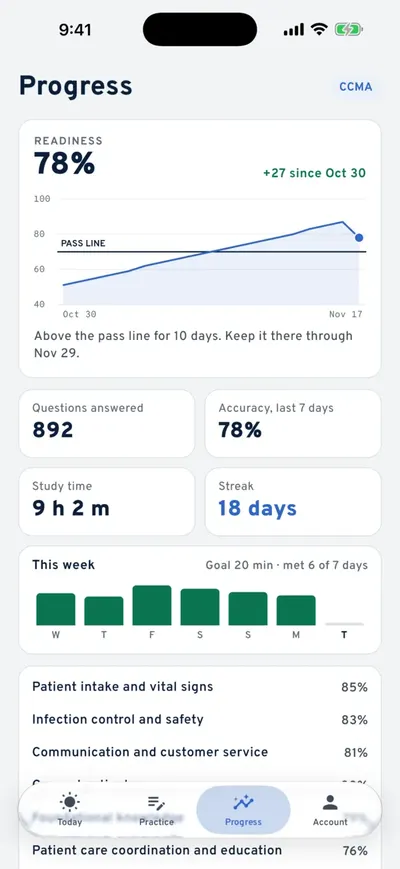 CCMA Exam Study Plan: 8 Weeks Built on the NHA Test PlanAn 8-week CCMA study plan weighted by NHA's test plan. Clinical Patient Care is 84 of 150 scored items, so here's how to split your hours, practice and review.