

After You Pass Part 107: IACRA, TSA, Registration, Remote ID
Short answer
After you pass, apply for the remote pilot certificate on FAA Form 8710-13 in IACRA using the 17 digit Knowledge Test Exam ID, which can take up to 48 hours to show up. Once the TSA security check clears, you print a temporary certificate. Before you fly for work, register each drone for $5 (good for 3 years), make sure it meets Remote ID, and plan on free recurrent training every 24 calendar months.
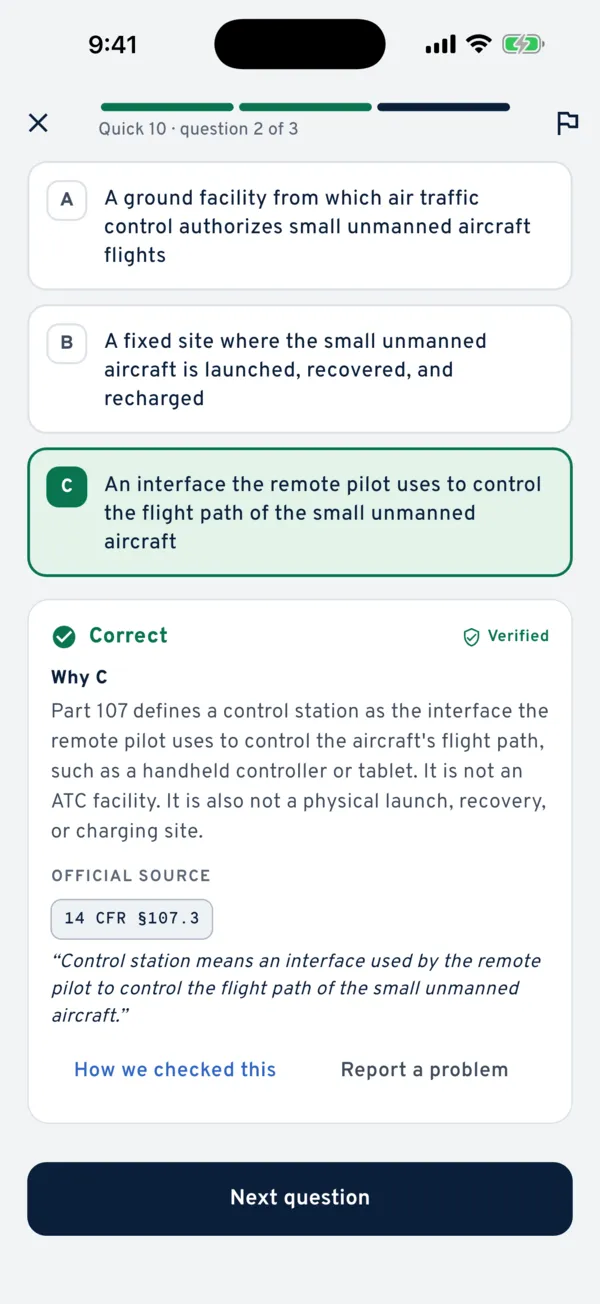
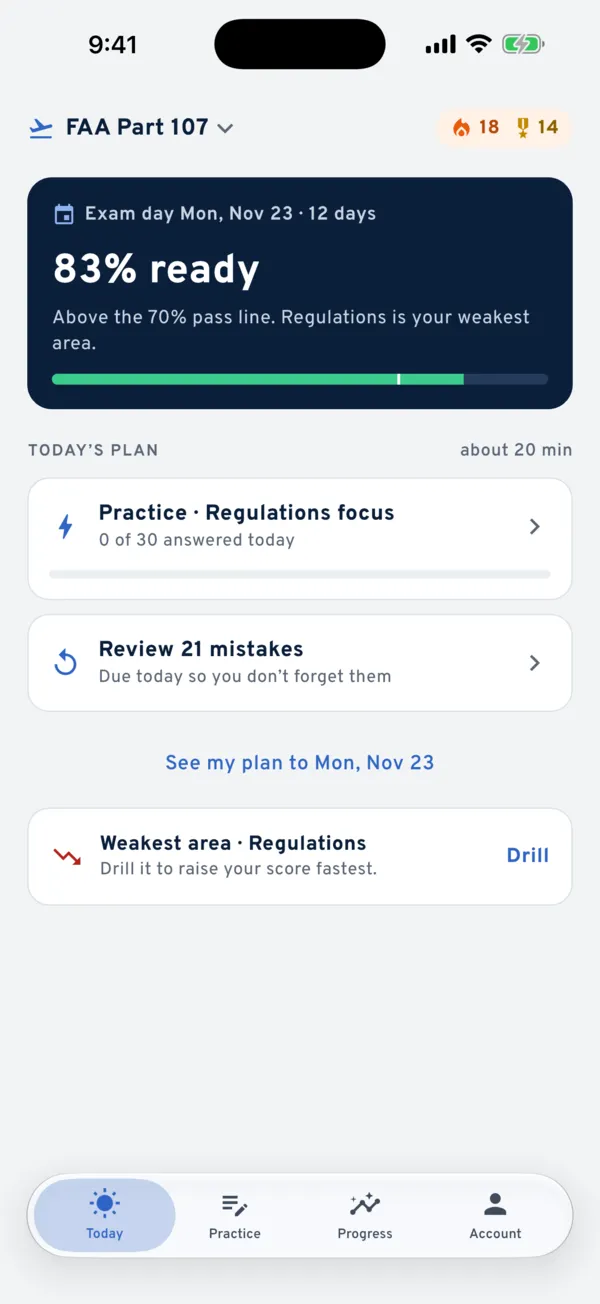
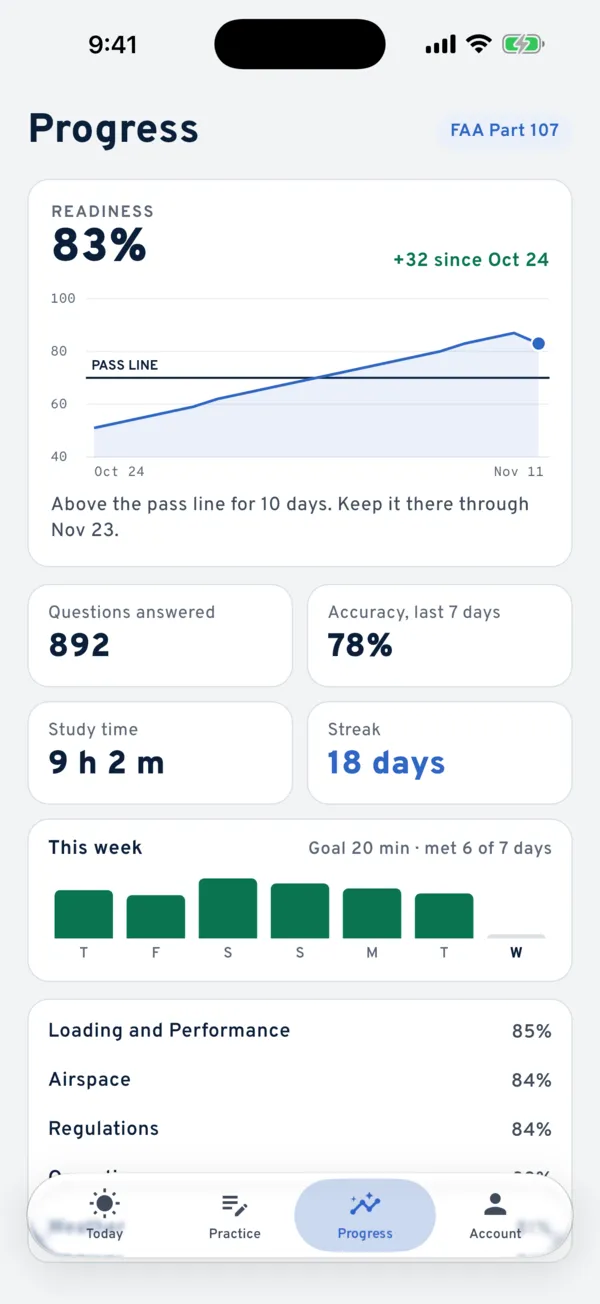
Passing the test is step three of seven. You still apply for the certificate in IACRA, clear a TSA security check, and then get your drone legal with registration and Remote ID. None of it costs more than a few dollars, but each step has a detail that trips people up.
Apply for your certificate in IACRA
You apply on FAA Form 8710-13 in the Integrated Airman Certification and Rating Application, the same IACRA account that gave you your FAA Tracking Number before the test.1
- Wait for your result to loadIt can take up to 48 hours from your test date for the knowledge test to appear in IACRA.
- Start a new applicationLog in, choose Start New Application, then Application Type "Pilot," Certifications "Remote Pilot," fill in Other Path Information, and start the application.
- Enter your exam IDWhen prompted, enter the 17 digit Knowledge Test Exam ID from your test report.
- Sign and submitSign electronically and submit for processing.
- Wait for the TSA emailThe FAA emails you once the TSA security check is complete, with instructions to print your temporary certificate from IACRA.
- Get the permanent cardThe permanent certificate comes by mail after the FAA finishes its internal processing.
All six steps are from the FAA’s Become a Drone Pilot page.1 Every applicant, whatever their nationality, has to pass the TSA Security Threat Assessment before the FAA issues either the temporary or the permanent certificate.6
The 17 digit exam ID is printed on the Airman Knowledge Test Report you got at the testing center. Don’t confuse it with your FTN. If you lost the report, you can reprint it from your PSI account.
The temporary certificate
A temporary remote pilot certificate is issued for up to 120 calendar days. It ends on the date shown on it, when your permanent certificate arrives, or if the FAA denies or revokes the certificate.2 You can fly for work with it.
Whenever you exercise the certificate, Part 107 requires you to have the certificate and your ID in your physical possession and readily accessible.2 You have to show both if asked by the FAA, the NTSB, the TSA, or any federal, state or local law enforcement officer.2
Register every drone you’ll fly
Under Part 107, every drone must be registered, no matter how light. The 250 gram exception applies only to recreational flying.3 You register on FAADroneZone, using the Part 107 dashboard.
- Cost and term. Part 107 registration costs $5 per drone and lasts three years.3
- One drone, one number. Part 107 pilots register each drone or Remote ID broadcast module separately, and each gets its own registration number.4
- Marking. Label each drone with its registration number before you fly it.3
- Proof. Carry the registration certificate, on paper or digitally, whenever you fly. Anyone else flying your drone must carry it too.3
- No switching. A drone registered under the recreational exception can’t be flown under Part 107, and registrations don’t transfer between the two.3
You’ll need your physical address, mailing address, email, phone number, the drone’s make and model, its Remote ID serial number if it has one, and a credit or debit card.3
Make sure the drone meets Remote ID
Since September 16, 2023, Part 89 bars flying a drone in U.S. airspace unless it meets the Remote ID rule or the FAA has authorized otherwise.5 Every drone that has to be registered must comply, and that includes every Part 107 drone.4 There are three ways to do it.4
| Option | How it works | Catch |
|---|---|---|
| Standard Remote ID drone | Built in broadcast of the drone’s ID and location and the control station’s location | Must be listed on an FAA-accepted Declaration of Compliance5 |
| Remote ID broadcast module | An add-on that broadcasts the drone’s ID and location plus its takeoff location | You must be able to see the drone at all times4 |
| FAA-Recognized Identification Area (FRIA) | A defined site where drones without Remote ID can fly | You must stay inside the FRIA and within visual line of sight4 |
When you register a Standard Remote ID drone or a module on the Part 107 dashboard, answer “Yes” to the Remote ID question and enter the Remote ID serial number.4 If you’re not sure your drone qualifies, check the FAA’s Declaration of Compliance system before you register.4
That landing rule is §89.110(a)(2).5
Keep your certificate current
Your certificate has no expiration date, but you can’t act as remote pilot in command unless you’ve passed the knowledge test or completed recurrent training within the previous 24 calendar months.2 The FAA’s Part 107 Small UAS Recurrent course, ALC-677, is free and online.1 Part 107 pilots who also hold a Part 61 pilot certificate with a current flight review can take ALC-515 instead.1
The 24 calendar months run to the end of the month. If you passed the test in March 2026, plan to finish recurrent training before the end of March 2028. Course completion certificates come from the FAA Safety Team site, so keep a copy.7
Other rules that start the day you’re certified
- Change of address. If your permanent mailing address changes, you can’t use your certificate after 30 days unless you’ve told the FAA, by letter or through the FAA website.2
- Safety event reports. Within 10 calendar days, report any operation that causes serious injury, loss of consciousness, or more than $500 of damage to property other than the drone.2
- Night flying. It’s allowed without a waiver if your drone has anti-collision lighting visible for at least 3 statute miles.2 If you passed your test after April 6, 2021, you meet the knowledge part of the night rule already.2
- Operations over people. Allowed under the four categories in Subpart D. Category 2 and 3 drones must be listed on an FAA-accepted Declaration of Compliance and labeled.2
Your first month as a remote pilot
- Submit Form 8710-13 in IACRA within a few days of the test
- Print the temporary certificate once the TSA email arrives
- Register each drone on the Part 107 dashboard of FAADroneZone and label it
- Confirm Remote ID for each drone, or plan to fly only inside a FRIA
- Install an FAA-approved LAANC app before your first job near an airport
- Put your 24 month recurrent deadline on the calendar
If you’re still preparing for the test, the Part 107 test guide covers the format and fees, and Part 107 airspace and LAANC explains how to get authorization for jobs near airports.
Questions people ask
How long does it take to get a Part 107 certificate after passing?
Your test result can take up to 48 hours to appear in IACRA. After you submit the application, the TSA runs a security check, and when it clears the FAA emails you instructions to print a temporary certificate. The permanent card follows by mail once the FAA finishes its internal processing.
Can I fly commercially with the temporary certificate?
Yes. The temporary remote pilot certificate carries the same privileges and is issued for up to 120 calendar days, or until your permanent certificate arrives. Keep it with you when you fly along with your ID.
Does the Part 107 certificate expire?
The certificate itself doesn't expire. To use it, though, you must have passed the knowledge test or completed recurrent training within the previous 24 calendar months. The FAA's online recurrent course, ALC-677, is free.
Sources
- Become a Certificated Remote PilotFederal Aviation Administration
- 14 CFR Part 107, Small Unmanned Aircraft SystemseCFR, National Archives
- How to Register Your DroneFederal Aviation Administration
- Remote Identification of DronesFederal Aviation Administration
- 14 CFR Part 89, Remote Identification of Unmanned AircrafteCFR, National Archives
- Aeronautical Information Manual, Chapter 11, Section 5, UAS Pilot Testing, Certification and ResponsibilitiesFederal Aviation Administration
- Part 107 Small UAS Recurrent (ALC-677)FAA Safety Team
ClinchedFAA Part 107
Pass FAA Part 107 on the first try.
Practice questions written from the official sources, full practice tests in the real format and a plan that ends on your test date. Free to start.
Keep reading
- Exam guide · FAA Part 107
 Part 107 vs TRUST: Which Drone Certificate Do You Need?TRUST is a free online test for flying purely for fun. Part 107 is a proctored $175 FAA test for everything else. How to tell which one applies to your flight.
- Exam guide · FAA Part 107
 Part 107 Test Changes for 2025 and 2026: What's DifferentSince Sept 29, 2025 the Part 107 test weights regulations at 48% and adds 5 unscored questions. Since Oct 26, 2026 it shows current sectional chart images.
- Topic explainer · FAA Part 107
 Part 107 Airspace Classes and LAANC Authorization ExplainedWhich airspace classes need FAA authorization under Part 107, how LAANC and UAS Facility Maps work, and the airspace traps that show up on the Part 107 test.
- Topic explainer · FAA Part 107
 How to Read a Sectional Chart for the Part 107 TestRead a sectional chart the way the Part 107 test asks: airspace lines, MSL vs AGL, airport data blocks, CTAF, obstacles and the new current chart images.