AviationFederal Aviation Administration
The FAA private pilot written test, explained
The FAA Private Pilot Airplane knowledge test (PAR), often called the private pilot written, is the computer test you must pass before your private pilot checkride. It has 60 scored multiple choice questions plus 5 unscored ones, you get 120 minutes, and you need 70% to pass. You take it at a PSI testing center for about $175 with an instructor endorsement, and a passing result is good for 24 calendar months.
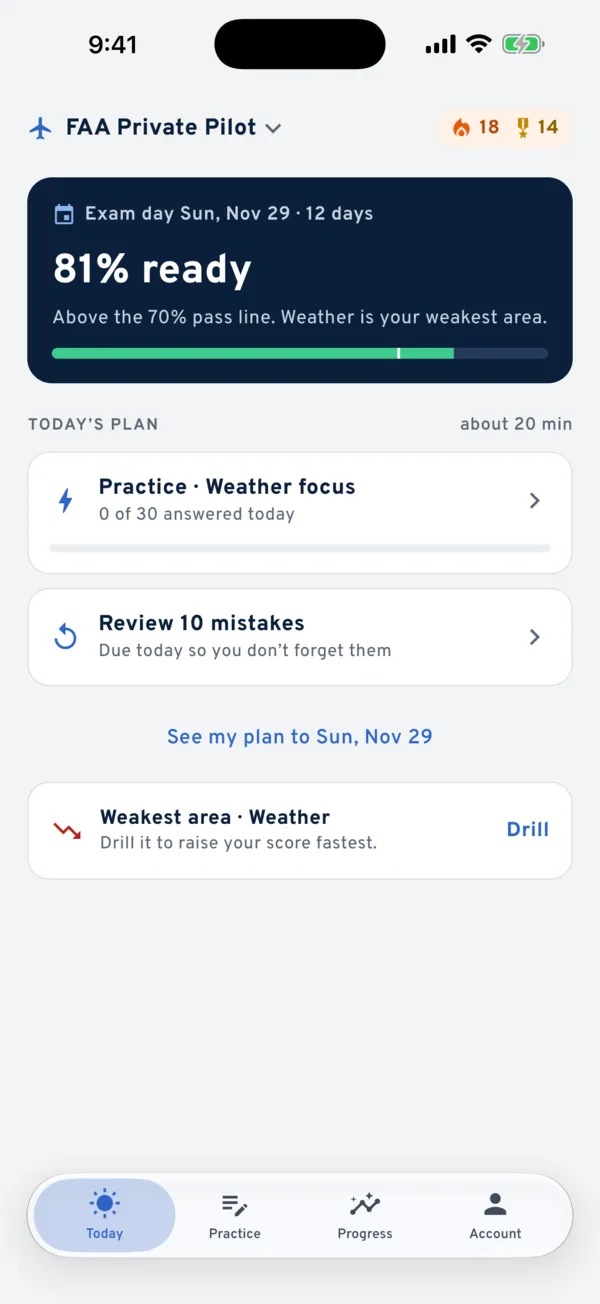
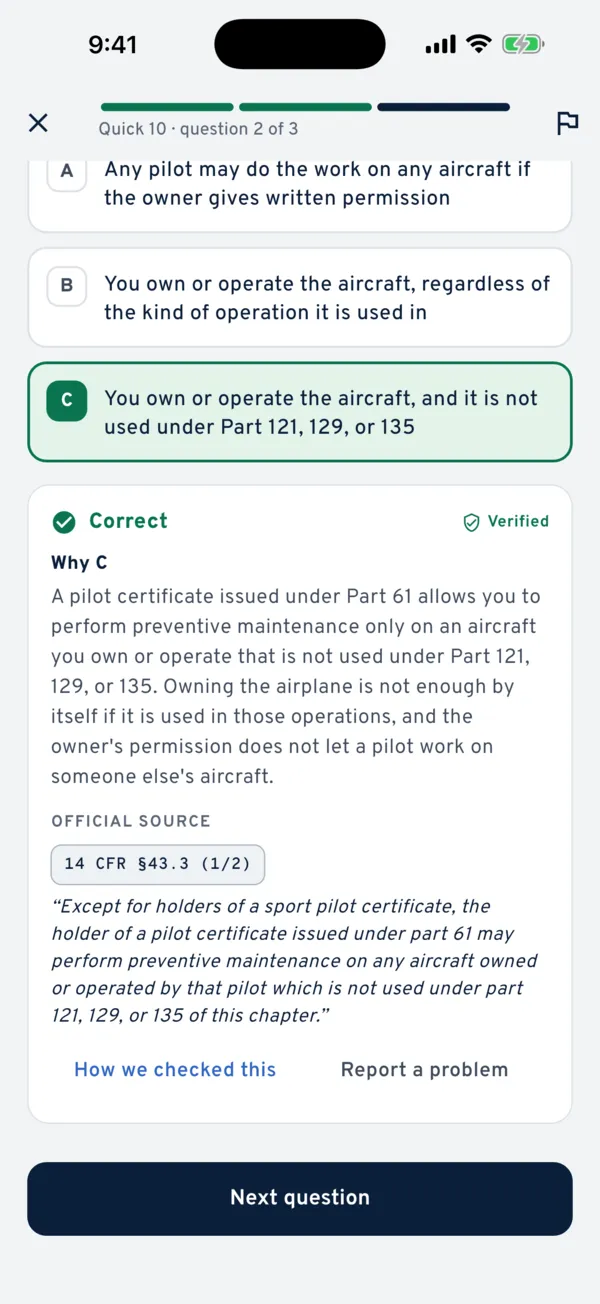
FAA Private Pilot at a glance
- Official test name
- Private Pilot Airplane (PAR)1
- Questions
- 60 scored + 5 unscored validation questions1
- Time
- 120 minutes1
- Passing score
- 70%1
- Minimum age to test
- 152
- Authorization
- Instructor endorsement or pilot school graduation certificate2
- Test fee
- About $175, paid to PSI5
- Result valid for
- 24 calendar months before the practical test3
- Retest after a fail
- No waiting period, but you need additional training and a new instructor endorsement3
What’s on the PAR test
The Private Pilot Airplane test, code PAR, draws its questions from the Private Pilot Airplane Airman Certification Standards (ACS), the same document your examiner uses on the checkride.1 4 PSI’s applicant bulletin publishes the share of questions from each area of operation, based on an industry job task analysis completed in 2020.1
- Preflight preparation22%
- Preflight procedures13%
- Airport and seaplane base operations7%
- Takeoffs, landings and go-arounds20%
- Performance and ground reference3%
- Navigation8%
- Slow flight and stalls8%
- Basic instrument maneuvers7%
- Emergency operations7%
- Night operations3%
- Postflight procedures2%
The area names come from the flight test, which can make the list misleading. “Takeoffs, landings and go-arounds” at 20% isn’t about stick and rudder.1 On a written test it means crosswind and headwind components, takeoff and landing distance charts, density altitude, wind shear and wake turbulence. “Preflight preparation” at 22% is the biggest bucket, and it’s where most of the classic ground school lives.1 That area covers pilot qualifications, airworthiness, weather information, cross-country planning, the National Airspace System, performance and limitations, aircraft systems and human factors.4 The multiengine area of the ACS isn’t part of the PAR test.1
Here’s how the ground school topics you’ll study map onto those areas.
| ACS area (share of test) | ACS tasks behind it |
|---|---|
| Preflight preparation (22%) | Pilot qualifications, airworthiness, weather information, cross-country planning, the National Airspace System, performance and limitations, systems, human factors4 |
| Preflight procedures (13%) | Preflight assessment, flight deck management, engine starting, taxiing, before takeoff check4 |
| Airport and seaplane base operations (7%) | Communications, light signals, runway lighting, traffic patterns4 |
| Takeoffs, landings and go-arounds (20%) | Normal, soft-field and short-field takeoffs and landings, forward slips, go-arounds4 |
| Navigation (8%) | Pilotage and dead reckoning, navigation systems and radar services, diversion, lost procedures4 |
| Slow flight and stalls (8%) | Slow flight, power-off and power-on stalls, spin awareness4 |
| Emergency operations (7%) | Emergency descent, emergency approach and landing, system malfunctions, survival gear4 |
The percentages come from the PSI bulletin.1
What the questions feel like
Expect a lot of figure work. The testing supplement FAA-CT-8080-2H has the sectional chart excerpts, weight and balance tables, performance charts, the density altitude chart, METARs, TAFs and Chart Supplement excerpts that many questions point to.10 You’ll compute a crosswind component, a takeoff distance over a 50 foot obstacle, a center of gravity, or a time and fuel burn between two checkpoints. Regulation questions lean on 14 CFR Parts 61 and 91, such as currency, medical durations, required documents, fuel reserves and VFR weather minimums.3
Where people lose points
The FAA’s frequently missed list for the year ending June 30, 2025 included PAR code PA.IX.A.K3, airspeed and airspeed limitations during an emergency descent, missed 73.33% of the time.7 4 It’s a small topic with a specific answer in the airplane’s limitations, which is why it catches people who studied in general terms. Across the whole test, 89.56% of the 44,657 PAR tests in 2025 were passes, and the average score was 81.64%.6
How the test works
The test shows 65 questions. Sixty are scored and 5 are unscored validation questions the FAA uses to try out new items before they count.1 You won’t know which are which. The 120 minute limit already includes them, and you need 70% on the scored questions, which is 42 of 60.1 Each question is multiple choice with one best answer.1
Some FAA documents, including the knowledge test table printed in the ACS, still show 2.5 hours for this test.4 The current testing matrix and the PSI bulletin both say 2.0 hours, or 120 minutes, so plan for that.2 1
The center gives you the printed testing supplement, scratch paper and a pen. The software has a built-in four function calculator.1 You may bring your own plotter, flight computer (E6B), scales, protractor, basic electronic calculator and a plain handheld magnifying glass.1 Calculators with memory are cleared in front of the proctor before and after the test.1
The FAA is moving its tests toward images embedded right in the question, and Private Pilot is one of the tests that already uses them. The printed supplement stays at test centers until the FAA announces a removal date with notice.9
Need an accommodation? Choose “yes” on the accommodations screen when you schedule, and PSI will follow up and may ask for documentation.1
Eligibility, cost and scheduling
You can take the PAR test at 15.2 You can’t hold the private pilot certificate until 17, but you only need to meet that age by the time the test report would expire.3
Unlike the drone test, PAR requires authorization. Bring one of these.2
- A logbook endorsement or written statement from an authorized ground or flight instructor certifying that you completed a ground training or home study course and are prepared for the test
- A certificate of graduation from an FAA certificated pilot school
You also need an FAA Tracking Number (FTN) from an IACRA profile before you book, and an ID with your photo, date of birth, signature and residential address.2 You book at PSI’s FAA site, faa.psiexams.com, and PSI prices FAA knowledge tests at $175 plus applicable tax.5 You can cancel or reschedule if PSI hears from you at least 24 hours before the appointment.1
PSI moves FAA testing to a new scheduling and check-in platform in the first quarter of 2027, and it will contact applicants whose existing appointments are affected.9
A six week study plan
A good time to take the written is partway through flight training, after solo and before the long cross-countries. That way the ground knowledge supports what you’re doing in the airplane, and the 24 month clock still leaves plenty of room.3 The plan below assumes about an hour a day, five days a week, alongside flying.
- Week 1Regulations. 14 CFR Part 61 for private pilot privileges, limits, currency and medicals, and Part 91 for VFR weather minimums, fuel, documents and equipment. Start a flash card deck for every number.
- Week 2Airspace and charts. Learn the sectional legend in the testing supplement, airspace dimensions and entry requirements, special use airspace, and the Chart Supplement entries.
- Week 3Weather. METARs, TAFs, winds aloft, fronts, stability, thunderstorms, icing, fog, and how to get a briefing.
- Week 4Performance and weight and balance. Density altitude, takeoff and landing distance charts, crosswind components, center of gravity problems. Do every figure in the supplement until the method is automatic.
- Week 5Navigation and aircraft systems. Pilotage, dead reckoning, wind triangles, VOR and GPS basics, plus engines, electrical, instruments and aerodynamics including stalls and load factor.
- Week 6Human factors, emergency procedures and full timed practice tests. Review every miss against the regulation or handbook paragraph behind it. Get your instructor's endorsement and book.
The Pilot’s Handbook of Aeronautical Knowledge is the main reference for most of this. A new edition, FAA-H-8083-25D, is scheduled for December 2026, so check which edition your course uses.9 Clinched has a Private Pilot course with practice questions that quote their FAA source. For a day by day version, see the private pilot written test study plan.
Test day
Plan to arrive early for check-in and ID verification. PSI recommends at least 15 minutes.1
- Government photo ID with date of birth, signature and residential address
- Instructor endorsement or pilot school graduation certificate
- Your FAA Tracking Number
- Your E6B and plotter, if you use them
- Failed test report and new endorsement, if this is a retest
Phones, watches, bags, notes and food stay outside, and you can’t wear hats, hoods, coats or shirts with pockets into the room, other than religious apparel.1 When you finish, the center prints one copy of your Airman Knowledge Test Report (AKTR).1 It lists the ACS codes for every question you missed, whether you passed or not.2
After you pass, or if you don’t
Your passing result is valid for 24 calendar months. You have to complete the private pilot practical test within that window, or take the written again.3 8 Before the checkride, your instructor has to review the areas you missed and endorse that you’ve shown satisfactory knowledge of them.3 The examiner will look at your test report too, so keep the original.
The rest of the path is in Part 61. To get the certificate in a single-engine airplane, you log at least 40 hours of flight time, including 20 hours of instruction and 10 hours of solo, with specific cross-country, night and instrument training.3 Then you pass the practical test with an examiner. The full sequence, from student pilot certificate to checkride, is in private pilot certificate steps and costs.
If you fail, there’s no mandatory waiting period. Under §61.49, you need additional training from an authorized instructor and an endorsement saying you’re proficient to pass.3 Bring the failed AKTR and the endorsement to the retest. The instructor can sign the Authorized Instructor’s Statement on the failed report itself.2 You’ll pay the fee again.
Working the figures in the supplement
A big share of PAR questions send you to a figure, and those questions reward method more than memory. The supplement FAA-CT-8080-2H is shared by the sport, recreational, private and remote pilot tests, so it holds far more figures than any one test uses.10 It opens with the sectional chart legend and a set of Chart Supplement legends, then runs through numbered figures that include a load factor chart, a density altitude chart, METAR and TAF examples and a series of sectional chart excerpts.10
A few habits save real time.
- Read the question before the figure. Know whether you need a distance, a time, a heading or a weight before you start reading the chart, so you pull out only what you need.
- Write every intermediate number down. Performance and weight and balance problems take three or four steps. A number written on scratch paper doesn’t get lost when you flip back to the question.
- Watch the units. Knots versus statute miles, MSL versus AGL, true versus magnetic course, and gallons versus pounds are where most figure mistakes come from.
- Interpolate honestly. Performance charts rarely give you the exact temperature and altitude in the question. Answer choices are often far enough apart that a careful estimate picks the right one, but a sloppy one doesn’t.
- Practice on the actual supplement. Your practice should use the same figures, at the same size, that you’ll have at your seat.
Since more FAA test questions now show the image inside the question itself, practice reading charts on a screen as well as on paper.9
Questions people ask
How many questions are on the private pilot written test?
The Private Pilot Airplane (PAR) test shows 65 questions. Sixty are scored and 5 are unscored validation questions the FAA is evaluating, and they aren't marked. You need 70% on the scored questions, which is 42 of 60, and you have 120 minutes.
Do I need an endorsement to take the private pilot written?
Yes. You need a logbook endorsement or written statement from an authorized ground or flight instructor saying you completed a ground training or home study course and are prepared for the test. A graduation certificate from an FAA certificated pilot school also works.
How long is the private pilot written test valid?
A passing result is good for 24 calendar months. You have to complete the private pilot practical test within that window, or you take the knowledge test again. Time the written so the checkride comfortably fits inside that window.
What happens if I fail the private pilot written?
There's no waiting period, but under 14 CFR 61.49 you need additional training from an authorized instructor and a new endorsement saying you're proficient to pass. Bring the failed test report to the retest. The instructor can sign the statement on the report itself.
Is the private pilot written hard?
In 2025, 89.56% of the 44,657 PAR tests taken were passes, with an average score of 81.64%. It's very passable with steady prep, but it covers a lot of ground, from regulations and weather to performance charts and navigation.
Sources
- Private Pilot Airplane (PAR) Applicant Information BulletinPSI Services
- FAA Airman Knowledge Testing Matrix, revised September 25, 2026Federal Aviation Administration
- 14 CFR Part 61, Certification: Pilots, Flight Instructors, and Ground InstructorseCFR, National Archives
- Private Pilot for Airplane Category Airman Certification Standards (FAA-S-ACS-6C)Federal Aviation Administration
- FAA Testing Programs (voucher pricing)PSI Services
- 2025 Airman Knowledge Tests (annual statistics)Federal Aviation Administration
- Frequently Missed Knowledge Test ACS Codes, 2nd Quarter CY25Federal Aviation Administration
- Recreational Pilot and Private Pilot Knowledge TestsFederal Aviation Administration
- Airman Testing Community Advisory, October 2026 EditionFederal Aviation Administration
- Airman Knowledge Testing Supplement for Sport Pilot, Recreational Pilot, Remote Pilot, and Private Pilot (FAA-CT-8080-2H)Federal Aviation Administration
More on FAA Private Pilot
- Exam guide · FAA Private Pilot
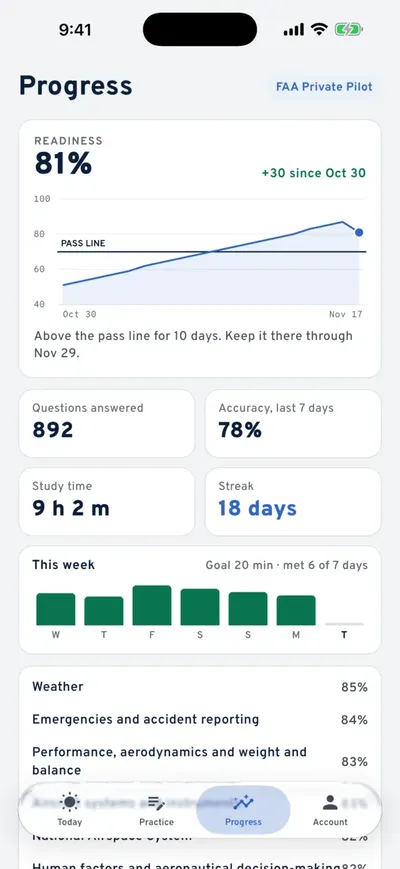 Private Pilot Certificate: Steps, Hours and What It CostsSteps to a private pilot certificate: medical, student certificate, 40 hour minimum (FAA average 75), the $175 written and the checkride, plus what you pay for.
- Study plan · FAA Private Pilot
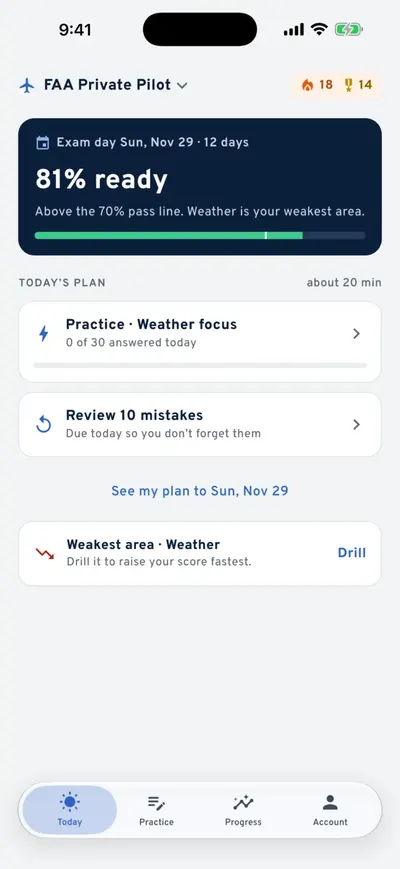 A 30 Day Study Plan for the Private Pilot Written TestA 30 day plan for the FAA private pilot written (PAR), with 60 scored questions, 120 minutes and a 70% pass mark. What to study, which FAA books, when to book.