HealthcarePharmacy Technician Certification Board
The PTCB pharmacy technician exam, explained
The PTCE is the Pharmacy Technician Certification Board exam you pass to earn the CPhT credential. It has 90 multiple choice questions (80 scored, 10 unscored) and 1 hour 50 minutes of testing time, and you need a scaled score of 1,400 on a 1,000 to 1,600 scale. The application and exam fee is $129 per attempt. Medications make up 35% of the January 2026 outline, so drug names, classes and pharmacy math decide most results.
PTCE at a glance
- Questions
- 90 multiple choice (80 scored, 10 unscored)1
- Time
- 1 hour 50 minutes of exam time inside a 2 hour appointment1
- Passing score
- 1,400 scaled (range 1,000 to 1,600)1
- Fee
- $129 application and exam fee, paid for each attempt1
- Content outline
- 4 domains, current version effective January 6, 20262
- Where you test
- In person at Pearson VUE test centers1
- Eligibility
- PTCB-Recognized Education/Training Program or 500 hours of technician work experience1
- Retakes
- No wait for attempts 2 and 3, a 6 month wait before attempt 44
- Renewal
- Every 2 years with 20 hours of continuing education6
- Medications35%
- Federal Requirements18.75%
- Patient Safety and Quality Assurance23.75%
- Order Entry and Processing22.5%
What the 2026 PTCE covers
PTCB rewrote the content outline for exams taken on or after January 6, 2026. It still has four knowledge domains, and every scored question maps to one of them.2 Here they are in PTCB’s order, with a rough count of how many of the 80 scored questions each domain represents. The counts are plain math on the published percentages, so read them as close estimates.
| Domain | Share of the exam | About this many scored questions |
|---|---|---|
| 1. Medications | 35% | 28 |
| 2. Federal Requirements | 18.75% | 15 |
| 3. Patient Safety and Quality Assurance | 23.75% | 19 |
| 4. Order Entry and Processing | 22.5% | 18 |
Medications
This is the largest domain by a wide margin. It covers generic and brand names, drug classes, indications, therapeutic duplication, interactions and contraindications, side effects and allergies, dosage forms and routes, drug stability, and storage requirements such as temperature ranges and light sensitivity.2
The part that trips people up is that PTCB never publishes a drug list. The outline just says “generic names, brand names, and classifications of medications” and leaves the rest to you.2 Most candidates work from a top 200 list built from national prescription data. That’s a reasonable approach as long as you learn drugs by class and use, not as 200 random flashcards. We cover how to do that in how to study the top 200 drugs for the PTCE.
Federal Requirements
This domain grew in the 2026 update.3 Expect questions on DEA controlled substance schedules, the federal rules for new, refill and transfer prescriptions of controlled drugs, and the life cycle of controlled substance stock from ordering and receiving through loss, theft, take-back and destruction.2 Schedule II ordering runs on DEA Form 222 or its electronic equivalent, and the details live in 21 CFR Part 1305.10 The domain also covers restricted programs like pseudoephedrine sales limits and Risk Evaluation and Mitigation Strategies (REMS), FDA recalls, hazardous waste disposal including P-listed drugs, and a new statement on the Drug Supply Chain Security Act (DSCSA), which governs product serialization, tracing and quarantine.2
Know federal law here, not your state’s law. When a state rule is stricter, the exam still wants the federal answer.
Patient Safety and Quality Assurance
You’ll see high-alert and look-alike/sound-alike (LASA) drugs, error prevention like Tall Man lettering and the rules on leading and trailing zeros, error types, event reporting through MedWatch and the Vaccine Adverse Event Reporting System (VAERS), and infection control down to cleaning counting trays.2
One statement in this domain lists issues that need pharmacist intervention, including drug utilization review alerts, OTC recommendations, therapeutic substitution and adherence problems.2 Questions built on it usually test whether you know where the technician’s job stops. If the situation calls for clinical judgment, the right answer is almost always to refer it to the pharmacist.
Order Entry and Processing
This domain holds Sig codes, abbreviations, medical terminology, days supply and quantity math, concentrations and dilutions, administration supplies like spacers and oral syringes, lot numbers, expiration dates, National Drug Code (NDC) numbers, and returns through credit return or reverse distribution.2
Don’t assume the math sits only here. PTCB marks 9 of the 24 outline statements as including calculation-based knowledge, and they’re spread across all four domains, from drug stability to controlled substance prescriptions.2 A days supply problem can show up dressed as a federal law question.
How the PTCE works
The exam has 90 multiple choice questions. Eighty count toward your score and 10 are unscored items that PTCB is trying out. They’re placed at random and not marked, so treat every question as if it counts.1
Your appointment runs about 2 hours. That’s a 5 minute tutorial, 1 hour 50 minutes for the exam itself, and a 5 minute survey at the end.1 With 90 questions in 110 minutes, you have a little over a minute per question. Straight recall questions go faster than that, and the time you save there pays for the multi-step calculations.
Scoring is scaled. You pass at 1,400 on a range of 1,000 to 1,600.1 PTCB uses scaled scores because it runs different exam forms that vary slightly in difficulty, and scaling keeps a pass on one form equal to a pass on another.5 PTCB doesn’t publish a raw cut score, so ignore any site that tells you exactly how many you can miss.
A calculator is built into the exam software. You can’t bring your own. If you ask and the test center has a hand-held calculator available, you’re allowed to use that one.5 Practice with an on-screen calculator before test day so the interface doesn’t slow you down.
If you have a disability, PTCB provides accommodations consistent with the Americans with Disabilities Act (ADA) at no cost. You have to request them while you’re applying, not after you’ve scheduled.1
Eligibility, cost and booking
You must live in the United States or its territories and qualify through one of two pathways.1
- Education pathway. Finish a PTCB-Recognized Education/Training Program, or be within 60 days of finishing one when you apply. A pharmacy degree also counts.1
- Work experience pathway. Complete at least 500 hours of work as a pharmacy technician before you submit the application.1
Either way, you have to fully disclose any criminal history and any action taken against a state board of pharmacy registration or license.1
The application and exam fee is $129.1 Once PTCB approves you, you get an email authorizing you to schedule, and that authorization lasts 90 days. You can extend it by 90 days through your PTCB Account for a nonrefundable $20, up to two extensions. If the window closes before you test, you forfeit the fee.5
- Create a PTCB AccountUse your legal name exactly as it appears on the ID you'll bring to the test center.
- Apply and pay $129Pick your eligibility pathway and answer the disclosure questions honestly.
- Wait for your authorization emailYour 90 day window to schedule and test starts here.
- Book a Pearson VUE seatSchedule from your PTCB Account or call Pearson VUE at (866) 902-0593, weekdays 7 AM to 7 PM Central.
- Lock in the dateRescheduling and canceling are free up to 24 hours before your appointment. A no-show forfeits all fees.
Those booking rules come from PTCB’s candidate guidebook.5 Not every Pearson VUE center offers PTCB exams, so search for your exam in the scheduler rather than assuming your nearest center has it.5
An 8 week PTCE study plan
Eight weeks at about an hour a day is a realistic pace if you’re already in a training program or working in a pharmacy. If you have no pharmacy background at all, stretch the drug weeks and plan on twelve.
- Week 1Read the official PTCE content outline line by line. Take a timed diagnostic and sort your misses by domain. Start 20 drugs a day, grouped by class.
- Week 2Pharmacy math foundations. Conversions, ratios and proportions, Sig codes, days supply and quantity to dispense. Do 20 problems a day by hand, then on an on-screen calculator.
- Week 3Medications by body system. Cardiovascular and diabetes drugs first because they dominate prescription volume. Add indications and the one or two side effects each class is known for.
- Week 4Federal Requirements. Controlled substance schedules, refill and transfer rules, DEA Form 222, loss and theft reporting, pseudoephedrine limits, REMS, recalls and DSCSA.
- Week 5Patient safety. High-alert drugs, LASA pairs and Tall Man lettering, error-prone abbreviations, MedWatch and VAERS, and when to hand a problem to the pharmacist.
- Week 6Concentration and dilution math, reconstitution, NDC structure, lot numbers and expiration dates. Finish the remaining drug classes.
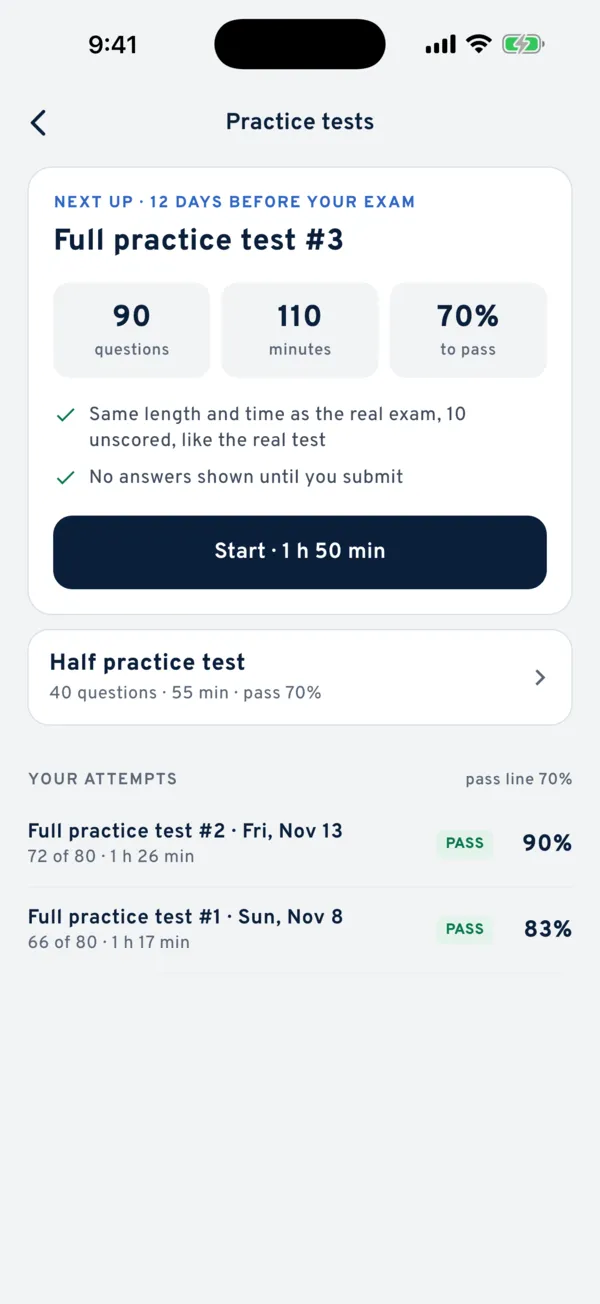
- Week 7Two full timed practice tests of 90 questions in 110 minutes. Review every miss and every lucky guess.
- Week 8Drill your two weakest domains. One more timed test early in the week, then light review. No new material in the last two days.
Clinched has a PTCE course with questions tied to the official outline and full practice tests in the 90-question format.
Test day at the Pearson VUE center
Get there 30 minutes before your appointment.1 Pearson VUE checks your ID against the name in your PTCB Account, and the rules are strict.
- A valid, unexpired, government-issued original photo ID with a signature (passport, driver's license, state ID card, military ID, green card or Employment Authorization Card)
- A second signed ID such as a credit, debit or employee ID if your photo ID has no signature
- Your appointment confirmation email, checked for the right date, time and center
- Nothing you plan to use during the exam, since personal calculators aren't allowed
PTCB’s guidebook lists the accepted IDs and says a photocopy or digital ID won’t be accepted.5 A few name differences are allowed, such as a missing hyphen or initials in place of a first name, but a maiden name on one document and a married name on the other isn’t, unless you bring original legal proof of the change.5
That rule is in the PTCB guidebook, along with the 10 business day deadline.5
Before the exam starts you’ll accept the PTCB candidate agreement, which bars you from copying or sharing exam content.5 After the last question and the survey, an unofficial result appears on screen. The official result is posted to your PTCB Account within three weeks.1
After you pass, or if you don’t
Turning the CPhT into a job
Passing makes you a Certified Pharmacy Technician, but the certification isn’t a license to work. PTCB’s own candidate agreement says so.5 Your state board of pharmacy decides who can work as a technician, and what it asks for varies a lot.
Texas recognizes only two national certifications, PTCB’s and the National Healthcareer Association’s ExCPT. If you aren’t certified yet, Texas offers a one-time trainee registration that lasts up to two years and can’t be renewed, and you upgrade to full technician registration after you pass.8 California lists PTCB certification as one of several qualifying methods on its technician license application, alongside ExCPT and approved training.9 Other states range from no certification requirement to a full registration process, so check your own board before you choose an exam. If you’re weighing the two national exams, read PTCE vs ExCPT.
Keeping it
The CPhT renews every two years. Each cycle you need at least 20 hours of continuing education, with at least 1 hour in pharmacy law and 1 hour in patient safety, all finished by your expiration date.6 Credits earned before you were certified don’t count, and PTCB grants no individual extensions.6 The recertification application fee is $55, and a $25 late processing fee applies after the application deadline.7
If you don’t pass
Wait for the official score report, then reapply and pay the $129 again.4 There’s no waiting period for your second or third attempt. Before a fourth attempt you must wait 6 months, and after four attempts PTCB wants evidence of new preparation before it approves another one, such as a formal review course, an accredited training program or six months of tutoring by a pharmacist or CPhT.4 PTCB says plainly that people who fail should expect to fail again without more preparation, so use the score report to find the domain that sank you and rebuild there first.4
What changed in January 2026, and why old prep books mislead
The 2026 outline came out of a job analysis study, and PTCB’s Certification Council approved it in August 2024.3 The four domains and the test length stayed the same. What moved was the content inside them.3
- Nonsterile compounding is gone. PTCB removed knowledge areas 1.9 and 4.1 from the old outline.3
- Alligation is gone. The term was removed from the old statement 4.2.3
- Narrow therapeutic index (NTI) drugs lost their own statement. NTI facts can still appear inside other questions.3
- DSCSA is new. Product serialization, tracing and quarantine now have a statement of their own.2
- The weights shifted. Medications and Patient Safety lost share, while Federal Requirements and Order Entry gained.3
This matters because a lot of used books and older question banks still teach alligation and nonsterile compounding math. That time is better spent on controlled substance rules, recalls and DSCSA. If a practice test is heavy on compounding, check its date. If it was written for the old outline, it’s training you for a test that no longer exists.
Questions people ask
How many questions are on the PTCB exam?
The PTCE has 90 multiple choice questions. Eighty are scored and 10 are unscored pretest items mixed in at random, and nothing on screen tells you which ones they are. You get 1 hour 50 minutes to answer them.
What is the passing score for the PTCE?
You need a scaled score of 1,400. PTCE scores run from 1,000 to 1,600, and PTCB reports scaled scores so results stay comparable across exam forms that differ slightly in difficulty. PTCB doesn't publish a fixed number of questions you must get right.
How much does the PTCE cost?
The application and exam fee is $129. You pay it again for every attempt. If you need more time to schedule, a 90 day extension of your exam authorization costs $20 and isn't refundable.
Can I take the PTCE online at home?
PTCB describes the PTCE as a computer-based exam given in person at Pearson VUE test centers under a live proctor. Plan on booking a test center seat. PTCB says there are more than 1,400 Pearson test centers in the country, including sites on military bases.
How soon can I retake the PTCE if I fail?
You can reapply as soon as your official score report is posted. There's no waiting period for your second or third attempt, but you must wait 6 months before a fourth. After four attempts PTCB wants proof of new preparation, such as a review course, before it approves another try.
Sources
- Certified Pharmacy Technician (CPhT)Pharmacy Technician Certification Board
- PTCE Content Outline, Effective January 6, 2026Pharmacy Technician Certification Board
- PTCE Job Analysis StudyPharmacy Technician Certification Board
- Guidebook, After the Exam (Retake Policy)Pharmacy Technician Certification Board
- PTCB Candidate Guidebook (full text)Pharmacy Technician Certification Board
- Guidebook, Recertification PolicyPharmacy Technician Certification Board
- Renewal RequirementsPharmacy Technician Certification Board
- Technician Application OptionsTexas State Board of Pharmacy
- Pharmacy Technician Application Packet (Form 17A-5)California State Board of Pharmacy
- 21 CFR Part 1305, Orders for Schedule I and II Controlled SubstancesElectronic Code of Federal Regulations
More on PTCE
- Topic explainer · PTCE
 Top 200 Drugs for the PTCE: How to Study Them by ClassPTCB publishes no drug list, but medications are 35% of the PTCE. Learn the top 200 drugs by stem and class with a 6 week plan, LASA pairs and schedules.
- Exam guide · PTCEPTCE vs ExCPT: Which Pharmacy Technician Exam Should You Take?PTCE or ExCPT? Compare questions, time, eligibility, content and testing options for the two national pharmacy technician exams, plus how states treat them.