Securities and insuranceState insurance departments
The property and casualty exam, explained
The property and casualty (P&C) exam is the state test you pass to get a producer license to sell home, auto and business insurance. Each state runs its own. Texas gives 130 scored questions in 150 minutes for $49, Florida's 2-20 General Lines exam runs 3 hours for $44, Georgia's combined exam runs 2.5 hours for $67, and most states pass you at 70. Pre-licensing education ranges from none in Texas to 90 hours in New York and 200 hours in Florida.
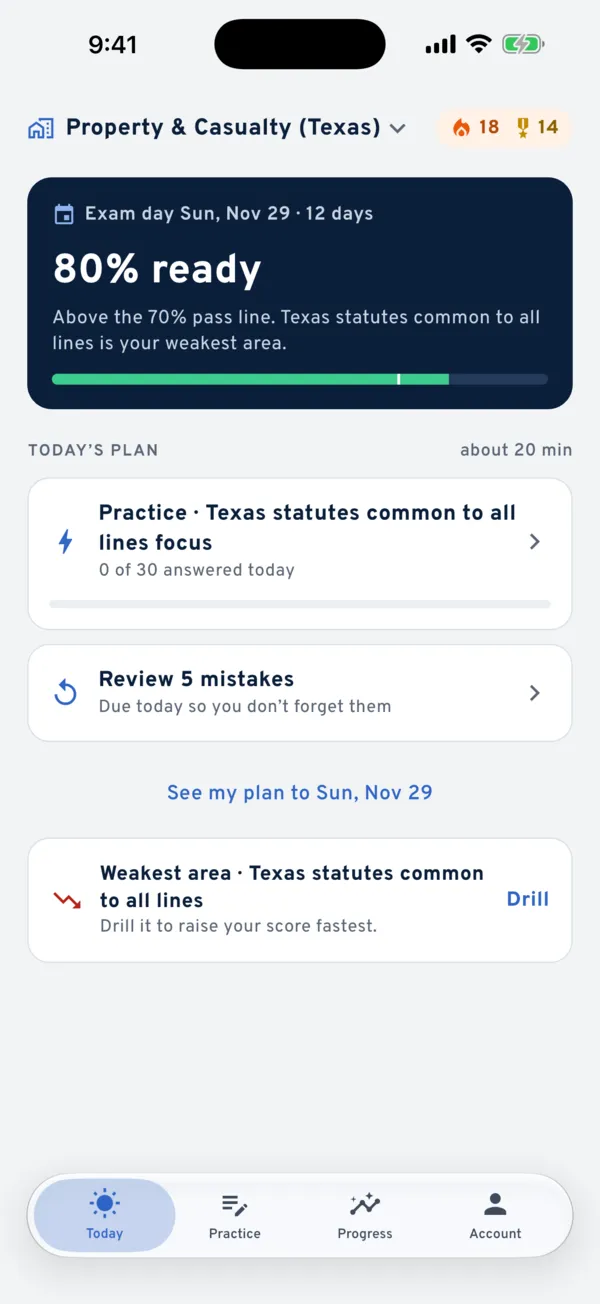
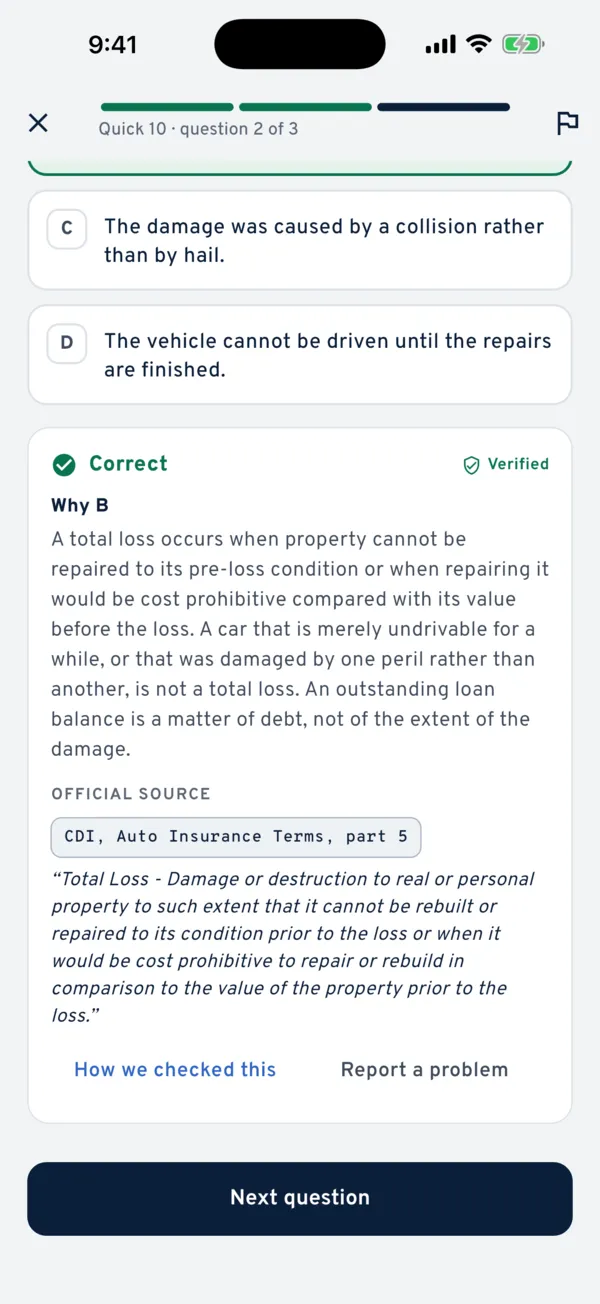
Property and Casualty Insurance at a glance
- Who licenses you
- Your home state's insurance department, under laws based on the NAIC Producer Licensing Model Act1
- Texas (Pearson VUE)
- 130 scored + 15 pretest questions, 150 minutes, $49, scaled score of 70 to pass3
- Florida 2-20 General Lines (Pearson VUE)
- 3 hours, $44, 70% to pass, up to 5 attempts in 12 months4
- Florida pre-licensing
- 200 hours of coursework, or a year of qualifying insurance work, within 4 years before applying5
- New York pre-licensing
- 90 hours for property and casualty, 40 hours for personal lines8
- California pre-licensing
- 12-hour ethics and Insurance Code course only. The 20-hour course was repealed January 1, 20266
- Georgia (Pearson VUE)
- Combined exam 2.5 hours, $67, 70% to pass, 8-hour course for each line9
- Illinois
- 20 hours per line, then separate General and State exams passed within 90 days10
What the property and casualty exam covers
The NAIC Producer Licensing Model Act, which most state licensing laws follow, defines property as coverage for direct or consequential loss of or damage to property, and casualty as coverage against legal liability for injury, death or damage to property.1 It also lists personal lines, P&C coverage sold to individuals and families for noncommercial purposes, as its own line.1 Most states let you test for property and casualty together, and that combined license is what most agents get.
Like the life and health exam, the P&C exam has a general section and a state law section. Texas is a good example of the typical split.3
| Texas P&C exam section | Scored questions |
|---|---|
| Property policy types (homeowners, dwelling, commercial, inland marine, flood) | 22 |
| Property insurance terms and concepts | 15 |
| Property policy provisions and contract law | 13 |
| Casualty policy types, bonds and related terms | 23 |
| Casualty insurance terms and concepts | 15 |
| Casualty policy provisions | 12 |
| Texas law common to property and casualty | 18 |
| Texas law specific to property and casualty lines | 12 |
That’s 100 general and 30 state questions, under the Texas outline effective September 1, 2026.3
Where people lose points
Homeowners forms. You need to know what each HO form covers and on what basis. The difference between named perils and open perils coverage, which forms are for renters and condo owners, and how the dwelling (DP) forms differ from homeowners policies all show up. The Texas outline lists the homeowners and dwelling forms by number.3
Loss valuation and coinsurance. Actual cash value, replacement cost, market value and stated value are all on the outline.3 Coinsurance penalty questions are the most common calculation on the exam. Learn the formula (insurance carried divided by insurance required, times the loss, minus the deductible) and practice it until it’s mechanical.
The personal auto policy. Liability, medical payments, physical damage, uninsured and underinsured motorists, who is an insured, and the exclusions.3 Most questions are scenarios. A friend borrows your car, a teenager drives a rental, a deer hits the windshield. You pick which coverage pays.
Commercial lines. Commercial general liability, business auto, workers compensation and employers liability, crime, bonds, professional liability, umbrella and the businessowners policy are all listed for Texas.3 Commercial lines are where people who only studied personal lines fall apart. Know occurrence versus claims-made triggers, and what the CGL’s coverage parts each pay for.
Contract law and policy provisions. Declarations, insuring agreement, conditions and exclusions, plus subrogation, appraisal, other insurance, mortgagee rights and the duties of the insured after a loss.3 These are shared by every policy, so they appear in both the property and casualty halves.
Insurance terms. Hazard versus peril, moral versus morale hazard, pure versus speculative risk, indemnity, insurable interest and the law of large numbers.3 These look easy, and that’s the trap. The answer choices are written so that two of them sound right unless you know the exact definition.
State law. In Texas this includes the Texas FAIR Plan, the Texas Windstorm Insurance Association, auto financial responsibility minimums and workers compensation rules.3 Every state has its own residual markets and auto minimums, and they’re tested.
How the exam works
P&C exams are computer-based multiple choice. Many include unscored pretest questions that aren’t labeled, and there’s no penalty for guessing.2 Texas gives 150 minutes for the general lines P&C exam, and Florida gives 3 hours for its 2-20 General Lines exam.24
Scoring depends on the state. Florida and Georgia count 70% correct as a pass.49 Texas converts your raw score to a scale from 0 to 100, and 70 passes.2 You get an official score report before you leave the test center.2
You’ll rarely need a calculator, but coinsurance and deductible questions go faster with one. Texas lets you bring a silent, nonprinting calculator without an alphabetic keypad, but not a financial calculator.2 Florida provides one if you ask and doesn’t allow your own.4
Eligibility, cost and scheduling by state
The national baseline is that you must be at least 18, finish any pre-licensing course your state requires and pass the exam for each line of authority you want.1 Here’s how six big states handle it. Rules change, so confirm with your own state insurance department before you pay.
| State | Test vendor | Pre-licensing education | Exam |
|---|---|---|---|
| Texas | Pearson VUE | None for the General Lines property and casualty license | 130 scored + 15 pretest, 150 minutes, $49 |
| Florida | Pearson VUE | 200 hours, or a year of qualifying insurance work, within 4 years before applying | 2-20 General Lines, 3 hours, $44 |
| California | PSI | 12-hour ethics and California Insurance Code course only, since January 1, 2026 | In person only from January 1, 2027 |
| New York | PSI | 90 hours for property and casualty, 40 for personal lines | Pass within 2 years of applying |
| Georgia | Pearson VUE | 8-hour course for each line taken within the last 12 months | Combined exam 2.5 hours, $67 |
| Illinois | Pearson VUE | 20 hours per line, 7.5 of them in a classroom | Separate General and State exams for each line |
Sources are the Texas handbook and outline,23 the Florida handbook and statute,45 the California notices,67 New York’s licensing page,8 the Georgia handbook9 and the Illinois Department of Insurance.10
Florida stands out. Its 200-hour route covers property, casualty, surety, health and marine insurance, and the statute also accepts a year of full-time insurance work instead, or a year as a licensed customer representative plus 40 hours of coursework.5 New York’s 90 hours is the other heavy requirement, though a CPCU can skip the course and take a shorter laws and regulations exam instead.8 California went the other way. AB 943 repealed its 20-hour pre-licensing course for P&C and other producer licenses on January 1, 2026, but the 12-hour ethics and Insurance Code course still applies before the license is issued.6
- Finish pre-licensingTake your state's approved course and keep the completion certificate. Illinois requires proof of completion at the test center.
- Book the examSchedule with your state's vendor and pay online. Payment isn't accepted at Pearson VUE test centers in Texas.
- Pass and get fingerprintedMost states require an FBI and state background check. California requires fingerprints after you pass and before you apply.
- Apply and get appointedApply online, usually through Sircon or NIPR, then have each insurer you'll represent appoint you.
The Illinois and California details come from the state regulators,610 and the Texas payment rule from its handbook.2
A five-week P&C study plan
P&C has more material than life and health, so give it an extra week. This plan assumes about an hour a day on weekdays and a longer weekend session. Our P&C exam study plan breaks it down day by day.
- Week 1Pre-licensing course plus the basics. Insurance terms, risk and hazard types, elements of a contract, and policy structure. Take a diagnostic test at the end of the week.
- Week 2Property. Homeowners and dwelling forms, loss valuation, coinsurance, inland marine, flood and commercial property. Do coinsurance problems every day.
- Week 3Casualty. The personal auto policy, CGL, workers compensation, umbrella, businessowners policies, crime and bonds.
- Week 4Policy provisions and state law. Conditions, duties after loss, subrogation, cancellation rules, and your state's residual markets, auto minimums and licensing rules.
- Week 5Two full timed practice exams, review every miss, then focus your last days on whichever half (property or casualty) scored lower.
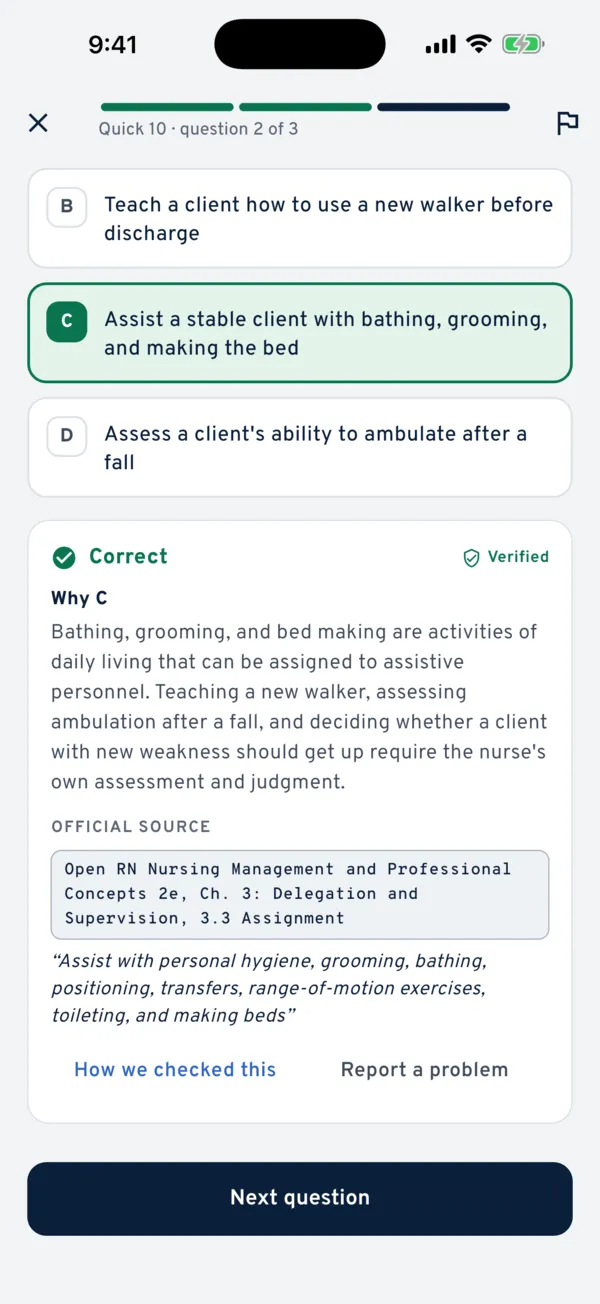
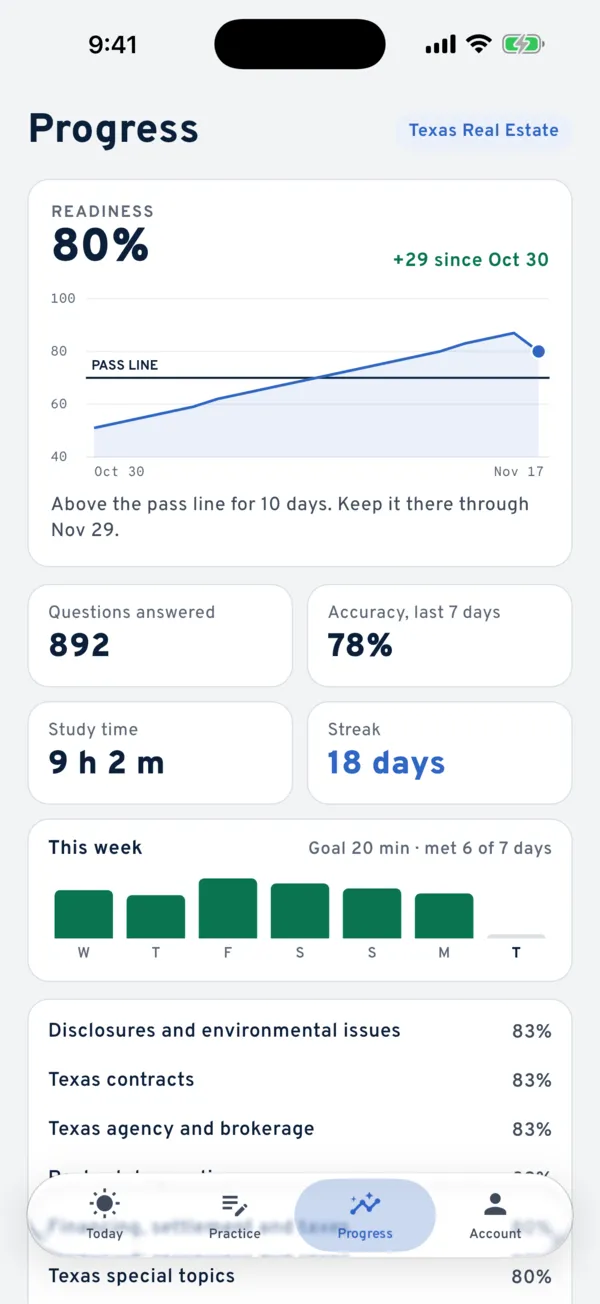
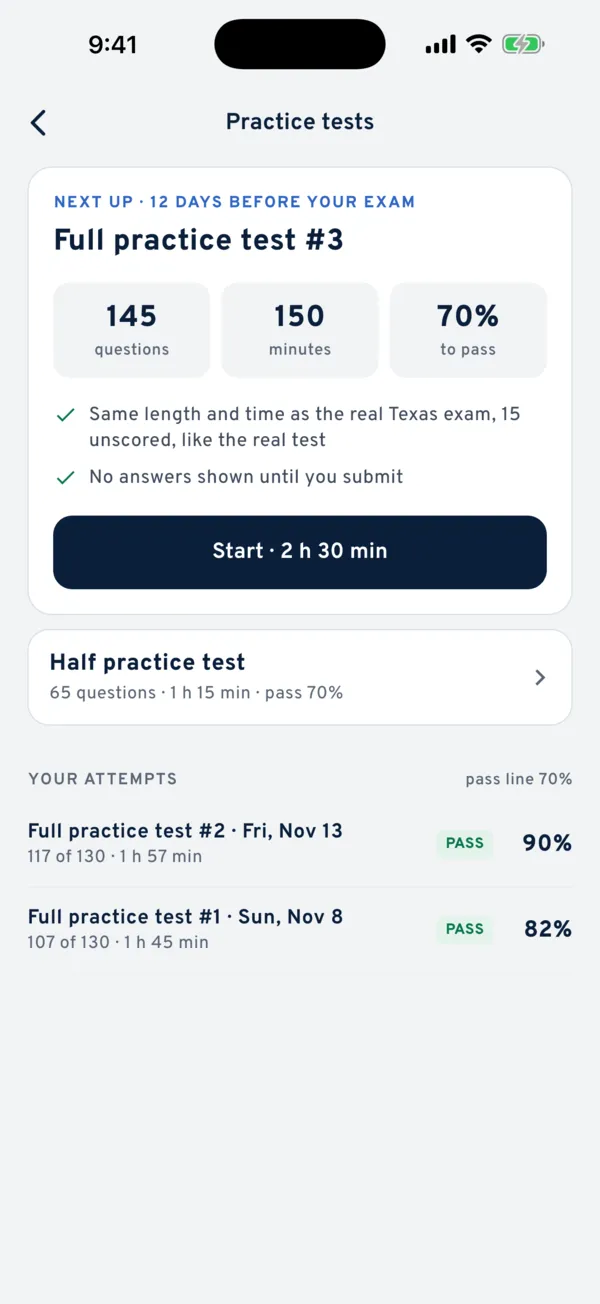
Clinched has a Texas property and casualty course with explanations that quote the policy language or statute behind each answer. For other states, tap “Notify me” in the app.
Test day
Bring the right ID. Texas and Georgia require two current signature IDs, a primary government photo ID and a secondary ID like a Social Security card or credit card.29 Florida requires one government photo ID with a signature.4 The name must match your booking exactly, and Pearson VUE doesn’t accept an ID that expired yesterday, even if your state gives a grace period for renewal.2
- Primary government photo ID with signature, unexpired, name matching your booking
- Secondary signature ID if your state requires two (Texas and Georgia do)
- Pre-licensing completion certificate if your state asks for it (Illinois does)
- Arrival 30 minutes early for check-in and photo
Phones, watches, wallets and notes go in a locker, and the exam clock keeps running during any break.2
After you pass, or if you don’t
Apply quickly. Texas and Florida void a passing score after one year if you haven’t completed your license application.24 New York requires that you passed within two years of applying.8 Georgia’s pre-licensing course only counts for one year, so you need to pass within a year of finishing it.9
Retake rules vary. Texas lets you rebook the next day with no limit on attempts.2 Florida allows five attempts at the same exam in any 12-month period.4 Georgia makes you wait 14 days after your first and second failures and 60 days after the third and later ones.9 Illinois requires both the General and State exams to be passed within 90 days of each other.10
That California change is from the department’s November 2, 2026 notice.7 Once licensed, expect continuing education each renewal. Texas requires 24 hours every two years for most licenses, including 3 hours of ethics.2
Personal lines versus the full P&C license
Several states offer a personal lines license that covers only auto and home insurance sold to individuals and families, matching the NAIC’s definition.1 It’s a shorter path. New York requires 40 hours for personal lines instead of 90.8 The tradeoff is that you can’t write commercial policies, and many agencies that hire for personal lines roles still prefer the full license so you can quote a small business owner’s general liability or BOP. If you’re unsure, take the full property and casualty license. If you’re also thinking about life insurance, our post on life and health vs property and casualty compares the two careers, and the life and health exam guide covers the second license.
Questions people ask
How many questions are on the property and casualty exam?
It depends on the state. Texas uses 100 scored general questions and 30 scored state questions, plus 15 unscored pretest questions, in 150 minutes. Other states use different counts, and your state's candidate handbook has the exact number.
How many hours of pre-licensing do you need for a P&C license?
It ranges widely. Texas requires none, Georgia requires an 8-hour course for each line, Illinois 20 hours per line, New York 90 hours and Florida 200 hours (or a year of qualifying work). California now requires only a 12-hour ethics and Insurance Code course.
What is the passing score for the P&C exam?
Most states pass you at 70. Florida and Georgia use 70% of questions correct, and Texas reports a scaled score where 70 passes. Check your state's handbook for how it scores.
Is the property and casualty exam harder than the life and health exam?
Many people find it harder because the policy forms are longer and more technical. In Texas, the department reported a 53% pass rate for the property and casualty exam in February 2021, compared with 60% for life, accident and health.
Can I take the P&C exam online?
It depends on your state. California stopped scheduling remote producer exams on November 6, 2026, and from January 1, 2027 all producer exams there are in person at a PSI center or the department's Los Angeles site.
Sources
- Producer Licensing Model Act (MDL-218)National Association of Insurance Commissioners
- Texas Insurance Licensing Candidate HandbookPearson VUE for the Texas Department of Insurance
- Texas Insurance Content Outlines, effective September 1, 2026Pearson VUE for the Texas Department of Insurance
- Florida Insurance Licensing Candidate HandbookPearson VUE for the Florida Department of Financial Services
- Florida Statutes, Section 626.732 (general lines agent qualifications)The Florida Senate
- Notice, New Law Repeals the 20-Hour Prelicensing Requirements for Insurance ProducersCalifornia Department of Insurance
- Notice, January 1, 2027 End Online Remote Proctored Producer and Bail Agent License ExaminationsCalifornia Department of Insurance
- Property and Casualty Agent or BrokerNew York State Department of Financial Services
- Georgia Insurance Licensing Candidate Handbook (October 2026)Pearson VUE for the Georgia Office of Insurance and Safety Fire Commissioner
- How to Become a Resident Producer / Illinois Insurance AgentIllinois Department of Insurance
More on Property and Casualty Insurance
- Study plan · Property and Casualty Insurance
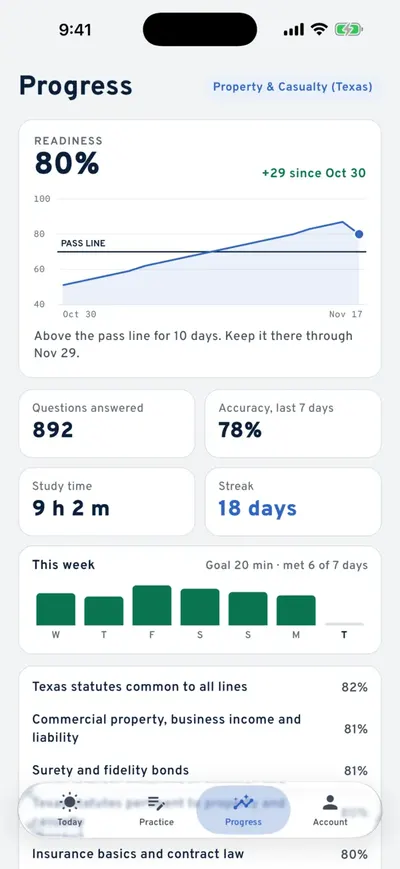 Property and Casualty Exam Study Plan: 5 Weeks to Test DayA 5-week P&C exam study plan built on a real state outline. What to study each week, how to drill coinsurance and auto scenarios, and when you're ready to book.
- After the exam · Life and Health Insurance · Property and Casualty Insurance
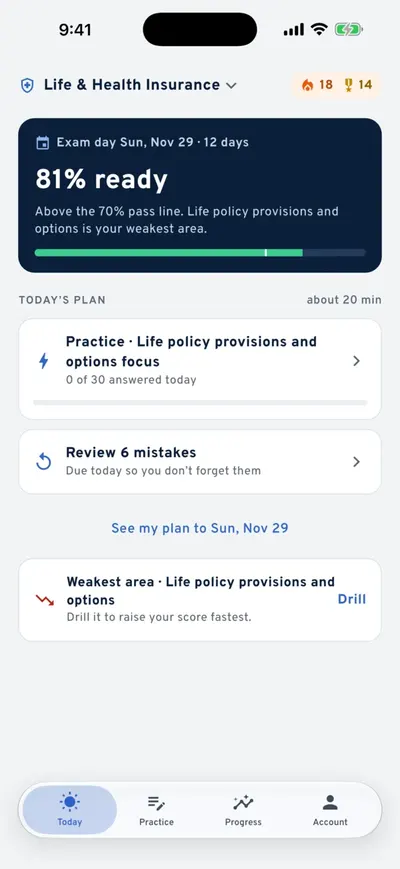 Life and Health vs Property and Casualty: Which License First?Life and health lets you sell life, annuities and health coverage. P&C covers home, auto and business. How the exams, education hours and jobs compare by state.