NCLEX-RN guideFree practice test
NCLEX-RN practice test
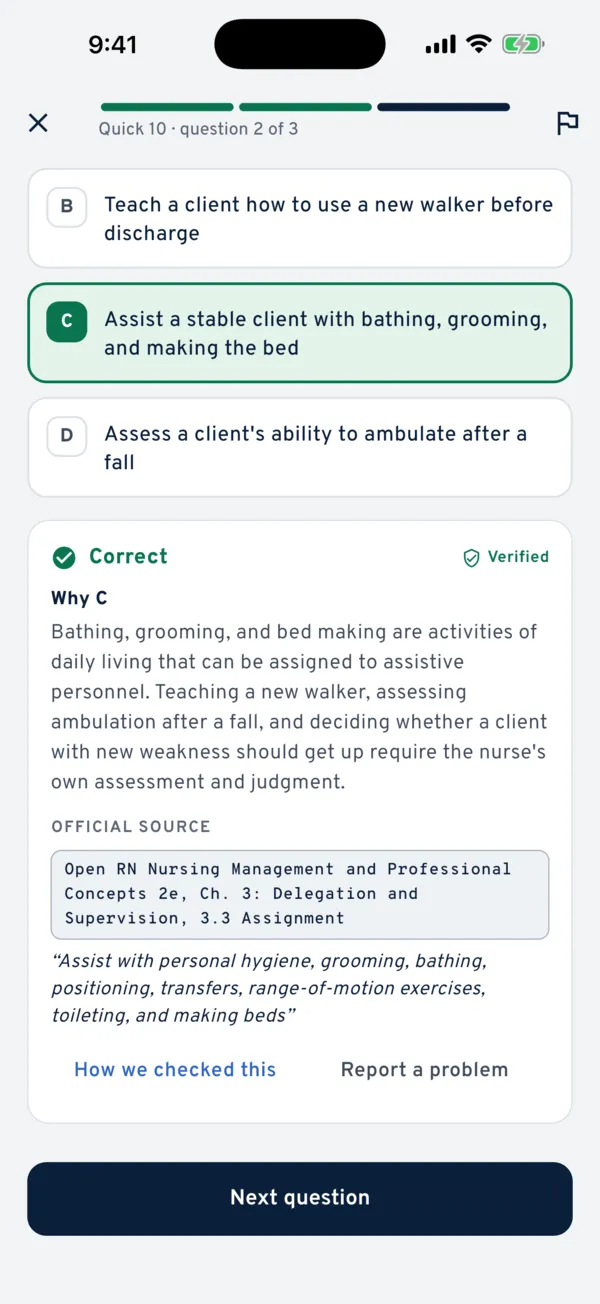
15 free NCLEX-RN questions from the 634 in Clinched, chosen to match how the real test is weighted. Pick an answer to see the explanation and the official text it comes from. Nothing to sign up for.
-
Question 1 of 15Basic Care and Comfort
A client is admitted with a small bowel obstruction. The nurse is reviewing the assessment findings from the last 24 hours. Which finding indicates that the obstruction is improving?
Correct answer B. Bowel sounds are heard in all four quadrants and the client passes flatus
The return of bowel sounds and the passage of flatus suggest that the bowel is moving again and the obstruction is improving. Absent bowel sounds with a firm abdomen, increasing drainage, and worsening distention are signs that the obstruction is continuing or worsening, not resolving.
Official source Open RN Health Alterations, Chapter 11 Gastrointestinal System Alterations, 11.13 Bowel ObstructionAssess the contour of the client’s abdomen and the presence of bowel sounds and flatus. The return of bowel sounds and flatus could indicate an improvement in the obstruction.
-
Question 2 of 15Health Promotion and Maintenance
The nurse is planning diet teaching for a client who has newly diagnosed type 2 diabetes and follows specific religious dietary practices. Which action should the nurse take first?
Correct answer B. Ask the client which cultural and religious food practices are part of daily meals.
A learner assessment comes before teaching, and it includes the client's cultural and religious beliefs that may affect how well the client follows a meal plan, so the nurse asks about them first. Handing out a standard meal plan or a list of foods to avoid skips that assessment, and having assistive personnel gather diet information does not replace the nurse's own assessment and teaching.
Official source Open RN Nursing Health Promotion, Ch. 3: Healthy Diets, 3.6 Spotlight ApplicationThe nurse also assesses Mr. Smith’s literacy level, preferred learning style, and any cultural or religious beliefs that may impact his learning and dietary adherence.
-
Question 3 of 15Health Promotion and Maintenance
The nurse is teaching the parents of a 2-month-old infant who was born prematurely and is now being seen in the clinic. The parents smoke cigarettes in the home. Which statement by a parent indicates understanding of the infant's risk for sudden infant death syndrome (SIDS)?
Correct answer C. Because our baby was born early and is around cigarette smoke, the risk for SIDS is higher.
SIDS can happen to any infant, but premature birth, low birth weight, exposure to secondhand smoke, and a recent upper respiratory infection all raise the risk, so the parent who links the early birth and the smoke exposure to a higher risk shows understanding. The other statements deny that prematurity still matters, deny that a recent cold affects risk, or postpone the danger of smoke exposure to a later age.
Official source Open RN Nursing Health Promotion, Ch. 20: High-risk Newborn Care, 20.2 Preterm BirthSIDS can happen to any infant, but premature infants and those with low-birth weight are at higher risk. Exposure to secondhand smoke and a recent upper respiratory infection also increase the risk for SIDS.
-
Question 4 of 15Management of Care
A client is scheduled for a cardiac catheterization in the morning. The nurse reviews the chart before the client is transported to the procedure area. Which action reflects the nurse's responsibility related to informed consent?
Correct answer C. Confirm that a valid, signed consent form is on the chart before the procedure.
For medical procedures the provider gives the information and obtains informed consent, while the nurse verifies that a valid, signed consent is present before the procedure is performed. Explaining risks, benefits, and alternatives and obtaining the signature is the provider's responsibility, not the nurse's. Re-signing the form does not make it valid, and confirming a legal document is a nursing responsibility that cannot be delegated to assistive personnel.
Official source Open RN Nursing Management and Professional Concepts 2e, Ch. 5: Legal Implications, 5.6 Other Legal IssuesWhile physicians have the responsibility to provide information and obtain informed consent related to medical procedures, nurses are typically required to verify the presence of a valid, signed informed consent before the procedure is performed.
-
Question 5 of 15Management of Care
A nurse reviewing a client's newly written orders finds one that is unclear about which of two medications should be given at bedtime. Which action should the nurse take?
Correct answer D. Contact the prescribing provider to clarify the order before giving either medication.
Provider orders are prescriptions the nurse must legally carry out, and when an order cannot be safely implemented as written, the nurse communicates it according to agency policy rather than acting on a guess. Choosing a medication, giving both, or holding both without telling anyone leaves an unclear order unresolved and risks the wrong drug or a missed dose.
Official source Open RN Nursing Management and Professional Concepts 2e, Ch. 7: Collaboration Within the Interprofessional Team, 7.5 Interprofessional CommunicationProvider orders: This section includes the prescriptions, or medical orders, that the nurse must legally implement or appropriately communicate according to agency policy if not implemented.
-
Question 6 of 15Physiological Adaptation
The nurse is teaching a client with gastroesophageal reflux disease about dietary changes that reduce symptoms. Which statement by the client indicates understanding of the teaching?
Correct answer D. "I will eat small, frequent meals instead of large meals."
Small, frequent meals are easier to digest and may reduce reflux symptoms, so replacing large meals with them is the change the nurse wants to hear. Large meals, lying down after eating, and eating close to bedtime all work against the goal of keeping stomach contents from refluxing.
Official source Open RN Health Alterations, Chapter 11 Gastrointestinal System Alterations, 11.9 Gastroesophageal Reflux DiseaseSmall, frequent meals are encouraged instead of large meals because they are easier to digest and may reduce GERD symptoms.
-
Question 7 of 15Physiological Adaptation
A client's cardiac monitor shows a regular rhythm with a rate of 72 beats per minute. The nurse recognizes that this rhythm is normally initiated by which structure?
Correct answer A. Sinoatrial node
The sinoatrial node is the heart's natural pacemaker and normally sends the signals that make the heart beat at 60 to 100 beats per minute, so a regular rate of 72 falls within the range it generates. The atrioventricular node is the backup pacemaker and paces the heart more slowly, and the bundle branches and Purkinje fibers are parts of the conduction pathway rather than the structure that sets the normal rate.
Official source Open RN Nursing Advanced Skills, Chapter 7 Interpret Basic ECG, 7.2 BASIC CONCEPTSThe SA node is often referred to as the heart’s natural pacemaker. The natural pacemaker rate for the SA node is 60-100 beats per minute.
-
Question 8 of 15Pharmacological and Parenteral Therapies
The nurse is preparing to administer a unit of packed red blood cells to a client with a hemoglobin of 6.8 g/dL. Which action should the nurse take before starting the transfusion?
Correct answer A. Verify that the client has signed the informed consent form in the medical record
Before any blood product is given, the nurse must verify that the client has signed informed consent and that it is documented in the medical record. A provider's order does not take the place of consent, and giving a premedication or starting the unit first does not satisfy the requirement, so the transfusion must wait until consent is confirmed.
Official source Open RN Nursing Advanced Skills, Chapter 3 Administer Blood Products, 3.2 BASIC CONCEPTSThe nurse must verify that the client has signed informed consent for the procedure in their medical record.
-
Question 9 of 15Pharmacological and Parenteral Therapies
A client starting a new oral medication asks the nurse why the provider said it may take several doses before the full effect is felt. Which response by the nurse is best?
Correct answer B. Some of the drug is broken down before it reaches the blood, so several doses may be needed for enough active drug.
After an oral dose, part of the drug is broken down before it reaches the general circulation, which is the first-pass effect, so several doses may be needed before enough free drug remains active to produce the desired effect. The first dose is not fully active on arrival, oral drugs are not all destroyed, and the liver does not store each dose for slow release.
Official source Open RN Nursing Pharmacology 2e, Chapter 1 Pharmacokinetics & Pharmacodynamics, 1.3 ABSORPTIONDue to the first-pass effect, prescribing providers and nurses administering medications must understand that several doses of an oral medication may be needed before enough free drug stays active in the circulation to exert the desired effect.
-
Question 10 of 15Psychosocial Integrity
A client is brought to the emergency department shortly after using PCP. Which finding should the nurse expect?
Correct answer A. Involuntary rapid up-and-down eye movements
PCP intoxication produces nystagmus, an involuntary eye movement that makes the eye rapidly move up and down or side to side, along with other signs such as hypertension, tachycardia, ataxia, and muscle rigidity. Pinpoint pupils with slow breathing, flaccid muscles with absent reflexes, and dilated pupils with sweating and tremors are not the expected findings of PCP intoxication.
Official source Open RN Nursing: Mental Health and Community Concepts 2e, Ch. 14: Substance Use Disorders, 14.2 Substances: Use, Intoxication, and OverdoseVertical or horizontal nystagmus (an involuntary eye movement that causes the eye to rapidly move up and down or from side to side)
-
Question 11 of 15Psychosocial Integrity
A client is admitted to the psychiatric unit with bipolar I disorder. The client's partner asks the nurse, "How can this be bipolar I when my partner has never been depressed?" Which response by the nurse is best?
Correct answer B. "Bipolar I disorder requires at least one manic episode, not a depressive one."
Bipolar I disorder is diagnosed when the client has had at least one manic episode; most people also have hypomanic and depressive episodes, but a depressive episode is not required. Waiting for depression to appear, expecting the diagnosis to change to bipolar II, or telling the partner that depression always occurs misstates how the disorder is identified.
Official source Open RN Nursing: Mental Health and Community Concepts 2e, Ch. 8: Bipolar DisordersThe most severe bipolar disorder with at least one manic episode; most individuals experience additional hypomanic and depressive episodes.
-
Question 12 of 15Reduction of Risk Potential
The nurse is teaching a client with peripheral arterial disease about habits that affect circulation. Which statement by the client indicates understanding of the teaching?
Correct answer B. "I will wear loose socks and avoid crossing my legs when I sit."
Constrictive clothing and crossing the legs are discouraged in peripheral arterial disease because they can further reduce blood flow. Crossing at the knee or ankle and wearing tight socks all keep pressure on the vessels.
Official source Open RN Health Alterations, Chapter 5 Cardiovascular Alterations, 5.9 Peripheral Arterial DiseaseConstrictive clothing and crossing the legs are discouraged.
-
Question 13 of 15Reduction of Risk Potential
The nurse is performing a venipuncture blood draw on a client's antecubital vein using a needle holder. Which technique should the nurse use to insert the needle?
Correct answer A. Bevel up, with the shaft parallel to the vein at a 30-degree angle to the arm
The needle holder is positioned with the bevel up and the shaft parallel to the path of the vein at a 30-degree angle to the arm. A steeper 45-degree entry, a shallower 15-degree entry, or turning the bevel down does not match the angle and bevel position used for venipuncture.
Official source Open RN Nursing Advanced Skills, Chapter 1 Initiate IV Therapy, 1.4 CHECKLIST: PERFORM VENIPUNCTURE BLOOD DRAWPosition the needle holder or syringe with the needle bevel up and the shaft parallel to the path of the vein at a 30-degree angle to the arm.
-
Question 14 of 15Safety and Infection Prevention and Control
The nurse is making room assignments on a medical unit. Which client should be placed in a private room with special air venting?
Correct answer C. A client with active tuberculosis who is coughing
Clients hospitalized with active tuberculosis are placed under airborne transmission precautions, which include a private room with special air venting, so this client needs that room. MRSA and C. difficile call for contact precautions rather than a room with special air venting, and a client receiving IV antibiotics for cellulitis does not need this type of room.
Official source Open RN Health Alterations, Chapter 6 Respiratory Alterations, 6.9 TuberculosisClients who are diagnosed with active TB and are hospitalized have airborne transmission precautions in place, including placement in private rooms with special air venting.
-
Question 15 of 15Safety and Infection Prevention and Control
The nurse finds soft wrist restraints in place on a confused client who was pulling at an endotracheal tube. There is no order for restraints in the client's record. Which action should the nurse take?
Correct answer B. Notify the primary health care provider as soon as possible.
When restraints are in place and the primary care provider did not order them, the provider should be notified as soon as possible so that the situation is addressed promptly. Waiting for rounds, having the charge nurse write the order, or simply removing the restraints from a client who is pulling at an endotracheal tube delays the needed notification and leaves the airway at risk.
Official source Open RN Nursing Fundamentals 2e, Part V: Safety, 5.7 RestraintsIf the primary care provider did not order the restraint, they should be notified as soon as possible.
Want the other 619?
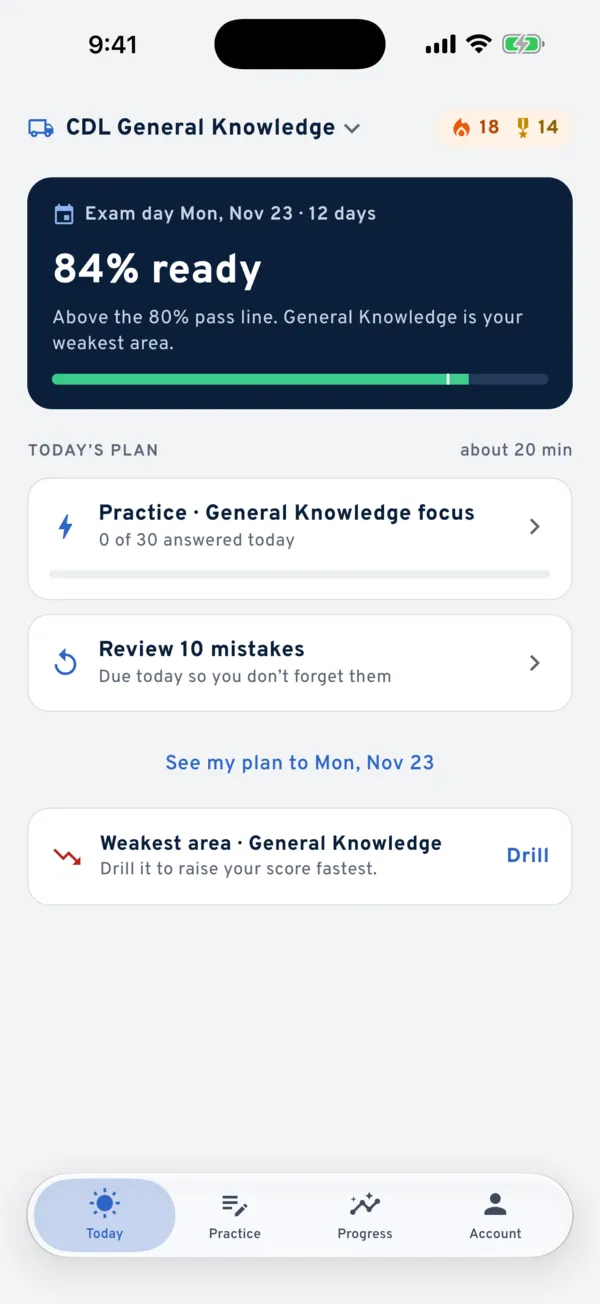
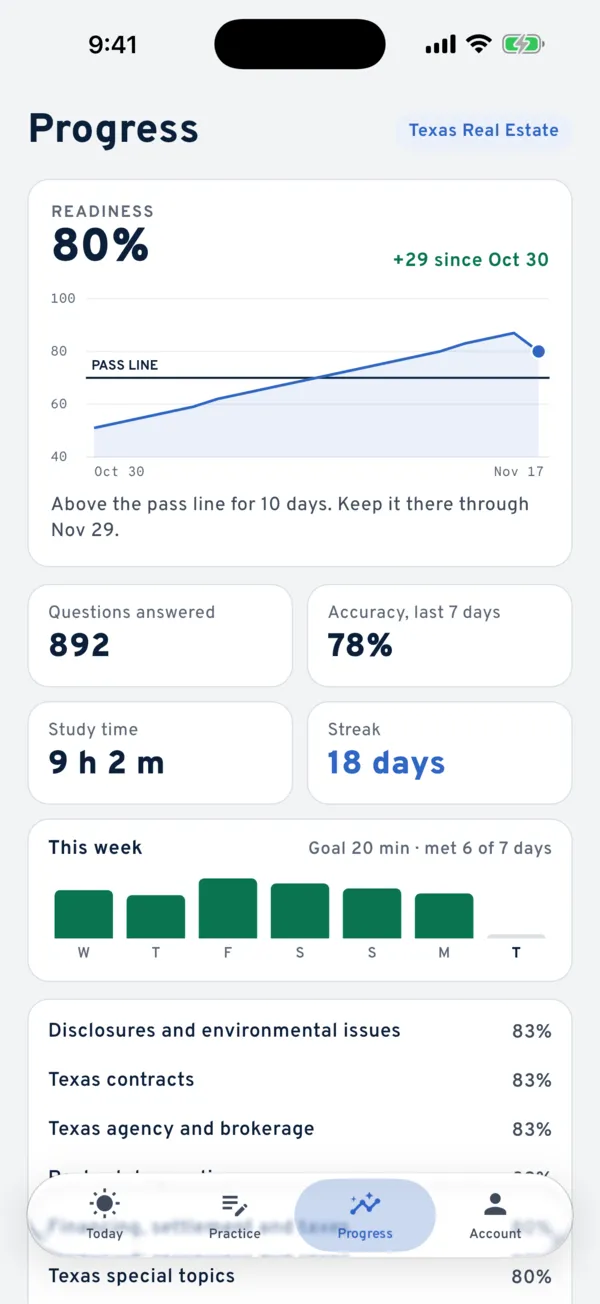
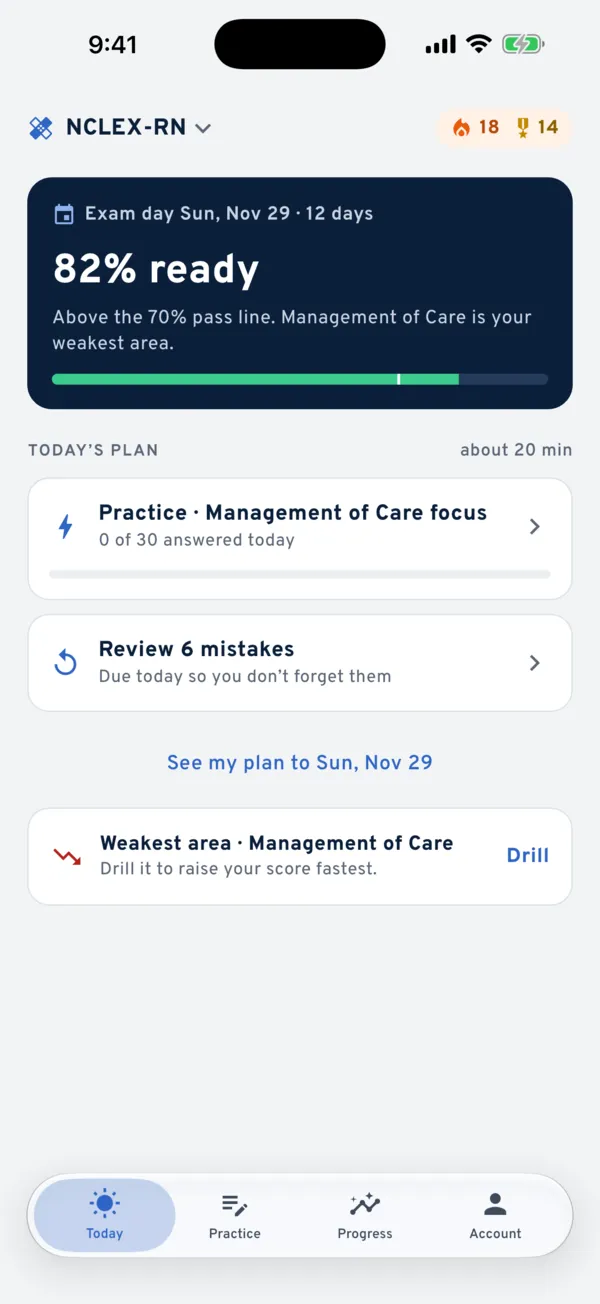
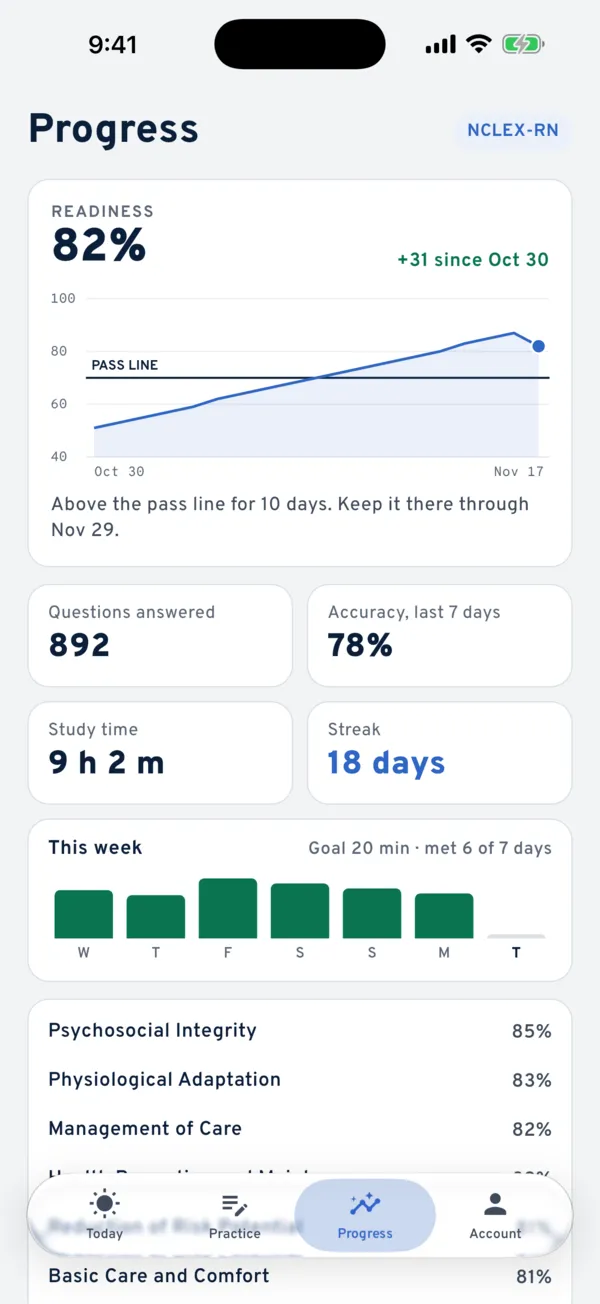
Clinched has every NCLEX-RN question in this format, with full practice tests that match the real one, a readiness score by area and a plan to your test date. Free to start with 10 questions a day.
Read the NCLEX-RN guide or see how we write and check every question.
Free on the App Store
Your exam, in your pocket.
20 exams ready with questions written from the official sources, timed practice tests in the real format and a readiness score with a pass line.
On your computer?
Scan with your iPhone camera to get Clinched practice in the app.