Driving and truckingFederal Motor Carrier Safety Administration
The CDL air brakes and combination tests, explained
The Air Brakes and Combination Vehicles tests are two separate CDL knowledge tests, taken at your state licensing office, usually when you apply for a Class A commercial learner's permit. Federal rules require 80% on each. In Washington, for example, air brakes is 25 questions (20 to pass) and combination is 20 questions (16 to pass). Fees and time limits are set by your state, and you study Sections 5 and 6 of your state's CDL manual.
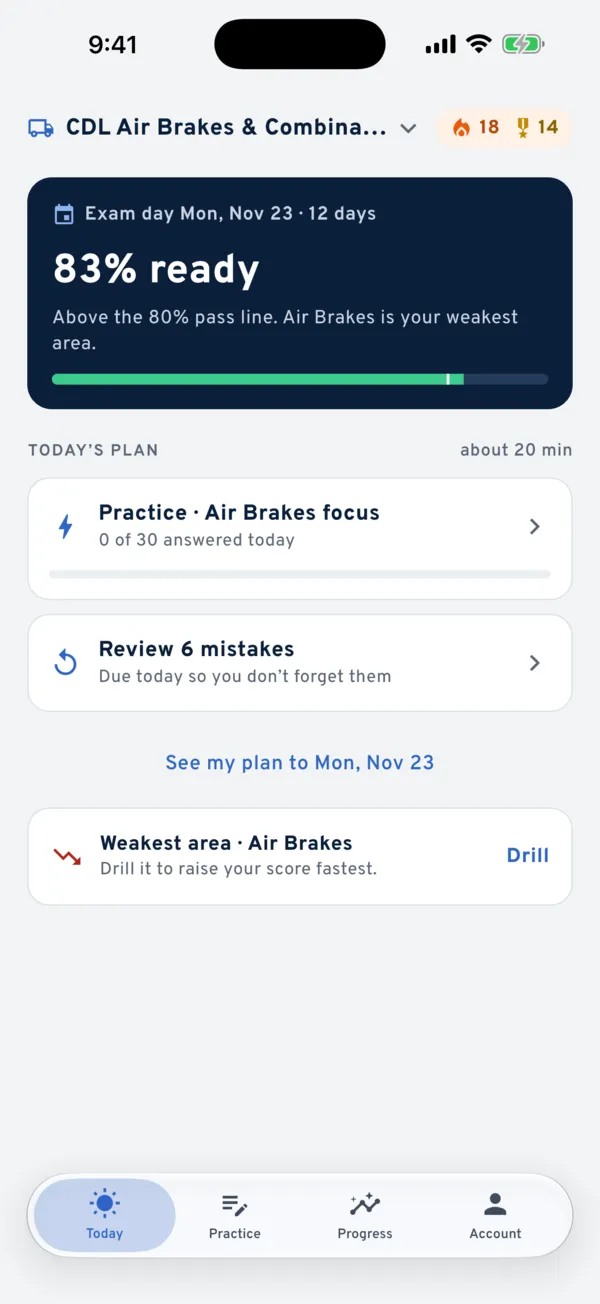
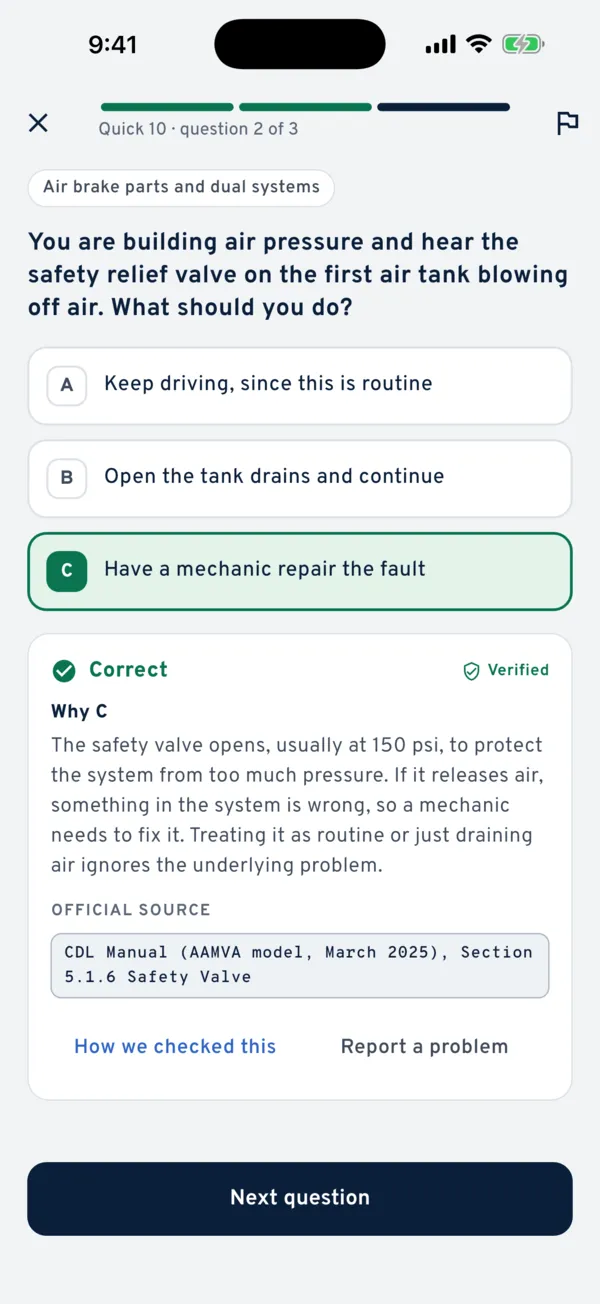
CDL Air Brakes and Combination at a glance
- Tests
- Two separate knowledge tests, Air Brakes and Combination Vehicles3
- Who takes air brakes
- Anyone driving a CMV with air brakes, including air over hydraulic3
- Who takes combination
- Every Class A applicant3
- Passing score
- 80% on each test1
- Typical length
- Air brakes 25 questions, combination 20 (Washington)7
- Question format
- Multiple choice, three options (New York)3
- Fail air brakes
- L restriction, no air brake vehicles, on the CLP or CDL2
- Fail combination
- No Class A permit or license1
- Study material
- Sections 5 and 6 of your state CDL manual3
What the two tests cover
The Air Brakes test comes from Section 5 of your state’s CDL manual and the Combination Vehicles test comes from Section 6. Nearly every state builds its manual from the same national model, so the section numbers line up from state to state. New York tells Class A applicants to study Sections 5 and 6 for the combination test, and Section 5 alone for air brakes.3 That pairing tells you something. A large part of the combination material is about trailer air brakes, so the two tests overlap more than people expect.
| Manual section | What it covers | Test |
|---|---|---|
| 5.1 Parts of an air brake system | Compressor, governor, tanks, drains, safety valve, brake chambers, slack adjusters, spring brakes, ABS | Air Brakes |
| 5.2 Dual air brake | Primary and secondary systems, gauges, low air warning | Air Brakes |
| 5.3 Inspecting air brake systems | Slack adjusters, drums and linings, the final air brake check | Air Brakes |
| 5.4 Using air brakes | Emergency stops, brake lag, fade, low air pressure, parking | Air Brakes |
| 6.1 Driving combinations safely | Rollover, crack the whip, trailer skids, offtracking, backing | Combination |
| 6.2 Combination air brakes | Trailer hand valve, tractor protection valve, service and emergency lines, glad hands | Combination |
| 6.3 to 6.5 | Trailer ABS, coupling and uncoupling, combination inspection | Combination |
Air brakes
Section 5 is mostly mechanical, and the questions reward understanding how air moves through the system.4 The compressor fills the tanks, and the governor stops it at the cut-out pressure (around 125 psi) and starts it again at cut-in (around 100 psi). The safety valve on the first tank usually opens at 150 psi. A visible low air warning has to come on before tank pressure falls below 60 psi, and spring brakes come fully on somewhere between 20 and 45 psi, typically 20 to 30. The manual’s point is that you stop when the warning comes on, while you still control the brakes, instead of waiting for the springs to stop you.
Expect questions about why tanks are drained (water and compressor oil collect there, and water can freeze in winter), what slack adjusters do, and why you never press the brake pedal while the spring brakes are on. Stopping distance shows up too. Air brakes add brake lag, and at 55 mph on dry pavement that lag adds about 32 feet, which pushes total stopping distance past 450 feet.4
Combination vehicles
Section 6 starts with the physics of pulling a trailer. More than half of truck driver deaths in crashes come from rollovers, and a fully loaded rig is ten times more likely to roll over in a crash than an empty one.5 The manual explains rearward amplification with a chart, where triples score 3.5, meaning the last trailer rolls over 3.5 times as easily as a five axle tractor-trailer.
Then it moves to the trailer air system. The red eight sided knob is the trailer air supply control. Push it in to send air to the trailer, pull it out to cut the air and set the trailer emergency brakes. The tractor protection valve closes on its own when pressure drops into the 20 to 45 psi range, so a broken trailer line doesn’t drain the tractor.5 The service line is usually blue and the emergency (supply) line is red. After that come trailer ABS, coupling and uncoupling (16 steps and 10 steps in New York’s version), and the extra checks for a combination inspection.
Where people lose points
A handful of facts cause most of the misses on the combination test.
- The trailer hand valve is for testing trailer brakes only. Using it to straighten a skidding trailer is the wrong answer, because locked trailer wheels caused the skid. You release the brakes.5
- If you cross the air lines, supply air goes to the service line and the trailer spring brakes won’t release. On an older trailer without spring brakes, you could drive off with no trailer brakes at all.
- After coupling, there should be no space between the upper and lower fifth wheel, and the jaws must close around the shank of the kingpin, not the head.
- The trailer should sit low enough that the tractor lifts it slightly when you back under it. Landing gear goes all the way up before you drive.
- An empty combination vehicle takes longer to stop than a fully loaded one, and a bobtail tractor can take longer to stop than a tractor-semitrailer loaded to maximum gross weight.
On the air brakes test, the classic misses are the order of events as pressure drops (warning first, then spring brakes) and the leak rate numbers covered in the last section of this page.
How the tests work
Each test is scored on its own, and you need at least 80% on each one.1 In New York every question is multiple choice with three answer options and one correct answer.3 States set the length. Washington publishes exact numbers, with 25 air brakes questions (20 correct to pass) and 20 combination questions (16 correct to pass).7 Pennsylvania’s fact sheet lists a 70 question knowledge test for Class A and 50 questions for Class B and C, plus a separate 25 question test for removing an air brake restriction later.8 Your state’s CDL page or manual will give you its count.
The two scores have different consequences, and that’s worth knowing before you sit down.
- Fail the air brakes test and the state can still issue your permit, but it must mark the CLP or CDL with a restriction that bars you from driving any commercial vehicle with air brakes, which includes air over hydraulic systems.2 That’s the L restriction.8
- Fail the combination test and you can’t be issued a Class A permit or license at all.1
Language options vary. Washington offers English, Spanish, Russian and Serbian-Croatian and doesn’t allow interpreters.7 Pennsylvania offers knowledge tests in several languages in written and audio formats.8 If you need a reading accommodation, ask the licensing office before test day.
Eligibility, cost and scheduling
You take both tests as part of your commercial learner’s permit (CLP) application, usually alongside the general knowledge test (see the CDL general knowledge guide). New York requires you to be at least 18, and drivers under 21 are limited to driving within the state.3 You’ll need a valid noncommercial license from the same state.9 California’s checklist for a CLP shows the usual paperwork, which includes the medical examination report (MCSA-5875) and medical examiner’s certificate (MCSA-5876), identity documents, and a 10 year driving history form if you’ve held a license in another state.9
Fees are set by each state and change often, so check your licensing agency’s fee page. A couple of examples show how differently states handle them. California charges a nonrefundable application fee that’s good for 12 months and gives you three attempts at each required knowledge test.9 Washington’s test fee covers one attempt at each knowledge test taken within 90 days, and passed scores stay valid for 180 days.7
Entry Level Driver Training (ELDT) is not required before these knowledge tests. California’s DMV explains that federal rules require proof of ELDT before a skills test or a HazMat knowledge test.9 The air brakes and combination tests aren’t on that list. If you plan to train with a school, you can take these tests first and hold your CLP while you train.
Booking works differently from state to state, so check whether your office wants an appointment for knowledge tests. California won’t start a knowledge test within 30 minutes of closing, so arrive early.9 There’s also been a recent change for applicants who need a non-domiciled CLP or CDL. California says it can’t issue, reissue or renew non-domiciled CDLs until further notice, and Washington has stopped knowledge and skills testing for non-domiciled drivers.97 If that applies to you, confirm your status with the state before you pay any fees.
A four week study plan
Most people take these tests on the same day as general knowledge, so this plan assumes you’re studying all three together. Read with the manual open and redo the “Test Your Knowledge” questions at the end of each subsection, since New York’s manual says those questions may be on your test.4
- Week 1Read Section 2 of your manual for the seven step inspection, then Section 5.1 and 5.2. Draw the air system from compressor to brake chamber and label the governor, tanks, drains and safety valve from memory.
- Week 2Finish Section 5. Make one flash card for every psi value, distance and time in the section and quiz yourself daily. Take a timed air brakes practice set at the end of the week and reread every subsection where you missed a question.
- Week 3Read Section 6 twice. Walk through the coupling and uncoupling steps out loud in order and write down what each control knob does and what color it is. Start mixing combination questions with air brakes questions.
- Week 4Take full length practice tests for general knowledge, air brakes and combination. Aim for 90% or better before you book, which gives you room for nerves. Spend the last two days only on questions you got wrong.
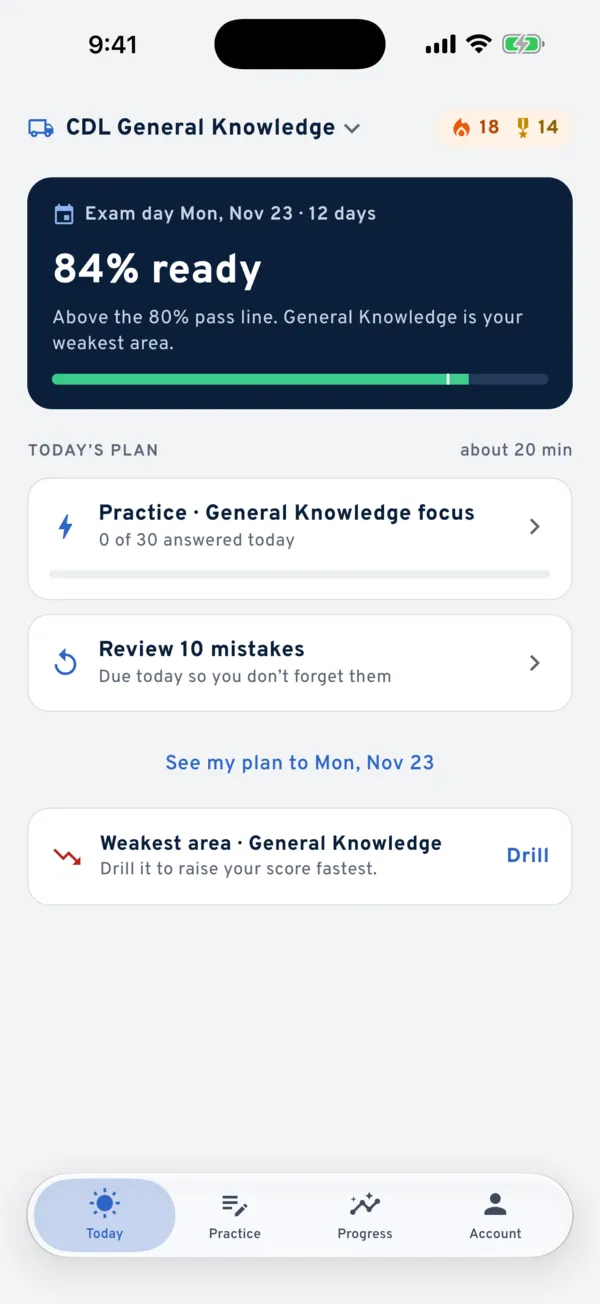
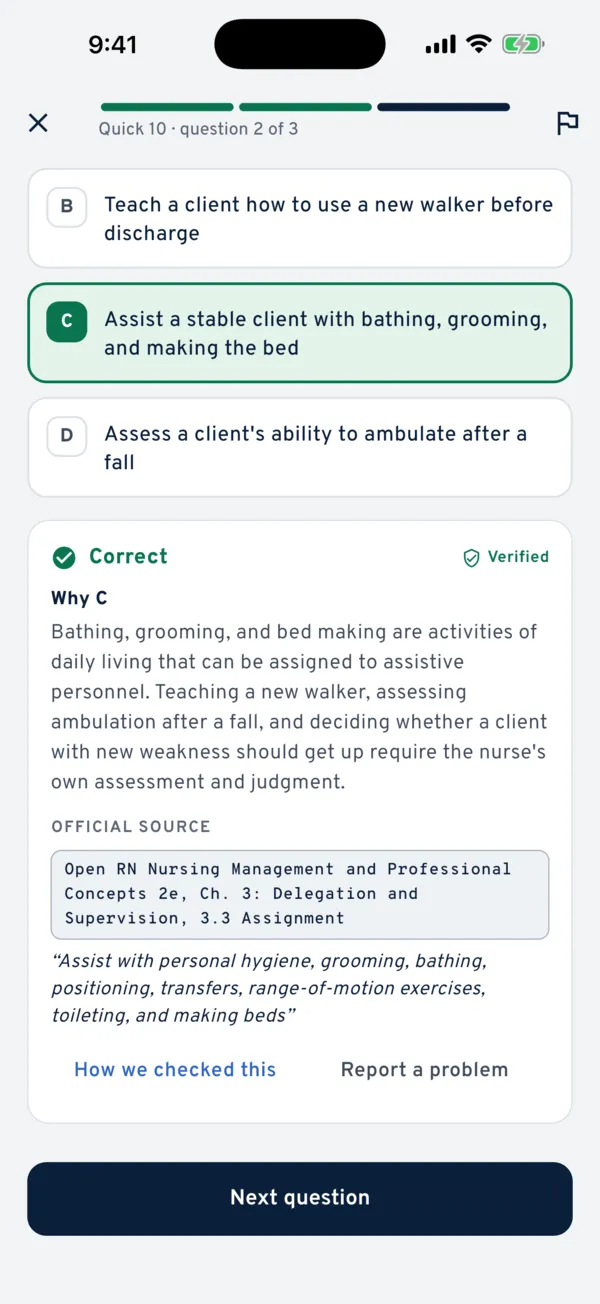
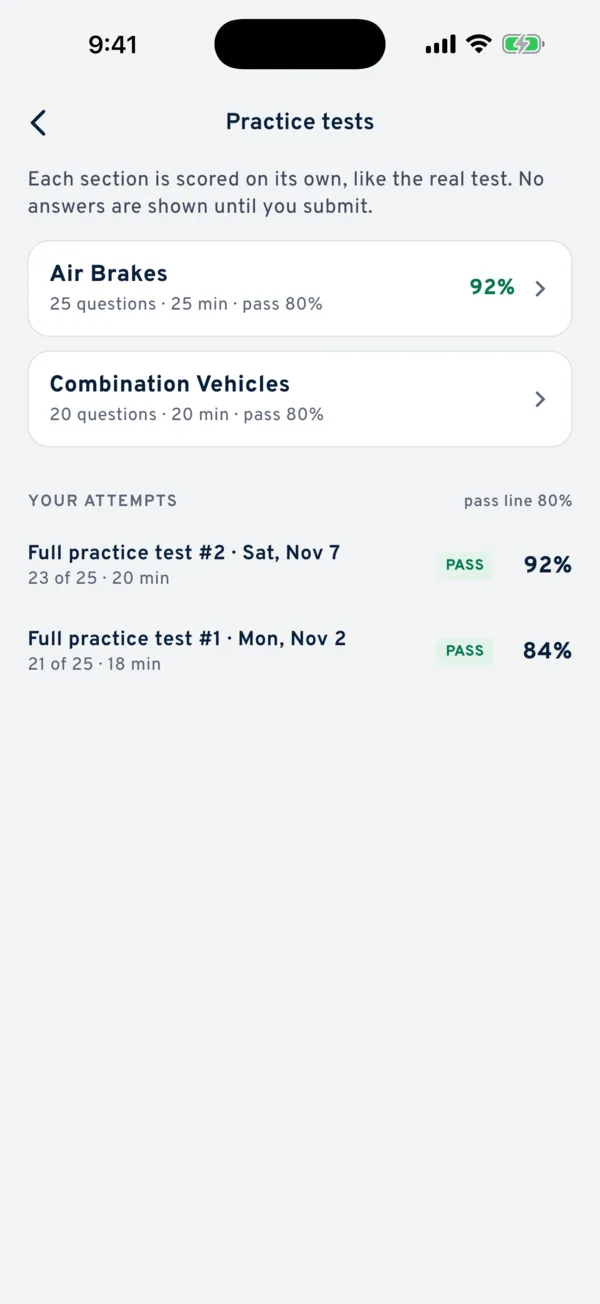
If you’re using an app, Clinched has both tests, each scored on its own like at the licensing office, with every answer tied to the manual text it comes from.
Two habits help more than extra hours. First, learn what each part does before memorizing its number. “The tractor protection valve closes at 20 to 45 psi” is easy to remember once you know it exists to keep a broken trailer line from emptying the tractor’s tanks. Second, read every option. With only three choices, wrong answers are often close to right, such as “60 psi” next to “45 psi.”
Test day
Bring your current driver’s license, your medical certificate paperwork, and whatever identity and residency documents your state lists. In New York you show your license again right before testing, you can bring only a pencil into the testing area, and phones aren’t allowed anywhere in the test area.3 Other states run their own rules, so read the instructions with your appointment confirmation.
Take the tests in whatever order the system offers, but don’t rush the air brakes test because it feels familiar after general knowledge. The questions are specific. If a question gives you a pressure, ask yourself which event happens at that pressure and in what order, and the answer usually falls out.
When you pass the tests your class requires, the office issues your CLP. If you passed combination and general knowledge but failed air brakes, you may be offered a permit with the L restriction. For a Class A driver that’s a poor trade, because almost every tractor-trailer has air brakes and you couldn’t train in one. Ask about retesting before you accept it.
After you pass, or if you don’t
With a CLP in hand, you must wait at least 14 days before the skills test.3 In California the permit is valid for up to 180 days and can be renewed for another 180, as long as you don’t go past one year from your application date.9 Use that time for ELDT if you need it and for behind the wheel practice with a qualified CDL holder beside you.
Your air brake knowledge gets tested again on the skills test. The pre-trip portion includes an in-cab air brake check with three required parts in New York’s version. You do a static leak check with the foot brake held, then pump the brake pedal to fan off air until the low air warning comes on, then keep going until the tractor protection valve and parking brake valve pop out. Getting any of those wrong is an automatic failure of the vehicle inspection test.6 Our post on how to pass the CDL air brakes test walks through it.
If you fail a knowledge test, retake rules vary. California gives you three attempts per test, and a third failure ends the application so you have to reapply.9 New York sets no limit, but retakes are at the discretion of the office.3 If you end up with an L restriction, you can remove it later by passing the air brakes knowledge test and a skills test in an air brake vehicle that includes the air brake pre-trip.1 The air brake restriction guide covers that process, including the Z restriction for air over hydraulic brakes.
Planning to pull doubles or triples later? That endorsement test builds directly on Sections 5 and 6. The CDL endorsements guide covers it.
The air pressure numbers worth memorizing
Air brakes questions lean hard on numbers. The table compares New York’s current manual with California’s handbook, because California uses its own figures in a few places and tests on them.410
| Check | New York manual (model text) | California handbook |
|---|---|---|
| Governor cut-out | Around 125 psi | Around 125 psi |
| Governor cut-in | Around 100 psi | Around 100 psi |
| Safety valve opens | Usually 150 psi | Usually 150 psi |
| Low air warning must come on | Before 60 psi | Before 55 psi (55 to 75 psi range) |
| Spring brakes come fully on | 20 to 45 psi, typically 20 to 30 | 20 to 45 psi, typically 20 to 30 |
| Pressure buildup, dual system | 85 to 100 psi within 45 seconds | 85 to 100 psi within 45 seconds |
| Leak rate, brakes released | Under 2 psi a minute single, under 3 combination | 2 psi single, 3 for two vehicles, 5 for three or more |
| Leak rate, brakes applied | No more than 3 psi a minute single, 4 combination | 3 psi single, 4 for two vehicles, 6 for three or more |
| Slack adjuster free play | More than about one inch means it needs adjustment | More than about one inch means it needs adjustment |
California also notes that large buses commonly signal low air at 80 to 85 psi, and New York’s manual says the same.104 When your state’s manual gives a number that differs from a practice question you find online, trust the manual. That’s what your test is written from.
Questions people ask
How many questions are on the CDL air brakes test?
It depends on the state, but 25 questions is common. Washington, for example, gives 25 air brakes questions and requires 20 correct. Federal rules set the passing score at 80% everywhere, so check your state's CDL page for the exact count.
Do I need the air brakes test for a Class B CDL?
You need it if the truck or bus you'll drive has air brakes of any kind, including air over hydraulic. The air brakes test isn't tied to a license class. If you skip or fail it, your permit and license carry an L restriction that bars you from any commercial vehicle with air brakes.
What happens if I fail the CDL combination test?
Under 49 CFR 383.135, a state can't issue you a Class A permit or license until you score at least 80% on the combination test. You can still hold a lower class if you passed the other required tests. Retake rules vary, so California allows three attempts per application while New York leaves retakes to the office manager.
Is the air brakes test the same in every state?
The structure is the same, because states build their manuals from one national model and federal rules set the 80% passing score. Some numbers differ. New York's manual says the low air warning must come on before 60 psi, while California's says 55 psi, so learn the figures in your own state's manual.
Can I take the combination test without the air brakes test?
Yes, they're separate tests. But the combination test draws on Section 5 of the manual as well as Section 6, and nearly every tractor-trailer has air brakes. Skipping air brakes leaves you with an L restriction that keeps you out of almost every Class A truck.
Sources
- 49 CFR 383.135, Passing knowledge and skills testseCFR, Office of the Federal Register
- 49 CFR 383.95, RestrictionseCFR, Office of the Federal Register
- Commercial Driver's Manual CDL-10, Section 1 IntroductionNew York State Department of Motor Vehicles
- Commercial Driver's Manual CDL-10, Section 5 Air BrakesNew York State Department of Motor Vehicles
- Commercial Driver's Manual CDL-10, Section 6 Combination VehiclesNew York State Department of Motor Vehicles
- Commercial Driver's Manual CDL-10, Sections 11 to 13 Skills TestsNew York State Department of Motor Vehicles
- CDL knowledge testWashington State Department of Licensing
- Commercial Driver's License Fact SheetPennsylvania Department of Transportation
- Commercial Driver's Licenses (CDL)California Department of Motor Vehicles
- California Commercial Driver HandbookCalifornia Department of Motor Vehicles
More on CDL Air Brakes and Combination
- Topic explainer · CDL General Knowledge · CDL Air Brakes and Combination
 CDL Pre-Trip Inspection vs the CDL Knowledge TestThe CDL knowledge test is a written exam you pass for your permit. The pre-trip inspection is the first part of the skills test. How each one works and is scored.
- Study strategy · CDL Air Brakes and Combination
 How to Pass the CDL Air Brakes Test on the First TryThe CDL air brakes test is often 25 questions and needs 80%. Learn the system in the order air flows, memorize a dozen psi numbers, and drill the brake check.
- Topic explainer · CDL Air Brakes and Combination
 CDL Air Brake Restrictions L and Z, and How to Remove ThemAn L on your CDL means no air brake vehicles, and Z means no full air brakes. How each code gets added under 49 CFR 383.95 and what it takes to remove it.