HealthcareCenters for Medicare & Medicaid Services rules, run by each state's nurse aide registry
The CNA exam, explained
The CNA exam is your state's nurse aide competency evaluation, a written (or oral) multiple choice test plus a hands-on skills test, and you must pass both to get on the state registry. In Prometric states like Texas, Florida and New York the written part is 60 questions in 90 minutes, and the skills part scores five skills (31 to 40 minutes in Florida and New York). Fees run about $115 to $155 for both parts in the big states, and federal rules give you at least three attempts. The surest route is a state-approved training program followed by drilling every skill step until it's automatic.
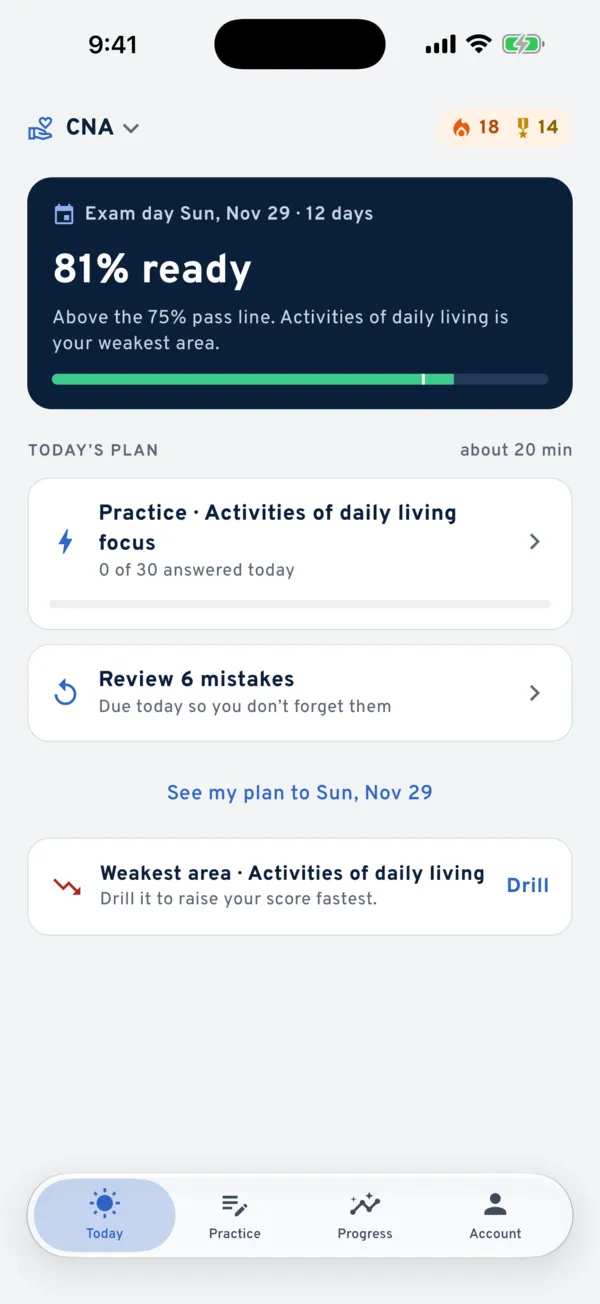
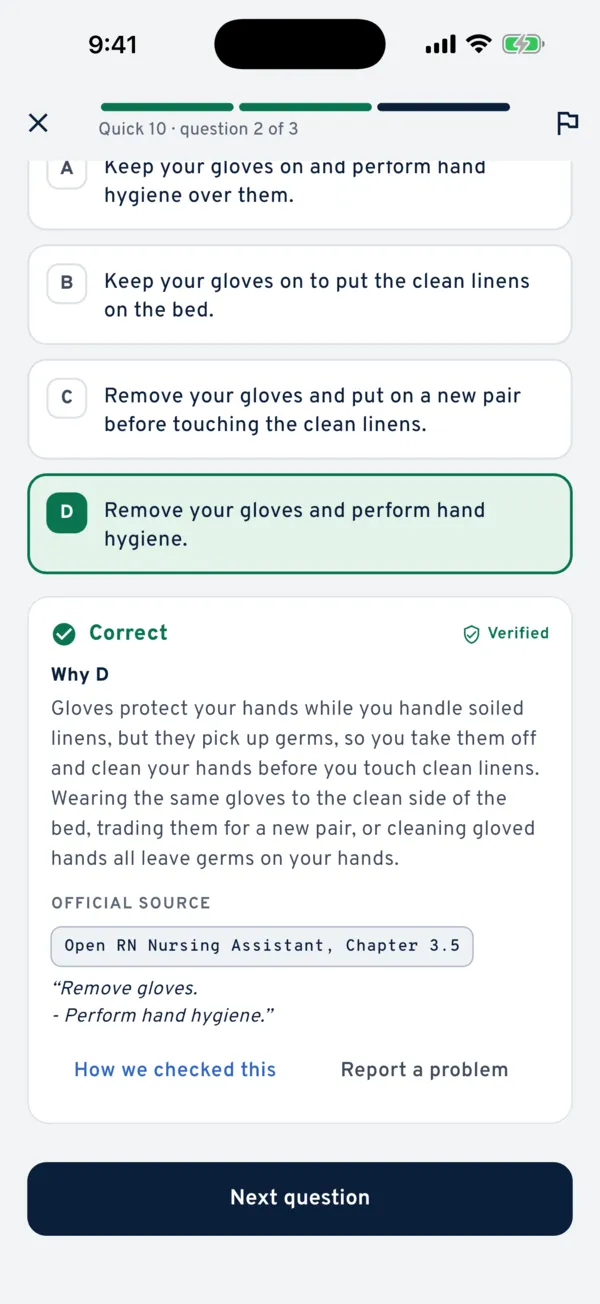
CNA Exam at a glance
- Federal minimum training
- 75 clock hours, including 16 hours of supervised practical training1
- Exam parts
- Written or oral test (your choice) plus a hands-on skills demonstration1
- Written test, Prometric states
- 60 multiple choice questions in 90 minutes4
- Written test, NNAAP (Credentia)
- 70 items, 10 of them unscored pretest items3
- Skills test, Prometric states
- 5 scored skills (3 assigned plus handwashing and indirect care), 31 to 40 minutes in Florida4
- Attempts
- Federal rule guarantees at least 31
- Example fee
- $155 for both parts in Florida4
- Cost if a nursing home employs you
- $0. Facilities can't charge employees for training or testing1
- Lapse rule
- 24 straight months without paid nursing work means new training or a new competency test2
- Activities of daily living22%
- Basic nursing skills35%
- Self-care and independence7%
- Emotional and mental health needs8%
- Spiritual and cultural needs2%
- Communication7%
- Client rights8%
- Legal and ethical behavior5%
- Member of the health care team6%
What the written test covers and where people slip
Federal rules decide what every CNA program teaches, and the written test has to cover all of it.1 That means communication, infection control, safety and emergencies (including the Heimlich maneuver), residents’ rights and independence, basic nursing skills like measuring pulse and weight, personal care, mental health and social needs, care of residents with dementia, and basic restorative care such as range of motion and bladder training.1
The exact blueprint depends on who writes your state’s test. The chart on this page uses the 2024 National Nurse Aide Assessment Program (NNAAP) outline, effective October 2024, which Credentia uses where it delivers the NNAAP.3 Basic nursing skills is the biggest slice at 35%, followed by activities of daily living at 22%.3 Prometric (Texas, Florida, New York) and D&S Diversified Technologies (Headmaster, used in California) publish their own outlines in their candidate handbooks. D&S, for example, weights its 75 question California test toward basic nursing skills (15 questions), resident rights (8) and safety (8).5
The topics that cost people points are rarely exotic. They’re the judgment questions.
- Scope of practice. Many questions hinge on what an aide does versus what the nurse does. When a resident reports chest pain or a new change, the right answer is usually to report it to the nurse, not to assess or treat it yourself.
- Resident rights. Privacy, choice, refusing care, and freedom from abuse and restraints come up again and again. Federal rules list each of these as required training content.1
- Infection control. Know when gloves are required, how to remove them without contaminating yourself, and why handwashing comes first.
- Dementia care. Expect scenarios about redirecting, calm communication and not arguing with a confused resident.
Read every question for the word that changes it, like “first,” “best” or “except.” Many wrong answer choices are reasonable actions done in the wrong order.
How the written and skills tests work
Every state’s CNA exam has two parts, and you have to pass both.1 Federal rules also say you must be allowed to choose between a written and an oral version of the knowledge test. The oral version is read from a prepared script in a neutral voice.1
The knowledge test
| Vendor | States covered here | Questions | Time |
|---|---|---|---|
| Prometric | Texas, Florida, New York | 60 multiple choice | 90 minutes |
| Credentia (NNAAP) | Northern California region | 70 items, 10 unscored | See your handbook |
| D&S (Headmaster) | California | 75 multiple choice | 60 minutes |
Prometric’s numbers come from its Florida and New York bulletins.49 The NNAAP count comes from Credentia’s outline.3 D&S requires 75% or better to pass its California knowledge test.5 If you choose the oral version with Prometric in New York, you also take a separate reading comprehension section of 16 questions with an extra 30 minutes, and you must pass it.9
The skills test
This is where most people get nervous, and with reason. One missed critical step fails the whole skill.
Prometric scores five skills. You perform three assigned skills and are also scored on handwashing and indirect care, which covers things like privacy, communication, safety and infection control during every task.4 The time limit runs from 31 to 40 minutes depending on which skills you draw, and you must pass all five.4 You can correct a step while you’re still in that skill, but you have to say you’re correcting it and actually do it.9
D&S in California assigns three or four tasks in 30 minutes. The first is always one of four mandatory tasks with handwashing built in, such as perineal care or emptying a urinary drainage bag. You must perform every critical step and at least 80% of the other steps on each task.5 Steps that you only talk through don’t count.5
For a step by step breakdown of what evaluators watch for, see our CNA skills test checklist.
Accommodations
Vendors handle disability accommodations through a request reviewed before you schedule. D&S asks you to submit the request early because approval takes time.5 Prometric has a separate accommodations packet for New York candidates.9
Training, eligibility, cost and scheduling
The federal baseline
The rules come from the Omnibus Budget Reconciliation Act of 1987 (OBRA '87), carried out in federal regulations at 42 CFR 483.150 to 483.160. A state-approved program must include at least 75 clock hours of training and at least 16 hours of supervised practical training.1 At least 16 hours of training must come before you have any direct contact with a resident, covering communication, infection control, safety, independence and rights.1
States can require more, and most big ones do. The test itself has to be given by the state or a state-approved entity, and it can’t be a nursing home that takes Medicare or Medicaid.1 That’s why vendors like Prometric, Credentia and D&S run it.
Here’s the part many people miss. If a nursing home employs you, or has offered you a job, on the day you start a training or testing program, it can’t charge you for any of it, including textbooks.1 If you pay your own way and get hired by a facility within 12 months of finishing, the state must provide for reimbursing your costs on a pro rata basis while you work there.1
Five big states side by side
| State | Minimum training | Who runs the exam |
|---|---|---|
| California | 160 hours (60 classroom, 100 supervised clinical) | D&S (Headmaster) or Credentia |
| Texas | 100 hours (60 classroom, 40 hands-on) | Prometric |
| Florida | None for challengers, 120 hours after 3 failed attempts | Prometric |
| New York | 100 hours, at least 30 supervised in a nursing home | Prometric |
| Illinois | 120 hours (62 theory, 18 lab, 40 clinical) | Southern Illinois University Carbondale |
Sources for each row are California’s Department of Public Health,6 Texas Health and Human Services,7 Prometric’s Florida bulletin,4 New York’s nursing home regulation8 and the Illinois Administrative Code.10 Illinois is the odd one out. Its state exam, run by Southern Illinois University Carbondale, is a written test, and there’s no separate state skills exam for new program graduates. Fees, retake rules and deadlines for each state are broken out in who runs the CNA exam in each state and what it costs.
These rules change. Texas, for example, plans to require fingerprints for nurse aide certification starting with a system change tentatively set for January 16, 2027.7 Always confirm the current rules with your own state’s registry before you pay.
What it costs and how you book
Fees are paid to the vendor, not the state, in most places. Florida charges $155 for both parts, $35 for the written test alone and $120 for the skills test alone.4 New York charges $115 for the skills and written tests, or $135 if you take the oral version.9 D&S charges $140 in California ($40 knowledge, $100 skills), with $5 extra for the audio version.5
Booking usually starts with your training program. It reports your completion, then you create an account with the vendor, pay and pick a date. In California with D&S you can schedule only after your fee is paid.5 In Florida, the Board of Nursing must approve your application before Prometric will schedule you.4
A four week study plan for both parts
Start this the week your classroom hours end, while the skills are fresh. Plan on more practice for the skills test than for the written one.
- Week 1Get your vendor's candidate handbook and print its skills checklist. Read the written test outline and mark the areas your program covered quickly. Take one timed practice test to find your weak spots.
- Week 2Practice four or five skills a day on a family member or classmate, saying each step out loud the first time. Study resident rights and infection control for 30 minutes a day. These two areas show up all over the written test.
- Week 3Run every skill on the list at least twice. Time yourself against your vendor's limit. Do daily mixed practice questions and review every miss until you can explain why the right answer is right.
- Week 4Do two full mock skills tests with a partner reading from the checklist and marking missed steps. Take a final timed written practice test. Pack your ID and test day items two days before, not the night before.
Clinched has a CNA course for the written test, with every question tied to an official source. Confirm your state’s current rules with your registry before test day.
Two habits help more than extra hours. First, practice handwashing until you don’t think about it, since it’s scored on every Prometric and Credentia test. Second, practice your measurement skills (pulse, respirations, urine output) with a real watch or graduate. Your number has to land within the evaluator’s range.
On test day
Arrive early. Prometric asks for at least 30 minutes before your appointment,4 and D&S in California turns you away as a no-show if you’re not in the waiting area 20 minutes before start time.5 Plan for a long day. D&S warns that the knowledge and skills tests together can take up to five hours.5
- The exact ID your vendor requires, with the same name you registered under
- Your confirmation or admission letter and any state form your vendor asks for (California candidates bring CDPH 283B or 932)
- A watch with a second hand for counting pulse and respirations
- Flat, closed-toe, nonskid shoes and scrubs or comfortable clothes
- Lunch and water to eat in the waiting area, since food isn't allowed in the testing room
- No phone, smartwatch or notes in the testing room
Your phone stays out of the room. D&S scores anyone caught with a recording device as a failed attempt and keeps the fees.5 Evaluators can’t coach you or tell you how you did.9
Results come quickly. In New York, Prometric posts official skills results online within 48 hours and emails a failing score report within five business days.9 In Florida your results are subject to review by the Department of Health before they’re final.4
After you pass, or if you don’t
Getting on the registry and keeping your status
Passing both parts puts you on your state’s nurse aide registry. The state must add a record of your successful completion within 30 days.1 In Florida, listing on the registry after Board approval takes three to five weeks.4 Employers must verify your registry status before you work as an aide.2
Federal rules also limit how long a nursing home can use someone who isn’t yet certified. A facility can’t use you as a nurse aide for more than four months full time unless you’ve completed a state-approved program or competency evaluation.2 Once you’re working, the facility must review your performance at least every 12 months and provide in-service training.2
Watch the lapse rule. If you go 24 straight months without doing paid nursing or nursing-related work, you must complete a new training and competency evaluation program or a new competency evaluation.2 States also set their own renewal steps, so check yours.
If you fail a part
You retake only the part you failed in most states. D&S in California makes you pay again only for the failed portion.5 Prometric lets you request a written test review in Florida, but you must ask within 21 days of the test.4
The deadlines matter more than the attempt count. California’s D&S program gives you three attempts on each part within two years of finishing training, then you must complete a new approved program.5 Florida requires at least 120 hours of approved training after three failed attempts.4 New York gives you three attempts on each part within two years.9
Use your score report. Prometric’s New York reports include feedback on your strong and weak areas,9 so drill those first. When you’re ready to plan the retake, the skills test checklist is a good place to rebuild from, and Clinched’s “Notify me” list will tell you when its CNA practice course opens.
Questions people ask
How many questions are on the CNA exam?
It depends on your state's test vendor. Prometric's written test, used in Texas, Florida and New York, has 60 multiple choice questions in 90 minutes. The NNAAP written exam from Credentia has 70 items, 10 of them unscored, and the D&S (Headmaster) California knowledge test has 75 questions in 60 minutes.
How much does the CNA exam cost?
In the big states it runs about $115 to $155 for both parts. Florida charges $155 through Prometric, New York charges $115 for the skills and written tests, and D&S charges $140 in California. If a nursing home employs you or has offered you a job when you start, federal rules say it can't charge you for the test.
How many times can you take the CNA exam?
Federal rules require states to give you at least three attempts. Most states then make you retrain, and many also set a deadline. California and New York give you two years from training, and Illinois gives you 12 months. Each part (written and skills) is usually counted separately.
How many skills are on the CNA skills test?
Prometric and Credentia (NNAAP) score five skills, and handwashing is always one of them. Prometric adds indirect care, such as privacy and safety, as a scored skill, and Credentia always includes one measurement like pulse or urine output. D&S in California assigns three or four tasks in 30 minutes.
Can I take the CNA exam without a training program?
Most states require a state-approved program first. Florida is the main exception. Its law lets you challenge the exam without training if you have a high school diploma or are at least 18, but if you fail three times you must complete at least 120 hours of approved training.
Sources
- 42 CFR Part 483 Subpart D, Requirements for nurse aide training and competency evaluation programsElectronic Code of Federal Regulations
- 42 CFR 483.35, Nursing servicesElectronic Code of Federal Regulations
- The 2024 National Nurse Aide Assessment Program (NNAAP) Content Outline, California HandbookCredentia
- Florida Certified Nursing Assistant Candidate Information Bulletin (Rev. 11/01/2025)Prometric
- California Nurse Aide Candidate Handbook (October 2026)D&S Diversified Technologies (Headmaster)
- Nurse Assistant Training Program ApplicantsCalifornia Department of Public Health
- Nurse Aide Training and Competency Evaluation Program (NATCEP)Texas Health and Human Services Commission
- 10 NYCRR 415.26, Organization and administrationNew York State Department of Health
- New York State Nurse Aide Candidate Information BulletinPrometric
- Ill. Admin. Code tit. 77, 395.150, Basic Nursing Assistant Training ProgramIllinois Department of Public Health (text via Cornell LII)
More on CNA Exam
- Exam guide · CNA Exam
 How Much Is the CNA Exam? Cost and Test Vendor by StateWho gives the CNA exam in California, Texas, Florida, New York and Illinois, what each part costs ($85 to $155), and the retake limits and deadlines in each state.
- Topic explainer · CNA Exam
 CNA Skills Test Checklist: What Evaluators Actually ScoreHow the CNA skills test is scored at Prometric, Credentia and D&S: 3 to 5 skills, critical steps, handwashing, indirect care, and a checklist to practice with.