Securities and insuranceFinancial Industry Regulatory Authority
The SIE exam, explained
The Securities Industry Essentials (SIE) exam is FINRA's entry-level securities test. You get 75 scored multiple choice questions plus 5 unscored ones, 1 hour 45 minutes, and you need a scaled score of 70 to pass. The fee is $100, you must be at least 18, no firm has to sponsor you, and a pass stays valid for four years. Products and trading rules make up 75% of the scored questions, so that's where your study hours should go.
SIE at a glance
- Questions
- 75 scored + 5 unscored pretest questions, multiple choice with 4 choices2
- Time limit
- 1 hour 45 minutes2
- Passing score
- 70 (scaled score, not a raw percentage)1
- Fee
- $100 (raised from $80 on January 1, 2026)3
- Eligibility
- Age 18 or older, no firm sponsorship required1
- Where you test
- Prometric test center or online with a remote proctor1
- Result valid for
- 4 years1
- Retake wait
- 30 days now, 15 days from January 19, 2027 (180 or 60 days after a third failure)4
What the SIE covers and where people lose points
The SIE tests whether you understand how the securities business works before a firm teaches you how to do a specific job. FINRA’s outline splits the 75 scored questions into four sections.2
- Capital markets16%
- Products and their risks44%
- Trading, accounts and prohibited activities31%
- Regulatory framework9%
That works out to 12, 33, 23 and 7 questions.2 Two sections carry three quarters of the test, so build your plan around them.
Knowledge of Capital Markets (12 questions)
This is the “who’s who” section. You need to know what the SEC does versus what a self-regulatory organization like FINRA or the MSRB does, and where the Treasury, the Federal Reserve, SIPC and the FDIC fit in.2 It also covers primary versus secondary markets, how offerings are underwritten (firm commitment versus best efforts), shelf registration, and basic economics like monetary versus fiscal policy, the business cycle and leading versus lagging indicators.2
What trips people up is the regulatory alphabet. SIPC protects customers when a broker-dealer fails. It doesn’t protect anyone against a market loss. The FDIC covers bank deposits, not securities. Expect at least one question built around exactly that confusion.
Understanding Products and Their Risks (33 questions)
This is the big one. Equities (common, preferred, rights, warrants, ADRs), debt (Treasuries, agencies, corporates, munis, money market instruments), options, investment companies, 529 plans and ABLE accounts, direct participation programs, REITs, hedge funds and exchange-traded products are all listed.2 Then come the risks, from credit and liquidity risk to prepayment and reinvestment risk.2
The questions are conceptual, but they’re precise. You should be able to say why a bond’s price falls when rates rise, what a callable feature does to the investor, what breakpoints and rights of accumulation are on mutual fund A shares, and how an exchange-traded note differs from an ETF (the ETN is an unsecured debt of its issuer, so it carries credit risk an ETF doesn’t). Options show up at a basic level. Know calls versus puts, in the money versus out of the money, and the maximum gain and loss for a buyer and a writer. You won’t need multi-leg strategies here. Those wait for the Series 7.
Trading, Customer Accounts and Prohibited Activities (23 questions)
Order types, settlement, corporate actions, account types and registrations, retirement accounts, anti-money laundering, books and records, Regulation S-P privacy rules, communications with the public, and a long list of prohibited conduct live here.2 The outline names market manipulation tactics like front running, marking the close and backing away, plus insider trading, borrowing from customers and financial exploitation of seniors.2
A detail that catches people who learned from old material is settlement. The outline uses T+1 as the regular-way standard.2 Under T+1, the ex-dividend date and the record date generally fall on the same business day, so any study source still teaching “ex-date is two days before record date” is out of date.
Overview of the Regulatory Framework (7 questions)
Registration, continuing education, Form U4 and Form U5, statutory disqualification and what an unregistered person may and may not do.2 It’s only 9% of the exam, but it’s mostly memorization, so it’s cheap points.
How the SIE works on test day
You’ll get 80 questions. 75 count toward your score and 5 are unscored pretest items scattered through the exam with no label.2 FINRA dropped the pretest count from 10 to 5 in the 2025 outline, so any book that says 85 questions is describing the older format.2 Each question has four answer choices, and there’s no penalty for guessing, so never leave one blank.2
You have 1 hour 45 minutes.2 That’s about 79 seconds per question if you answer all 80, which is plenty for most people. The SIE rewards knowing the material, not speed.
The passing score is 70.1 That’s a scaled score. FINRA places every candidate’s result on a common scale through a process called equating, which adjusts for small differences in difficulty between question sets.2 So don’t try to work out “how many I can miss.” Aim to know the material well enough that the scale doesn’t matter.
At a test center, Prometric gives you a four-function calculator and an erasable note board with markers.5 You can’t bring reference materials.2 At the end you see your result on screen shortly after you finish, and you leave with a printed pass or fail report. If you fail, the report shows your overall score and how you did in each section.5
Eligibility, cost and scheduling
The SIE is open to anyone 18 or older, and you don’t need to be associated with a firm.1 That’s the whole point of the exam. Students and career changers can pass it before they ever apply for a job, and it shows hiring managers you’ve already done some of the work.
The fee is $100.1 FINRA raised it from $80 effective January 1, 2026, under its multi-year fee adjustment schedule.3 Schools, training companies and firms can buy vouchers for candidates, and you redeem the voucher when you enroll.1
- Create a FINRA accountSet up an individual account on FINRA's site. FINRA notes some users have had enrollment trouble on Mac, mobile and tablet devices, so use a Windows laptop or desktop if you can.
- Enroll and payEnroll for the SIE and pay $100 by credit card or ACH, or redeem a voucher. Enrollment opens a 120-day window to take the exam.
- Pick test center or onlineBook through Prometric. Any SIE candidate with an open window can test online with a remote proctor, which needs a webcam setup and Prometric's ProProctor app.
- Schedule earlyChoose a date near the end of your study plan, not the end of your 120-day window. Rescheduling fees can apply if you change the appointment late.
The 120-day window and online option come from FINRA’s scheduling guidance.6 Firms that already have access to FINRA’s Central Registration Depository (CRD) can also enroll you through a Form U4 filing or a direct upload.1
A six-week SIE study plan
Six weeks at about an hour a day on weekdays and a longer session on weekends is a realistic plan for someone with no finance background. If you’ve worked in banking or taken finance courses, you can compress it to three or four. The order below front-loads the products section because it’s 44% of the test and the hardest to cram.2
- Week 1Capital markets and economics. Learn the regulators and what each one does, primary versus secondary markets, underwriting, and the Fed's tools. Take a diagnostic test at the end of the week to see where you stand.
- Week 2Equities and debt. Common and preferred stock, rights and warrants, bond pricing and yields, Treasuries, munis and money market instruments. Work price and yield problems until they feel automatic.
- Week 3Packaged products and options. Mutual funds, share classes, breakpoints, variable annuities, 529 plans, DPPs and REITs. Then basic options vocabulary and buyer versus writer risk.
- Week 4Trading and accounts. Order types, settlement, corporate actions, account registrations, retirement accounts, margin basics and AML.
- Week 5Prohibited activities and the regulatory framework. Manipulation, insider trading, U4 and U5, registration rules and continuing education. Start mixed practice sets every day.
- Week 6Full timed practice tests. Take at least two under real conditions, review every miss, then spend the last two days only on your weakest section.
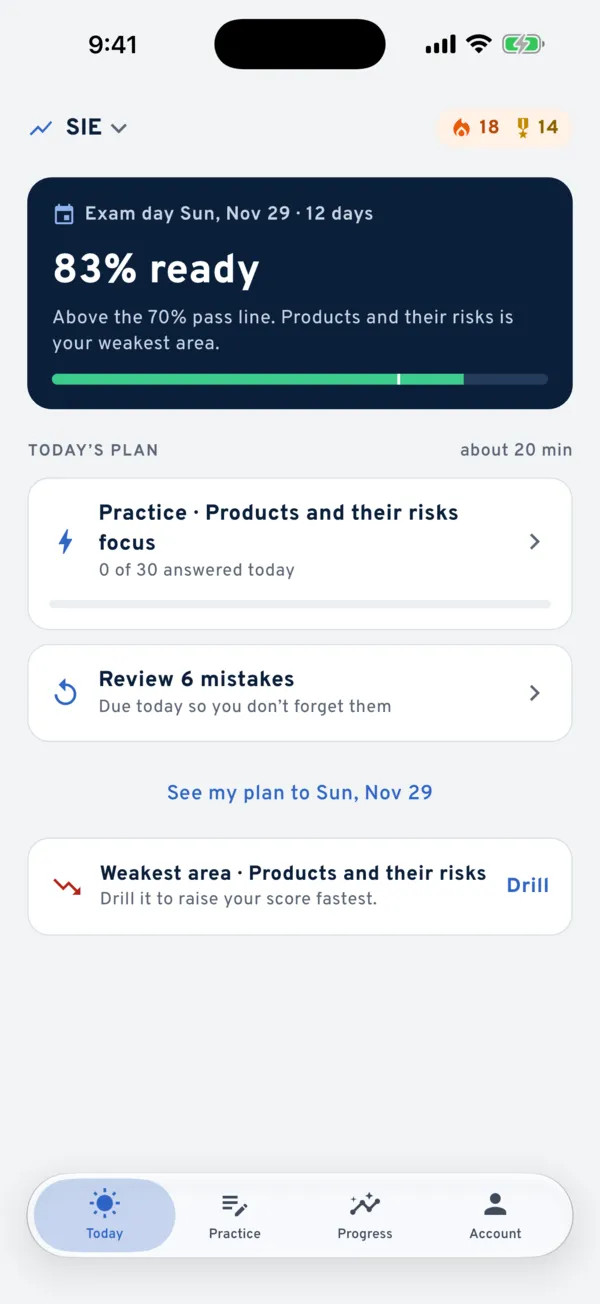
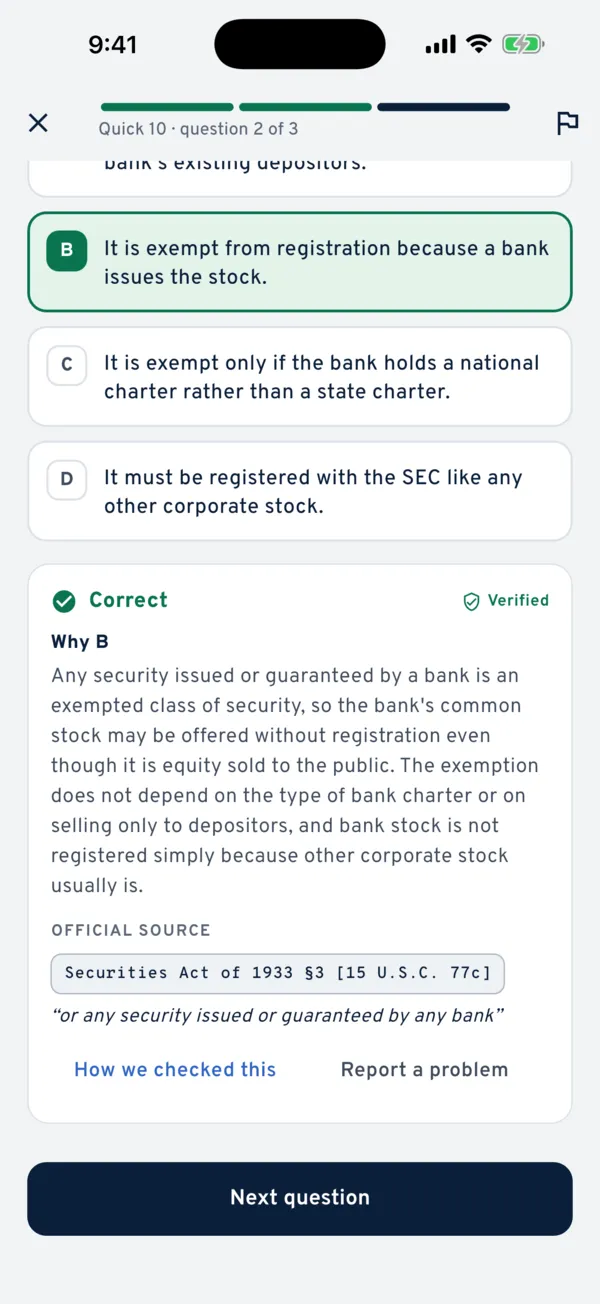
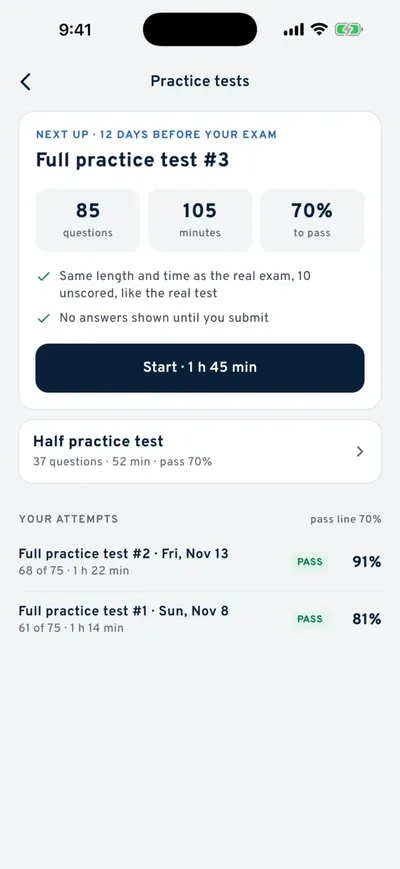
Practice questions matter more than rereading. Every time you miss one, find the rule or concept behind it and write it down in one sentence. Clinched has an SIE course with explanations that quote the rule behind every answer.
SIE test day
Get there 30 minutes early. If you’re more than 30 minutes late and the center can’t fit your full testing time, you won’t test and you’ll have to pay for a new enrollment.5
- One valid, unexpired government photo ID with a signature, with the name matching your enrollment exactly
- The email address you used to schedule the appointment
- Nothing else that you need during the exam, since phones, watches, wallets and jewelry go in a locker
- A plan for the clock, since restroom breaks are allowed but the timer keeps running
Prometric checks your pockets, sleeves and pant legs, takes your photo and has you agree to the rules of conduct before you sit down.5 Electronic copies or photocopies of ID aren’t accepted.5 If you’re testing online, run Prometric’s system check well before the appointment, and have a camera you can move to show the room.6
After you pass, or if you don’t
Passing the SIE doesn’t register you or let you do business. FINRA’s rules say a pass on the SIE alone doesn’t qualify anyone for registration.7 You still need a firm to hire and sponsor you for a representative exam such as the Series 7, and you need both passes for the registration.7 Our Series 7 guide covers that next step, and SIE vs Series 7 lays out how the two fit together.
Your SIE pass is valid for four years.1 If you’re not registered with a firm within four years, you’ll have to retake it.7
If you fail, you can retake it after a waiting period. Right now that’s 30 days after a first or second failed attempt, and 180 days after a third failure within two years.7 Effective January 19, 2027, FINRA cuts those waits to 15 days and 60 days.4 Open enrollment windows without a booked appointment get the shorter wait automatically on that date. If you’ve already booked a retake appointment, it won’t move unless you cancel and reschedule, and rescheduling fees can apply.4 A failure on the SIE doesn’t block you from taking the Series 7 in the meantime, because the wait applies only to the exam you failed.4 Each retake means a new enrollment and a new $100 fee.
Why the SIE comes before the job
The SIE separates general industry knowledge from the job-specific exams, and it’s the only one of them you can take without a firm behind you.1 That changes your strategy in a useful way. If you’re trying to break into the industry, passing the SIE before your interviews is something you can do on your own schedule, and it removes one hurdle from the firm’s onboarding plan. If you’re already hired, many firms will ask you to take the SIE first and the Series 7 a few weeks later, while the material is fresh. Either way, the SIE is the foundation the later exams build on. Our post on taking the SIE without a sponsor walks through the do-it-yourself route step by step.
Questions people ask
How many questions are on the SIE exam?
You'll see 80 questions. 75 are scored and 5 are unscored pretest questions mixed in at random, and you can't tell which is which. FINRA cut the pretest count from 10 to 5 in its 2025 outline, so older guides that say 85 questions are out of date.
Do you need a sponsor to take the SIE?
No. FINRA lets anyone 18 or older enroll and pay for the SIE without being associated with a firm. You will need a sponsoring firm later for the Series 7 or another representative exam, and a pass on the SIE alone doesn't let you register or work as a representative.
What is the passing score for the SIE?
The passing score is 70. It's a scaled score, so it doesn't mean exactly 70% of questions. FINRA equates every version of the exam to a common scale so that slightly harder question sets don't penalize you.
How much does the SIE cost?
The SIE fee is $100. FINRA raised it from $80 on January 1, 2026, as part of a scheduled fee adjustment. Firms, schools and training companies can also buy vouchers that you redeem when you enroll.
How long is an SIE pass good for?
Four years. If you don't get registered with a firm within four years of passing, you have to take the SIE again. Once you're registered, the clock resets based on your registration history under FINRA Rule 1210.
Can I take the SIE online?
Yes. FINRA allows any SIE candidate with an open enrollment window to test online through Prometric's remote proctoring, in addition to test centers. Online testing for most other FINRA exams requires an approved accommodation.
Sources
- Securities Industry Essentials (SIE) ExamFINRA
- Securities Industry Essentials (SIE) Examination Content Outline (2025)FINRA
- FINRA Fee Adjustment Schedule (SR-FINRA-2024-019)FINRA
- Frequently Asked Questions Regarding Qualification Exam Waiting PeriodsFINRA
- Prepare for Your Test Center AppointmentFINRA
- Schedule an ExamFINRA
- FINRA Rule 1210, Registration RequirementsFINRA
- Regulatory Notice 26-18FINRA
More on SIE
- After the exam · SIE · Series 7
 Which Securities Licenses Do You Need, and in What Order?Most brokers need the SIE, Series 7 and Series 63. Advisers need the Series 65. Dual reps add the Series 66. The order, costs and sponsor rules for each license.
- Exam guide · SIE · Series 7
 SIE vs Series 7: How the Two FINRA Exams Fit TogetherThe SIE has 75 scored questions and needs no sponsor. The Series 7 has 125 and needs a firm. How they differ in content, cost and difficulty, and which comes first.
- Exam guide · SIE · Series 7
 FINRA and NASAA Retake Waiting Periods Change in January 2027FINRA cuts SIE and Series 7 retake waits to 15 and 60 days on January 19, 2027. NASAA cuts the third-failure wait to 60 days on January 4. What changes for you.
- Exam guide · SIECan You Take the SIE Without a Sponsor? Yes, Here's HowYou can take the SIE without a sponsor if you're 18 or older. How to enroll on your own, what the $100 fee covers, and what you still need a firm for afterward.