Citizenship, military and educationU.S. Citizenship and Immigration Services
The U.S. citizenship test, explained
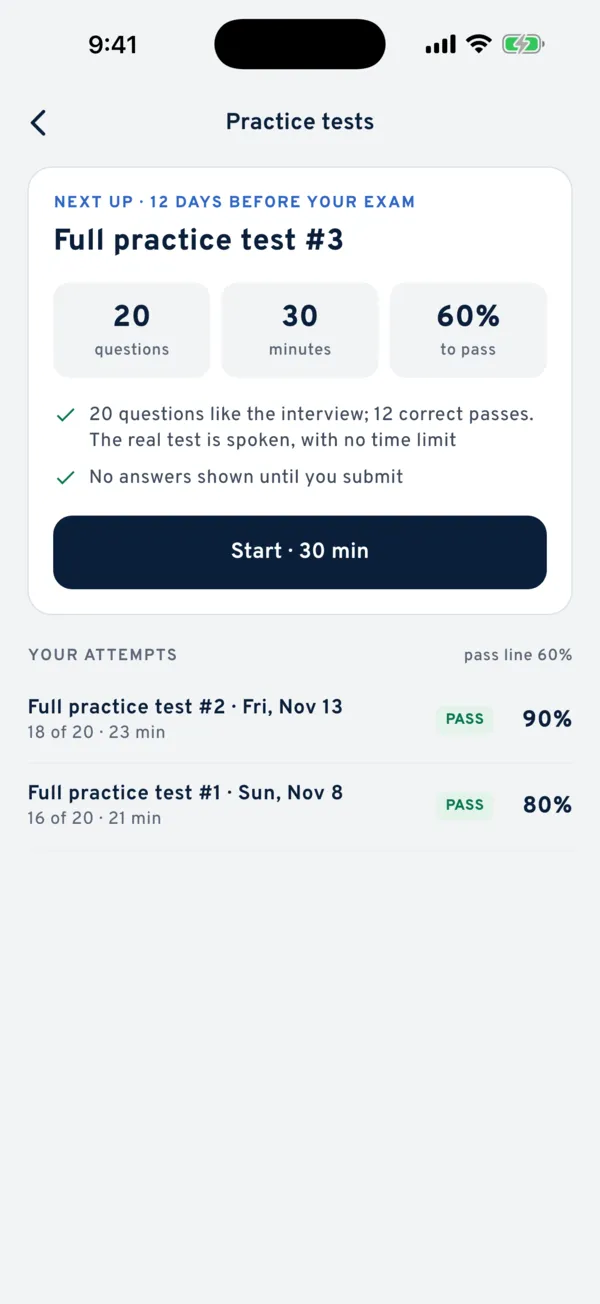
The U.S. citizenship test is given by a USCIS officer during your naturalization interview and has two parts. For English, you read 1 of 3 sentences aloud, write 1 of 3 dictated sentences, and show you can speak English by answering questions about your Form N-400. If you filed on or after October 20, 2025, the oral civics test draws up to 20 questions from a public list of 128 and you pass with 12 correct, because the officer stops at 12 right or 9 wrong. There is no separate test fee (the N-400 costs $760 on paper or $710 online), and you get two attempts at each part.
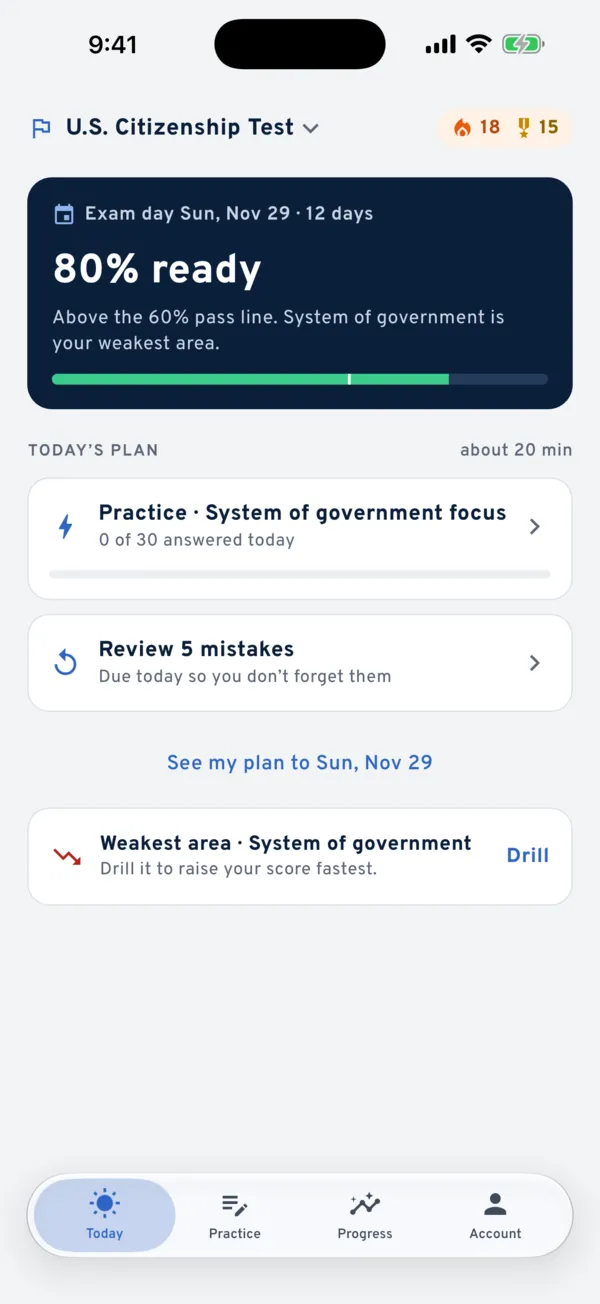
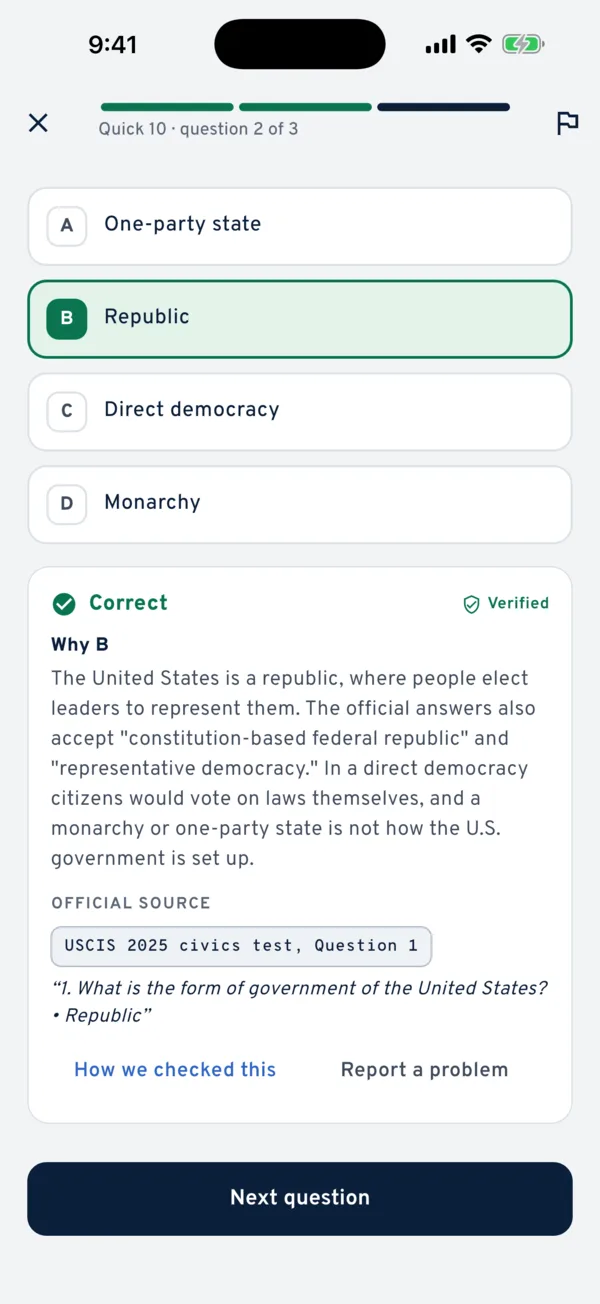
U.S. Citizenship Test at a glance
- Civics questions
- Up to 20, asked orally, from a public list of 128 (2025 test)3
- Civics passing score
- 12 correct. The officer stops at 12 right or 9 wrong3
- English reading
- Read 1 of 3 sentences aloud correctly3
- English writing
- Write 1 of 3 dictated sentences so the officer can understand it3
- English speaking
- Judged from your answers during the N-400 interview3
- Which civics test
- 2025 test if you filed on or after Oct. 20, 2025. Filed earlier, the 2008 test (6 of 10 from 100)1
- Filing fee (Form N-400)
- $760 on paper, $710 online, $380 reduced fee for eligible households5
- Attempts
- 2. A failed part is retested 60 to 90 days after the first interview3
- 65/20 special consideration
- 10 questions from 20 starred questions, 6 correct to pass, in your language2
What the English and civics tests cover
The naturalization test has two parts, and both happen inside your interview at a USCIS field office. The English part checks that you can read, write, speak and understand basic English. The civics part checks what you know about U.S. history and government.3 There is no separate test appointment, no computer and no multiple choice. An officer asks, and you answer out loud.
The 128 civics questions
If you filed Form N-400 on or after October 20, 2025, your civics questions come from the 2025 list of 128 questions and answers, published by USCIS as form M-1778.2 The list is public, and so are the answers. That makes this one of the few government tests where you can see every possible question before you walk in.
The 128 questions sit in three sections. American Government covers questions 1 to 72, American History covers 73 to 118, and Symbols and Holidays covers 119 to 128.2
- American Government56%
- American History36%
- Symbols and Holidays8%
Those bars show how the list is split, not a promised mix for your test. A USCIS system picks your questions at random.3
What trips people up
The questions people miss tend to fall into three groups.
- Questions that change. Some answers depend on who holds office on your interview day, such as the President, the Vice President, the Speaker of the House, your U.S. senators, your representative and your governor. You must give the name of the person serving at the time of your interview.2 Check the USCIS test updates page the week before.
- “Why” questions. The 2025 list asks things like why each state has two senators and why Supreme Court justices serve for life.2 A memorized single word won’t carry you here. Learn the short answer USCIS lists.
- Questions that ask for several items. One question asks you to name five of the 13 original states, and another asks for three national holidays.2 Giving two when the officer asked for three counts as wrong.
USCIS says it knows other answers may also be correct, but it encourages you to use the answers on its list.2 An alternative phrasing of a correct answer is accepted.3
The English part
The speaking test isn’t a separate section. The officer judges your speaking and understanding from how you answer questions about your application, and you may ask the officer to repeat or rephrase.3 For reading, you read one of three sentences aloud. For writing, the officer dictates and you must write one of three sentences in a way the officer can understand.3 Spelling, capitalization and punctuation mistakes don’t fail you unless they change the meaning, but you can’t abbreviate a dictated word unless the officer approves it.3 USCIS publishes reading and writing vocabulary lists on its Study for the Test page, and the words come from civics and history topics.
How the test works at your interview
The officer goes through your N-400 with you, asking about your background and eligibility, and that conversation is your speaking test.3 Unless you qualify for an exception, the reading, writing and civics tests happen during the same interview.1
| Part | What you do | To pass |
|---|---|---|
| Speaking | Answer questions about your N-400 | Officer finds you understand and respond meaningfully |
| Reading | Read sentences aloud | 1 of 3 correct |
| Writing | Write dictated sentences | 1 of 3 understood |
| Civics (2025) | Answer up to 20 oral questions | 12 correct |
Each English test stops once you pass. The civics test stops at 12 correct or 9 incorrect, so a strong applicant may answer only 12 questions.3 In percentage terms the passing mark is 60%, the same as on the 2008 test.3
Officers also apply what the Policy Manual calls “due consideration.” In choosing subjects, wording questions and judging answers, an officer can weigh your age, background, education and length of residence.3 It doesn’t lower the 12 correct answers you need, but it does shape how a question is asked.
Accommodations
An accommodation changes how you take the test, not whether you take it. USCIS can provide things like a sign language interpreter, extra time, or an interview at an off-site location.6 Request it through the accommodations link on the USCIS exceptions and accommodations page as soon as your appointment notice arrives.
Eligibility, cost and getting an interview
Most applicants qualify after 5 years as a permanent resident, or 3 years if married to a U.S. citizen, and you can file up to 90 days before you reach that mark.5 You also need to be at least 18, have been physically present in the U.S. for at least 30 of the 5 years before filing, and have lived for 3 months in the state or USCIS district where you apply.8 Good moral character runs through the whole period.8
| Fee item | Amount |
|---|---|
| N-400 filed online | $710 |
| N-400 filed on paper | $760 |
| Reduced fee (household income at or below 400% of federal poverty guidelines) | $380 |
| Fee waiver (Form I-912) | No fee if approved |
| Qualifying military service under INA 328 or 329 | No fee |
The $50 difference is the online filing discount.5 Reduced fee and fee waiver requests must go in on paper.5 Those amounts come from 8 CFR 106.2, which still lists $760 and $380 as of November 2026.9
After you file, USCIS sends a receipt notice. That notice extends your green card for 2 years from its expiration date while the case is pending.5 Next comes a biometrics appointment for fingerprints and a photo, then an interview notice with a date, time and field office.7 You don’t book the interview yourself. USCIS schedules it.
A six-week study plan
Six weeks fits most people with a full-time job, studying 20 to 30 minutes on weekdays and an hour on weekends. Study out loud from day one, because the real test is oral, and start before the interview notice arrives rather than after.
- Week 1Print the 128 questions. Do questions 1 to 15 (principles of government). Look up your two U.S. senators, your representative, your governor and your state capital and write them on the list.
- Week 2Questions 16 to 62, the system of government. Group them by branch. Say each answer aloud, then cover it and answer from memory the next day.
- Week 3Questions 63 to 89, rights and responsibilities and the colonial period. Pay attention to questions that want two, three or five items.
- Week 4Questions 90 to 128, the 1800s through recent history, then symbols and holidays. Start a list of every question you miss.
- Week 5Have someone read you 20 random questions from the full list, out of order. Stop at 12 right or 9 wrong, as the officer would. Practice dictation from the writing vocabulary list.
- Week 6Read your copy of the N-400 aloud and answer each item in your own words. Run two more full civics drills, recheck the test updates page for current officials, and retire questions you've answered correctly three times in a row.
Two habits matter more than total hours. First, test yourself instead of rereading the list, since recall under questioning is the skill the interview checks. Our post on studying while working full time explains why. Second, practice the speaking part by talking through your own application. Many applicants know the civics list cold but stumble when the officer asks about trips abroad or employment dates in English.
Clinched has a course for the citizenship test with all 128 official questions, practiced with every accepted answer.
Interview day
Report to the USCIS office at the date and time on your appointment notice, and bring the notice with you.7 Federal buildings have security screening, so leave time for a line.
- Your interview appointment notice
- Your green card
- A government-issued photo ID, such as a driver's license or state ID
- Passports and travel documents you used since becoming a permanent resident
- Any documents your appointment notice tells you to bring
- An interpreter fluent in English and your language, only if you qualify for an English exception
During the interview, take your time. You can ask the officer to repeat or rephrase a question.3 When you answer civics questions, give the short answer first. Long explanations give you more chances to say something wrong.
At the end, the officer gives you Form N-652 with the result.3 It will say granted, continued or denied. Continued usually means USCIS needs more documents or you failed a part of the test.7
After you pass, or if you don’t
If you pass
You are not a citizen until you take the Oath of Allegiance at a naturalization ceremony.7 Some offices can hold the ceremony the same day as the interview. Otherwise USCIS sends Form N-445 with the date, time and place.7 At check-in you turn in your green card. After the oath you receive your Certificate of Naturalization, and you should check it for errors before you leave.7
If you fail a part
You get two attempts at each part. USCIS reschedules you for a re-examination between 60 and 90 days after your first interview, and the officer retests only what you failed.3 If you passed civics but failed writing, you take only the writing test the second time. The officer must use different test forms on the retest.3
Missing the re-examination without being excused counts as a failed attempt.3 If you fail the same part twice, USCIS denies the application.3 You can ask for a hearing with a different officer by filing Form N-336 within 30 days of receiving the denial.10 The N-336 fee is $830.9 At that hearing you get one more chance at the part you failed.3
The 2025 civics test change
The 2025 civics test took effect for applications filed on or after October 20, 2025.4 It reuses the 128-question bank from a 2020 version of the test, which USCIS gave from December 2020 until it went back to the 2008 test in 2021.4 The one change from 2020 is that officers now stop once you’ve clearly passed or failed, instead of asking all 20 questions.4
| 2008 test | 2025 test | |
|---|---|---|
| Who takes it | N-400 filed before Oct. 20, 2025 | N-400 filed on or after Oct. 20, 2025 |
| Question list | 100 | 128 |
| Questions asked | Up to 10 | Up to 20 |
| To pass | 6 correct | 12 correct |
| Officer stops at | 6 right or 5 wrong | 12 right or 9 wrong |
| 65/20 applicants | 10 from 20 starred, pass with 6 | 10 from 20 starred, pass with 6 |
The Policy Manual and the 2025 question list set out both versions.32
USCIS says the notice did not change the English parts of the test.4 For the full comparison, including the geography questions the 2008 list had, see 2025 vs 2008 civics test. If you are 65 or older, or think a medical exception might apply, read 65/20 civics questions and exemptions before you start studying the full list.
Questions people ask
How many questions are on the 2025 civics test?
The officer asks up to 20 questions, chosen from the public list of 128, and you need 12 correct to pass. The officer stops as soon as you reach 12 correct or 9 incorrect, so many people answer fewer than 20. The test is oral, and you can study every question and answer on uscis.gov in advance.
Do I take the 2008 or the 2025 civics test?
It depends on the date you filed Form N-400, not the date of your interview. If USCIS received your application before October 20, 2025, you take the 2008 test (6 correct out of up to 10 questions from a list of 100). If you filed on or after October 20, 2025, you take the 2025 test.
What happens if I fail the citizenship test?
You get a second chance. USCIS schedules a re-examination 60 to 90 days after your first interview and retests only the part you failed, such as writing or civics. If you fail the same part again, USCIS denies the application, and you can request a hearing on Form N-336 within 30 days of the denial.
How much does the U.S. citizenship test cost?
There is no separate fee for the test. It is part of the Form N-400 application, which costs $760 if you file on paper or $710 if you file online. Households at or below 400% of the federal poverty guidelines can pay a reduced $380, and fee waiver requests use Form I-912, both on paper only.
Can I take the citizenship test in my own language?
Only if you qualify for an exception. If you are 50 or older with 20 years as a permanent resident, or 55 or older with 15 years, you skip the English test and can take civics in your language with an interpreter you bring. Applicants 65 or older with 20 years as a permanent resident also get a shorter civics test from 20 starred questions.
Sources
- The Naturalization Interview and TestU.S. Citizenship and Immigration Services
- 128 Civics Questions and Answers (2025 version), M-1778U.S. Citizenship and Immigration Services
- Policy Manual, Volume 12, Part E, Chapter 2, English and Civics TestingU.S. Citizenship and Immigration Services
- Notice of Implementation of 2025 Naturalization Civics Test, 90 FR 45047Federal Register
- N-400, Application for NaturalizationU.S. Citizenship and Immigration Services
- Policy Manual, Volume 12, Part E, Chapter 3, Medical Certification for Disability ExceptionsU.S. Citizenship and Immigration Services
- 10 Steps to NaturalizationU.S. Citizenship and Immigration Services
- 8 CFR 316.2, EligibilityeCFR, National Archives
- 8 CFR 106.2, FeeseCFR, National Archives
- 8 CFR 336.2, USCIS hearingeCFR, National Archives
More on U.S. Citizenship Test
- Test day · U.S. Citizenship Test
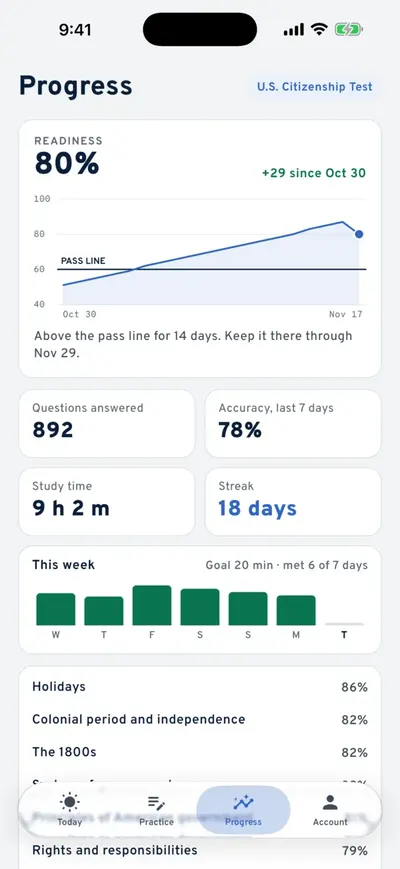 How the Citizenship Interview Works, Step by StepWhat happens at the USCIS naturalization interview, from the oath and N-400 review to the English and civics tests, the N-652 result and the oath ceremony.
- Topic explainer · U.S. Citizenship Test
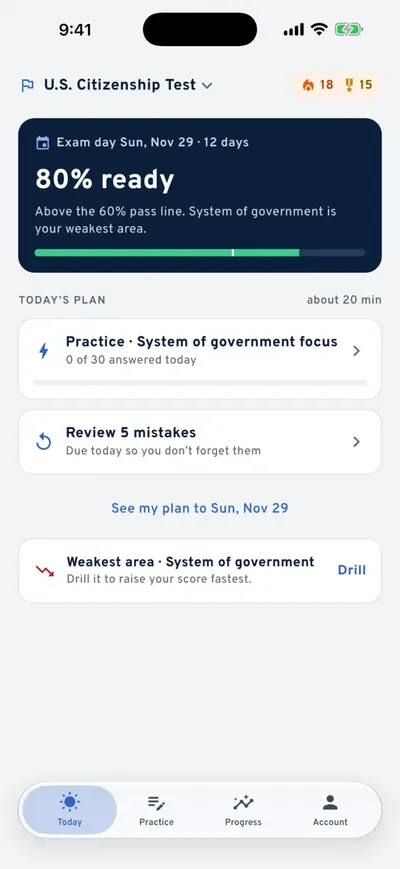 65/20 Civics Questions and Other Citizenship Test ExemptionsWho qualifies for the 65/20, 50/20 and 55/15 rules and the N-648 medical exception, the 20 starred 2025 civics questions, and how to pass with 6 of 10 correct.
- Topic explainer · U.S. Citizenship Test2025 vs 2008 Civics Test: What Changed and Which One You TakeThe 2025 civics test asks up to 20 of 128 questions and needs 12 right. The 2008 test asks up to 10 of 100 and needs 6. Your N-400 filing date decides which.