Series 63, 65 and 66 guideFree practice test
Series 65 practice test
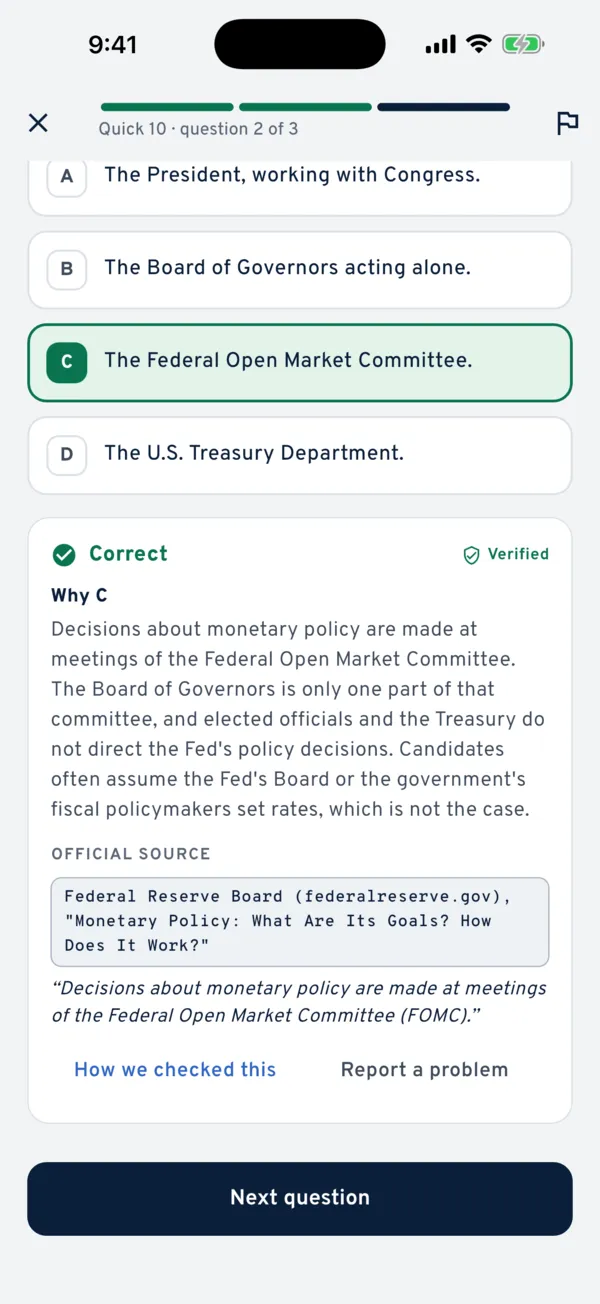
15 free Series 65 questions from the 798 in Clinched, chosen to match how the real test is weighted. Pick an answer to see the explanation and the official text it comes from. Nothing to sign up for.

-
Question 1 of 15Economic factors and business information
A client asks what rate of inflation the FOMC judges most consistent with both parts of the dual mandate, and how that rate is measured. The adviser should say it is:
Correct answer D. 2 percent per year, measured by the annual change in the price index for personal consumption expenditures.
The FOMC judges that low and stable inflation at the rate of 2 percent per year is most consistent with both parts of the dual mandate, and it measures that rate by the annual change in the price index for personal consumption expenditures. The Fed does not aim for zero inflation, and its stated measure of prices is the personal consumption expenditures index rather than the Consumer Price Index. Candidates commonly assume price stability means no inflation or that the CPI is the Fed's chosen yardstick.
Official source Federal Reserve Board (federalreserve.gov), "Monetary Policy: What Are Its Goals? How Does It Work?"The FOMC judges that low and stable inflation at the rate of 2 percent per year, as measured by the annual change in the price index for personal consumption expenditures, is most consistent with achievement of both parts of the dual mandate.
-
Question 2 of 15Economic factors and business information
A client asks how the Federal Reserve eases monetary policy when the economy weakens and the federal funds rate is well above zero. The adviser should say the Fed's primary means of easing is to:
Correct answer B. Lower its target for the federal funds rate.
Cutting the target for the federal funds rate is the Fed's primary means of easing monetary policy. The Fed does not set consumer loan or mortgage rates directly; it influences them through its policy rate. Tax and spending changes are fiscal policy, which is set by Congress and the President, not by the FOMC.
Official source Federal Reserve Board (federalreserve.gov), "Monetary Policy: What Are Its Goals? How Does It Work?"The FOMC's primary means of adjusting the stance of monetary policy is by changing its target for the federal funds rate.
-
Question 3 of 15Economic factors and business information
A client says a weaker dollar is simply bad for the U.S. economy. When an easing of monetary policy is accompanied by a fall in the exchange value of the dollar, the adviser should tell the client that U.S. products:
Correct answer B. Become cheaper than foreign products and gain market share at home and abroad.
A fall in the exchange value of the dollar lowers the relative price of U.S. products, so they gain market share both at home and against foreign goods abroad. A weaker dollar is therefore not simply harmful, since it helps U.S. producers compete. The other options either reverse the price effect or split the home and abroad markets incorrectly.
Official source Federal Reserve Board (federalreserve.gov), "Monetary Policy: What Are Its Goals? How Does It Work?"And to the extent that an easing of monetary policy is accompanied by a fall in the exchange value of the dollar, the prices of U.S. products will fall relative to those of foreign products so that U.S. products will gain market share at home and abroad.
-
Question 4 of 15Laws, regulations and ethics
An investment adviser's advisory agreement contains a provision stating that the client waives compliance with the Investment Advisers Act and the rules under it. The client signed the agreement. That provision is:
Correct answer B. Void and unenforceable against the client.
Any provision that binds a person to waive compliance with the Investment Advisers Act or the rules under it is void. Voluntary signature and written disclosure do not make such a waiver enforceable, and the adviser's continuing fiduciary duty does not allow the adviser to contract around the Act's requirements.
Official source 15 U.S.C. §80b-15(a) (Advisers Act §215)Any condition, stipulation, or provision binding any person to waive compliance with any provision of this subchapter or with any rule, regulation, or order thereunder shall be void.
-
Question 5 of 15Laws, regulations and ethics
A client bought shares directly from a privately held company in a private placement and asks the adviser whether the shares are restricted securities. The adviser should tell the client:
Correct answer C. The shares are restricted, having been acquired from the issuer in a transaction not involving a public offering.
Restricted securities include those acquired directly or indirectly from the issuer, or from an affiliate of the issuer, in a transaction or chain of transactions not involving a public offering, which covers this private placement. The label limits resale of the shares; it does not mean the holder can never sell them, and it does not turn on buying away from an exchange or on buying from another individual investor.
Official source 17 CFR §230.144Securities acquired directly or indirectly from the issuer, or from an affiliate of the issuer, in a transaction or chain of transactions not involving any public offering;
-
Question 6 of 15Laws, regulations and ethics
An investment adviser has no place of business in a particular state and, during the preceding 12-month period, has had five clients who are residents of that state. The state's securities regulator is considering requiring the adviser to register. Under the national de minimis standard, the state:
Correct answer C. May not require registration, and its anti-fraud provisions still apply.
A state cannot force registration when the adviser has no place of business in the state and had fewer than six clients resident there during the preceding 12-month period, and five clients falls below that number. The state may still apply its anti-fraud provisions to the adviser. Treating any single resident client as a trigger or using a five-client cutoff misstates the standard, and the state does not lose its anti-fraud reach.
Official source 15 U.S.C. §80b-18a(a) (Advisers Act §218A)or to comply with such law (other than any provision thereof prohibiting fraudulent conduct) if the investment adviser—
15 U.S.C. §80b-18a(a) (Advisers Act §218A)“(1) does not have a place of business located within the State; and (2) during the preceding 12-month period, has had fewer than 6 clients who are residents of that State.” -
Question 7 of 15Laws, regulations and ethics
An investment adviser representative wants to hold a client's funds and securities personally, and the client is willing to give written permission. Under the Uniform Securities Act, which statement about the representative's custody of client funds or securities is correct?
Correct answer D. The representative may hold them under the supervision of an investment adviser or a federal covered investment adviser.
An investment adviser representative may not have custody of client funds or securities except under the supervision of an investment adviser or a federal covered investment adviser, so client permission is not enough. The broker-dealer supervision rule covers an agent of a broker-dealer, not a representative of an adviser, and a bond or insurance is a separate requirement that does not authorize anyone to hold client assets.
Official source Minn. Stat. §80A.66an investment adviser representative may not have custody of funds or securities of a client except under the supervision of an investment adviser or a federal covered investment adviser.
-
Question 8 of 15Client recommendations and strategies
A client delivers a traditional IRA contribution to the custodian on January 20 and gives no instruction about which year the money is for. The custodian reports the contribution as:
Correct answer C. A contribution for the current year, the year the custodian received it
When a contribution is received between January 1 and April 15, the client should tell the custodian which year the money is for; if no instruction is given, the custodian can treat and report it for the current year, the year it was received. The custodian does not default to the prior year and does not choose the year based on which deduction is larger.
Official source IRS Publication 590-A, "Note:"If you don’t tell the sponsor which year it is for, the sponsor can assume, and report to the IRS, that the contribution is for the current year (the year the sponsor received it).
-
Question 9 of 15Client recommendations and strategies
A taxpayer contributed more to a Coverdell education savings account than is allowed for the year and wants to withdraw the excess, with the net income attributable to it, to avoid the 10% additional tax. The withdrawal must be made before:
Correct answer A. The first day of the sixth month of the following taxable year.
The excess contribution escapes the additional tax if it is distributed before the first day of the sixth month of the taxable year following the year of the contribution, provided the net income attributable to it comes out too. That net income is then included in gross income for the year the excess contribution was made, so the correction is neither tied to the end of the contribution year nor to the return due date.
Official source 26 U.S.C. §530(d)(4)(i) such distribution is made before the first day of the sixth month of the taxable year following the taxable year, and (ii) such distribution is accompanied by the amount of net income attributable to such excess contribution.
-
Question 10 of 15Client recommendations and strategies
A client who owns a Roth IRA is worried that the account will force a required distribution every year once the client reaches the required beginning date. The investment adviser representative should tell the client that:
Correct answer D. The mandatory distribution rules do not apply to a Roth IRA during the owner's lifetime
The required distribution rules that apply to traditional IRAs do not apply to a Roth IRA, so the owner is never forced to take a lifetime distribution. Assuming the Roth IRA works like a traditional IRA and simply pays the forced amounts tax-free is a common error. The exception also does not turn on how the Roth IRA was funded, so the conversion-only rule is wrong as well.
Official source 26 U.S.C. §408A(c)(3)Notwithstanding subsections (a)(6) and (b)(3) of section 408 (relating to required distributions), the following provisions shall not apply to any Roth IRA:
-
Question 11 of 15Client recommendations and strategies
An employee asks an investment adviser representative how a 401(k) plan at work is funded. The representative should explain that in this type of plan:
Correct answer D. The employee, the employer, or both contribute to an individual account.
A 401(k) is a defined contribution plan: the employee, the employer, or both put money into the employee's individual account, sometimes at a set rate such as a percentage of salary, and the account balance at retirement depends on contributions plus or minus investment gains or losses. Options describing a promised monthly benefit, pooled money run by managers the employer hires, or a benefit formula based on salary and years of service describe a defined benefit pension plan, where the employer carries the investment risk.
Official source Investor.gov, "Employer-Sponsored Plans"In these plans, you or your employer (or both) contribute to your individual account under the plan, sometimes at a set rate, such as 5% of your annual salary.
-
Question 12 of 15Investment vehicles
A client sees a quant fund that is labeled as an index fund but does not follow the S&P 500 and asks how that is possible. The adviser should explain that the fund:
Correct answer C. Builds a custom index using numerical methods such as algorithms instead of tracking a standard published market index.
A quant fund is a non-traditional index fund: its custom-built index uses numerical methods such as quantitative analysis or algorithms to select investments, so it need not match any standard published benchmark. The word "index" in the fund's name does not mean it tracks a well-known index, and the fund does follow an index, just one it creates itself, rather than screening a standard index for environmental traits.
Official source Investor.gov, "Smart Beta, Quant Funds and other Non-Traditional Index Funds", "What are some examples of non-traditional index funds?"Quant Funds – The custom-built indexes for these funds use numerical methods like quantitative analysis or algorithms to select the fund’s investments.
-
Question 13 of 15Investment vehicles
A client receives a mutual fund's disclosure documents describing the fund and its investment policies. The client asks what the purpose of this disclosure is. The adviser should say it is meant to:
Correct answer C. Inform the public about the fund, its objectives, and its operations.
The focus is disclosure to the investing public of information about the fund and its investment objectives, as well as investment company structure and operations, so investors can evaluate the fund for themselves. Disclosure is not a finding by the SEC that the objectives are sound, it does not give the SEC control over portfolio decisions, and it does not take the place of registering the fund's shares when they are first sold.
Official source Investor.gov, "The Laws That Govern the Securities Industry", "Investment Company Act of 1940"The focus of this Act is on disclosure to the investing public of information about the fund and its investment objectives, as well as on investment company structure and operations.
-
Question 14 of 15Investment vehicles
A client holds shares in a money market fund that seeks to keep its net asset value at a stable $1.00 per share and asks whether the share price can ever fall below $1.00. The investment adviser representative should tell the client that:
Correct answer D. The fund must re-price if the NAV per share deviates by more than half a cent from $1.00.
When a stable NAV fund's NAV per share deviates by more than half a cent from $1.00, the fund must re-price its shares to something other than $1.00, an event known as breaking the buck. A stable NAV is a price target rather than a guarantee, one full cent is not the threshold, and floating NAV funds are not the only ones that can trade below $1.00.
Official source Investor.gov, "Money Market Funds"If a stable NAV money market fund’s NAV per share deviates by more than half a cent from $1.00, the fund must re-price its shares to something other than $1.00.
Investor.gov, "Money Market Funds"“This is known as “breaking the buck” and could happen when a money market fund is exposed to substantial losses from some of its holdings.” -
Question 15 of 15Investment vehicles
A client asks which federal securities law governs the conduct of investment advisers and the representatives who work for them. The adviser should identify the:
Correct answer D. Investment Advisers Act of 1940.
The Investment Advisers Act of 1940 is the federal statute aimed at investment advisers, so it is the law that governs adviser conduct and registration. The Investment Company Act of 1940 governs the funds advisers may recommend, the Securities Exchange Act of 1934 governs broker-dealers and the markets, and the Trust Indenture Act of 1939 deals with debt securities issued under an indenture.
Official source Investor.gov, "The Laws That Govern the Securities Industry"Investment Advisers Act of 1940
Want the other 783?
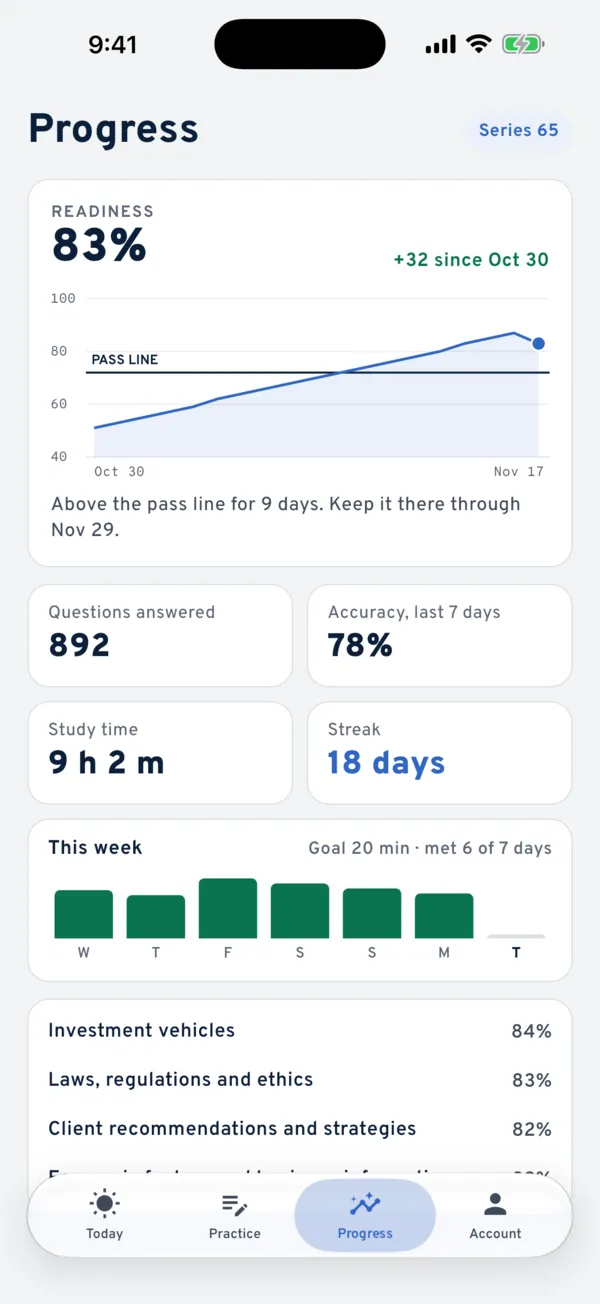
Clinched has every Series 65 question in this format, with full practice tests that match the real one, a readiness score by area and a plan to your test date. Free to start with 10 questions a day.
Read the Series 63, 65 and 66 guide or see how we write and check every question.
Free on the App Store
Your exam, in your pocket.
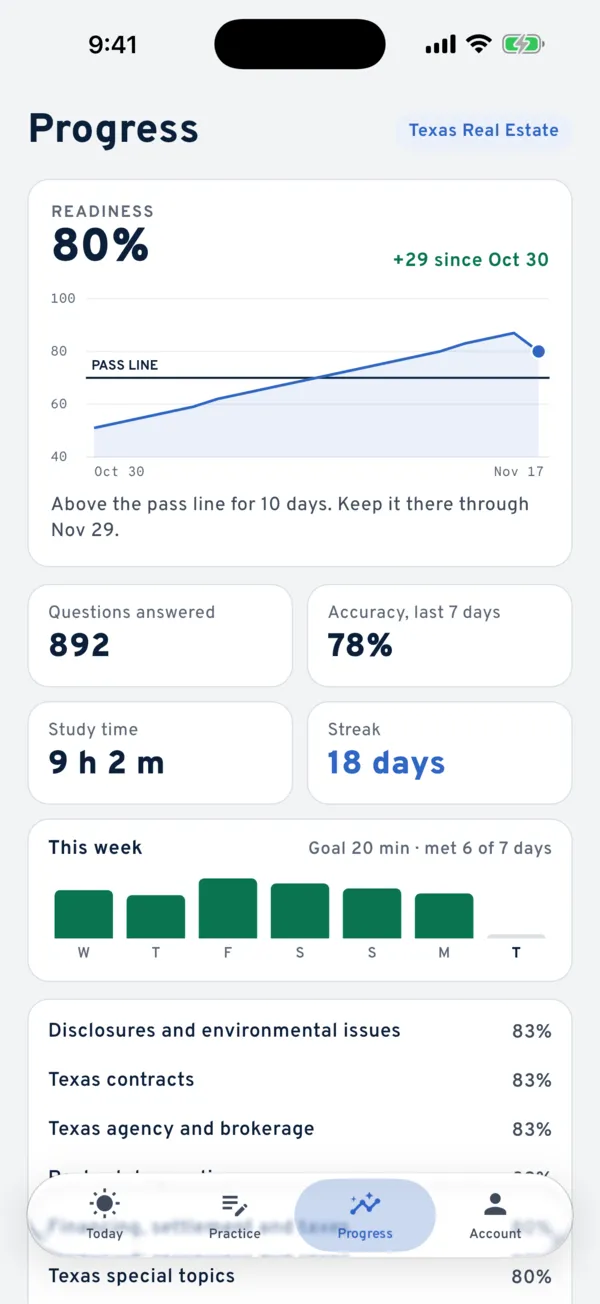
20 exams ready with questions written from the official sources, timed practice tests in the real format and a readiness score with a pass line.
On your computer?
Scan with your iPhone camera to get Clinched practice in the app.