

Exam guideSeries 63, 65 and 66
Series 65 vs Series 66: Which One Should You Take?
Short answer
Take the Series 66 if you hold or will hold a Series 7 and need both state agent and investment adviser registration, since it replaces the Series 63 and 65 in one 150-minute exam with 100 scored questions. Take the Series 65 (130 scored questions, 180 minutes, $187) if you'll only give fee-based advice or won't keep a Series 7.
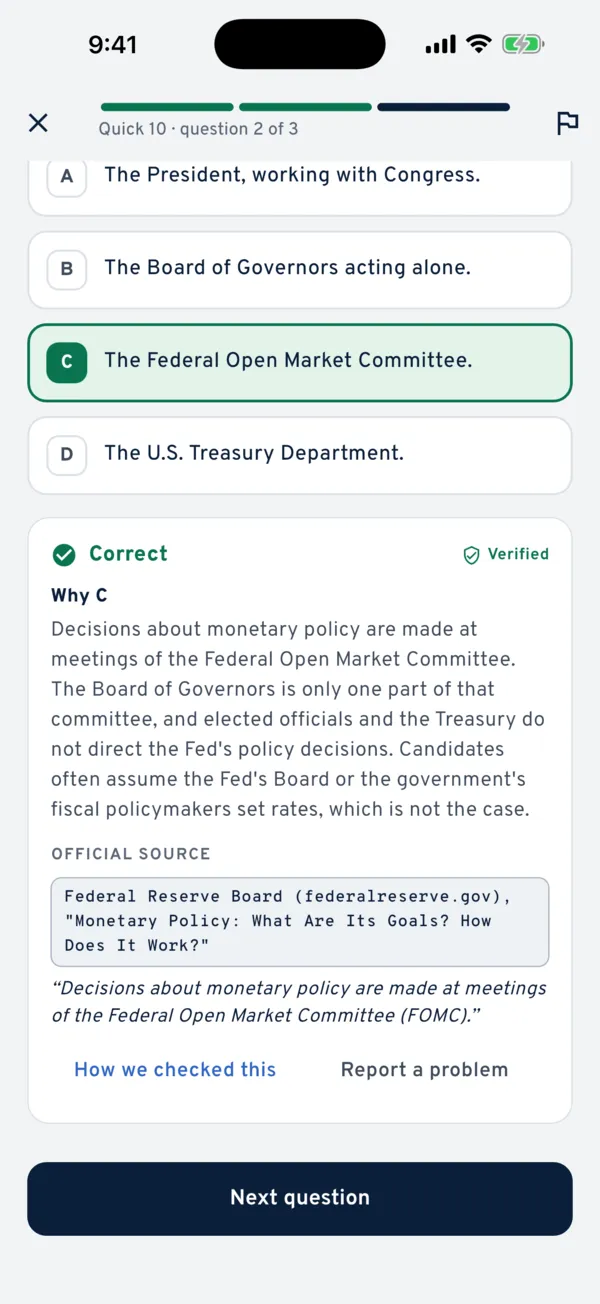
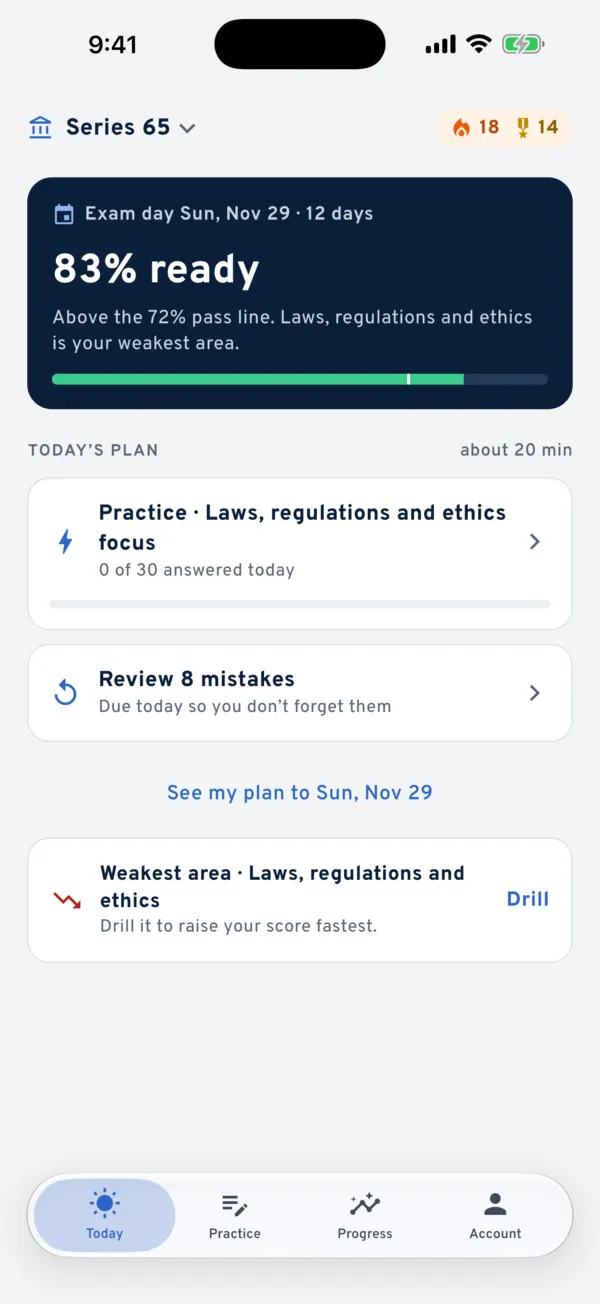
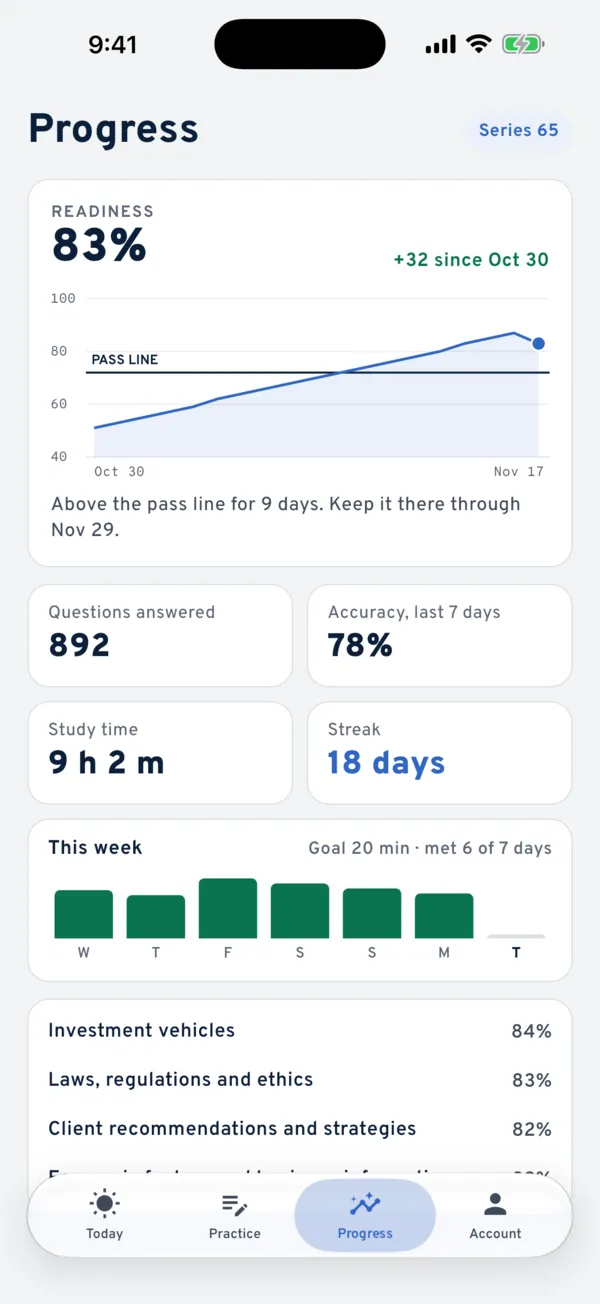
If you’ll hold a Series 7 and need to be registered both as a securities agent and as an investment adviser representative, take the Series 66. If you’ll only give advice for a fee and won’t hold a Series 7, take the Series 65. That’s the short version. The details below matter if your career might change direction.
The two exams side by side
| Series 65 | Series 66 | |
|---|---|---|
| Scored questions | 130 | 100 |
| Unscored pretest | 10 | 10 |
| Time | 180 minutes | 150 minutes |
| Correct answers to pass | 92 | 73 |
| Fee | $187 | $177 |
| Co-requisite | None | SIE and Series 7 |
| Qualifies you as | Investment adviser representative | Agent and investment adviser representative (with a Series 7) |
All figures are from FINRA’s exam pages for each series.12
What each one is for
The Series 65 is the Uniform Investment Adviser Law Exam. It’s the standalone qualification for investment adviser representatives, people who give investment advice for a fee at a registered investment adviser.1 It has no co-requisite, so you don’t need any other license to use it.1
The Series 66 is the Uniform Combined State Law Exam. It covers the state agent law from the Series 63 and the adviser material from the Series 65, but it leans on the Series 7 for product knowledge.2 FINRA lists the SIE and Series 7 as its co-requisites.2 That means a Series 66 pass only works together with a Series 7.
How the content differs
The Series 65 is mostly investments. Its four sections are economic factors and business information (15%), investment vehicle characteristics (25%), client investment recommendations and strategies (30%), and laws, regulations and guidelines (30%).3 70% of the scored questions are investment content.
The Series 66 flips that. Under NASAA’s June 2023 specifications, it’s economic factors 8%, investment vehicles 17%, client recommendations and strategies 30%, and laws, regulations and guidelines 45%.4 It assumes you already learned the products for the Series 7, so it spends its questions on state law and ethics.
So which is harder depends on you. If you’re strong on products and portfolio math but haven’t studied state law, the 65 plays to your strengths. If you’ve just passed the Series 7 and know the products cold, the 66’s heavy law section is the only new ground.
Who should take the Series 66
Dually registered representatives. If your firm is both a broker-dealer and an investment adviser and you’ll earn commissions and advisory fees, you need agent registration and adviser representative registration in each state. The Series 7 plus the Series 66 covers both in one state exam.2
Series 7 holders who’d otherwise take the 63 and 65. The 66 is one sitting of 150 minutes.2 The Series 63 plus the Series 65 is two exams, 75 plus 180 minutes, and two fees.61
Who should take the Series 65
Advisers at fee-only firms. If you work at a registered investment adviser and won’t sell commission products, you don’t need a Series 7, and the Series 65 is the only exam you need.1
People who might leave the broker-dealer world. This is the case people miss. Your Series 66 depends on your Series 7. If you leave a broker-dealer and your Series 7 registration lapses, the 66 can’t carry your adviser registration on its own, and you may end up taking the 65 anyway. If there’s a real chance you’ll move to a fee-only adviser in the next few years, taking the Series 65 now (and the 63 if you need it) protects you.
People without a sponsor. None of the NASAA exams needs a sponsoring firm.5 But the Series 7 does, so the 66 is only useful once a broker-dealer has sponsored your 7. If you’re building a career on your own as an adviser, the 65 is the one you can take start to finish without anyone’s help.
Professional designations
Under NASAA’s model rule, holders of the CFP, ChFC, CFA, PFS or CIMA designations who are in good standing can have the Series 65 requirement waived, in states that adopt the rule.5 A designation only waives the Series 65. It doesn’t help with the Series 66 or the Series 63.5 If you already hold one of those designations, check with your state securities regulator before you register for any exam.
Passing scores in context
The two exams use a fixed number of correct answers, not a scaled score. On the Series 65 you need 92 of 130 scored questions, which is just under 71%.1 NASAA lowered that cutoff from 94 when its current test specifications took effect on June 12, 2023.3 On the Series 66 you need 73 of 100, or 73%.2
The 10 unscored pretest questions on each exam are mixed in without labels, so you’ll answer 140 questions on the 65 and 110 on the 66.12 That’s about 77 seconds per question on the 65 and 82 on the 66. Neither exam is a race, but the 65’s long scenario questions about portfolios and retirement plans take time to read.
A content change coming in 2027
NASAA adopted model rule amendments on investment adviser advertising in May 2026 and is updating exam questions affected by them, with the update planned for early 2027 and the exact date still to come.3 That matters more for the 65 and 66 than for the 63, since adviser advertising is adviser territory. If you’re studying with materials printed before mid 2026, check that they cover the current advertising rules once NASAA announces the date.
Timing and retakes
Both exams use the same NASAA retake rules. The wait is 30 days after a first or second failure. After a third failure, it has been 180 days, but NASAA cuts it to 60 days for exam windows opened on or after January 4, 2027.12 NASAA also says it will stop offering remote testing for these exams on that same date, so plan to test at a Prometric center.5
A practical study note. The Series 65 takes most people five to eight weeks. The Series 66 takes most Series 7 holders four to five weeks, and the best time to take it is right after the Series 7, while the products are still fresh.
Our Series 63, 65 and 66 guide covers all three exams in more depth, and which securities licenses you need maps the full path from the SIE onward. Clinched has courses for both the 65 and the 66, with every explanation quoting the statute or rule it’s based on.
Questions people ask
Can you take the Series 66 without the Series 7?
You can sit for it, but it won't qualify you for anything without a Series 7. FINRA lists the SIE and Series 7 as co-requisites for the Series 66, so a 66 on its own doesn't support agent or adviser registration.
Is the Series 65 or 66 harder?
The Series 65 is longer and broader, with 130 scored questions and more investment content. The Series 66 is shorter but 45% law and regulation, which many people find denser. Series 7 holders usually find the 66 more manageable.
Does a CFP waive the Series 66?
No. Under NASAA's model rule, designations like the CFP, ChFC, CFA, PFS and CIMA can waive only the Series 65 requirement, in states that follow the rule.
Sources
ClinchedSeries 63, 65 and 66
Pass Series 63, 65 and 66 on the first try.
Practice questions written from the official sources, full practice tests in the real format and a plan that ends on your test date. Free to start.
Keep reading
- After the exam · SIE · Series 7
 Which Securities Licenses Do You Need, and in What Order?Most brokers need the SIE, Series 7 and Series 63. Advisers need the Series 65. Dual reps add the Series 66. The order, costs and sponsor rules for each license.
- Exam guide · SIE · Series 7
 FINRA and NASAA Retake Waiting Periods Change in January 2027FINRA cuts SIE and Series 7 retake waits to 15 and 60 days on January 19, 2027. NASAA cuts the third-failure wait to 60 days on January 4. What changes for you.
- Exam guide · SIE · Series 7
 SIE vs Series 7: How the Two FINRA Exams Fit TogetherThe SIE has 75 scored questions and needs no sponsor. The Series 7 has 125 and needs a firm. How they differ in content, cost and difficulty, and which comes first.