Property and Casualty Insurance guideFree practice test
Texas Property and Casualty practice test
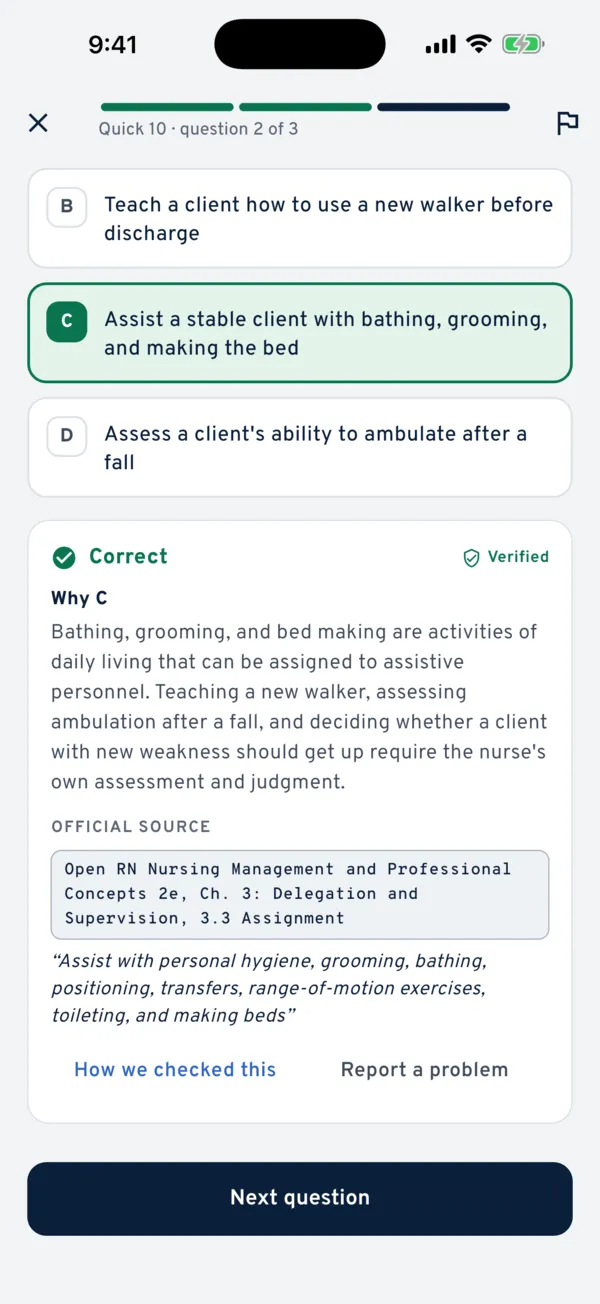
15 free Texas Property and Casualty questions from the 452 in Clinched, chosen to match how the real test is weighted. Pick an answer to see the explanation and the official text it comes from. Nothing to sign up for.
-
Question 1 of 15Personal and business auto concepts
An insurer decides it will not continue a personal auto policy when the current policy period ends. The insured asks the agent how this differs from having the policy cancelled. What does the agent explain?
Correct answer C. The policy terminates at its normal expiration date
A non-renewal is the termination of a policy at its normal expiration date, so the coverage simply runs to the end of the period already paid for. A cancellation ends the policy before that date, and a rescission wipes out the policy back to its effective date with all premium returned. The insurer's decision not to renew does not leave the policy in force indefinitely.
Official source CDI, Auto Insurance Terms, part 4Non-Renewal - The termination of an insurance policy at its normal expiration date.
-
Question 2 of 15Insurance basics and contract law
An applicant owns a commercial building jointly with a business partner and wants the policy to cover the applicant's share of the property. What must the policy state about the applicant's ownership?
Correct answer D. The insured's interest in the property
When the insured is not the absolute owner of the property, the policy must state the insured's interest in it, so the applicant's partial share is identified on the policy. A property policy is not written on the building in a vacuum, and the lender's loan balance and the whole building value are not substitutes for describing what the insured actually owns.
Official source Cal. Ins. Code §381(c) The interest of the insured in property insured, if he is not the absolute owner thereof.
-
Question 3 of 15Surety and fidelity bonds
A contractor submits a bid on a project and must furnish a bid bond along with the bid. What does the bid bond ensure?
Correct answer A. Full payment and performance bonding from the bidder
A bid bond ensures full payment and performance bonding from the contract bidder, which is what the project owner needs before accepting a bid. Completion of the contract is what a performance bond ensures, payment to suppliers and subcontractors is what a payment bond ensures, and maintenance items fall under an ancillary bond.
Official source SBA, Surety bonds, part 2Ensures full payment and performance bonding from the contract bidder.
-
Question 4 of 15Commercial property, business income and liability
A customer is injured while shopping in a retail store and threatens to sue the owner. The owner wants to look into the incident and work out a settlement with the customer before telling the insurer anything. What does the commercial liability policy require of the owner?
Correct answer C. The owner must turn the claim over to the broker-agent or the insurer promptly.
The policy requires the insured to report claims in a timely manner, and the insured's own handling of a claim violates those contractual duties and can end up costing far more. Waiting for a written demand or an actual lawsuit is not permitted, and settling first defeats the insurer's chance to investigate early.
Official source CDI, Commercial Insurance guide (2024), p. 8 (part 2/3)This is why it is necessary to turn all claims over to your broker-agent or insurance company as soon as you are made aware of the claim. Trying to handle the claim yourself violates your duties under the insurance contract and can be costly to you in the long run.
-
Question 5 of 15Homeowners, renters and dwelling coverage concepts
A homeowner asks the agent whether a replacement cost policy can pay more than the dwelling limit when rebuilding costs run higher than expected. How does the agent describe these policies?
Correct answer B. Some pay the limit plus a percentage above it
Replacement cost policies are not all alike: some will pay the policy limit plus a certain percentage above that limit, which helps when rebuilding costs exceed the limit. A limit is therefore not an absolute ceiling on every replacement cost policy, and market value including land and the mortgage balance are measures of value or debt, not of rebuilding cost.
Official source CDI, Residential Insurance: Homeowners and Renters guide (2024), p. 7 (part 1/2)Other types of replacement cost policies will pay your policy limits, plus a certain percentage above those limits.
-
Question 6 of 15Policy structure, conditions and claims
A fire badly damages an insured home. The homeowner tells the agent that he will simply turn the property over to the insurer and collect the full policy limit. How does the policy respond?
Correct answer B. The insured may not abandon the property to the insurer.
The policy provides that there can be no abandonment of property to the insurer, so the insured keeps the damaged property and the claim is measured under the policy's loss provisions instead. The 30-day window belongs to the insurer, which may choose to take the property at an agreed or appraised value, and filing a proof of loss does not hand the property over either.
Official source Cal. Ins. Code §2071 (part 7/8)There can be no abandonment to this company of any property.
-
Question 7 of 15Policy structure, conditions and claims
Wind opens a gap in an insured's roof, and the insured does nothing to cover it. Rain the next day soaks the ceilings and interior walls. How does the homeowners policy respond to the interior water damage?
Correct answer C. The insurer may not cover the interior damage because the insured did not take reasonable steps to protect the property from further harm
A homeowners policy may not cover ensuing damage when the insured has not taken reasonable steps to protect the property from further damage. The wind being the originating cause, water damage appearing on a list of coverages, or treating the interior damage as a separate loss does not excuse the duty to protect the property.
Official source CDI, Residential Claims Guide (2023), p. 1 (part 1/2)Homeowners insurance policies may not cover ensuing damage to your property if you have not taken reasonable steps to secure the property from subsequent damage.
-
Question 8 of 15Flood, terrorism and other property coverages
A flood policy settles a covered loss to an insured's damaged furnishings on an actual cash value basis. How is that amount determined?
Correct answer D. The cost to replace the damaged property at the time of loss, less physical depreciation
Actual cash value is defined as the cost to replace an insured item of property at the time of loss, less the value of its physical depreciation. Replacement cost, by contrast, pays to replace the item without deducting for depreciation, and market value or original purchase price are different measures that the policy does not use.
Official source 44 CFR Part 61, Appendix A(1) (part 2/39)Actual Cash Value. The cost to replace an insured item of property at the time of loss, less the value of its physical depreciation.
-
Question 9 of 15Flood, terrorism and other property coverages
A mortgage loan is secured by a home in a special flood hazard area and by a detached shed on the same lot that is not used as a residence. How does the flood insurance requirement apply to the shed?
Correct answer A. It is not required for the shed, because the shed does not serve as a residence
Flood insurance is not required for a structure that is detached from the primary residential structure and does not serve as a residence, even when it sits on residential property that secures the loan. The fact that the shed secures the loan, stands on the same lot, or is detached does not by itself create a requirement.
Official source 42 U.S.C. §4012a (part 6/13)Notwithstanding any other provision of this section, flood insurance shall not be required, in the case of any residential property, for any structure that is a part of such property but is detached from the primary residential structure of such property and does not serve as a residence.
-
Question 10 of 15Texas statutes common to all lines
A Texas agent is found to have violated a rule of the commissioner. Which of these may the Texas Department of Insurance do to the agent?
Correct answer C. Reprimand the agent
The department's remedies for a violation include reprimanding a license holder, placing a suspended license holder on probation, and assessing an administrative penalty. A criminal fine is imposed by a court, not by the department, and the department does not order an agent to pay a claim. Appointments are a matter between the agent and the insurer.
Official source Texas Insurance Code §4005.102In addition to any other remedy available under Chapter 82, for a violation of this code, another insurance law of this state, or a rule of the commissioner, the department may:
Texas Insurance Code §4005.102“(5) reprimand a license holder; or” -
Question 11 of 15Texas statutes common to all lines
An individual is issued a general property and casualty license in an even-numbered year. On what date does that license expire?
Correct answer D. On the license holder's birthday in each even-numbered year
An individual license issued or renewed in an even-numbered year expires on the license holder's birthday each even-numbered year, and one issued in an odd-numbered year follows the odd-numbered years. The expiration is tied to the holder's birthday, not to the end of the calendar year. The second-anniversary rule applies to a license issued to a person that is not an individual.
Official source Texas Insurance Code §4003.001(A) for a license issued or renewed in an even-numbered year, the individual license holder ’s birthday each even-numbered year; or
-
Question 12 of 15Texas statutes pertinent to property and casualty
An applicant buys a personal automobile policy for a term of 14 days and receives a document evidencing proof of purchase. The applicant asks the agent whether that document can be used to register a vehicle and obtain license plates. What does the agent tell the applicant?
Correct answer A. It cannot be used for a license, registration, plates or an inspection certificate
A policy or proof document written for a term of less than 30 days may not be used to obtain an original or renewal driver's license, an automobile registration or license plates, or a motor vehicle inspection certificate. The prohibition covers all of those uses, so it is not limited to driver's licenses, and no shorter term such as 14 days makes the document acceptable.
Official source Texas Insurance Code §1952.054An insurance policy or other document evidencing proof of purchase of a personal automobile insurance policy written for a term of less than 30 days may not be used to obtain an original or renewal driver ’s license, an automobile registration or license plates
-
Question 13 of 15Texas statutes pertinent to property and casualty
An applicant asks an agent whether a coastal property sits in the territory the Texas Windstorm Insurance Association serves. Which areas make up the seacoast territory?
Correct answer D. The first tier coastal counties and the second tier coastal counties
The seacoast territory is composed of the first tier coastal counties together with the second tier coastal counties, so it reaches inland beyond the counties that touch the Gulf. It is not a statewide program, and the eligible territory is fixed by statute rather than by the association's plan of operation.
Official source Texas Insurance Code §2210.003 (part 2/2)(10) "Seacoast territory" means the territory of this state composed of the first tier coastal counties and the second tier coastal counties.
-
Question 14 of 15Workers' compensation and employers liability
An employee is hurt at the employer's warehouse while moving inventory. The employer asks the agent what makes the injury a compensable injury under workers' compensation.
Correct answer B. It must arise out of and in the course and scope of employment.
A compensable injury is one that arises out of and in the course and scope of employment and for which compensation is payable. Being on the premises during working hours is not enough by itself, fault by the employer or a co-worker is not the test, and the timing of a report does not decide compensability.
Official source Texas Labor Code §401.011 (part 1/7)"Compensable injury" means an injury that arises out of and in the course and scope of employment for which compensation is payable under this subtitle.
-
Question 15 of 15Workers' compensation and employers liability
An employee is hurt on the job and is treated at a clinic the same day. The insurance carrier does not accept the claim until several weeks later. From what point are the employee's medical benefits payable?
Correct answer D. From the date of the compensable injury, so the treatment on the day of the injury is covered.
Medical benefits for a compensable injury are payable from the date of the injury, so care received on the day of the injury is covered even though the carrier's acceptance comes later. Approval or recommendation by the treating doctor is required for non-emergency care, but that condition does not change the start date of benefits.
Official source Texas Labor Code §408.021Medical benefits are payable from the date of the compensable injury.
Want the other 437?
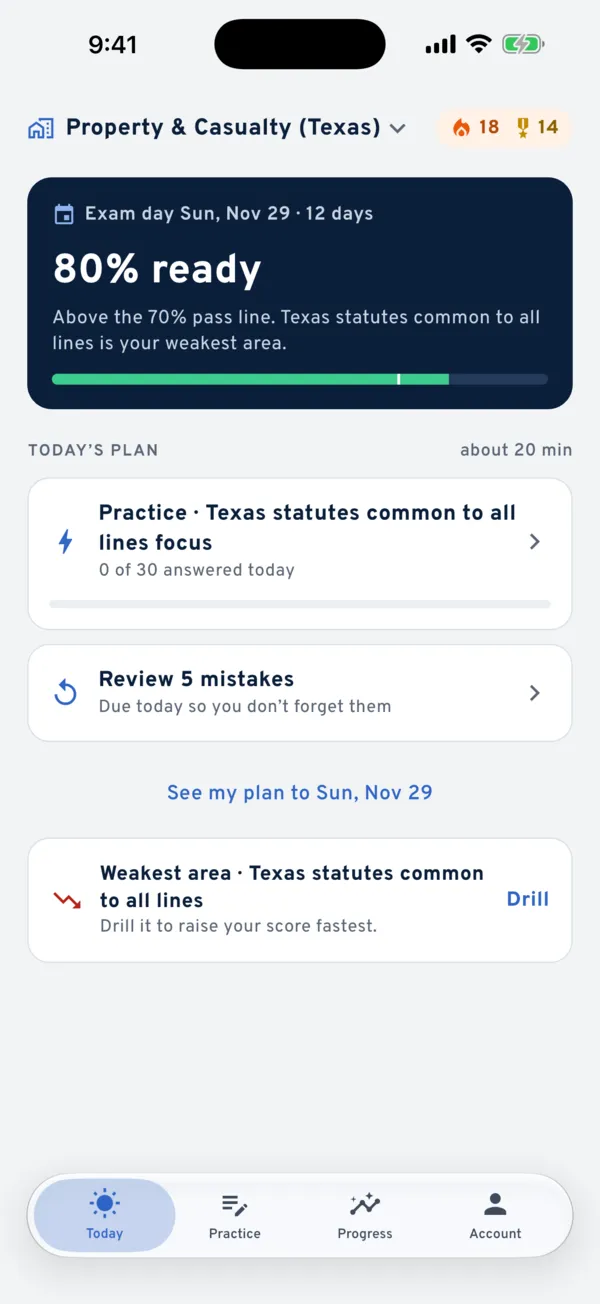
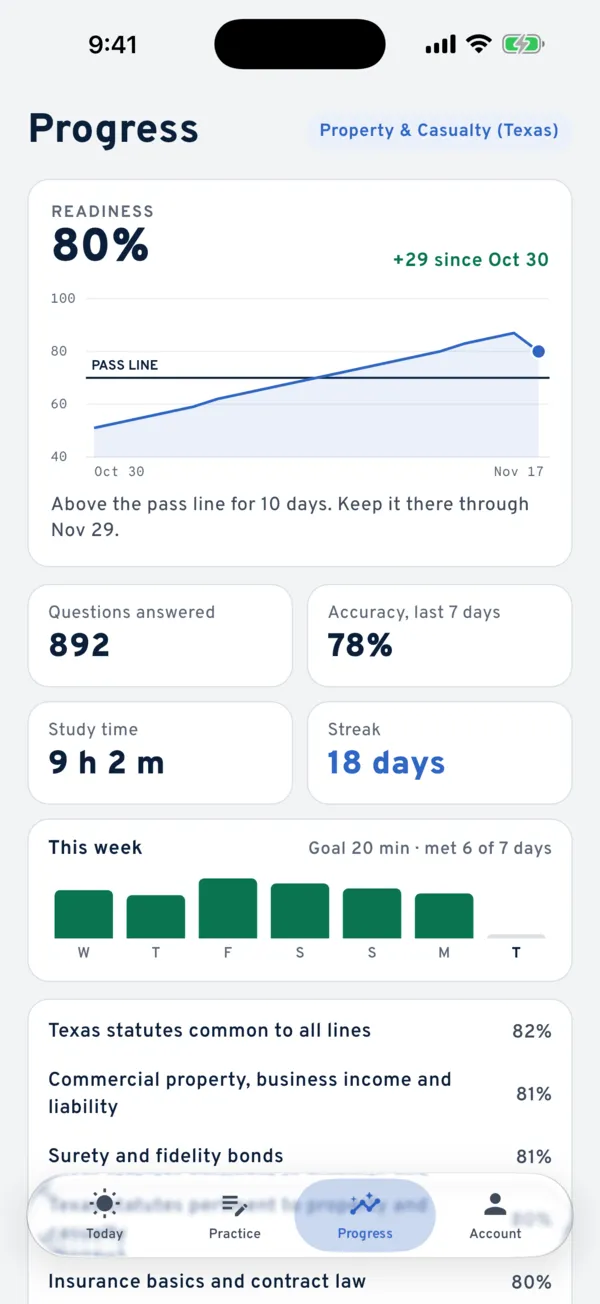
Clinched has every Texas Property and Casualty question in this format, with full practice tests that match the real one, a readiness score by area and a plan to your test date. Free to start with 10 questions a day.
Read the Property and Casualty Insurance guide or see how we write and check every question.
Free on the App Store
Your exam, in your pocket.
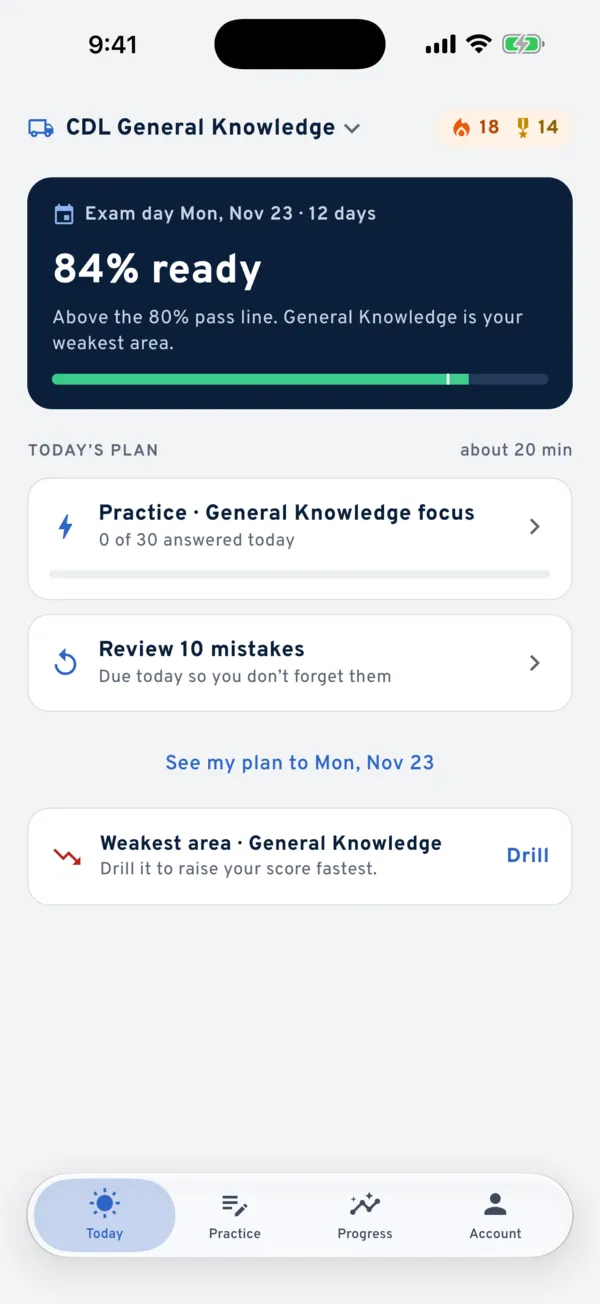
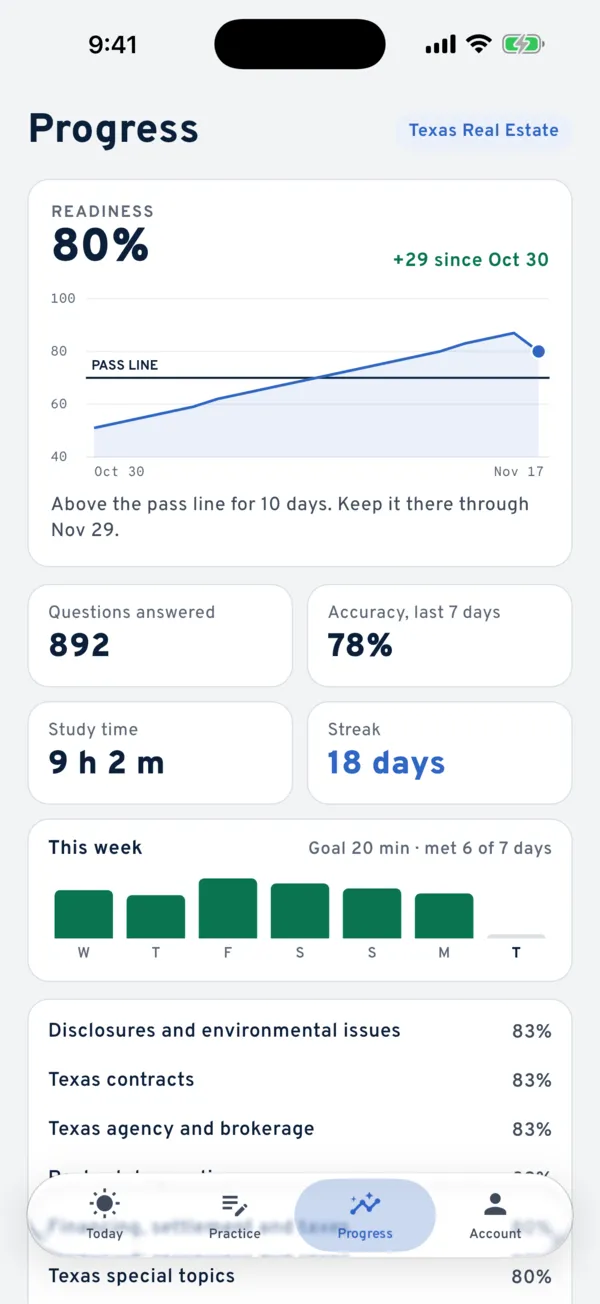
20 exams ready with questions written from the official sources, timed practice tests in the real format and a readiness score with a pass line.
On your computer?
Scan with your iPhone camera to get Clinched practice in the app.