

Study planProperty and Casualty Insurance
Property and Casualty Exam Study Plan: 5 Weeks to Test Day
Short answer
Plan on about five weeks after your pre-licensing course, at an hour a day. Texas's P&C exam, for example, has 100 general questions split evenly between property and casualty plus 30 state law questions, so give each half its own week and save the last week for full timed practice exams.
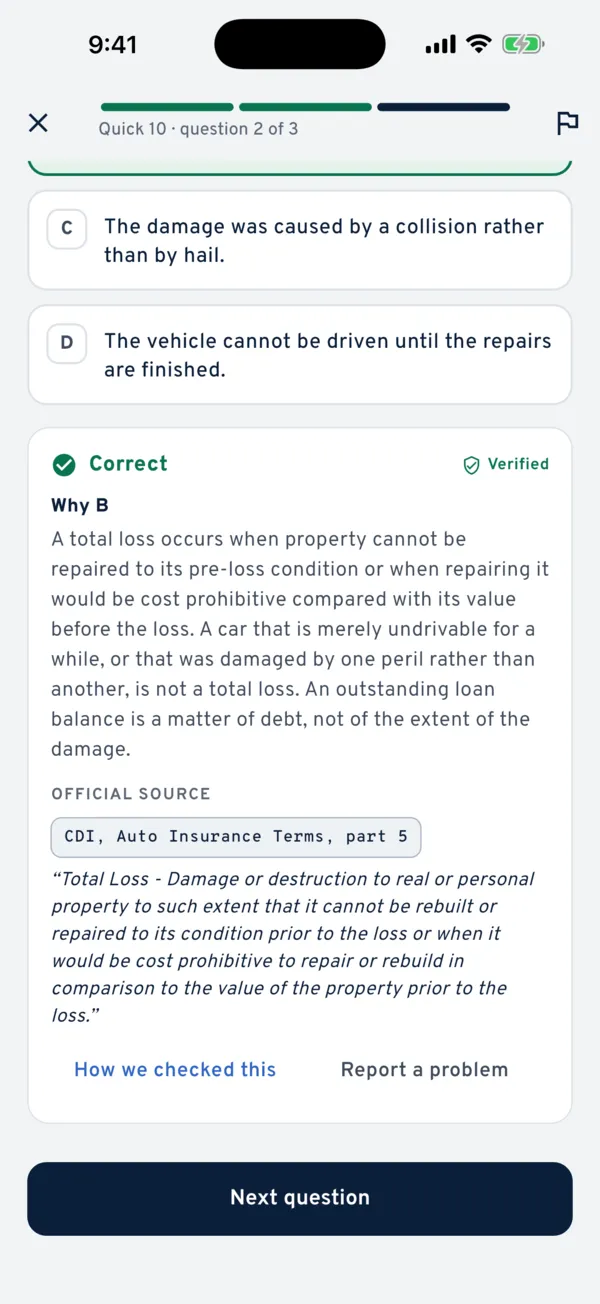
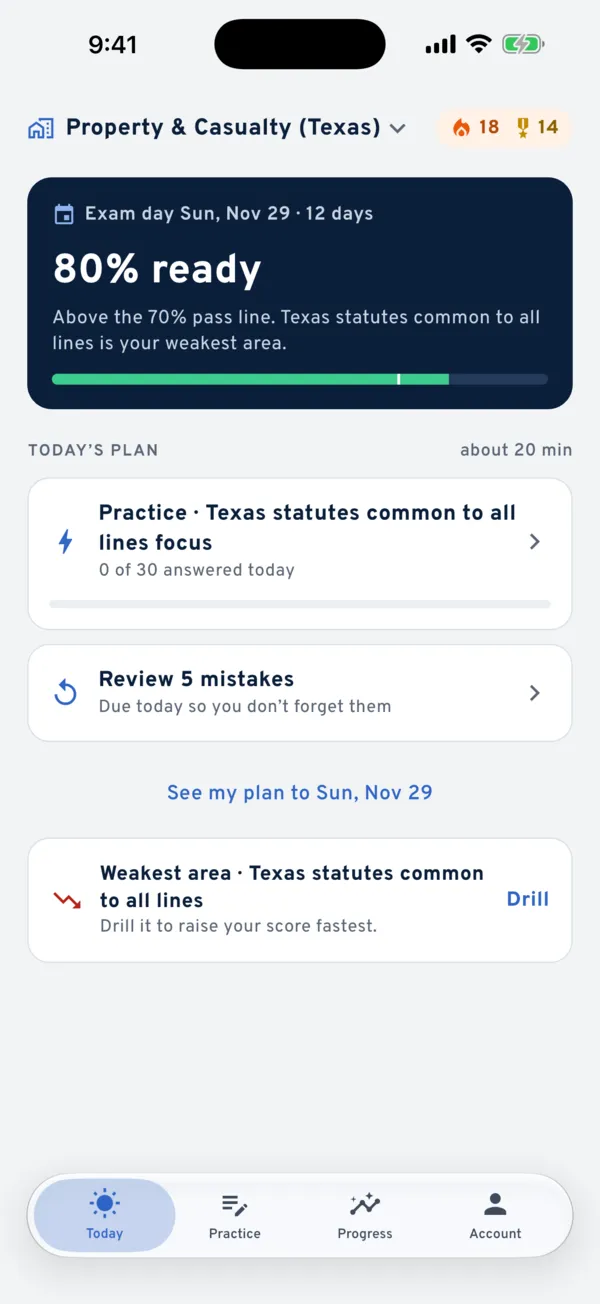
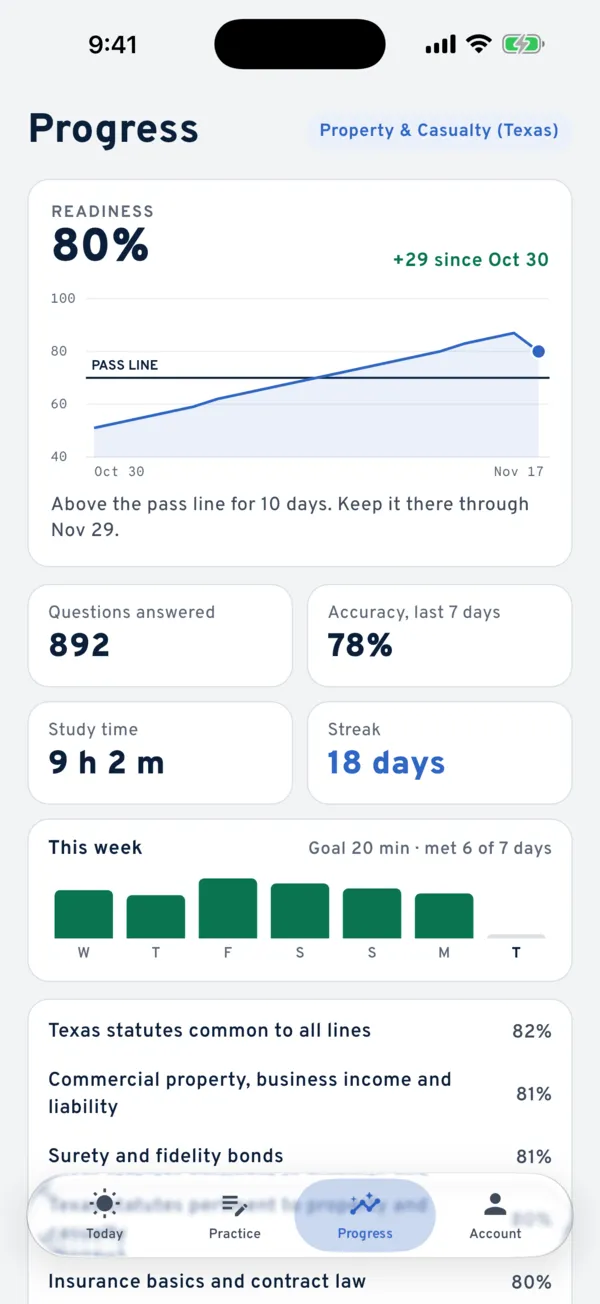
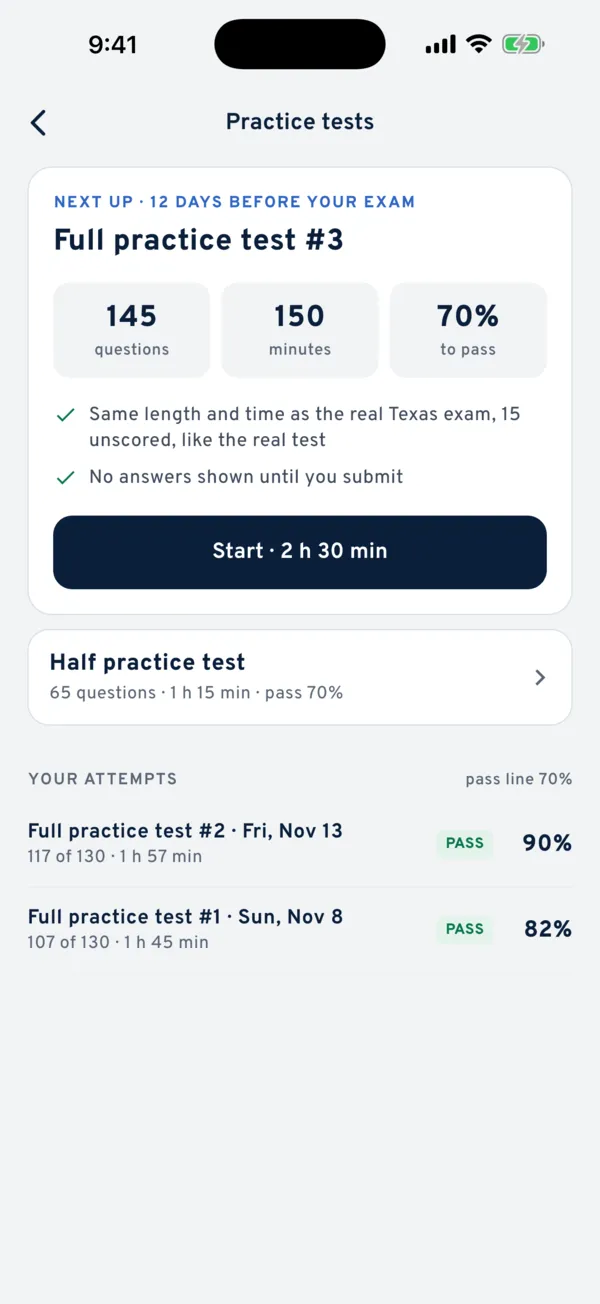
Give yourself five weeks after your pre-licensing course, at about an hour a day on weekdays and a longer session on weekends. That’s enough for most people to pass the property and casualty exam on the first try. The plan below follows the Texas outline because it’s detailed and typical, and you can map it onto your state’s outline in a few minutes.
Know what you’re studying for
The Texas P&C exam has 100 scored general questions and 30 scored state questions.1 The general half splits almost evenly.1
| Section | Scored questions |
|---|---|
| Property policy types | 22 |
| Property terms and concepts | 15 |
| Property provisions and contract law | 13 |
| Casualty policy types, bonds and terms | 23 |
| Casualty terms and concepts | 15 |
| Casualty policy provisions | 12 |
| Texas law (common and P&C specific) | 30 |
Two things stand out. Policy types are the biggest category on both sides, and state law is almost a quarter of the scored questions. Plan accordingly.
It’s also not an easy exam. In February 2021, the Texas Department of Insurance reported that 53% of candidates passed property and casualty.3
The five-week plan
- Week 1Foundations. Insurance terms (risk, hazard, peril, indemnity, insurable interest, law of large numbers), elements of a contract, and how every policy is built (declarations, insuring agreement, conditions, exclusions). Take a diagnostic test on day 7.
- Week 2Property. Homeowners forms, dwelling forms, loss valuation (actual cash value, replacement cost), coinsurance, inland marine, flood and commercial property. Ten coinsurance problems every day.
- Week 3Casualty. The personal auto policy, commercial general liability, workers compensation and employers liability, umbrella, businessowners policy, crime, bonds and professional liability.
- Week 4Provisions and state law. Duties after loss, subrogation, appraisal, other insurance, cancellation and nonrenewal, then your state's licensing rules, residual markets and auto minimums.
- Week 5Two full timed practice exams, three days apart. Review every miss, rework your weakest section, then book the test.
Week 1. Foundations
Don’t skip this week because the terms look easy. The Texas outline lists hazard, peril, moral and morale hazard, pure versus speculative risk and the law of large numbers.1 Exam questions on these terms are written so that two answers sound right. Learn the exact definitions.
The policy structure matters just as much. Declarations, insuring agreement, conditions and exclusions appear on both the property and casualty sides of the outline.1 If you understand how a policy is built, every specific form becomes easier.
Week 2. Property
Homeowners forms are the center of this week. Learn which form covers what, on a named perils or open perils basis, and which ones are for renters and condo owners. Texas also tests the dwelling forms and the National Flood Insurance Program.1
Coinsurance is the calculation you’ll see most. Divide the insurance carried by the insurance required (the coinsurance percentage times the property’s value), multiply by the loss, then subtract the deductible. Do ten problems a day until you can do one in under a minute. Pair that with actual cash value versus replacement cost, which the outline lists under loss valuation.1
Week 3. Casualty
Start with the personal auto policy. Liability, medical payments, physical damage (collision and other than collision), uninsured and underinsured motorists, who is an insured and the exclusions are all on the outline.1 Most auto questions are scenarios. Read who was driving, whose car it was and what was damaged, then decide which part of the policy responds.
Then commercial lines. Commercial general liability, business auto, workers compensation, crime, bonds, professional liability, umbrella and the businessowners policy are all listed.1 People who only studied personal lines struggle here. Know occurrence versus claims-made coverage triggers, and know what the CGL’s separate coverage parts each pay for.
Week 4. Provisions and state law
Policy provisions are the glue. Duties of the insured after a loss, appraisal, subrogation, other insurance clauses, mortgagee rights and cancellation and nonrenewal all appear.1 They’re tested on both halves of the exam.
Then state law. In Texas that includes the commissioner’s powers, licensing requirements, surplus lines, the Texas FAIR Plan, the Texas Windstorm Insurance Association, auto financial responsibility, rideshare coverage and workers compensation.1 Every state has its own version. Make flash cards for every number your state’s law section mentions, like deadlines and minimum limits, and drill them daily this week.
Week 5. Timed practice
Take two full-length practice exams under real conditions, three days apart. Match the real time limit. Texas gives 150 minutes and Florida’s General Lines exam gives 3 hours.24 After each one, review every question you missed or guessed on, and write the rule behind it in one sentence.
Book the real exam when you’re scoring comfortably above 70 on both. Most states pass you at 70, though some use a scaled score.2
Calculators and test-day logistics
Coinsurance is the one place a calculator helps, and the rules differ by state. Texas allows your own silent, nonprinting calculator without an alphabetic keypad, but not a financial calculator.2 Florida doesn’t let you bring one, but the test center will give you a calculator if you ask.4 Practice coinsurance on the kind of calculator you’ll actually use.
Check your ID requirements during week 5, not the night before. Texas wants two current signature IDs, a primary government photo ID and a secondary ID like a Social Security card or credit card.2 Florida wants one government photo ID with a signature.4 Plan to arrive 30 minutes early.2
Adjusting the plan for your state
States with long pre-licensing courses cover more of this material up front. New York requires 90 hours for property and casualty.5 If you’ve just finished a course that long, you may be able to compress weeks 1 through 3 into two weeks and spend the saved time on practice exams. States with little or no required education, like Texas, need the full five weeks or more.
If your state splits the exam into separate parts, like Illinois’s General and State exams, keep the same order but plan to take both within your state’s deadline.
For the format, fees and rules by state, see the property and casualty exam guide. If you’re weighing a second license, our post on life and health vs property and casualty compares them. Clinched has a Texas property and casualty course with explanations that quote the policy language or statute behind each answer. For other states, tap “Notify me” in the app.
Questions people ask
How long does it take to study for the property and casualty exam?
Most people need about five weeks after their pre-licensing course at an hour a day. If your state's course is long, like New York's 90 hours, you may need less extra time, but still plan at least two weeks of practice questions.
What is the hardest part of the P&C exam?
Commercial lines and policy provisions trip up the most people, along with coinsurance calculations. Personal auto scenarios are also common and reward careful reading.
Should I study property or casualty first?
Start with property. Homeowners and dwelling forms introduce the policy structure, loss valuation and coinsurance concepts that casualty policies build on.
Sources
- Texas Insurance Content Outlines, effective September 1, 2026Pearson VUE for the Texas Department of Insurance
- Texas Insurance Licensing Candidate HandbookPearson VUE for the Texas Department of Insurance
- Careers in insurance, How to become an insurance agent or adjusterTexas Department of Insurance
- Florida Insurance Licensing Candidate HandbookPearson VUE for the Florida Department of Financial Services
- Property and Casualty Agent or BrokerNew York State Department of Financial Services
ClinchedProperty and Casualty Insurance
Pass Property and Casualty Insurance on the first try.
Practice questions written from the official sources, full practice tests in the real format and a plan that ends on your test date. Free to start.
Keep reading
- After the exam · Life and Health Insurance · Property and Casualty Insurance
 Life and Health vs Property and Casualty: Which License First?Life and health lets you sell life, annuities and health coverage. P&C covers home, auto and business. How the exams, education hours and jobs compare by state.
- Study plan · NHA CCMA
 CCMA Exam Study Plan: 8 Weeks Built on the NHA Test PlanAn 8-week CCMA study plan weighted by NHA's test plan. Clinical Patient Care is 84 of 150 scored items, so here's how to split your hours, practice and review.
- Study plan · NATE Certification
 NATE Core Exam Study Guide: Topics, Weights and a PlanWhat the NATE Core and specialty exams test, how each KATE weights the topics, and a four week plan to reach 70% on 50 Core and 100 specialty questions.