

EMT Psychomotor Exam: The 7 Skills and How They're Scored
Short answer
The EMT psychomotor exam is a hands-on skills test run by your state EMS office or your training program under state oversight, not by the National Registry. In the National Registry's EMT format you perform seven timed skills, and each one is pass or fail based on a minimum point score plus a list of critical criteria. Fail three or fewer skills and you can retest just those, up to two times.
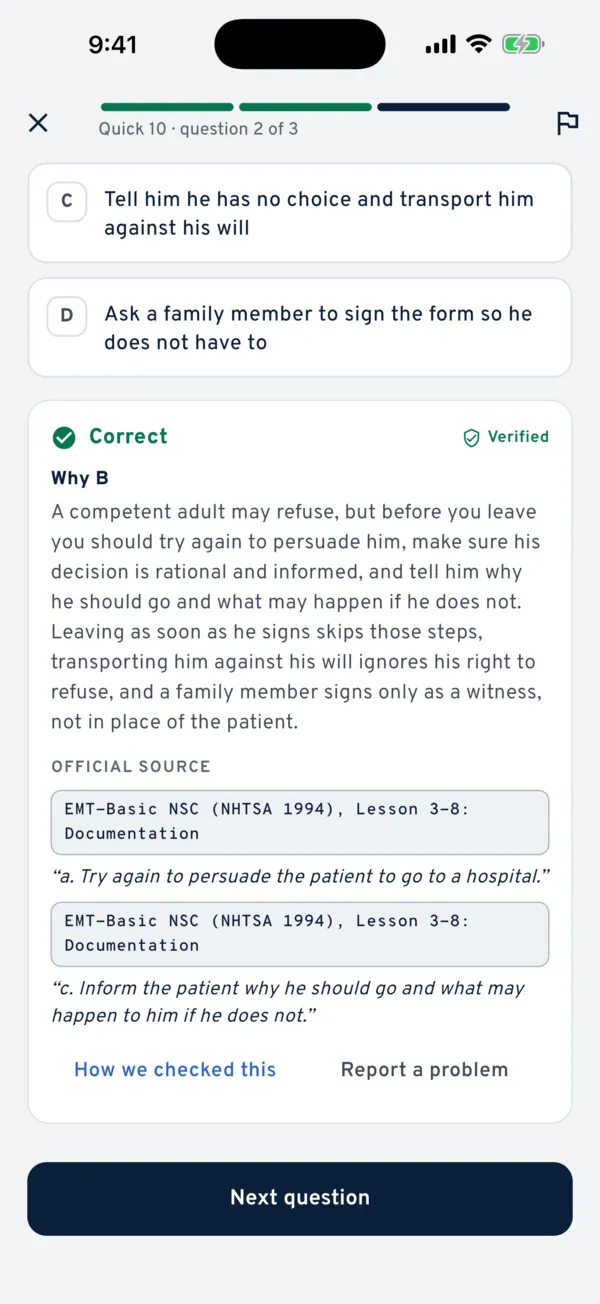
The EMT psychomotor exam is the hands-on half of National Registry certification, and it’s run by your state, not the National Registry. To certify as an EMT you need a skills competency approved by your State EMS Office on top of the computer-based cognitive exam.2 The usual reference point is the National Registry’s own seven station EMT format, and that’s what this post walks through.
Who runs it and when
The National Registry’s own users guide is plain about it. All basic level psychomotor exams are administered by the State EMS Office or its approved agents.1 Some states fold the skills exam into the EMT course itself, and the National Registry tells candidates to contact their State EMS Office or course instructor to find out how theirs works.2 Accommodation requests go through the State EMS Office too. Examiners at the site aren’t allowed to grant them.1
The 2025 update to the EMT cognitive exam didn’t touch this. The National Registry said the EMT skills process stays in its current format as approved by each state.3 That’s different from the advanced levels. AEMT and paramedic candidates stopped taking a separate psychomotor exam after June 30, 2024.4 If you’re an EMT candidate, you still test skills.
Passed skills competency stays valid for 24 months, as long as you meet the other eligibility rules.2 Some states require it outright. California’s local EMS agencies, for example, treat the NREMT cognitive and psychomotor exams as the standard for initial EMT certification.6
The seven skills
The National Registry’s EMT Psychomotor Examination Users Guide lays out a sample exam of seven skills, and says every candidate using it for national certification should be tested on all seven.1 The guide also sets a maximum time for each one and a recommended minimum score.1
| Skill | Time limit | Minimum points to pass |
|---|---|---|
| Patient Assessment/Management, Trauma | 10 minutes | 33 |
| Patient Assessment/Management, Medical | 15 minutes | 33 |
| Bag-Valve-Mask Ventilation of an Apneic Adult Patient | 5 minutes | 12 |
| Oxygen Administration by Non-rebreather Mask | 5 minutes | 8 |
| Cardiac Arrest Management/AED | 10 minutes | 13 |
| Spinal Immobilization (Supine Patient) | 10 minutes | 11 |
| Random EMT Skill | 5 to 10 minutes | 5 to 9, depending on the skill |
The random skill is one of four, chosen at random on the day.1 They are Spinal Immobilization (Seated Patient) with a 9 point minimum, Bleeding Control/Shock Management at 5, Long Bone Immobilization at 8 and Joint Immobilization at 7.1
Here’s what each station asks of you, as the guide describes it.1
Trauma and medical assessment. A hands-on, head-to-toe assessment of a moulaged simulated patient or a high fidelity manikin, voicing your treatment as you go. Both stations cover scene size-up, the primary survey and resuscitation, history taking and secondary assessment, and vitals with reassessment.
BVM ventilation. An apneic adult with a weak carotid pulse. You open the airway manually, suction the mouth and oropharynx, insert an oropharyngeal airway and ventilate the manikin with a bag-valve-mask.
Oxygen by non-rebreather. You assemble the regulator on a portable oxygen tank and put a short-of-breath adult on a non-rebreather mask.
Cardiac arrest and AED. An adult found in cardiac arrest with no bystanders. You perform 2 minutes of one-rescuer adult CPR, then attach and use the AED, including delivering a shock.
Supine spinal immobilization. You secure a supine adult with a suspected unstable spine to a long immobilization device. An EMT assistant is provided, and you’re responsible for directing what that assistant does. The same goes for the random skill.
Your state can change this list. Minnesota’s current forms page, for instance, lists the same assessment, airway, oxygen and AED sheets with seated spinal, bleeding control, joint and long bone immobilization as random skills, and marks supine spinal immobilization as optional.5 Use the skill sheets your program gives you.
How each skill is scored
Every skill sheet is a checklist of observable steps, and each step is worth 1 point.1 The National Registry chose that design so examiners don’t have to guess at partial credit.1 Each sheet also has a short list of critical criteria, which are actions (or omissions) serious enough to fail the skill no matter how many points you earned.1
So there are two ways to fail a station. You can fall below the minimum point total, or the examiner can check a critical criterion and document why.1
The examiner essays in the users guide show how critical criteria come up in practice.1
- Not checking that the scene is safe before touching the patient in the trauma station
- Disregarding spinal precautions when the mechanism of injury suggests a spine injury
- Not voicing a call for transport before the 10 minute trauma time limit runs out
- Prolonged or excessive suctioning in the BVM station
Examiners are also told to ask you to explain what you’re checking if they can’t tell from your hands.1 Talk through what you’re assessing. The examiner can only score what they can see or hear.
Retests and failing
The users guide grades the exam on a pass, retest or fail basis.1 Your state can set its own rules, so confirm with your program, but these are the National Registry’s.
- Pass all seven skillsYou've passed the psychomotor exam. The result is good for up to 24 months if you meet the other entry requirements.
- Fail three or fewer skillsYou retest only the skills you failed. You get up to two retest attempts within 24 months of the exam date.
- Retest on the same day if offeredOnly one retest attempt can happen on the same day, and you must retest every failed skill or none of them. Same-day retests aren't guaranteed at any site.
- Fail four or more skills, or any skill on the second retestYou've failed the entire psychomotor exam.
- Document remedial trainingBefore your second full attempt, your program director or training officer has to sign off that you were retrained on all skills and showed competence.
- Fail the second full attemptYou must complete a new state-approved EMT course.
All of those rules come from the users guide.1 That last step is why the second full attempt deserves real preparation. The guide allows two full attempts in total.1
That date and guideline reference are on the guide itself.1
How to practice the stations
The skill sheets are your study guide. Every point is a step written in observable terms,1 so practice with the sheet in a classmate’s hand while they check off what they see you do and hear you say.
Run each station against a timer. Ten minutes for a full trauma assessment, including calling for transport, goes faster than you’d expect the first few times.1 Practice the random skills as seriously as the fixed ones, since you won’t know which you’ll draw.
Rehearse directing your assistant. In supine spinal immobilization and the random skill you’re graded on what your partner does under your direction,1 so give clear, specific instructions out loud.
Treat the skills exam and the written exam as one project with one deadline. The cognitive exam leans on the same assessment sequence, with Primary Assessment worth 39 to 43% of it.3 For the written side, see the NREMT EMT exam guide and the rundown of what changed on the EMT exam in 2025.
Questions people ask
Who gives the NREMT EMT psychomotor exam?
The National Registry doesn't administer EMT skills exams. Your state EMS office runs them, or approves your training program to run them under its oversight, and some states build the skills exam into the EMT course. Ask your instructor or state EMS office where and when you'll test.
What skills are on the EMT psychomotor exam?
In the National Registry format there are seven. Trauma and medical patient assessment, bag-valve-mask ventilation of an apneic adult, oxygen by non-rebreather mask, cardiac arrest management with an AED, supine spinal immobilization, and one random skill (seated spinal immobilization, bleeding control and shock, long bone or joint immobilization). Your state may use a different set.
What happens if you fail a station on the EMT skills exam?
Under the National Registry rules, if you fail three or fewer skills you retest only those skills, and you get up to two retest attempts. Failing four or more skills, or failing any skill on the second retest, means you've failed the whole exam and need documented remedial training before a second full attempt.
Sources
- Emergency Medical Technician Psychomotor Examination Users Guide (Version 1.1)National Registry of Emergency Medical Technicians
- EMT Full Education Program PathwayNational Registry of Emergency Medical Technicians
- The Updated EMR and EMT Certification ExaminationsNational Registry of Emergency Medical Technicians
- AEMT and Paramedic Certification ExaminationsNational Registry of Emergency Medical Technicians
- Psychomotor Exam Forms and ResourcesMinnesota Emergency Medical Services Regulatory Board
- EMS Agency: EMT Certification and NREMT TestingLos Angeles County Department of Health Services
ClinchedNREMT EMT
Pass NREMT EMT on the first try.
Practice questions written from the official sources, full practice tests in the real format and a plan that ends on your test date. Free to start.
Keep reading
- Exam guide · NREMT EMT
 NREMT EMT Exam Changes: What's Different Since April 2025The NREMT EMT exam changed on April 7, 2025. New domains, new item types like build list, same adaptive 70 to 120 items, 2 hours and $104 fee.
- Topic explainer · Food Protection Manager
 ServSafe Manager vs Other Food Protection Manager ExamsServSafe Manager, NRFSP, Learn2Serve and Always Food Safe compared on questions, time, passing score, proctoring, retakes and how long the certificate lasts.
- Topic explainer · Phlebotomy Technician · NHA CCMA
 Order of Draw for Phlebotomy Exams: Tubes, Colors and WhyThe venous order of draw is blood cultures, citrate, serum, heparin, EDTA, then fluoride. Learn the capillary order, the discard tube rule and why it matters.