

NREMT EMT Exam Changes: What's Different Since April 2025
Short answer
On April 7, 2025 the National Registry replaced the EMT exam's five topic domains with five assessment-based ones, led by Primary Assessment at 39 to 43%, and added technology-enhanced items such as build list and drag-and-drop. The exam is still adaptive, 70 to 120 items, 2 hours and $104 per attempt, and the skills exam is still set by each state.
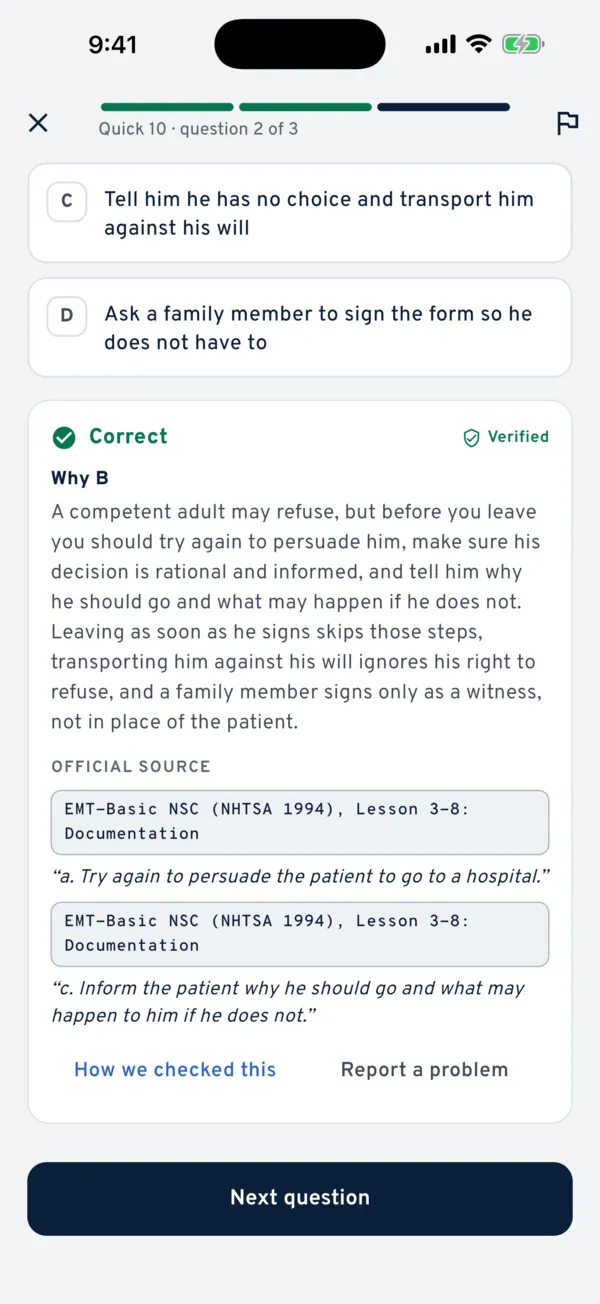
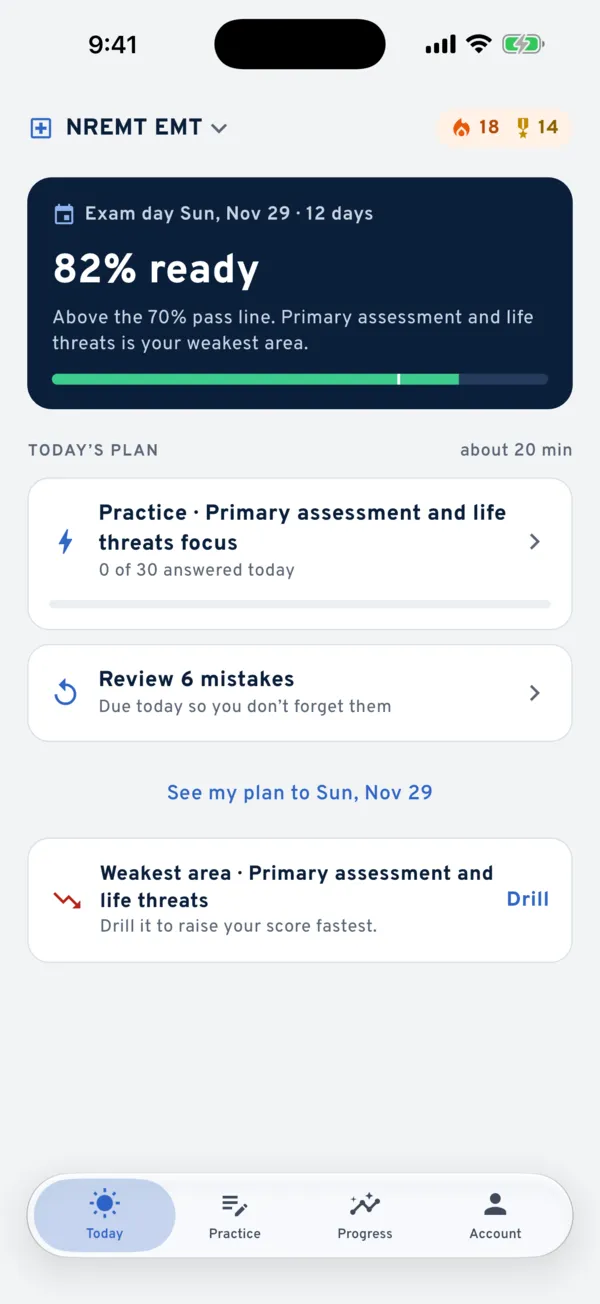
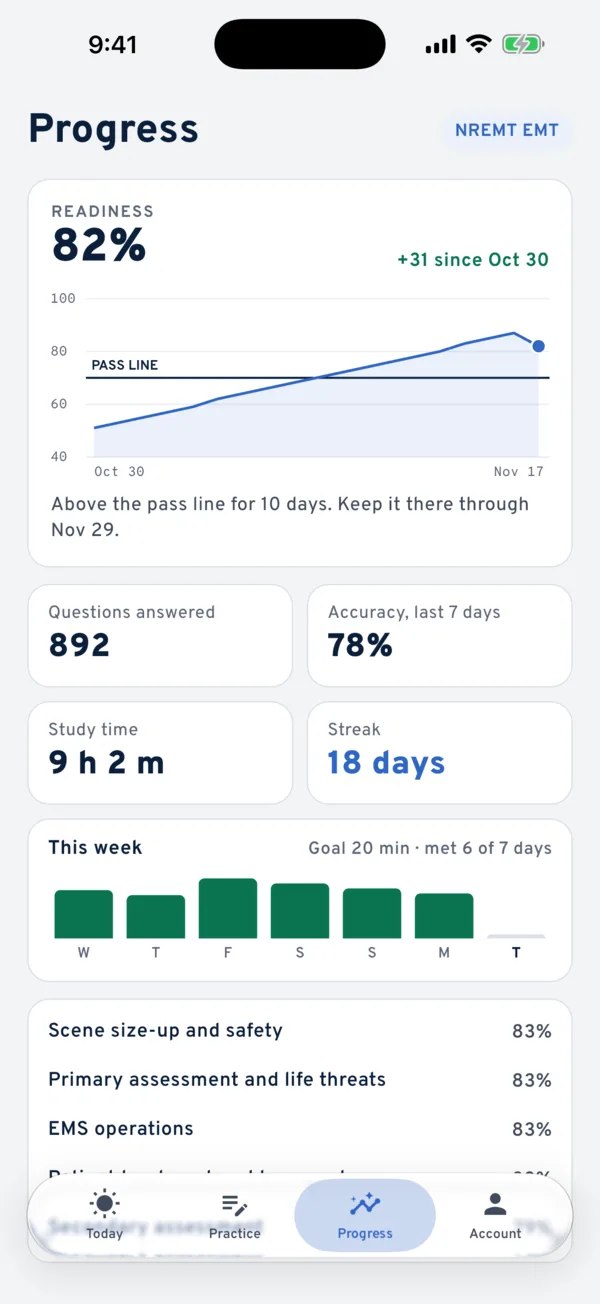
The National Registry of Emergency Medical Technicians (NREMT) launched an updated EMT cognitive exam on April 7, 2025.1 The content is reorganized and there are new question formats, but the test itself works the way it did before. It’s still adaptive, still 2 hours, and still $104.1 If you’re testing now, every attempt you take is on the new version.
The timeline
The EMT change was the last piece of a two year overhaul that hit every National Registry level. Here’s the order things happened.
| Date | What changed |
|---|---|
| July 1, 2024 | New AEMT and paramedic exams launch, with no psychomotor exam for those levels5 |
| September 20, 2024 | New York recognizes the National Registry as a certification pathway, the last of the 50 states to do so7 |
| December 11, 2024 | The National Registry announces updated EMR and EMT exams2 |
| April 7, 2025 | The updated EMT exam goes live1 |
Candidates with valid course eligibility who hadn’t tested by April 4, 2025 got a new Authorization to Test (ATT) for the updated exam on April 7.1
Five new domains
This is the biggest change. The old exam sorted questions by body system and topic, with domains for airway, respiration and ventilation, cardiology and resuscitation, trauma, medical with obstetrics and gynecology, and EMS operations.1 The new exam sorts them by where they fall in a patient encounter.
| New domain | Share of the exam |
|---|---|
| Scene Size-Up and Safety | 15 to 19% |
| Primary Assessment | 39 to 43% |
| Secondary Assessment | 5 to 9% |
| Patient Treatment and Transport | 20 to 24% |
| Operations | 10 to 14% |
The ranges come from the official examination specifications, which are based on the National Registry’s 2023 practice analysis of the tasks entry-level EMTs actually perform.3 The analysis weighted the tasks EMTs do more often more heavily.3
- Scene Size-Up and Safety17%
- Primary Assessment41%
- Secondary Assessment7%
- Patient Treatment and Transport22%
- Operations12%
What the shift means for your studying
The medical knowledge you need didn’t disappear. Asthma, chest pain, stroke, burns and childbirth are all still fair game. What changed is the angle. A question about a patient in respiratory distress might now sit in Primary Assessment because it’s really asking whether you recognize inadequate breathing, or in Patient Treatment and Transport because it’s asking which oxygen device fits. The specifications list the job tasks under each domain, and reading them is the fastest way to see the new angle.3
Primary Assessment at 39 to 43% is the single biggest block of the test.3 That domain covers your general impression, level of consciousness, airway, breathing, circulation, chief complaint, life threats, baseline vitals and the decision about rapid transport or more resources.3 Expect lots of “what do you do first” and “what’s the priority” questions.
Secondary Assessment shrank to 5 to 9%.3 It’s still on the test, but a week spent memorizing detailed history mnemonics is a week not spent on priorities.
Pediatrics is no longer something you can isolate. Items on pediatric patient care are integrated throughout the exam content.1
New item types
All National Registry exams now include technology-enhanced items (TEIs).1 On the EMT exam you can see these formats.3
| Item type | What you do |
|---|---|
| Multiple choice | Pick the one correct answer out of four |
| Multiple response | Pick two correct answers out of five, or three out of six |
| Options table | Classify or identify several options in a table against a rule |
| Build list | Put several options into the order the item asks for |
| Drag-and-drop | Sort options into categories |
Every item is scored all or nothing. You get no credit for a build list with one step out of place.3 That matters for build list questions especially, since sequence is exactly what the Primary Assessment domain tests. Practice putting assessment steps in order from memory, not just recognizing the right order when you see it.
An untimed tutorial at the start of the exam shows each item type, and the Help function explains them during the test.1 The specifications also include a sample of each type in Appendix A, so look at those before test day.3
What stayed the same
Here’s what the National Registry kept from the old exam.
- Computerized adaptive testing, ending at 95% confidence or at the maximum length or time
- A minimum of 70 and a maximum of 120 items, with 10 unscored pilot items
- A 2 hour time limit
- Testing at Pearson VUE centers or online through OnVUE
- The $104 fee per attempt
- Testing and retesting rules
- The EMT skills (psychomotor) process, still set by each state
- Recertification requirements
The format details are in the specifications,3 and the National Registry confirmed the fee, delivery, retesting, skills and recertification points when it announced the update.1 2 Retest rules are still a 15 day wait, six attempts and remedial education after the third failure.4
The National Registry also said it didn’t expect the new exam to be harder or easier. The passing standard was set by its board of directors after a standard-setting study.1 Scores are reported on a 100 to 1500 scale, and 950 passes.4
How the EMT change compares to AEMT and paramedic
The advanced levels changed more. Starting July 1, 2024, AEMT and paramedic candidates take one exam with no psychomotor component.5 Those exams lean heavily on clinical judgment, which is 31 to 35% of the AEMT exam and 34 to 38% of the paramedic exam, with TEIs built into scenarios that move from en route to scene to post-scene.5 The AEMT exam is a set length of 135 questions, 35 of them unscored, in 3 hours.6 Fees are $159 for AEMT and $175 for paramedic.5
The EMT exam kept its adaptive format and its state-run skills exam. If you hear from an AEMT or paramedic student that “the Registry got rid of the practical,” that’s true for them, not for you. The skills piece is covered in the EMT psychomotor exam guide.
Using older study materials
Books and question banks written before 2025 aren’t useless. The underlying EMT knowledge is the same. Watch for three problems with them.
First, any score report or study plan organized by the old domains (airway, cardiology, trauma, medical, operations) won’t match your real score feedback. Re-sort your weak areas into the five new domains. Second, older banks have only standard multiple choice, so they won’t prepare you for build list or drag-and-drop. Third, older domain percentages are wrong now, so don’t use them to decide how much time each topic gets.
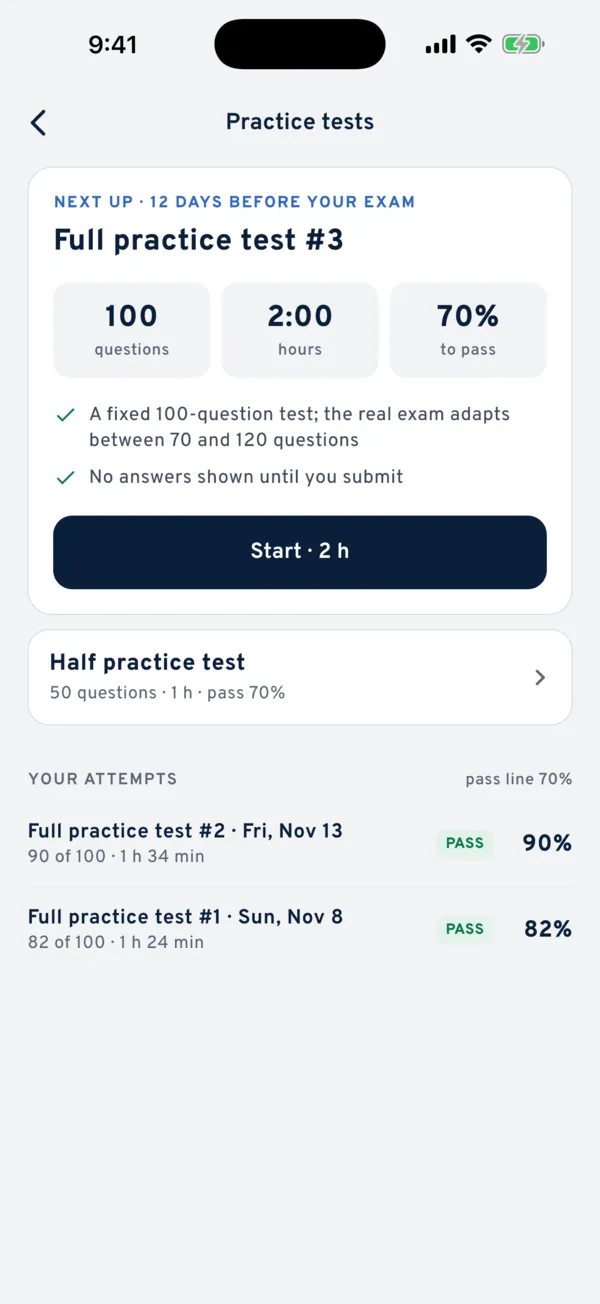
For the full picture of the current exam, including cost, booking and retakes, read the NREMT EMT exam guide. Clinched has an NREMT EMT course with questions tied to the official outline and full practice tests.
Questions people ask
Is the new NREMT EMT exam still adaptive?
Yes. The updated EMT exam that launched April 7, 2025 is still a computerized adaptive test. You answer 70 to 120 items in up to 2 hours, and the test ends once the computer is 95% confident you're above or below the passing standard.
Is the new NREMT EMT exam harder?
The National Registry said it doesn't expect the updated exam to be harder or easier. The passing standard was set by its board after a standard-setting study, and scores are reported on a 100 to 1500 scale where 950 passes.
Did the EMT skills exam change in 2025?
No. The National Registry said the EMT psychomotor process stays in its current format as approved by each state. The skills exam was dropped only for AEMT and paramedic candidates, effective after June 30, 2024.
Sources
- The Updated EMR and EMT Certification ExaminationsNational Registry of Emergency Medical Technicians
- National Registry of Emergency Medical Technicians Announces Updates to Basic Life Support Certification ExaminationsNational Registry of Emergency Medical Technicians
- National Registry Emergency Medical Technician Examination SpecificationsNational Registry of Emergency Medical Technicians
- EMT Candidate Handbook, Part 4: About the ExaminationNational Registry of Emergency Medical Technicians
- AEMT and Paramedic Certification ExaminationsNational Registry of Emergency Medical Technicians
- AEMT Candidate Handbook: About the ExaminationNational Registry of Emergency Medical Technicians
- State of New York to Utilize National Registry of EMTs as Recognized Pathway for EMS CertificationNational Registry of Emergency Medical Technicians
ClinchedNREMT EMT
Pass NREMT EMT on the first try.
Practice questions written from the official sources, full practice tests in the real format and a plan that ends on your test date. Free to start.
Keep reading
- Topic explainer · NREMT EMT
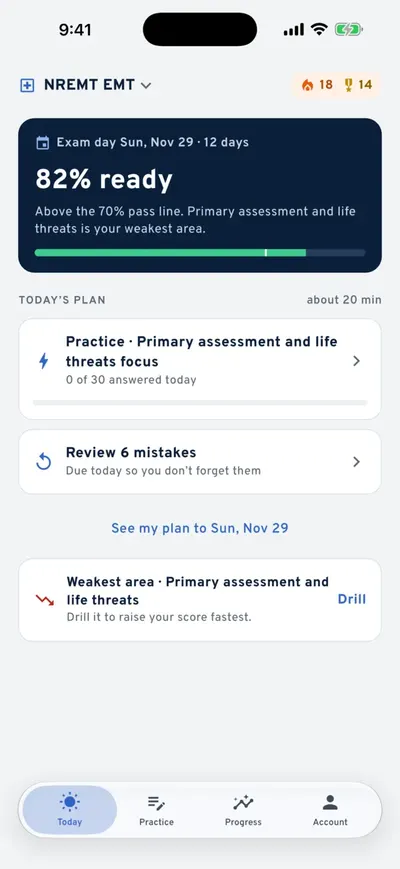 EMT Psychomotor Exam: The 7 Skills and How They're ScoredHow the EMT psychomotor exam works. Who runs it, the seven National Registry skill stations, time limits, minimum points, critical criteria and retests.
- Exam guide · Series 63, 65 and 66
 Series 65 vs Series 66: Which One Should You Take?The Series 65 has 130 scored questions and stands alone. The Series 66 has 100 and only counts with a Series 7. How to choose based on your job and where you work.
- Exam guide · SIE · Series 7
 SIE vs Series 7: How the Two FINRA Exams Fit TogetherThe SIE has 75 scored questions and needs no sponsor. The Series 7 has 125 and needs a firm. How they differ in content, cost and difficulty, and which comes first.