

Study strategyCDL Air Brakes and Combination
How to Pass the CDL Air Brakes Test on the First Try
Short answer
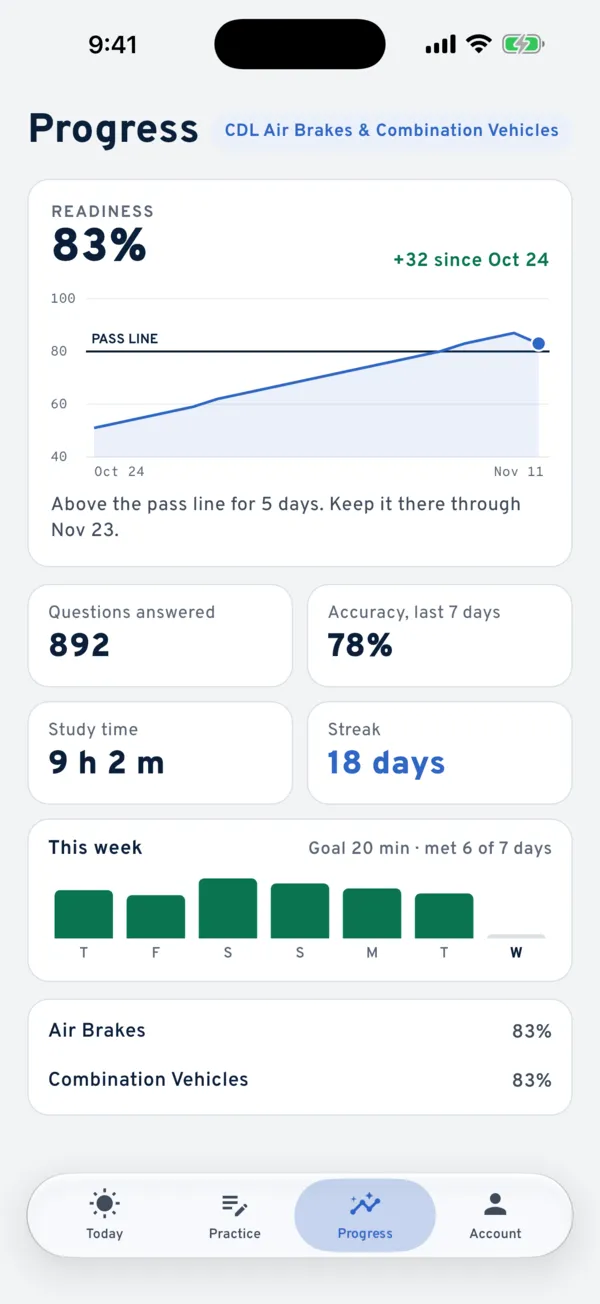
The CDL air brakes test covers Section 5 of your state's CDL manual, and you need at least 80% to pass. In Washington that means 20 of 25 questions. Most misses come from pressure numbers and the order things happen as air pressure drops, so learn how air moves through the system before you memorize the figures.
The CDL air brakes test is a separate knowledge test built from Section 5 of your state’s CDL manual, and you need at least 80% to pass it.5 Washington, for example, gives 25 questions and requires 20 correct.7 People who fail usually knew the parts but mixed up the numbers or the sequence of events as pressure drops. The fix is to study in a particular order. Understand the system, then memorize the numbers, then drill the checks.
Know what Section 5 asks
Section 5 has four parts in New York’s current manual, which follows the national model text most states use.1 Subsection 5.1 names every part of the system. Subsection 5.2 covers dual air systems. Subsection 5.3 covers inspection, and 5.4 covers driving with air brakes, including emergency stops, brake fade and what to do when pressure drops.
Each subsection ends with a short “Test Your Knowledge” list, and the manual says plainly that these questions may be on your test.1 Answer them in writing before you take a practice test. If you can’t explain why air tanks are drained or how to test the low pressure warning in a sentence or two, you aren’t ready yet.
For the full test format and how it pairs with the combination test, see the air brakes and combination guide.
Learn the system in the order air moves
Memorizing parts as a list is slow. Follow the air instead, from the engine to the wheel, and each part has an obvious job.
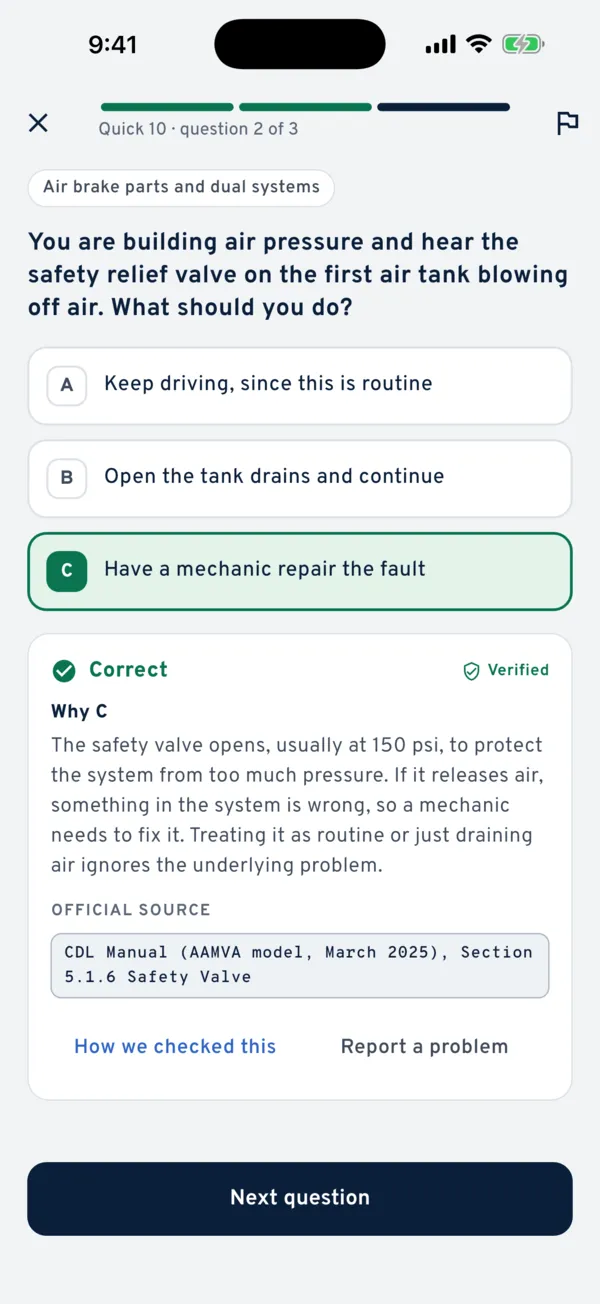
The compressor, driven by the engine through gears or a belt, pumps air into the storage tanks.1 The governor decides when it pumps. It stops the compressor at the cut-out pressure, around 125 psi, and lets it start again at cut-in, around 100 psi. The tanks hold enough air to apply the brakes several times even if the compressor quits. Water and compressor oil collect at the bottom of each tank, which is why tanks have drains and why you drain manual tanks at the end of each driving day. A safety valve on the first tank protects against overpressure and is usually set to open at 150 psi. If it releases air, something is wrong.
Next comes the brake pedal, also called the foot valve or treadle valve. Pressing harder applies more air. Fanning the pedal wastes air faster than the compressor can replace it. At the wheel, air enters the brake chamber, pushes a rod that moves the slack adjuster, and twists the S-cam, which forces the shoes against the drum. Spring brakes are the backup. Air pressure holds powerful springs back while you drive, and when air is lost, the springs apply the brakes.
Once you can trace that path out loud, most questions turn into “what happens next” questions, and those are easier than recall.
The numbers, and why your state’s manual wins
About a dozen numbers carry most of the test. The model text gives these.1
| Item | Model manual figure |
|---|---|
| Governor cut-out and cut-in | Around 125 psi and around 100 psi |
| Safety valve | Usually opens at 150 psi |
| Low air warning | Must come on before 60 psi (80 to 85 psi is common on large buses) |
| Spring brakes come fully on | 20 to 45 psi, typically 20 to 30 |
| Dual system buildup | 85 to 100 psi within 45 seconds at operating rpm |
| Single system buildup (pre-1975) | 50 to 90 psi within 3 minutes |
| Leak rate, brakes released | Under 2 psi a minute single vehicle, under 3 combination |
| Leak rate, brakes applied at 90 psi or more | No more than 3 psi a minute single, 4 combination |
| Slack adjuster | Moves more than about one inch, it needs adjustment |
| Brake lag at 55 mph | About 32 feet, total stopping distance over 450 feet |
Here’s the catch. States edit the model text, and the test follows the state’s edit. California’s handbook says the low air warning must activate before 55 psi and lists leak limits for three or more vehicles (5 psi released, 6 psi applied).3 Pennsylvania’s Section 5 gives the spring brake range as 40 to 20 psi rather than 20 to 45.4 A practice question written from another state’s manual can mark your right answer wrong. Study from your own state’s manual, and when a practice source disagrees, go with the manual.
Drill the final air brake check
The inspection material in 5.3 shows up on the knowledge test and again on the skills test, so it pays twice. New York’s manual lists seven checks for Step 7 of the inspection on an air brake vehicle.1
- Test the low pressure warningEngine off, key on, pump the brake pedal to lower pressure. The warning must come on before the tank pressure drops below 60 psi.
- Check that spring brakes come onKeep fanning off air. On a tractor-trailer the tractor protection valve and parking brake valve should pop out at the maker's setting, within 20 to 45 psi.
- Check pressure buildupAt operating rpm, a dual system should go from 85 to 100 psi within 45 seconds.
- Test the leakage rateWith a full system, engine off and parking brake released, time the drop. Then hold 90 psi or more on the pedal and time it again.
- Check governor cut-in and cut-outPumping should stop at about 125 psi and start again at about 100 psi.
- Test the parking brakeSet it and pull gently against it in a low gear.
- Test the service brakesAt about 5 mph, brake firmly and notice any pull to one side or delayed stop.
Say the steps and their numbers out loud until you can do it without notes. That one habit covers a big share of the questions in 5.2 and 5.3.
Questions that catch prepared people
A few facts in Section 5 run against intuition, and test writers like them.1
- Never push the brake pedal while the spring brakes are on. The combined force of the springs and air can damage the brakes.
- Front wheel braking is good under all conditions. On older trucks with a front brake limiting valve, the control belongs in “normal,” not “slippery.”
- ABS doesn’t necessarily shorten stopping distance. It helps you keep steering control. Air brake tractors built on or after March 1, 1997, and other air brake vehicles built on or after March 1, 1998, must have it.
- In stab braking, it can take up to one second for locked wheels to start rolling after you release. Reapply too soon and the vehicle won’t straighten out.
- On a long downgrade, get into the right low gear first. Brake until you’re about 5 mph under your safe speed, which takes about three seconds, then release and repeat.
- Don’t set the parking brakes when the brakes are very hot or very wet in freezing weather. Chock the wheels instead.
- Manually adjusting an automatic slack adjuster usually hides a mechanical problem. The manual wants you to get the truck to a repair shop.
The air brake check on the skills test
Passing the knowledge test isn’t the end of it. During the pre-trip portion of the skills test, you’ll do an in-cab air brake check, and in New York failing to do every required part correctly is an automatic failure of the vehicle inspection test.2 New York’s version starts with a static check, holding the foot brake for one minute with the engine off and watching for a drop of more than 3 psi (single vehicle) or 4 psi (combination). Then you fan off air until the low air warning comes on before 60 psi, and keep going until the tractor protection valve and parking brake valve pop out, at about 40 psi on a tractor-trailer.
California is stricter about talking through it. Its handbook says you must verbalize the parameters for each required check, and that not doing so counts as an automatic failure of the vehicle inspection.3 Knowing the numbers cold from your knowledge test study makes this part easy.
If you fail
Federal rules let a state issue your permit even if you fail air brakes, but it must then restrict you from driving any commercial vehicle with air brakes.6 That’s the L restriction, and for most Class A trainees it means you can’t drive the truck you’re supposed to train in. Retake rules and waits vary by state, so ask the office before you leave. The air brake restriction explainer covers how the L and Z codes work and how to remove them.
Clinched has a CDL air brakes course that ties every answer to the manual text it comes from.
Questions people ask
How many questions are on the CDL air brakes test?
Each state sets the length, and 25 questions is common. Washington gives 25 questions and requires 20 correct. The 80% passing score is a federal rule under 49 CFR 383.135, so it's the same in every state.
At what psi should the low air warning come on?
The model manual used by most states, including New York and Pennsylvania, says a visible warning must come on before tank pressure falls below 60 psi. California's handbook uses 55 psi. Learn the number in your own state's manual, since that's what your test is written from.
What checks are in the final air brake check?
New York's manual lists seven, in this order. Test the low pressure warning, check that the spring brakes come on automatically, check the rate of pressure buildup, test the leakage rate, check governor cut-in and cut-out, test the parking brake, and test the service brakes.
What happens if I fail the air brakes test?
If your state issues your permit or license anyway, it must add a restriction that bars you from any commercial vehicle with air brakes, shown as the L code. You can retake the test under your state's retest rules and have the restriction removed once you pass it and a skills test in an air brake vehicle.
Sources
- Commercial Driver's Manual CDL-10, Section 5 Air BrakesNew York State Department of Motor Vehicles
- Commercial Driver's Manual CDL-10, Sections 11 to 13 Skills TestsNew York State Department of Motor Vehicles
- California Commercial Driver HandbookCalifornia Department of Motor Vehicles
- Commercial Driver's License Manual, Section 5 Air BrakesPennsylvania Department of Transportation
- 49 CFR 383.135, Passing knowledge and skills testseCFR, Office of the Federal Register
- 49 CFR 383.95, RestrictionseCFR, Office of the Federal Register
- CDL knowledge testWashington State Department of Licensing
ClinchedCDL Air Brakes and Combination
Pass CDL Air Brakes and Combination on the first try.
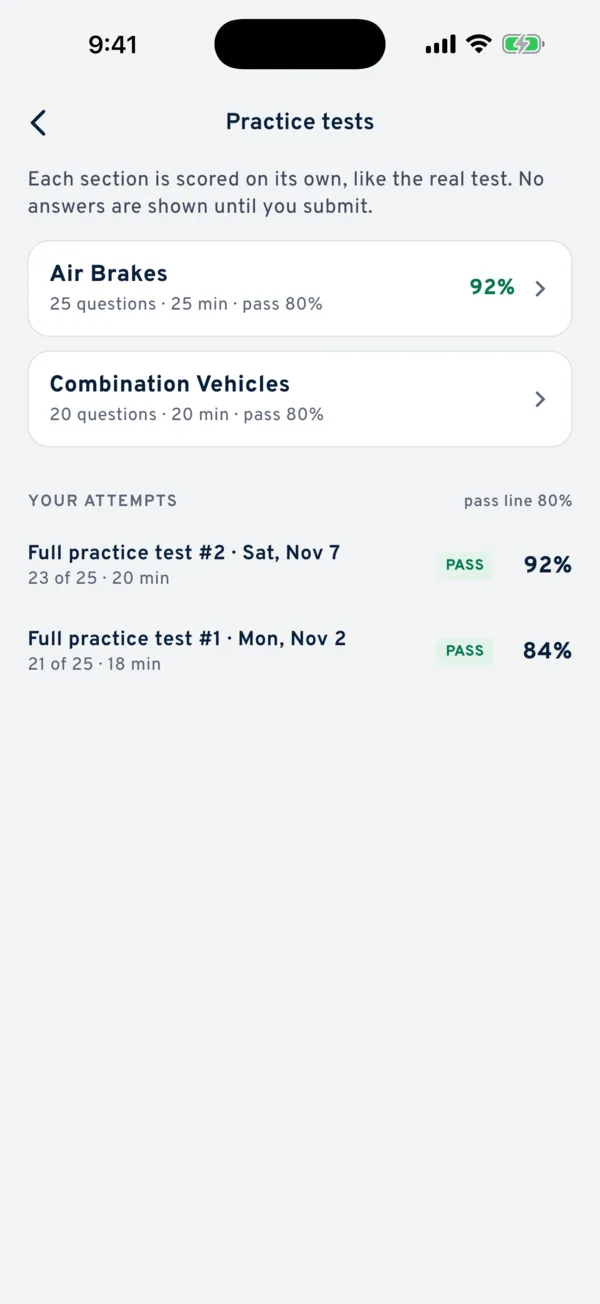
Practice questions written from the official sources, full practice tests in the real format and a plan that ends on your test date. Free to start.
Keep reading
- Topic explainer · CDL General Knowledge · CDL Air Brakes and Combination
 CDL Pre-Trip Inspection vs the CDL Knowledge TestThe CDL knowledge test is a written exam you pass for your permit. The pre-trip inspection is the first part of the skills test. How each one works and is scored.
- Topic explainer · CDL Air Brakes and Combination
 CDL Air Brake Restrictions L and Z, and How to Remove ThemAn L on your CDL means no air brake vehicles, and Z means no full air brakes. How each code gets added under 49 CFR 383.95 and what it takes to remove it.
- Study strategy · Life and Health Insurance
 How Hard Is the Life Insurance Exam? What the Numbers ShowTexas reported a 60% pass rate on its life, accident and health exam. Why so many people fail, which topics cause it, and how much study you really need to pass.