CDL Air Brakes and Combination guideFree practice test
CDL Air Brakes and Combination practice test
15 free CDL Air Brakes and Combination questions from the 577 in Clinched, chosen to match how the real test is weighted. Pick an answer to see the explanation and the official text it comes from. Nothing to sign up for.
-
Question 1 of 15Air brake rules and standards
You are driving when the air pressure falls below the warning level and stays there. How must the low air warning behave?
Correct answer A. It stays on the whole time pressure is low
Federal rules require the low air warning to give a continuous warning for as long as reservoir pressure is at or below the warning level. A warning that beeps once and stops, or one that works only while you brake, would not meet that requirement.
Official source 49 CFR §393.51 Warning signals, air pressure and vacuum gauges.(2) A warning signal that is audible or visible to a person in the normal driving position and provides a continuous warning to the driver whenever the air pressure in the service reservoir system is at 379 kPa (55 psi) and below, or one-half of the compressor governor cutout pressure, whichever is less.
-
Question 2 of 15Using air brakes
You are going down a long, steep grade. What role should your service brakes play?
Correct answer A. They add to the slowing done by the engine
On a long or steep downgrade, engine braking is the main way to slow down. The service brakes only add to it. If you make the brakes the main source of slowing, they overheat and fade.
Official source CDL Manual (AAMVA model, March 2025), Section 5.4.6 Proper Braking Technique -
Question 3 of 15Inspecting air brakes
While you fan down the air during an inspection, the parking brake valve pops out. What happens to the brakes at that moment?
Correct answer C. The spring brakes come on
When the valves close because of low pressure, the spring brakes apply. This is the safety backup that holds the vehicle when air runs low. The brakes do not release, and nothing staying the same would defeat the purpose of the valve.
Official source CDL Manual (AAMVA model, March 2025), Section 5.3.3 Step 7 Final Air Brake Check -
Question 4 of 15Air brake parts and dual systems
Your truck uses spring brakes as its parking brakes. What does their stopping and holding power depend on?
Correct answer C. How well the brakes are adjusted
Spring brakes get their force from springs, and that force only reaches the drums properly when the brakes are in adjustment. Tank air pressure is what releases spring brakes, not what applies them. Drum temperature is not what determines spring brake power here.
Official source CDL Manual (AAMVA model, March 2025), Section 5.1.14 Spring Brakes -
Question 5 of 15Air brake parts and dual systems
You are climbing into a late-model tractor with air brakes for the first time. What does the parking brake control most likely look like?
Correct answer B. A yellow, diamond-shaped push-pull knob
On newer air-brake vehicles, the parking brake control is a yellow knob shaped like a diamond that you push or pull. The red eight-sided knob is a different control, and parking brakes are not set with a blue toggle switch.
Official source CDL Manual (AAMVA model, March 2025), Section 5.1.15 Parking Brake Controls -
Question 6 of 15Air brake parts and dual systems
Where can an air compressor get the oil that lubricates it?
Correct answer A. Its own supply or the engine oil
A compressor is lubricated either from its own oil supply or from the engine's oil. Oil found in the bottom of an air tank is contamination that must be drained out, not a lubricant source. Alcohol is added only to reduce icing.
Official source CDL Manual (AAMVA model, March 2025), Section 5.1.1 Air Compressor -
Question 7 of 15Air brake parts and dual systems
You are learning about the dual air brake system on your tractor. How is air stored and carried in each of the two systems?
Correct answer A. Each system has its own tanks, hoses and lines
The two halves of a dual system are fully separate. Each one has its own air tanks, hoses and lines, so a failure in one does not drain the other. A shared tank would defeat the point of having two systems, and the secondary system does not feed off the primary tank.
Official source CDL Manual (AAMVA model, March 2025), Section 5.2 Dual Air Brake -
Question 8 of 15Coupling, uncoupling and inspection
After coupling a ball-type drawbar, part of the coupling ball can still be seen. What should you do about it?
Correct answer B. Fit the rubber bellows cover over it and anchor its edge on the ball
The exposed part of the ball gets covered with the rubber dust-proof bellows, and its edge must be anchored right onto the ball. Leaving it bare lets dirt get into the joint. Tape is not the protective cover the procedure calls for.
Official source CDL Manual (AAMVA model, March 2025), Section 6.4.5 Coupling a Drawbar -
Question 9 of 15Combination vehicle air brakes
You are pulling a loaded trailer when it breaks loose and tears the emergency air hose apart. What happens to the trailer's brakes?
Correct answer B. The trailer emergency brakes come on
When the emergency line loses its air, the trailer's emergency brakes apply. That is the built-in safety feature for a breakaway. The brakes do not release, and the hand valve cannot control them, because the hand valve sends air through the service line.
Official source CDL Manual (AAMVA model, March 2025), Section 6.2.4 Trailer Air-linesCDL Manual (AAMVA model, March 2025), Section 6.2.4 Trailer Air-lines“” -
Question 10 of 15Driving combination vehicles
During your pre-trip inspection, you want to find the trailer's yellow ABS malfunction lamp. Where should you look?
Correct answer B. On the left side, at the front or rear corner
Trailer ABS malfunction lamps are yellow and are mounted on the left side of the trailer, at either the front or the rear corner. They are not placed on the right side or in the middle of the rear end.
Official source CDL Manual (AAMVA model, March 2025), Section 6.3.1 Trailers Required to Have ABS -
Question 11 of 15Coupling, uncoupling and inspection
You have just adjusted the trailer to the right height. What else should you check before hooking up the air lines?
Correct answer B. That the kingpin and fifth wheel are lined up
Once the height is right, confirm that the kingpin lines up with the fifth wheel so the jaws can catch it. The trailer stays held by its chocks or spring brakes at this point. A sliding fifth wheel should be locked, not unlocked.
Official source CDL Manual (AAMVA model, March 2025), Section 6.4.1 Coupling Tractor-Semitrailers -
Question 12 of 15Coupling, uncoupling and inspection
You have stopped the tractor with its frame still under the trailer and secured it. What do you go back to check?
Correct answer C. That the ground holds the trailer and the landing gear is intact
Before you drive fully away, confirm the ground is truly carrying the trailer and the landing gear isn't bent or broken. The fifth wheel is already out from under the trailer, so its jaws are no longer on the kingpin. Tank pressure is not what tells you the trailer is safely supported.
Official source CDL Manual (AAMVA model, March 2025), Section 6.4.2 Uncoupling Tractor-Semitrailers -
Question 13 of 15Driving combination vehicles
This week you drive three rigs. One has ABS on the tractor only, one on the trailer only, and one on both. How should your braking change from rig to rig?
Correct answer B. Brake the same way in all three rigs
Which units have ABS does not change how you brake. Use the same technique in every rig: only the force needed to stop safely while staying in control. Full ABS is no reason to brake harder. Tractor-only ABS does not call for a lighter touch either.
Official source CDL Manual (AAMVA model, March 2025), Section 6.3.2 Braking with ABS -
Question 14 of 15Coupling, uncoupling and inspection
You have coupled and connected the lines, and you are cranking up the landing gear. How far should you raise it before you drive?
Correct answer B. All the way up, then secure the crank handle
Raise the landing gear fully and secure the crank handle. Landing gear left partly down can catch on railroad tracks or other objects. Raising it only a little or halfway is not enough.
Official source CDL Manual (AAMVA model, March 2025), Section 6.4.1 Coupling Tractor-SemitrailersCDL Manual (AAMVA model, March 2025), Section 6.4.1 Coupling Tractor-Semitrailers“” -
Question 15 of 15Driving combination vehicles
Partway through your trip, the trailer's ABS malfunction lamp comes on and stays lit. What is the right action?
Correct answer C. Keep driving normally and have the ABS serviced soon
ABS is added on top of your normal brakes. When it fails, your regular brakes still work. Drive normally and get the system repaired soon. ABS does not add stopping power, so you do not need extra brake force, and the trailer has not lost its brakes.
Official source CDL Manual (AAMVA model, March 2025), Section 6.3.2 Braking with ABSCDL Manual (AAMVA model, March 2025), Section 6.3.2 Braking with ABS“”
Want the other 562?
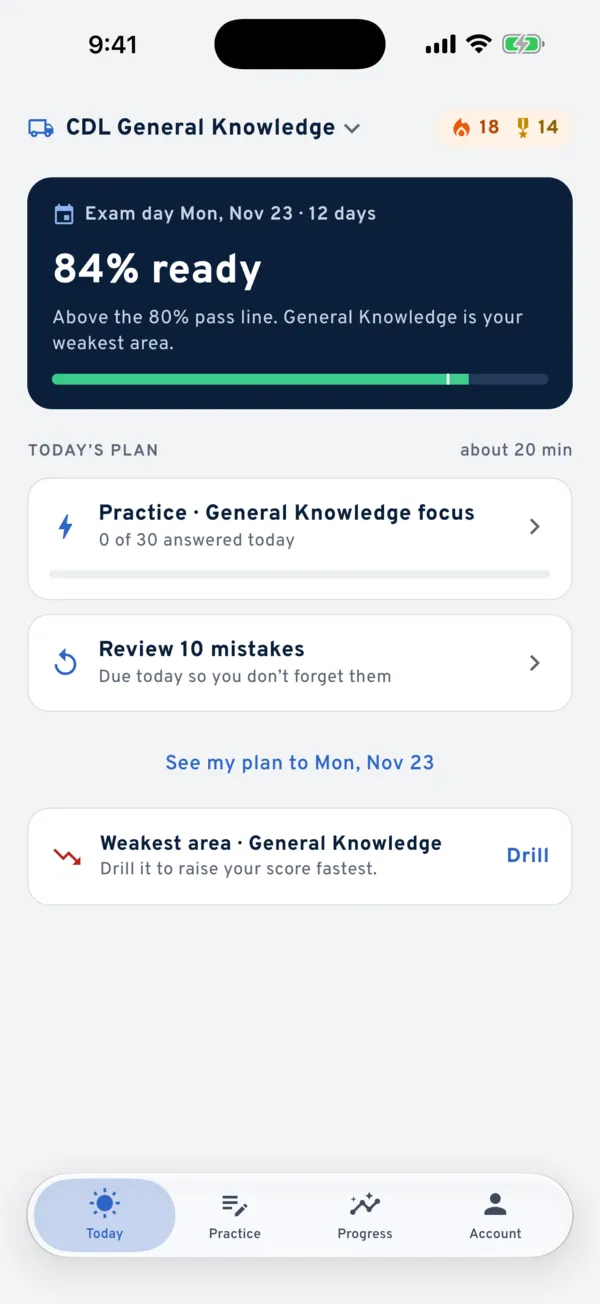
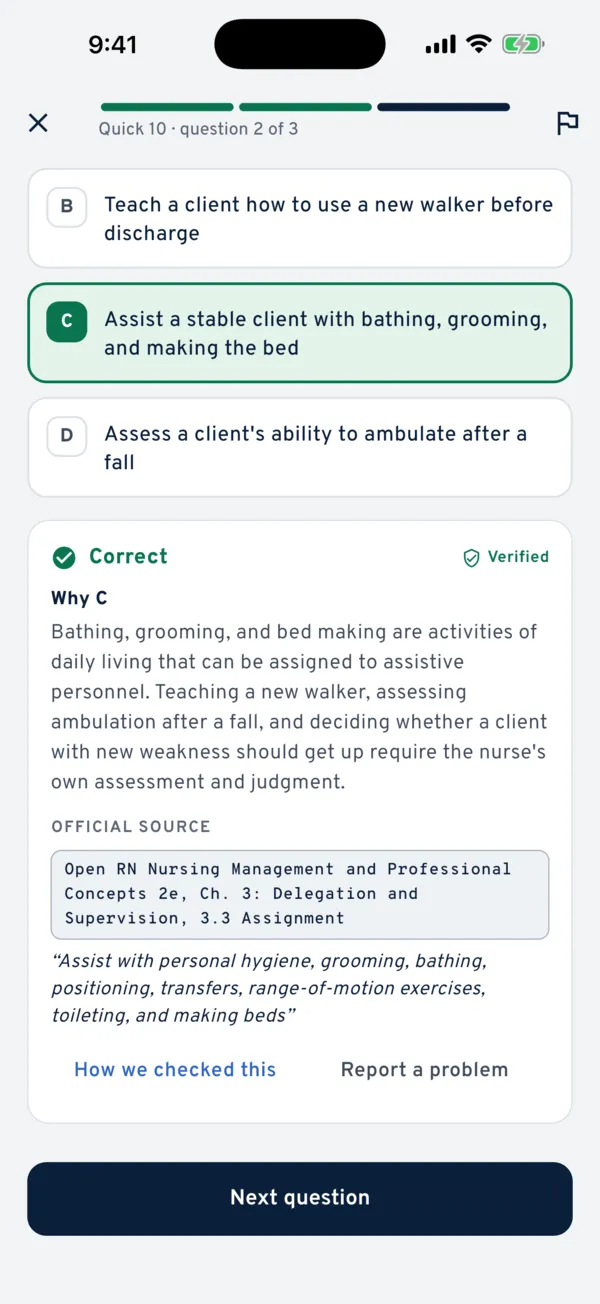
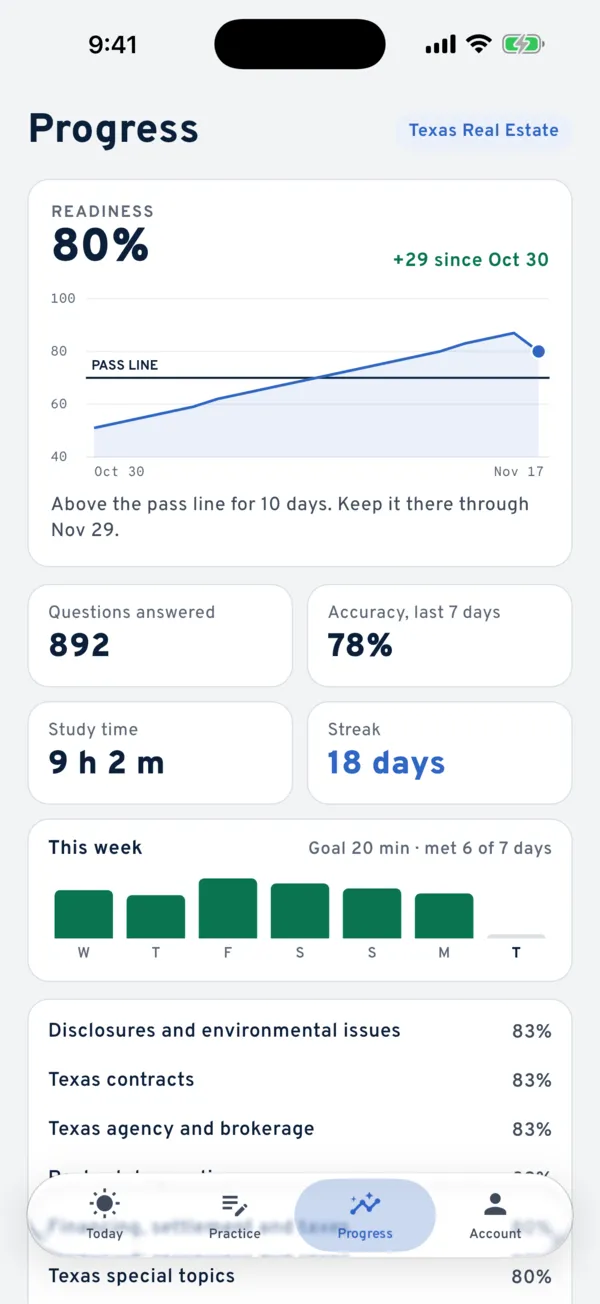
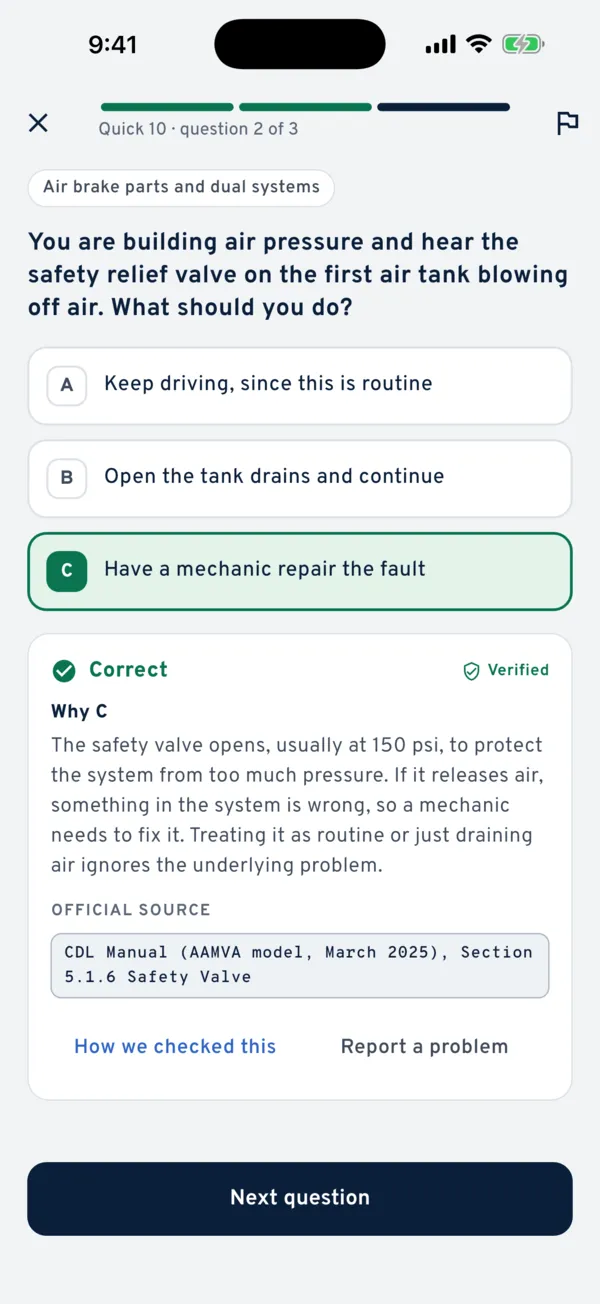
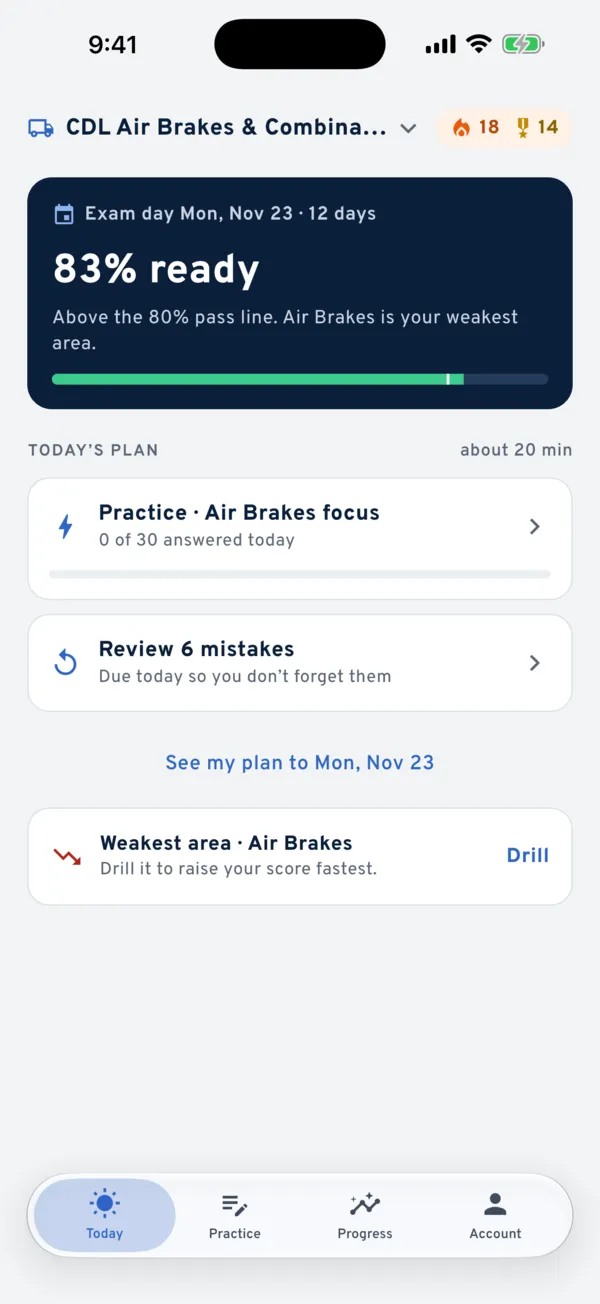
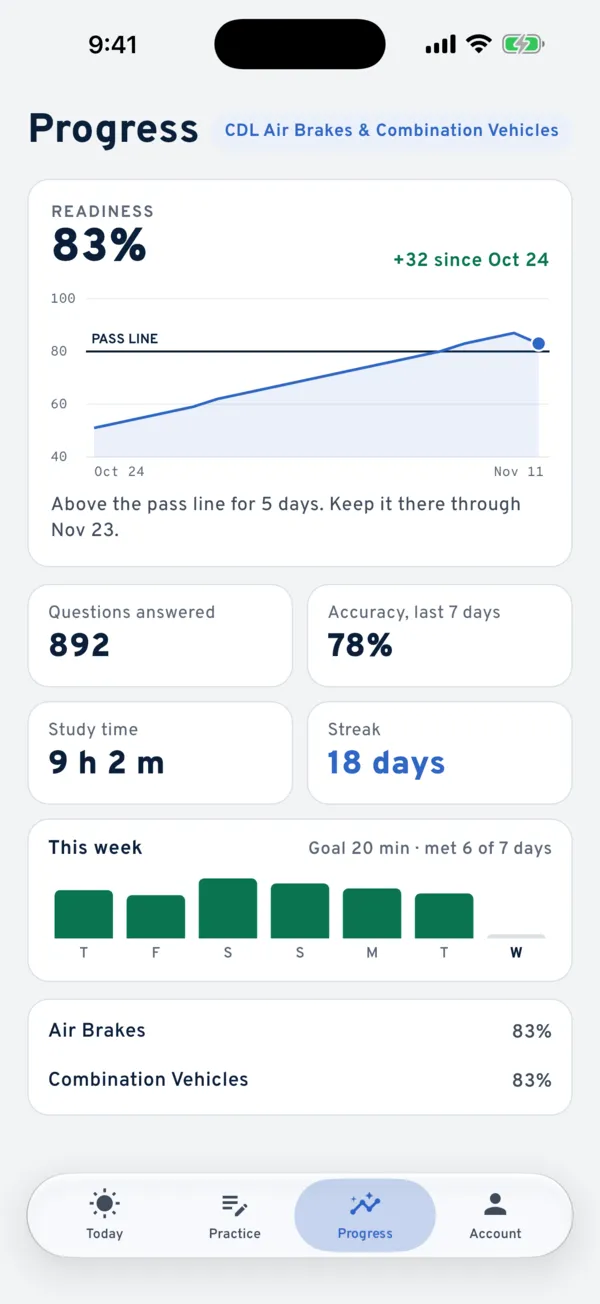
Clinched has every CDL Air Brakes and Combination question in this format, with full practice tests that match the real one, a readiness score by area and a plan to your test date. Free to start with 10 questions a day.
Read the CDL Air Brakes and Combination guide or see how we write and check every question.
Free on the App Store
Your exam, in your pocket.
20 exams ready with questions written from the official sources, timed practice tests in the real format and a readiness score with a pass line.
On your computer?
Scan with your iPhone camera to get Clinched practice in the app.