

NATE Core Exam Study Guide: Topics, Weights and a Plan
Short answer
The NATE Core exam is 50 questions in 1.5 hours, and basic electricity (26%) and safety (18%) make up almost half of it. Specialty exams are 100 questions in 2.5 hours, split into installation, service, system components and applied knowledge, and both need 70% to pass. Study straight from the KATE outline for each exam, since NATE says no question appears unless it's referenced there.
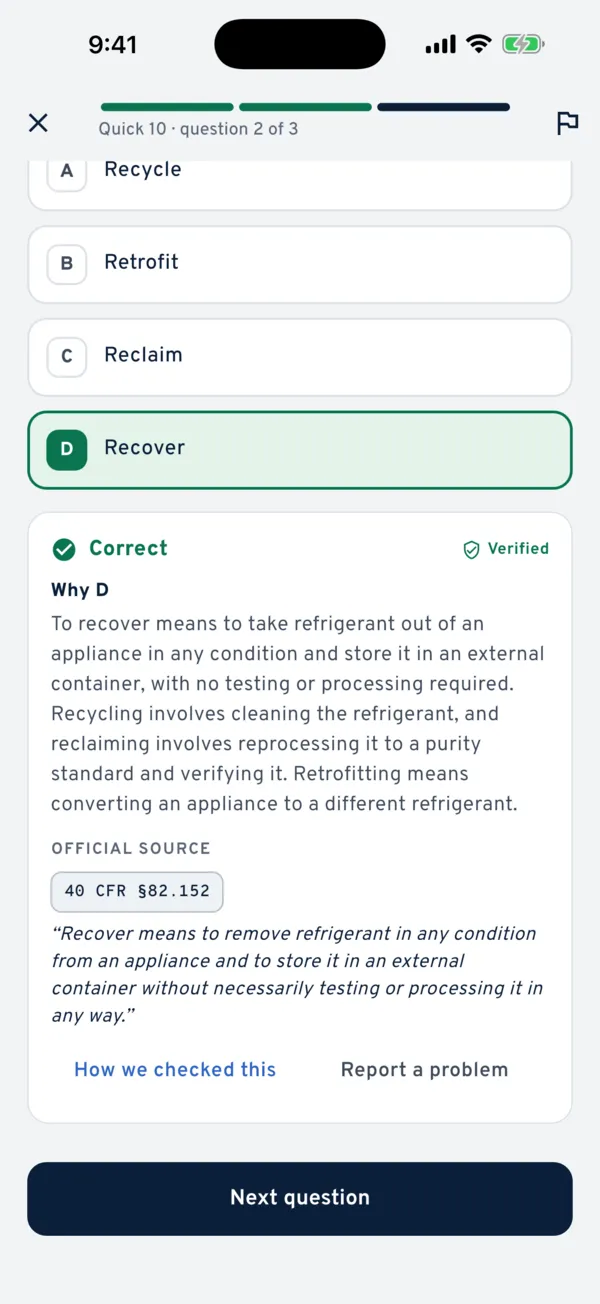
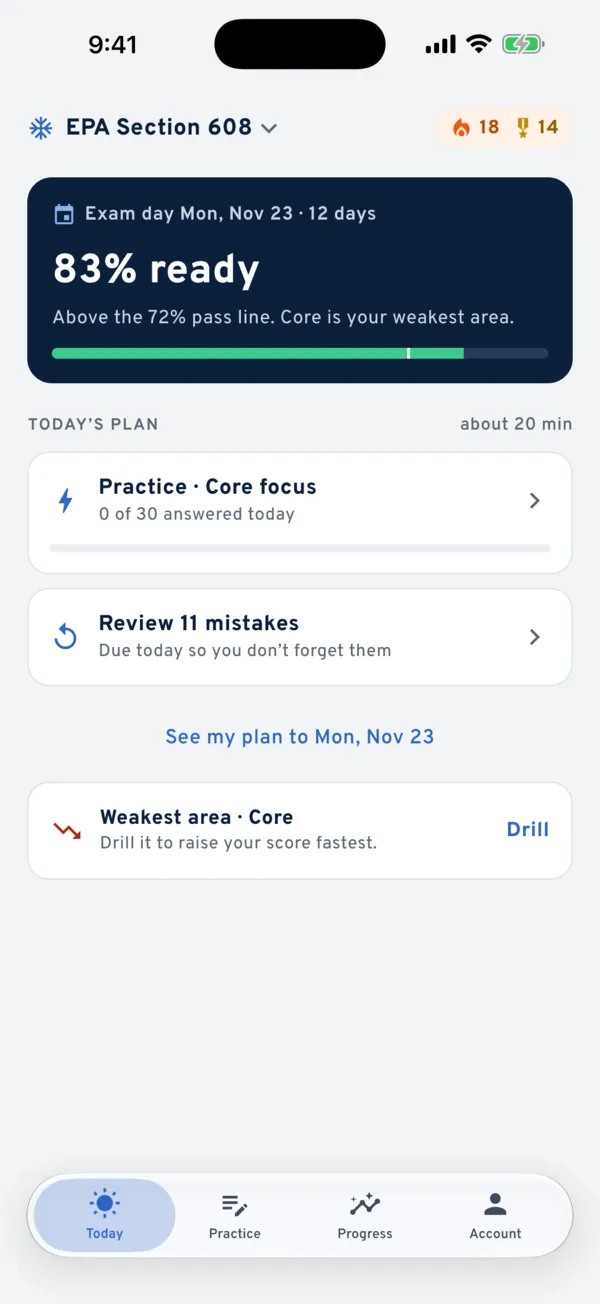
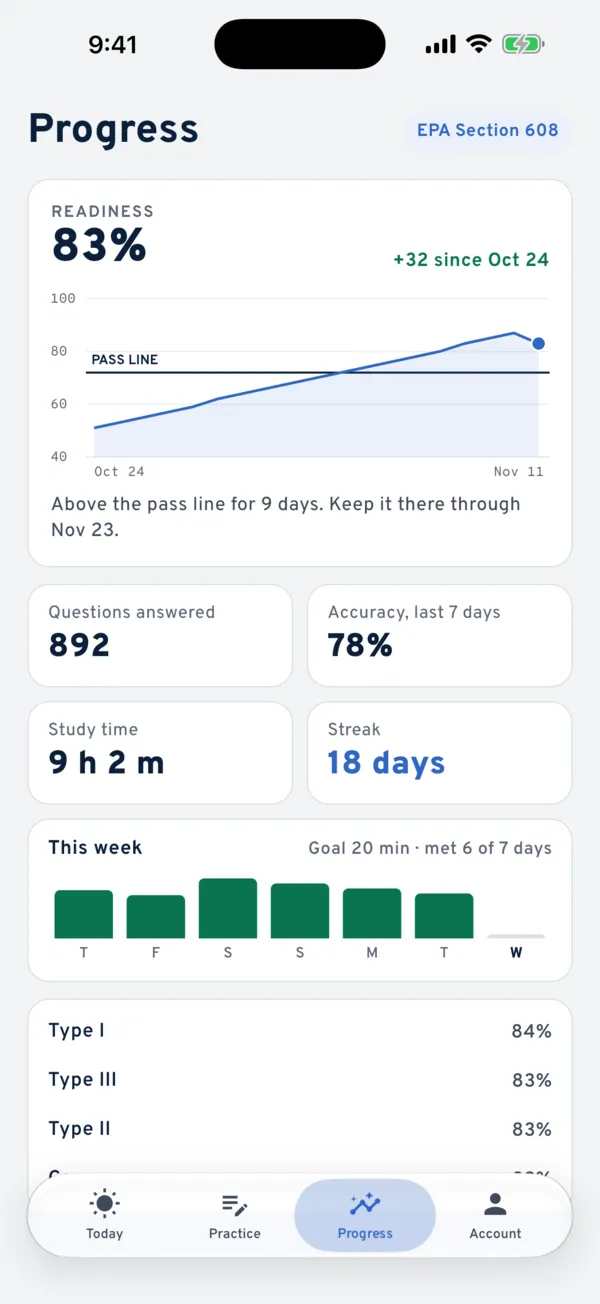
The NATE Core exam is 50 questions with a 1.5 hour limit, and you need 70%, or 35 correct, to pass.13 A specialty exam is 100 questions in 2.5 hours at the same 70%.38 The most useful study document for both is free. It’s the KATE (Knowledge Areas of Technician Expertise) for each exam, and NATE says no question will be on a NATE-developed test unless it’s referenced in a KATE.2
What the Core exam tests
Core is the general exam every technician on the traditional pathway takes, whatever their specialty.4 Here’s the official split and what each section really asks for.1
| Area | Share | What to know cold |
|---|---|---|
| Basic electricity | 26% | Ladder schematics, field and pictorial wiring diagrams, single and three phase motors, symbols |
| Safety | 18% | Hazmat transport and labeling, confined spaces, brazing with oxygen and acetylene, purging gases, grounding |
| Temperature and humidity measurements | 14% | Sensible and latent heat, BTU, wet bulb and dry bulb, the psychrometric chart, enthalpy |
| Achieving desired conditions | 14% | Temperature and humidity for comfort, ventilation, air cleaning, equipment and airflow noise |
| Tools | 10% | Measuring and scale drawings, fabrication tools, tubing benders, flaring and swaging tools |
| Using basic science | 10% | Ohm’s law, series and parallel circuits, gas laws, pressure and temperature, fractions, algebra, geometry |
| Basic construction | 8% | Plans and specs, walls, roofs, floors, fenestration, trusses, chimneys |
Electricity and safety together are 44% of the exam.1 If you can read a ladder diagram and trace a sequence of operation without hesitating, you’ve already covered the biggest piece. If you can’t, start there.
Where experienced techs lose points
Field experience covers safety and tools well. It doesn’t cover the math. The KATE lists transposing formulas, interpolation, 30-60-90 and 45-45-90 triangles, and volumes of irregular shapes.1 Expect to calculate, not just recognize.
The psychrometric chart is the other trap. The measurement section names the sling psychrometer, wet bulb and dry bulb readings, and enthalpy directly.1 Spend an evening plotting conditions and reading off relative humidity, dew point and enthalpy until it’s automatic.
Basic construction is only 8%, about four questions.1 Read through the topic list once so you aren’t surprised, but don’t spend a week on it.
How specialty exams are built
Every installation and service specialty KATE splits its 100 questions into the same four domains. Those are installation, service, system components and applied knowledge. The balance changes by exam.
| Specialty exam | Installation | Service | System components | Applied knowledge |
|---|---|---|---|---|
| Air Conditioning, Installation5 | 43% | 10% | 27% | 20% |
| Air to Air Heat Pump, Service6 | 20% | 42% | 21% | 17% |
| Gas Heating (Air), Service7 | 20% | 45% | 25% | 10% |
An installation exam is mostly installation and components. A service exam puts the heaviest weight on diagnosis and repair. Download the KATE for your exact specialty, since the weights differ even between similar exams. NATE offers installation exams in four specialties and service exams in nine.4
What the topic lists look like
The Heat Pump Service KATE goes deep on defrost control circuits and defrost termination, reversing valve diagnosis using pressure differences, auxiliary heat circuits with outdoor thermostat lockouts, compressor staging and time delays, and charging blended refrigerants.6 Airflow shows up too, including static pressure checks and the formulas for calculating CFM.6
The Gas Heating Service KATE centers on ignition sequences for standing pilot, intermittent pilot, hot surface and direct spark systems, flame sensing, combustion air and flue gases, and vent categories including Category III and IV positive pressure venting.7 Carbon monoxide detection appears as its own item.7
Specialty installation topics overlap with refrigerant work you need an EPA 608 card for, like evacuation, leak checking and refrigerant container handling.6 If you don’t have 608 yet, the EPA 608 exam guide covers what that test asks.
Study from the KATE, then add material
NATE’s own advice starts with the KATEs. Each one lists the references the questions came from, so you can look up a topic in the index of any HVACR reference book.2 The Core KATE’s reference list includes the ACCA manuals D, J, S, T, QI and RS, SMACNA duct construction standards, the International Code Council codes, the National Fuel Gas Code, OSHA standards and generally accepted HVACR textbooks.1 You don’t need to buy all of them. One solid HVACR textbook plus the ACCA manuals for your specialty covers most of it.
Beyond that, NATE sells official study guides with practice questions at the end of each chapter, and runs the NATE Training Academy online with Interplay Learning.2 NATE-recognized training providers also run in-person prep classes.2 Pick one structured source and stick with it. Jumping between five question banks feels productive but mostly repeats the easy material.
Clinched is building a NATE course and isn’t live for this exam yet. Tap “Notify me” in the app to hear when it is.
A four week plan for Core plus a specialty
This assumes at least a year in the field and about an hour a night, five nights a week. If you’re newer, double each block.
- Week 1Read the Core KATE line by line and mark every topic strong, shaky or never seen. Then spend the week on basic electricity. Ohm's law, series and parallel circuits, motors, capacitors, and reading ladder diagrams for sequence of operation.
- Week 2Measurements, science and math. Plot ten points on a psychrometric chart, work through sensible and latent heat problems, and drill the math topics from the KATE. Finish with a pass through safety and construction.
- Week 3Your specialty KATE. Work the system components list first, then installation or service, whichever carries more weight on your exam. Tie every topic back to a real job you've done.
- Week 4Timed practice only. Take a 50-question set in 90 minutes and a 100-question set in 150 minutes. Log every miss by KATE topic, review those topics, and book once you're scoring in the mid 80s.
The NATE certification levels guide explains whether Core plus a specialty, the five-exam CHP-5 route, or an entry level certificate fits you better.
Pacing, calculators and the charts
Core gives you 1.8 minutes per question, and a specialty gives you 1.5.8 Most questions take far less, so the real risk is getting stuck on a multi-step calculation. Mark it, move on and come back.
At an in-person session you can bring a non-programmable calculator.8 On a paper exam, the back of the test booklet includes a formula sheet and a temperature and pressure chart.8 Practice with a printed pressure and temperature chart and a basic calculator so the format isn’t new to you on test day.
If you fail, your score report shows your percentage in each topic domain.3 Since domains don’t have equal question counts, weigh a weak score in a 26% area more heavily than one in an 8% area.3 For costs, booking and renewal rules, see the NATE exam guide.
Questions people ask
What is on the NATE Core exam?
The Core exam covers seven areas. Basic electricity is 26%, safety 18%, temperature and humidity measurements 14%, achieving desired conditions 14%, tools 10%, basic science 10% and basic construction 8%. It's 50 questions in 1.5 hours, and you need 35 correct to pass.
How long should I study for the NATE Core exam?
A technician with a year or more of field experience can usually prepare for Core in two to three weeks of steady evening study, and for a specialty in another two. Newer techs should plan longer. The best guide is the KATE outline, so mark which topics you can explain cold and which you can't.
Can you use a calculator on the NATE exam?
Yes. At an in-person session you can bring a non-programmable calculator. For Live Online Proctoring you use the calculator built into the exam software, and handheld calculators aren't allowed.
Is the NATE Core exam hard?
It's broad rather than deep. The questions that cost people points tend to be electrical diagrams, psychrometrics, math and the construction topics most techs never study. NATE doesn't publish a pass rate, so judge your readiness by timed practice against the KATE topics.
Sources
- Core Exam KATE (Knowledge Areas of Technician Expertise)North American Technician Excellence
- How to PrepareNorth American Technician Excellence
- Frequently Asked QuestionsNorth American Technician Excellence
- Traditional PathwayNorth American Technician Excellence
- Air Conditioning Installation KATENorth American Technician Excellence
- Air to Air Heat Pump Service KATENorth American Technician Excellence
- Gas Heating (Air) Service KATENorth American Technician Excellence
- NATE Exam Administration ScriptNorth American Technician Excellence
ClinchedNATE Certification
Pass NATE Certification on the first try.
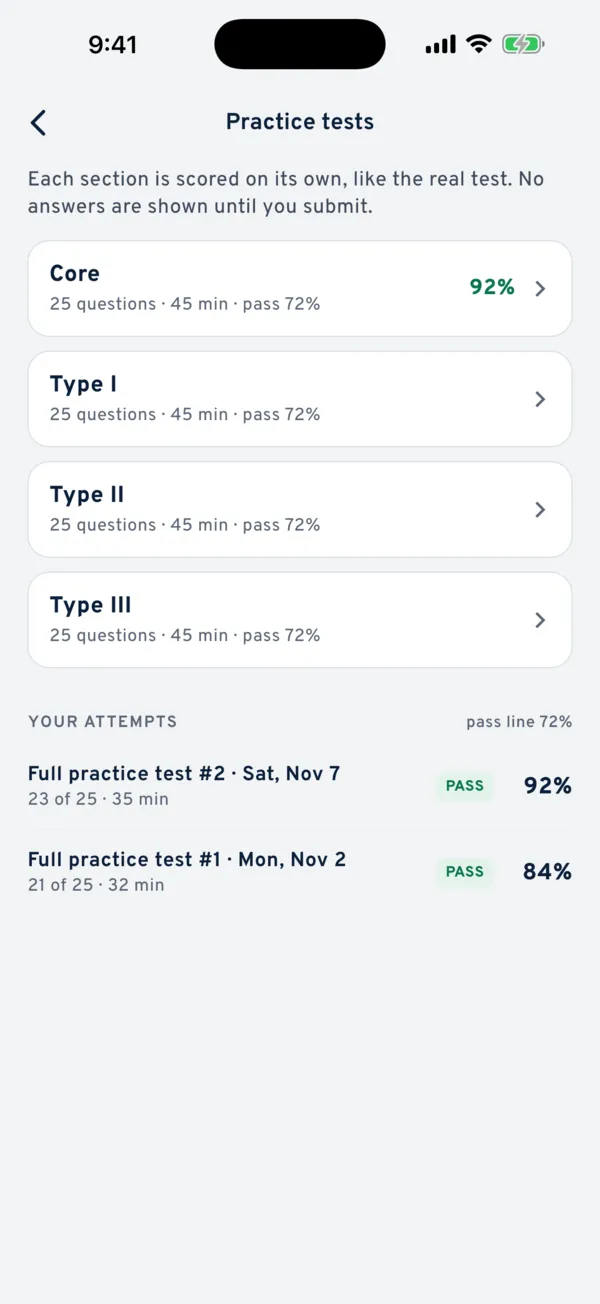
Practice questions written from the official sources, full practice tests in the real format and a plan that ends on your test date. Free to start.
Keep reading
- Exam guide · NATE Certification
 NATE Certification Levels: Which NATE Exam Should You Take?Ready to Work, HVAC Support Technician, Core plus specialty, or Senior Level Efficiency Analyst. Question counts, time limits, prerequisites and who each fits.
- Study plan · Property and Casualty Insurance
 Property and Casualty Exam Study Plan: 5 Weeks to Test DayA 5-week P&C exam study plan built on a real state outline. What to study each week, how to drill coinsurance and auto scenarios, and when you're ready to book.
- Study plan · NHA CCMA
 CCMA Exam Study Plan: 8 Weeks Built on the NHA Test PlanAn 8-week CCMA study plan weighted by NHA's test plan. Clinical Patient Care is 84 of 150 scored items, so here's how to split your hours, practice and review.