

NATE Certification Levels: Which NATE Exam Should You Take?
Short answer
NATE has four rungs. Ready to Work (50 questions, $60, online and unproctored) is for people new to the trade, and HVAC Support Technician (100 questions, proctored) fits techs with 6 to 12 months in the field. Full NATE certification takes the 50-question Core plus a 100-question specialty at 70%, and the Senior Level Efficiency Analyst exam (100 questions, 4 hours, 75%) requires two service specialties first.
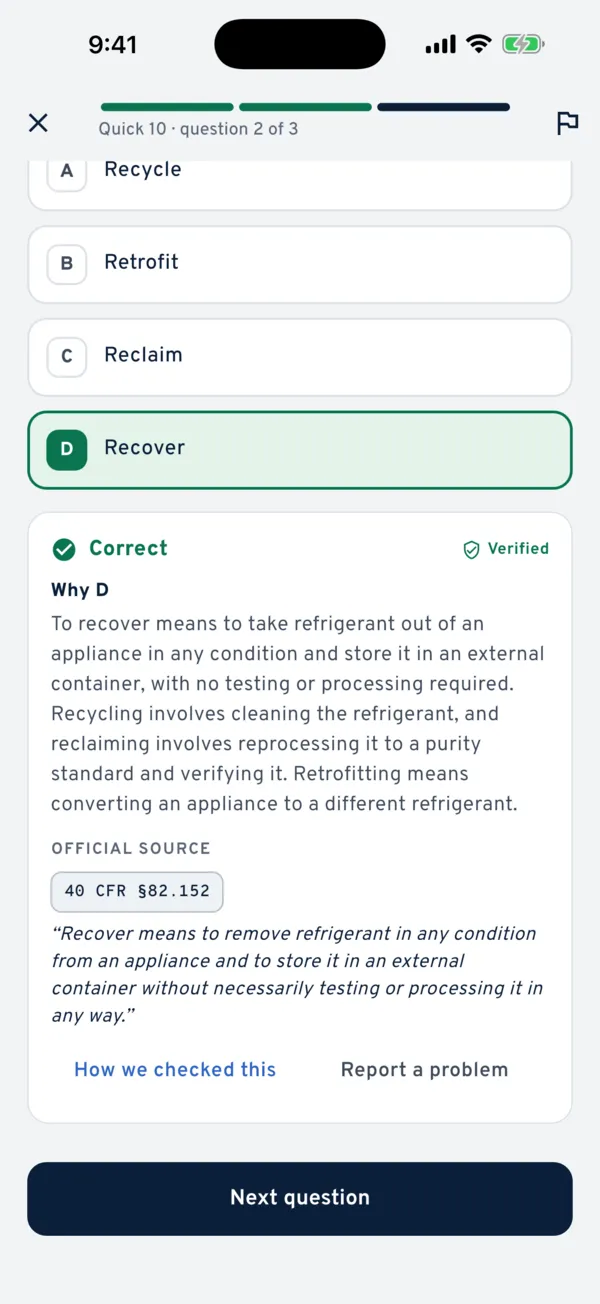
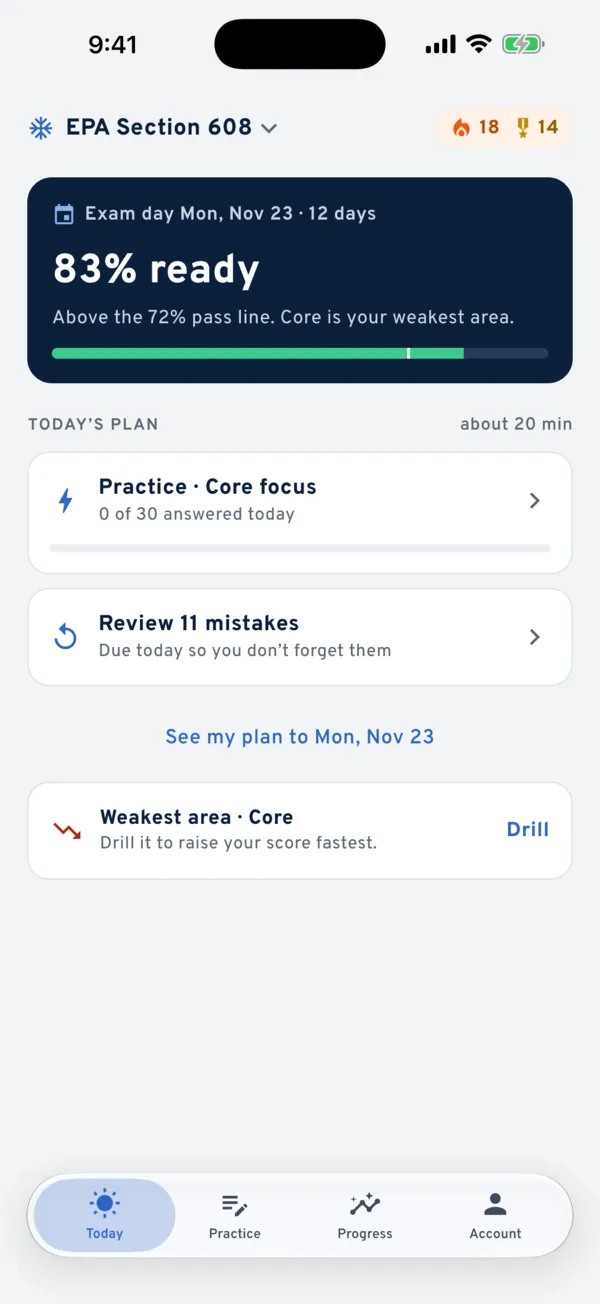
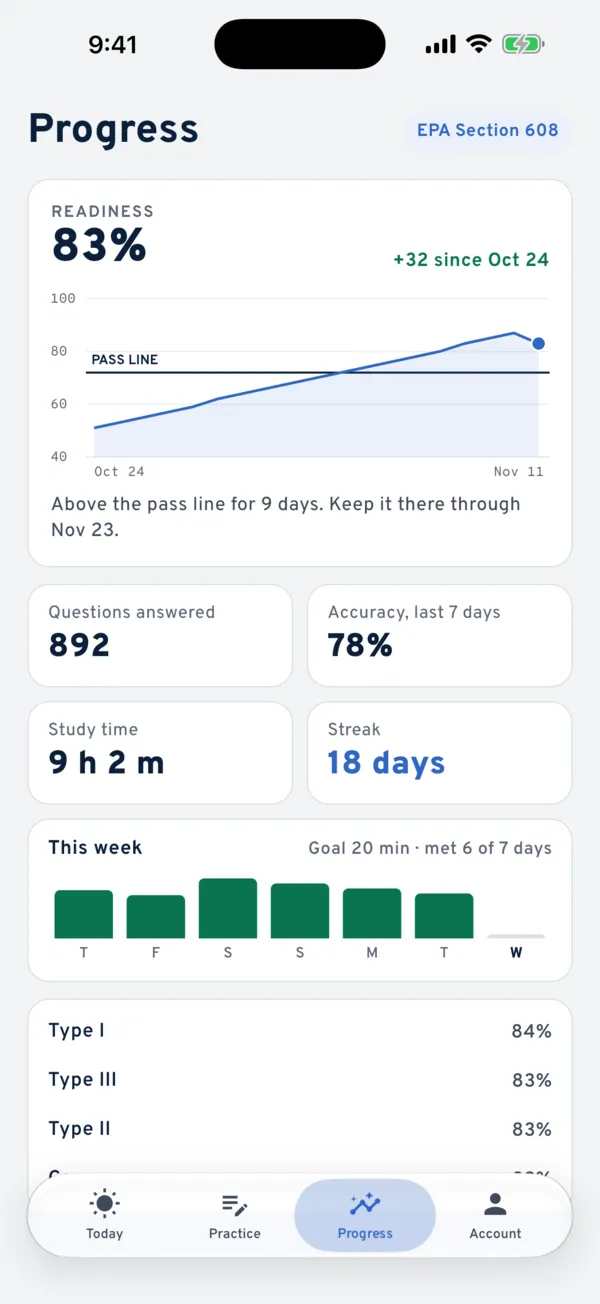
NATE offers four levels, and the right one depends mostly on how long you’ve been in the field. If you’re brand new, start with Ready to Work. With 6 to 12 months of experience, take HVAC Support Technician. At one to two years, go for full NATE certification through the Core and a specialty. The Senior Level Efficiency Analyst exam comes after you hold two service specialties.
The four levels side by side
| Level | Questions and time | How you take it | Who it’s for |
|---|---|---|---|
| Ready to Work certificate | 50 questions, 1.5 hours2 | Online, no proctor2 | New to the field, little or no training1 |
| HVAC Support Technician certificate | 100 questions, 2.5 hours3 | Proctored1 | 6 to 12 months in the field1 |
| NATE certification (Core plus one specialty) | 50 plus 100 questions, 70% each6 | Proctored, in person or online8 | 1 year for installation, 2 for service6 |
| Senior Level Efficiency Analyst | 100 questions, 4 hours, open book5 | Proctored | Holders of two service specialties4 |
The first two rows are certificates. NATE is explicit that passing them earns a certificate, not a NATE certification.1 Employers who ask for “NATE certified” mean the third row or above.
Ready to Work, for your first months
Ready to Work is designed for people just entering heating, ventilation, air conditioning and refrigeration (HVACR) work, with little or no formal training.1 It costs $60, and a downloadable study guide comes with the order.1 You take it online, without a proctor, from any computer, including at home.1 NATE also lets you study for and take it through the SkillCat phone app.1
The test has 50 questions and a 1.5 hour limit.2 Here’s how the questions split.2
- Tools32%
- Components22%
- General safety14%
- Electrical safety12%
- Basic heat transfer12%
- Measurements and units8%
Almost a third of it is tools, so knowing a manifold gauge from a micron gauge and what each meter measures matters more than theory here. Retakes cost $45.1 The certificate is valid for five years, and you renew it by retaking the exam.1
Take Ready to Work if you’re in a trade school program, starting as a helper, or applying for your first job and want something on your resume that shows you know the basics. Skip it if you already have a year in the field. It won’t tell an employer much about you at that point.
HVAC Support Technician, for your first year
HVAC Support Technician is built for technicians with 6 to 12 months on the job.1 It covers the same subjects as the professional exams at a more basic level.1 It’s 100 questions, closed book, with a 2.5 hour time limit.3 Unlike Ready to Work, it has to be proctored, either at a NATE testing organization or through NATE’s Live Online Proctoring.18
The biggest piece of the exam is installation at 24%, followed by system components at 13% and safety at 10%.3 The rest is spread thin across basic electricity, tools, measurements, service, comfort conditions, applied knowledge, basic science and terminology, none above 9%.3 Like Ready to Work, it’s a certificate valid for five years and renewed by retesting.1
This one makes sense when you’re past the helper stage and want a structured goal before you attempt Core. Many of its topics are the same as Core, so studying for it doubles as early Core prep.
Full NATE certification
This is the credential contractors and customers mean when they say NATE certified. NATE designed it for professional technicians and recommends at least one year of experience for installation exams and two years for service exams.6 You have two ways to earn it.4
Traditional pathway
You pass the 50-question Core exam and one 100-question specialty exam. Each needs 70%, which is 35 correct on Core and 70 correct on a specialty.6 Core covers safety, tools, basic construction, basic science, comfort conditions, measurements and basic electricity. The specialty goes deep on one equipment family, such as Air Conditioning, Gas Heating or Hydronics. Our NATE Core exam study guide covers the content of both in detail.
CHP-5 pathway
The Certified HVAC Professional (CHP-5) route swaps the two big exams for five 30-question exams on HVAC Fundamentals, Electrical and Controls, Comfort and Airflow, Installation, and Service.7 You can take them in any order and space them up to six months apart.7 It suits techs who’d rather pass one smaller exam at a time while working full time. The end result and the two-year renewal are the same.7
Either way, the certification lasts two years.6 You renew by logging 16 continuing education hours or retaking your specialty exam.4
Senior Level Efficiency Analyst
The senior exam targets the most experienced technicians, and NATE recommends five years in the field before you attempt it.6 You can’t sit for it until you hold two NATE service specialty certifications in an approved pairing.4 Air Conditioning plus Gas Heating works, as does Heat Pump plus Air Distribution. Air Conditioning plus Heat Pump isn’t on the approved list, so check your pairing before you plan.4
The exam has 100 questions with a 4 hour limit, and it’s open book.5 You need 75% to pass, higher than the 70% on Core and specialty exams.6 It’s limited to systems of 10 tons or less of cooling and 325,000 BTU or less of heating.5 Here’s the split.5
- System performance, 35%
- Air distribution, 20%
- Load calculation, 15%
- Equipment selection, 10%
- Hydronic distribution, 7%
- Indoor air quality, 7%
- Planned maintenance, 6%
Open book doesn’t make it easy. Load calculations and equipment selection mean working through ACCA Manual J and Manual S logic under time pressure, so tab your references before test day.
How to choose
- Count your field time honestlyUnder six months points to Ready to Work. Six to twelve months points to HVAC Support Technician. A year or more of installs, or two years of service calls, points to full certification.
- Check what your employer wantsIf your company pays for or requires NATE, ask which credential counts. Most mean full certification, not a certificate.
- Match the specialty to your workPick the equipment family you work on every week.
- Get your EPA 608 card first if you handle refrigerantNATE is voluntary, but EPA Section 608 is federal law for refrigerant work, and you need it regardless.
If you don’t have your 608 card yet, our EPA 608 Type I vs Type II vs Type III guide explains which type covers the equipment you work on. NATE offers the 608 exams through its own online proctoring too.8 For costs, booking and test day rules for the full certification, see the NATE exam guide. Clinched is building a NATE course, and you can tap “Notify me” in the app to hear when it opens.
Questions people ask
Is the NATE Ready to Work certificate the same as NATE certification?
No. Ready to Work and HVAC Support Technician are entry level certificates, and NATE says plainly that passing them earns a certificate, not a NATE certification. Full NATE certification requires passing the Core exam and a specialty exam, or all five CHP-5 exams.
How much does the NATE Ready to Work exam cost?
NATE lists the Ready to Work exam at $60, and retakes for the same technician cost $45 each. A downloadable study guide comes free with the exam. It's online, unproctored, and can be taken from any computer.
What do you need to take the NATE Senior Level Efficiency Analyst exam?
You must already hold two NATE service specialty certifications in an approved pairing, such as Air Conditioning plus Gas Heating. The exam is 100 questions, open book, with a 4 hour limit, and the passing score is 75%. NATE recommends about five years of experience.
How long are NATE certificates valid?
Since July 2023, the Ready to Work and HVAC Support Technician certificates are valid for five years, and you renew them by retaking the exam. Full NATE certification lasts two years and renews with 16 continuing education hours or a specialty retest.
Sources
- NATE Entry Level CertificatesNorth American Technician Excellence
- Ready-to-Work KATENorth American Technician Excellence
- HVAC Support Technician KATENorth American Technician Excellence
- NATE Certification PathwaysNorth American Technician Excellence
- Senior Level Efficiency Analyst KATENorth American Technician Excellence
- Frequently Asked QuestionsNorth American Technician Excellence
- Certified HVAC Professional (CHP-5)North American Technician Excellence
- Live Online ProctoringNorth American Technician Excellence
ClinchedNATE Certification
Pass NATE Certification on the first try.
Practice questions written from the official sources, full practice tests in the real format and a plan that ends on your test date. Free to start.
Keep reading
- Study plan · NATE Certification
 NATE Core Exam Study Guide: Topics, Weights and a PlanWhat the NATE Core and specialty exams test, how each KATE weights the topics, and a four week plan to reach 70% on 50 Core and 100 specialty questions.
- Exam guide · Series 63, 65 and 66
 Series 65 vs Series 66: Which One Should You Take?The Series 65 has 130 scored questions and stands alone. The Series 66 has 100 and only counts with a Series 7. How to choose based on your job and where you work.
- Exam guide · SIE · Series 7
 SIE vs Series 7: How the Two FINRA Exams Fit TogetherThe SIE has 75 scored questions and needs no sponsor. The Series 7 has 125 and needs a firm. How they differ in content, cost and difficulty, and which comes first.