

EPA 608 Type I vs Type II vs Type III: Which Do You Need?
Short answer
Type I covers small appliances, meaning factory-sealed units with 5 pounds of refrigerant or less. Type II covers medium, high and very high pressure equipment such as residential splits, rooftop units and supermarket refrigeration. Type III covers low pressure chillers, and Universal (Core plus all three types, 100 questions) covers everything.
Type I covers small appliances, Type II covers medium, high and very high pressure equipment, Type III covers low pressure equipment, and Universal covers all three.1 Every type also requires the Core section. If you work on central air, heat pumps, rooftop units or commercial refrigeration, you need Type II at minimum. If you might ever service a centrifugal chiller, you need Type III too, and at that point most people just take Universal.
Which type matches which job
This table sorts common equipment by the type EPA requires. The definitions behind it come from 40 CFR 82.152 and are explained in the next section.
| Equipment | Type you need |
|---|---|
| Window and portable AC, household refrigerators and freezers | Type I |
| Dehumidifiers, vending machines, drinking water coolers, under-counter ice makers | Type I |
| Packaged terminal heat pumps (factory-sealed, 5 lb or less) | Type I |
| Central split AC and heat pumps, ductless mini-splits | Type II |
| Rooftop units, walk-in coolers, reach-in cases with remote condensers | Type II |
| Supermarket rack systems, high pressure chillers | Type II |
| Centrifugal chillers on R-123, R-11 or R-245fa | Type III |
| Car and truck AC | Section 609, not 608 |
The Type I examples come straight from the regulation’s own list of small appliances.2 The rest follow from the pressure class of the refrigerant, which is where people get tripped up.
How EPA draws the lines
Small appliances (Type I)
A small appliance is one that is fully manufactured, charged and hermetically sealed in a factory with 5 pounds or less of refrigerant.2 All three conditions have to be true. A refrigerator with a 4-ounce charge qualifies. A ductless mini-split with a 3-pound charge does not, because its line set is connected and opened in the field, so it was never a factory-sealed system as installed. That is why mini-split installers need Type II.
Pressure classes (Types II and III)
Everything else is sorted by the refrigerant’s liquid saturation pressure at 104°F.2
| Class | Pressure at 104°F | Examples in the rule | Type |
|---|---|---|---|
| Low pressure | Below 45 psia | R-11, R-123, R-113, R-245fa | III |
| Medium pressure | 45 to 170 psia | R-114, R-124, R-12, R-134a, R-500 | II |
| High pressure | 170 to 355 psia | R-22, R-407A, R-407C, R-410A, R-502 | II |
| Very high pressure | Above 355 psia, or critical temperature below 104°F | R-13, R-23, R-503, R-508A, R-508B | II |
Notice that Type II is much broader than its nickname. People call it the high pressure test, but the regulation assigns it medium, high and very high pressure appliances, except small appliances and car AC.1 So a large R-134a chiller is a Type II job even though R-134a is a medium pressure refrigerant.
What each type tests
The Core section is the same no matter which type you take. Each test pairs 25 Core questions with 25 questions from the technical group you are certifying in.4 You need 70% on each section, which with 25 questions means 18 correct.46
Type I focuses on recovery from small appliances. EPA’s topic list includes recovery requirements that depend on whether the compressor works and when the recovery equipment was made, passive recovery, access valves, and the decomposition products refrigerants form at high temperature.5 It is the shortest list and the easiest section for most people.
Type II covers leak detection, leak repair rates and records, recovery techniques, required evacuation levels by appliance size, pressure and temperature relationships, and safety around compressors and equipment rooms.5 It has the most numbers to memorize, starting with the evacuation table and the leak repair trigger rates.
Type III covers leak testing by pressurizing low pressure systems, leak repair rates, recovery techniques like heating the oil and preventing water in the tubes from freezing, recharging, purge units, and refrigerant sensors in R-123 machine rooms.5 Many residential techs find it the hardest because they have never seen the equipment.
The section-by-section details are in the EPA 608 exam guide.
Special cases people ask about
Car and truck AC
Section 608 doesn’t cover motor vehicle air conditioning. If you service car or truck AC for pay, you need Section 609 certification under 40 CFR Part 82, Subpart B.1 There is one overlap. MVAC-like appliances, meaning open-drive compressor systems with 20 pounds or less that cool the cab of off-road equipment such as tractors and excavators, can be serviced with either Type II or Section 609 certification.12
Disposal and scrapping
You don’t need certification to dispose of small appliances, car AC systems or MVAC-like appliances.1 The refrigerant still has to be recovered before the unit is scrapped, but the person who does the final disposal step doesn’t need a 608 card. Disposing of Type II or Type III equipment is different. Those disposals do require the matching certification.1
Apprentices
A registered apprentice can do certified work without a card as long as a certified technician closely and continually supervises them.1 The exemption lasts only two years from the date the apprentice first registered with the U.S. Department of Labor’s Office of Apprenticeship or a recognized state apprenticeship council.2
Who counts as a technician
EPA treats you as a technician if you attach or detach hoses and gauges to read pressures, add or remove refrigerant, or do anything else that opens the refrigerant circuit.3 A helper who only carries equipment doesn’t need a card. A helper who hooks up gauges does.
Should you just take Universal
Universal means passing Core plus all three types, 100 questions in total, and you can do it in one sitting or by combining passing scores from separate tests.4 There are three practical reasons to go for it.
First, cost. Many programs price the exam as a bundle. ESCO’s 2026 online proctored exam, for example, costs $85 and includes Core, Type I, Type II and Type III.6 Taking only Type II saves you study time, not money.
Second, scoring. Each section is graded on its own, so trying for Universal carries little downside. If you pass Core, Type I and Type II but miss Type III, you are certified Type I and Type II and retake only Type III.6
Third, your career. Your certification never expires.3 A Type II card that is fine for residential work today becomes a problem the day you take a job with a mechanical contractor that services chillers.
There’s one trap. A Type I test taken in a mail-in or open book format needs 84% to pass and can’t be used toward Universal.4 EPA states plainly that an open book Core test doesn’t count for Universal certification.3 If you might want Universal later, take Core and Type I closed book with a proctor the first time.
How to prepare for the type you choose
Start with Core, because nothing counts without it. Then spend your time where the numbers are. For Type II that means the evacuation table and the leak repair rates, which are laid out in refrigerant recovery and evacuation levels. For Type III, read up on purge units and chiller recovery even if you’ve never been in a machine room.
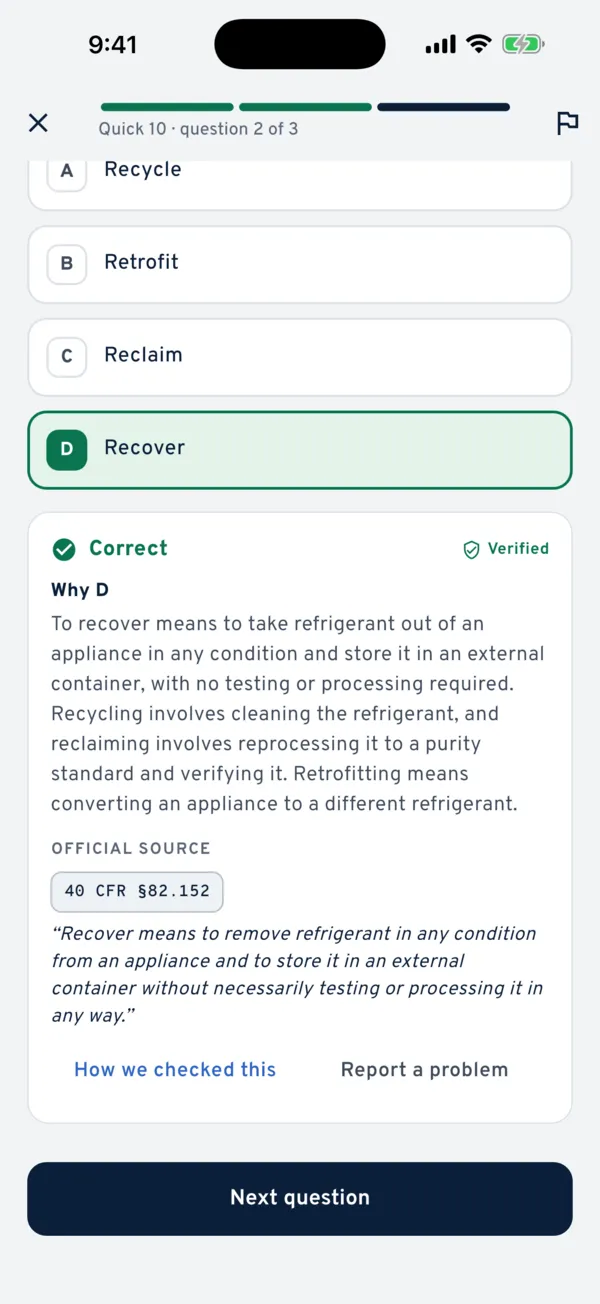
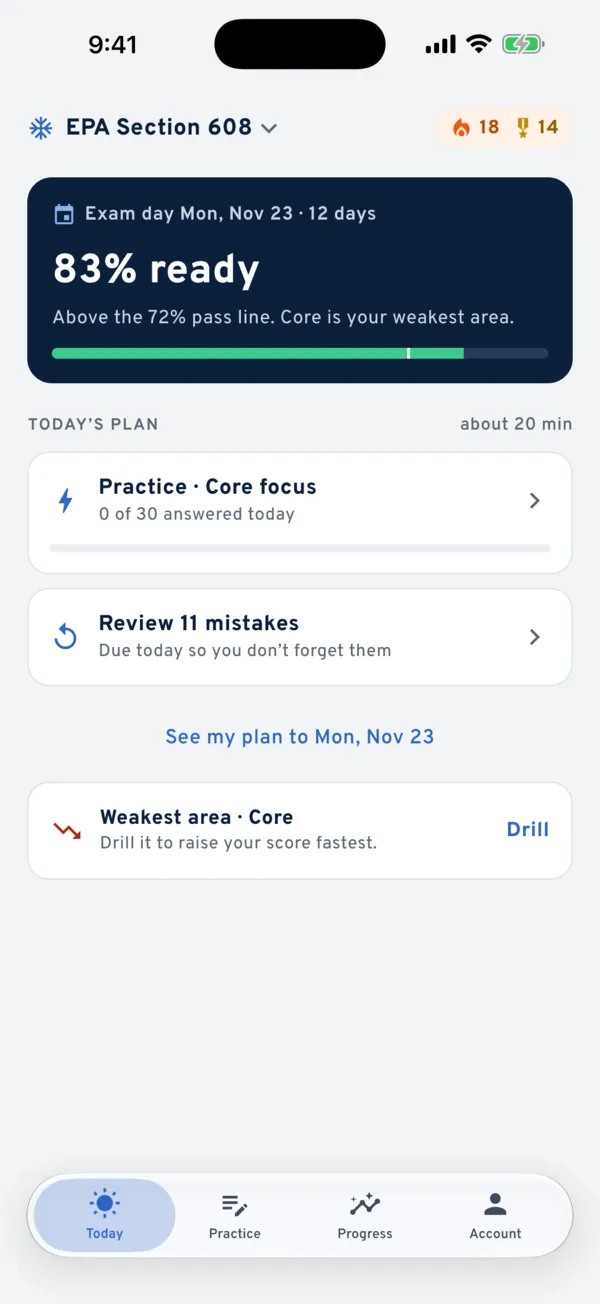
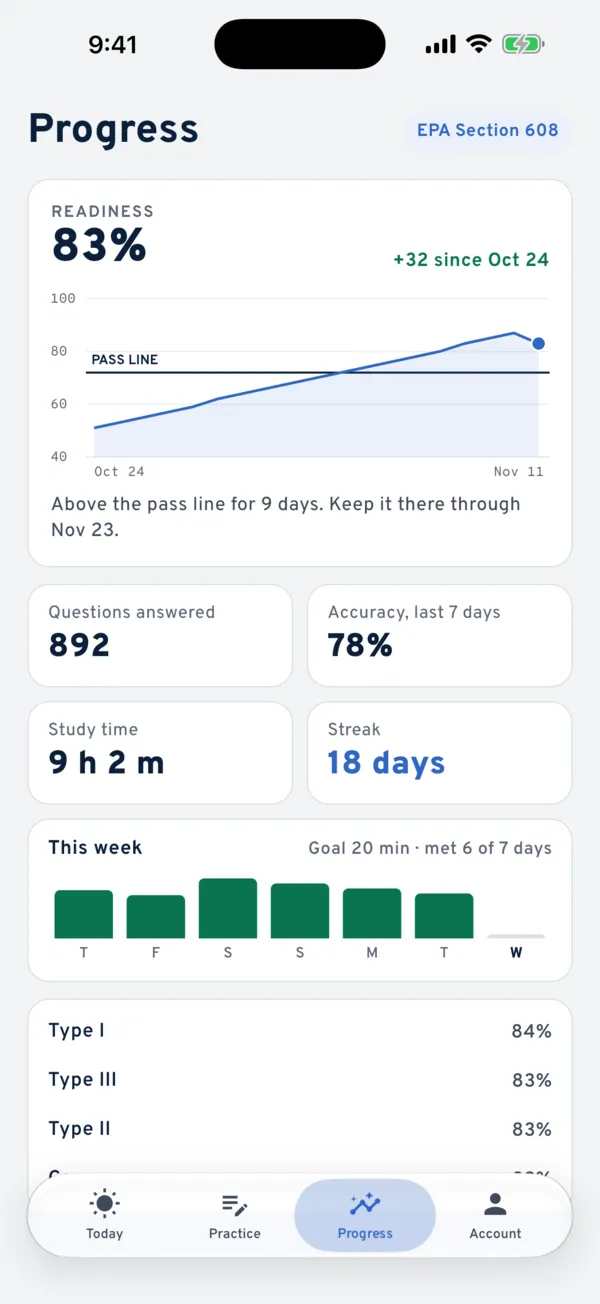
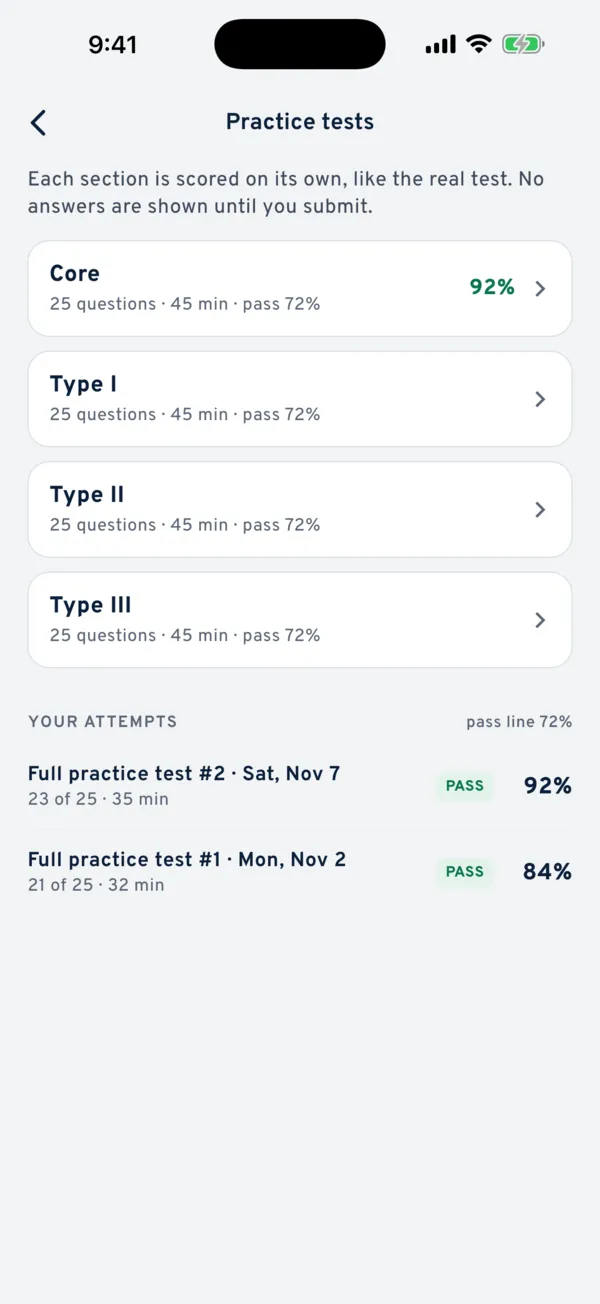
Clinched’s EPA 608 course drills all four sections in the real 25-question format and shows the regulation text under every answer, so you can see which rule a question is built on. Whatever you study with, don’t book the exam until you can score 18 out of 25 on each section you plan to take, every time.
Questions people ask
Do I need Type II for residential air conditioning?
Yes. Central air conditioners and heat pumps using R-410A, R-22 or the newer residential refrigerants are high pressure appliances under EPA's definitions, which puts them in Type II. Type I only covers factory-sealed appliances holding 5 pounds of refrigerant or less, such as window units.
Is a mini-split Type I or Type II?
A ductless mini-split is Type II. EPA's small appliance definition requires a unit that is fully manufactured, charged and hermetically sealed in a factory, and a mini-split has its line set connected and opened in the field, so it doesn't meet that definition even when the charge is small.
Can I work on car air conditioning with EPA 608 certification?
Not for pay. Technicians who service motor vehicle air conditioners for consideration must be certified under Section 609 (40 CFR Part 82, Subpart B), which is a separate program. Off-road equipment AC with 20 pounds or less, called MVAC-like appliances, can be serviced with either Type II or Section 609 certification.
Should I get Universal instead of one type?
Usually yes. Universal is Core plus all three types, 25 questions each, and many programs include all four sections in a single fee (ESCO's 2026 online exam is $85 for all four). Each section is scored separately, so if you miss one type you keep the ones you passed and retake only the miss.
Sources
- 40 CFR 82.161 Technician certificationElectronic Code of Federal Regulations
- 40 CFR 82.152 DefinitionsElectronic Code of Federal Regulations
- Section 608 Technician Certification RequirementsU.S. Environmental Protection Agency
- 40 CFR Part 82, Subpart F, Appendix D: Standards for Becoming a Certifying Program for TechniciansElectronic Code of Federal Regulations
- Section 608 Technician Certification Test TopicsU.S. Environmental Protection Agency
- Take the 2026 EPA Section 608 ExamESCO Institute
ClinchedEPA 608
Pass EPA 608 on the first try.
Practice questions written from the official sources, full practice tests in the real format and a plan that ends on your test date. Free to start.
Keep reading
- Topic explainer · EPA 608
 Refrigerant Leak Repair Rules: Thresholds, Rates and DeadlinesEPA leak repair kicks in at 20% for commercial refrigeration, 30% for industrial process and 10% for comfort cooling, with 30 days to repair. Who it covers in 2026.
- Topic explainer · EPA 608
 Refrigerant Evacuation Levels: The EPA 608 Recovery ChartRequired recovery vacuum levels by appliance type and charge size from 40 CFR 82.156, plus the 90% and 80% small appliance rule and the 0 psig exceptions.
- Exam guide · EPA 608
 Lost Your EPA 608 Card? How to Get a ReplacementEPA can't replace a lost 608 card. Your certifying organization can, and if it closed, ESCO Institute or Ferris State can with proof. Here are the four steps.
- Exam guide · EPA 608
 How to Take the EPA 608 Exam: Online or In Person, and CostEPA lists 87 approved 608 certifying programs, 15 with online testing. How proctored online and in-person exams work, what they cost and how to book one.