

Study strategyLife and Health Insurance
How Hard Is the Life Insurance Exam? What the Numbers Show
Short answer
Harder than most people expect. The Texas Department of Insurance reported that 60% of candidates passed its life, accident and health exam in February 2021, so roughly 4 in 10 failed. Most states require a score of 70, and the people who fail usually skipped practice questions on policy provisions, annuities and state law.
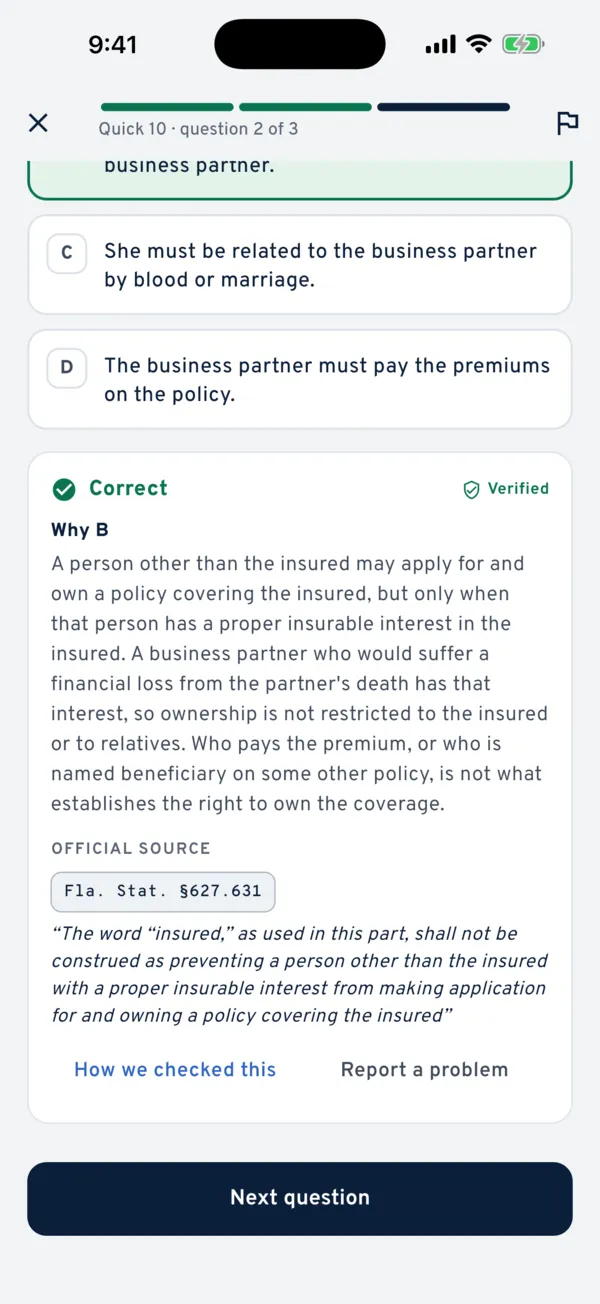
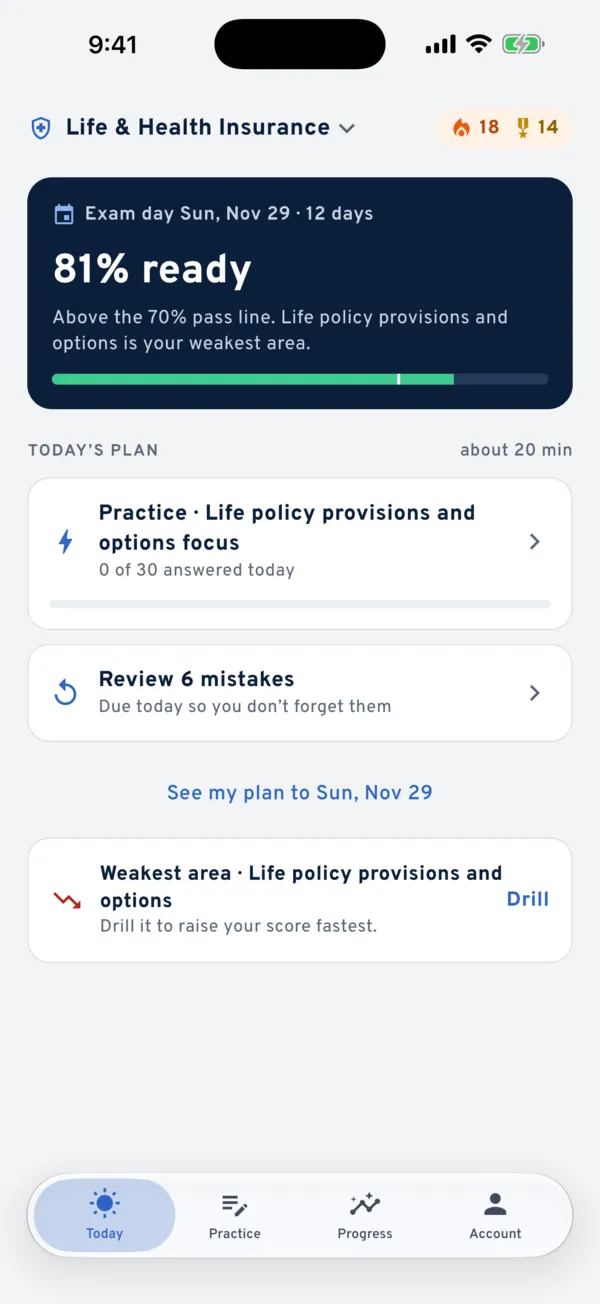
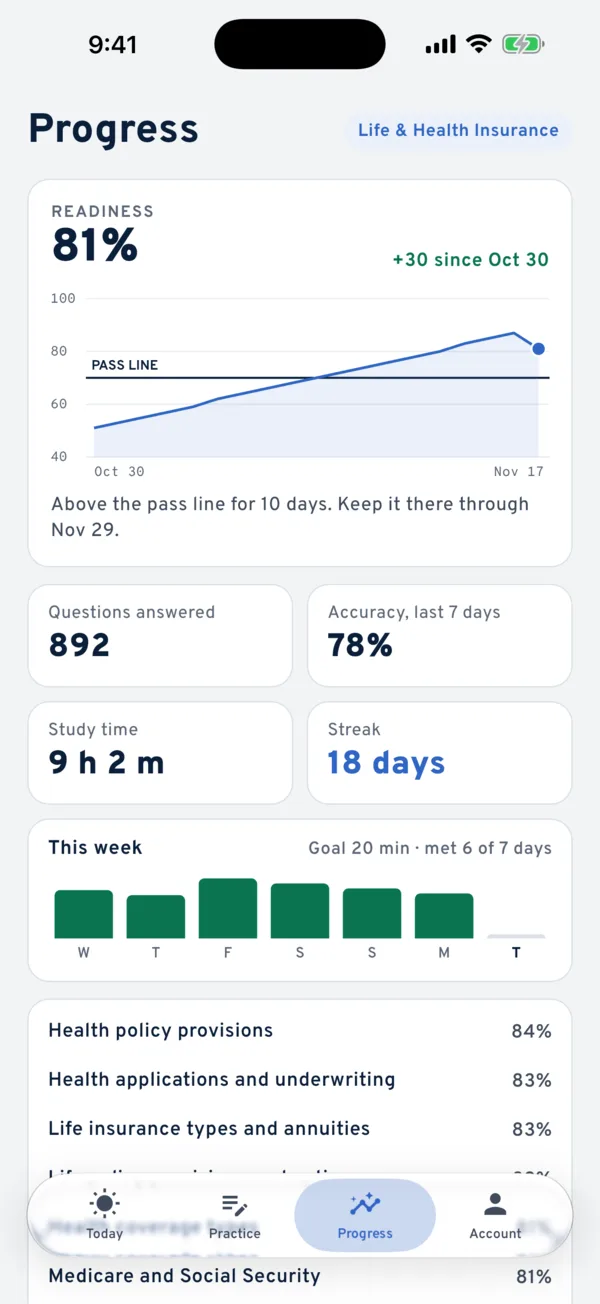
The life insurance exam is harder than its reputation. The Texas Department of Insurance reported that 60% of candidates passed its life, accident and health exam in February 2021.1 That’s one of the few official pass rates any state publishes, and it means about 4 in 10 people failed. The department’s own advice right next to that number is that you’re much more likely to pass if you take a preparation course.1
Why people fail it
The content isn’t advanced. There’s no calculus and very little math. People fail for three predictable reasons.
They underestimate it. The pre-licensing course feels like it covers everything, so they book the exam the next day. The course teaches the material once. It doesn’t drill it.
The questions are precise. Insurance exams test the difference between terms that sound alike. A revocable versus irrevocable beneficiary, a grace period versus a free look period, a waiver of premium rider versus a payor benefit rider. Two answer choices often look right until you know the exact definition.
State law is pure memorization. In Texas, the state section is 30 scored questions out of 130.3 It covers licensing rules, the commissioner’s powers, replacement rules, unfair practices and the guaranty association. There’s no reasoning your way to the answer.
The topics that cost the most points
The Texas outline is a good map, because most states test the same general topics. Here’s where people tend to struggle.
Policy provisions, riders and options. Texas gives this section 15 scored questions.3 It covers beneficiary designations, settlement options, nonforfeiture options, incontestability, the grace period, reinstatement and misstatement of age.3 Know what each provision does and who it protects.
The application and underwriting. 12 scored questions in Texas.3 Signatures, changes to the application, warranties versus representations, conditional receipts, insurable interest and the Fair Credit Reporting Act.3 Questions often turn on timing, like when coverage begins.
Annuities and retirement. The accumulation and annuitization phases, fixed versus variable versus indexed, and who carries the investment risk. Retirement concepts get 8 questions in the Texas life section.3
Health insurance. Disability income definitions, medical expense coverage, long-term care, and social insurance like Medicare and Social Security.3 Medicare parts get mixed up constantly.
How the scoring works
Most states pass you at 70, but they don’t all calculate it the same way. Florida and Georgia count the percentage of questions you got right, and 70% passes.45 Texas uses a scaled score from 0 to 100, where 70 passes and the number isn’t the same as your percentage correct.2
Unscored pretest questions are mixed in on many exams, and you can’t tell which ones they are.2 There’s no penalty for guessing, so never leave an answer blank.2
How much study it really takes
The people who pass on the first try usually do the same thing. They finish their pre-licensing course and then spend two to four more weeks on practice questions, about an hour a day, before they book the exam. They track their scores by topic and go back to the weakest topic every few days.
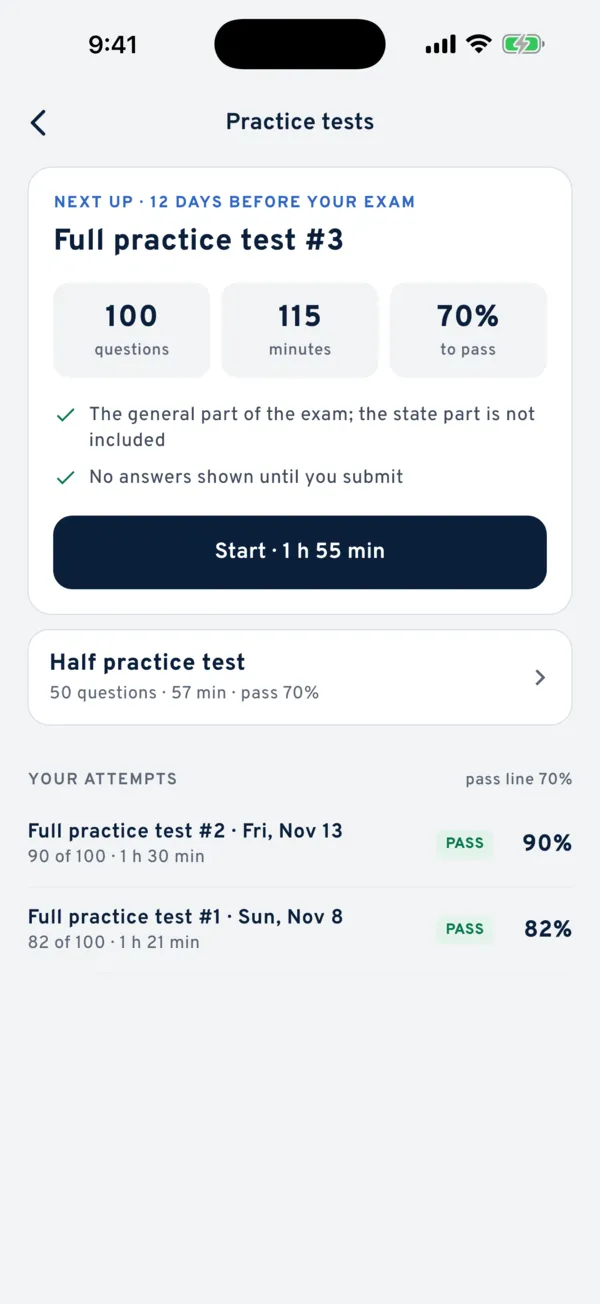
A good rule is to book the exam once you’re scoring comfortably above 70 on two or three full-length timed practice tests, not when you’ve finished the reading. If you’re scoring in the low 70s, you’re one bad day away from failing.
A few habits help.
Write the definitions in your own words. If you can’t explain the difference between a cash refund annuity and an installment refund annuity in one sentence, you’ll miss the question that tests it.
Do state law last but don’t skip it. It’s the freshest thing in your head on test day if you study it in the final week.
Read every answer choice. Insurance questions often include “all of the following except.” The fastest way to lose points is to pick the first true statement you see.
What happens if you fail
It isn’t the end of the process, but rules differ by state. Texas lets you schedule a new exam right away with no limit on attempts.2 Florida allows up to five attempts at the same exam in any 12-month period.4 Georgia makes you wait 14 days after a first or second failure and 60 days after a third.5 Every attempt costs a new exam fee, $49 in Texas and $67 in Georgia.25
Your score report shows how you did in each area. Use it. Retaking the exam a week later after rereading the whole book usually produces the same score.
Test day mistakes that cost people the exam
Some candidates never get to answer a question. Pearson VUE turns people away for ID problems, and the rules are strict. Texas and Georgia require two forms of current signature ID, a government photo ID plus a secondary ID such as a Social Security card or credit card.25 Florida requires one government photo ID with a signature.4 The name has to match your booking exactly, and an ID that expired yesterday is expired, even if your state gives a grace period for renewal.2 If you’re turned away, you lose the fee.2
Arrive 30 minutes early.2 Bring a calculator only if your state allows it. Texas permits a silent, nonprinting calculator without an alphabetic keypad and bans financial calculators.2 Florida doesn’t allow your own but will give you one if you ask.4 You’ll rarely need one on a life and health exam anyway.
Breaks are allowed at most Pearson VUE centers, but the exam clock keeps running.2 Use the bathroom before you start.
Is it harder than the P&C exam?
Most people find the property and casualty exam a bit harder. In the same February 2021 Texas data, 53% passed property and casualty, compared with 60% for life, accident and health.1 The P&C policy forms are longer and more technical. Our post on life and health vs property and casualty compares the two licenses in more detail.
For the format and rules in your state, see the life and health exam guide. Clinched has a life and health course for the general (national) part of the exam, with every explanation quoting its source. State law sections are on the way.
Questions people ask
What percentage of people pass the life insurance exam?
Few states publish it. Texas reported a 60% pass rate for its life, accident and health exam in February 2021, which means about 4 in 10 candidates failed that month. Pass rates vary by state and by month.
How long should I study for the life and health exam?
Plan on two to four weeks after your pre-licensing course, at about an hour a day. Book the exam once you're scoring well above 70 on two or three full timed practice tests.
What happens if I fail the life insurance exam?
You retake it after paying a new fee. Texas lets you rebook the next day with no limit on attempts, Florida caps you at five attempts in 12 months, and Georgia makes you wait 14 days after a first or second failure.
Sources
- Careers in insurance, How to become an insurance agent or adjusterTexas Department of Insurance
- Texas Insurance Licensing Candidate HandbookPearson VUE for the Texas Department of Insurance
- Texas Insurance Content Outlines, effective September 1, 2026Pearson VUE for the Texas Department of Insurance
- Florida Insurance Licensing Candidate HandbookPearson VUE for the Florida Department of Financial Services
- Georgia Insurance Licensing Candidate Handbook (October 2026)Pearson VUE for the Georgia Office of Insurance and Safety Fire Commissioner
ClinchedLife and Health Insurance
Pass Life and Health Insurance on the first try.
Practice questions written from the official sources, full practice tests in the real format and a plan that ends on your test date. Free to start.
Keep reading
- After the exam · Life and Health Insurance · Property and Casualty Insurance
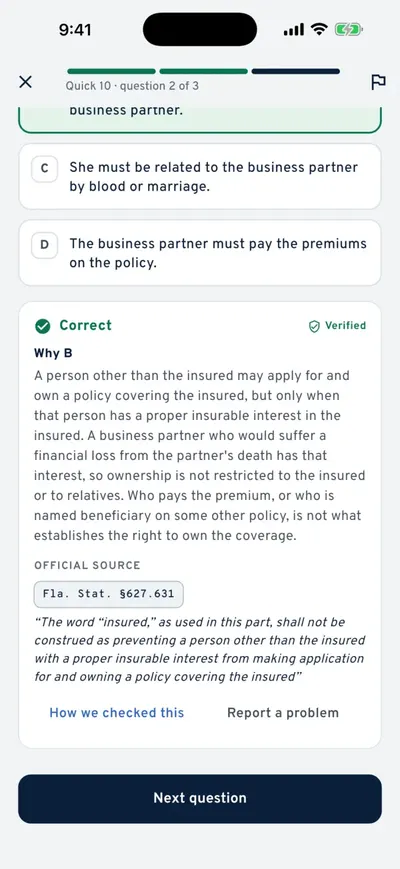 Life and Health vs Property and Casualty: Which License First?Life and health lets you sell life, annuities and health coverage. P&C covers home, auto and business. How the exams, education hours and jobs compare by state.
- Study strategy
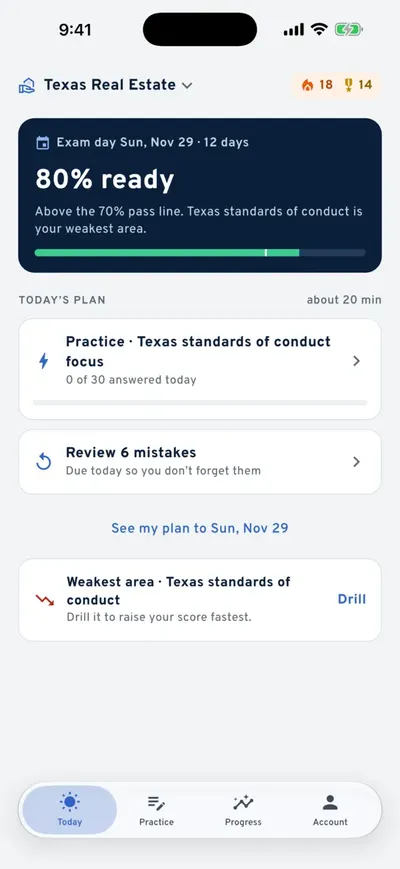 Why Practice Test Scores Overestimate ReadinessRepeated questions, answer recognition and untimed conditions inflate practice test scores. How to tell a memorized question bank from knowing the rules.
- Study strategy
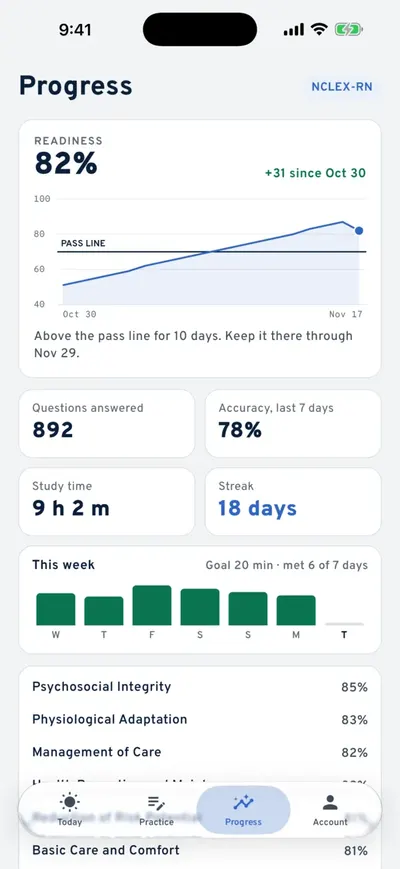 Test Anxiety Before a Licensing Exam: What Actually HelpsWhat research says helps with test anxiety, from practice under real conditions to writing down worries, reframing nerves and asking for accommodations.