

EPA 608 Core Study Guide: Ozone, Laws, the 3 Rs and Safety
Short answer
The Core section is 25 multiple choice questions and you need 18 correct to pass, and you must pass it to get any EPA 608 certification. It covers ozone depletion, the Clean Air Act and Montreal Protocol, the venting prohibition and sales restriction, the three Rs (recover, recycle, reclaim), dehydration, safety and shipping. Most of it is memorization of dates, definitions and limits such as the 80% cylinder fill rule.
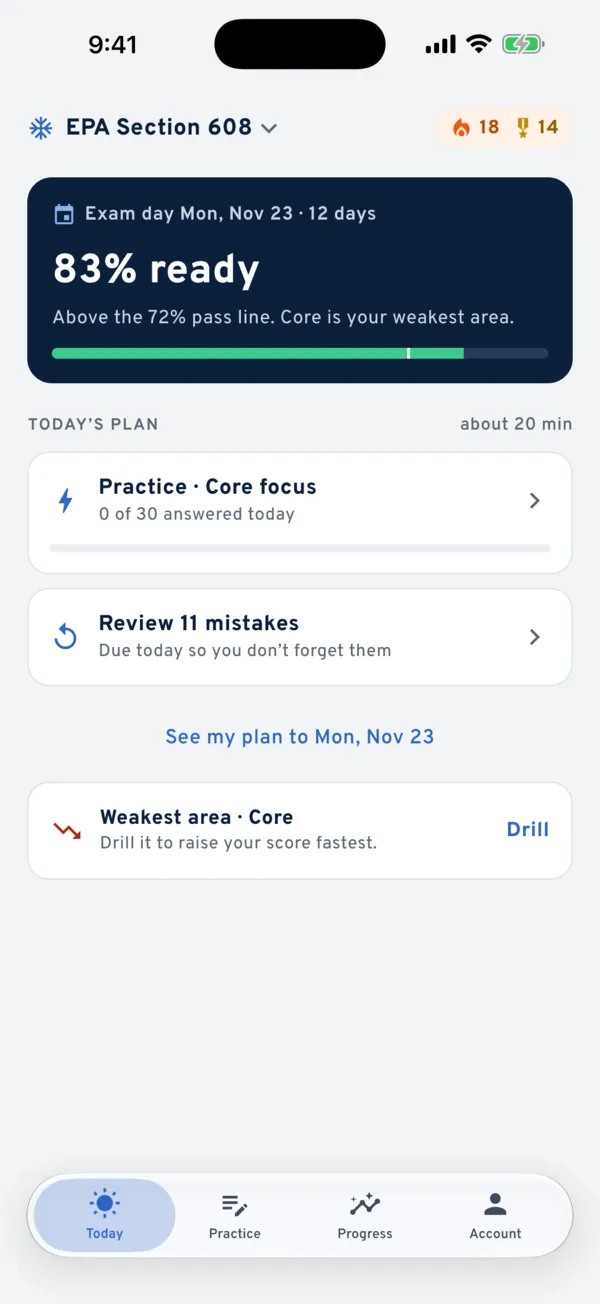
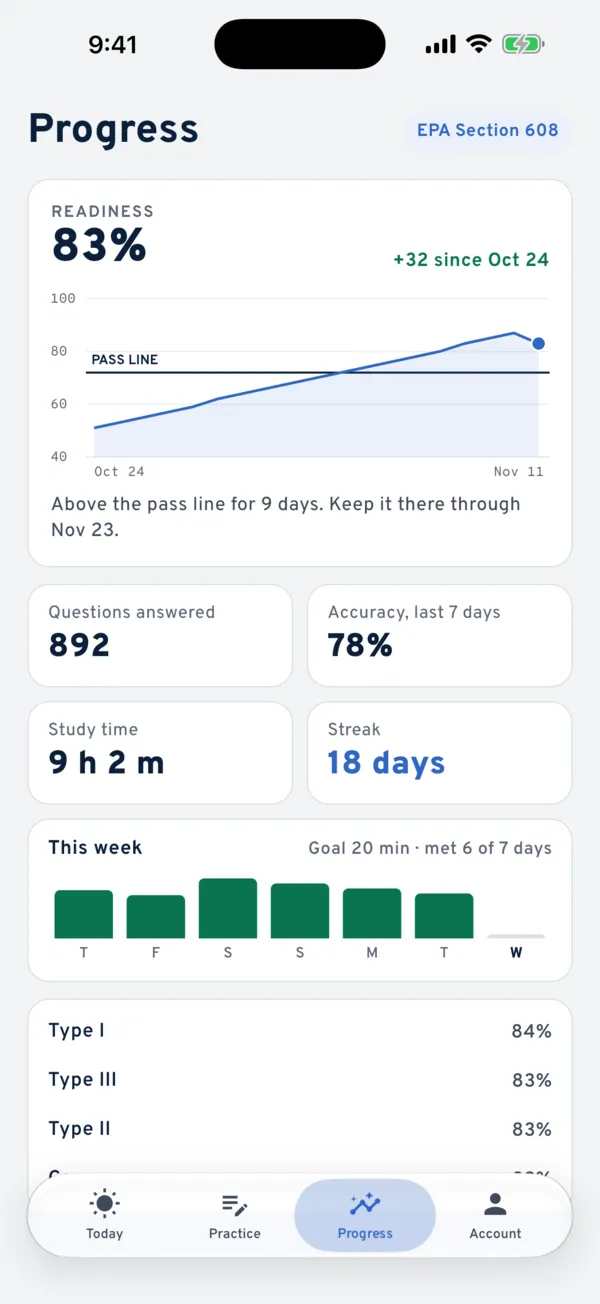
The Core section is 25 questions, you need 18 right, and nothing else on the EPA 608 exam counts until you pass it. EPA’s topic list for Core covers ozone depletion, the Clean Air Act and Montreal Protocol, Section 608 regulations, substitute refrigerants and oils, the refrigeration cycle, the three Rs, recovery and dehydration, safety and shipping.1 Here is what you need to know in each area, in the order you should study it.
Ozone depletion in plain terms
The ozone layer sits in the stratosphere, roughly 10 to 25 miles above the ground, and absorbs most of the sun’s UVB radiation.2 CFCs are so stable in the lower atmosphere that they drift up into the stratosphere intact. Up there, intense ultraviolet light breaks them apart and frees chlorine atoms, which destroy ozone.2 EPA’s figure, and a favorite test fact, is that one chlorine atom can destroy over 100,000 ozone molecules before it leaves the stratosphere.2 Less ozone means more UVB at ground level, which EPA ties to higher rates of skin cancer and cataracts, plus damage to crops and marine life.2
The refrigerant families differ by what is in the molecule.
| Family | Contains | Ozone impact | Examples |
|---|---|---|---|
| CFC | Chlorine, fluorine, carbon | Highest | R-11, R-12, R-502 |
| HCFC | Hydrogen plus chlorine | Lower, breaks down sooner | R-22, R-123 |
| HFC | Hydrogen, fluorine, carbon, no chlorine | None, but high global warming potential | R-134a, R-410A |
Expect questions that hinge on the chlorine. If a refrigerant has no chlorine, it doesn’t deplete ozone. The concern with HFCs is global warming potential, which is why they are now being phased down too.
The laws and dates
The Montreal Protocol is the treaty that phases out ozone-depleting substances. The United States signed it in 1987, and EPA notes it was the first treaty in UN history to reach universal ratification, with 197 parties.3 The Clean Air Act carries out those commitments in U.S. law, and Section 608 of that act is where the technician rules come from.
| Date | What happened |
|---|---|
| 1987 | U.S. signs the Montreal Protocol3 |
| January 1, 1996 | U.S. production and import of CFCs ends4 |
| January 1, 2010 | No production or import of R-22 and R-142b except for equipment made before 20105 |
| January 1, 2020 | No production or import of R-22 and R-142b5 |
| December 27, 2020 | AIM Act enacted, directing an 85% HFC phasedown by 20366 |
| January 1, 2030 | Full phaseout of all HCFCs5 |
Note what the 2020 date means in the field. R-22 systems can still be serviced, but the refrigerant comes from existing stock and reclaimed supply, not new production.5
The Section 608 rules you will be tested on
The venting prohibition
No one servicing, repairing or disposing of an appliance may knowingly vent refrigerant.7 Releases are allowed only as “de minimis” amounts that happen during good faith recovery, using certified equipment and the required practices.7 Releasing refrigerant after you’ve recovered it also counts as venting.7
A short list of substitutes is exempt from the venting ban. Carbon dioxide, nitrogen and water are exempt in any application, ammonia is exempt in commercial and industrial refrigeration and absorption units, and certain hydrocarbons such as propane (R-290) and isobutane (R-600a) are exempt in specific uses like household refrigerators and stand-alone retail cases.7
The sales restriction
Ozone-depleting refrigerants, and since January 1, 2018 non-exempt substitutes like HFCs, can be sold only to certified technicians or to buyers who employ one and show proof.7 The main exception is small cans of 2 pounds or less of car AC refrigerant with a self-sealing valve.7
Penalties
Clean Air Act civil penalties can reach $124,426 per day for each violation, the inflation-adjusted figure EPA has applied since January 8, 2025.8 Older study guides print lower numbers, so don’t be thrown if you see a different amount in practice material. The test checks that you know violations are expensive and counted per day.
The three Rs
These three words are the most tested definitions on Core, and the wrong answers are built to sound alike.
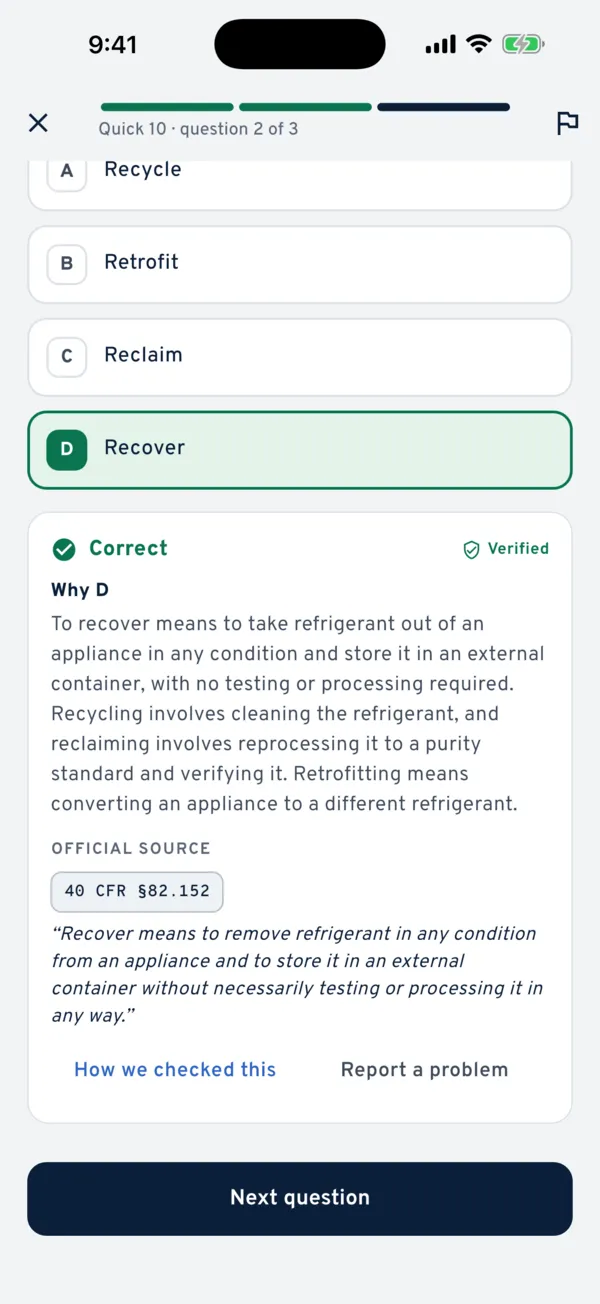
Recover means removing refrigerant in any condition from an appliance and storing it in an external container without necessarily testing or processing it.7
Recycle means extracting refrigerant and cleaning it for reuse in equipment of the same owner, without meeting the full reclaim specification.7
Reclaim means reprocessing refrigerant to the purity standard in Appendix A of Subpart F, which is based on AHRI Standard 700, and verifying it with the specified lab analysis.7 Only reclaimed refrigerant can be sold to a new owner.
One related rule shows up often. Recovered refrigerant may go back into the appliance it came from, or into another appliance owned by the same person, without being recycled or reclaimed. That doesn’t apply to car AC.7
Recovery, dehydration and oils
Recovery equipment must be certified for the refrigerant and appliance type you are working on.7 System-dependent (passive) recovery, which relies on the appliance’s own compressor or pressure, can’t be used on appliances with more than 15 pounds unless the unit is permanently attached as a pump-out unit.7
Dehydration is the evacuation you do at the end of a repair, before charging. A vacuum pump pulls the system down so moisture boils off and noncondensables are removed. Moisture left in a system forms acids and sludge, so the test expects you to know why a deep vacuum matters and that a micron gauge is how you measure it.
Blends are another Core favorite. Zeotropic blends (the 400 series, such as R-410A and R-407C) have temperature glide and can fractionate, meaning their components leak or boil off at different rates. Charge them as liquid so the mix stays correct. On oils, know that mineral oil goes with CFCs and HCFCs while most HFC systems use polyolester (POE) oil, which absorbs moisture quickly, so keep containers closed.
Safety and shipping
Most refrigerants are heavier than air. In a basement or machine room, a large leak can push out oxygen and suffocate you without much warning. An open flame or hot surface breaks refrigerants down into toxic and corrosive products, including hydrochloric and hydrofluoric acids, so ventilate before brazing anywhere near a leak.
When you pressurize a system to look for leaks, use dry nitrogen through a pressure regulator. Never use oxygen or compressed air, because oxygen and compressor oil under pressure can explode.
Cylinder rules are a reliable source of easy points.
- Fill a recovery cylinder to no more than 80% of its rated volume at 70°F (21°C)
- Recovery cylinders are gray with a yellow top
- Never refill a disposable cylinder
- Never heat a cylinder with an open flame
- Secure cylinders upright when transporting them
- Label recovered refrigerant cylinders with the refrigerant type before shipping
The 80% limit and the gray body with a yellow top both come from the recovery equipment standards in 40 CFR Part 82, which point back to Department of Transportation rules in 49 CFR 173.304.7
How to study Core
Core rewards memorization more than field experience, which is why veteran techs sometimes fail it. Make one page of facts from this guide (the dates table, the three Rs, the exempt substitutes, the sales restriction and the cylinder rules) and review it daily for a week. Then take timed 25-question sets until you clear 18 every time, and aim higher than that to leave a margin.
Clinched’s EPA 608 course shows the exact federal regulation under each answer, which is the fastest way to stop mixing up recycle and reclaim. For the full exam picture, including Types I, II and III, see the EPA 608 exam guide. If you’re still deciding which types to take, read EPA 608 Type I vs Type II vs Type III.
Questions people ask
How many questions are on the EPA 608 Core test?
The Core section has 25 multiple choice questions, and the federal passing score is 70%, which means 18 correct. Every Type I, Type II and Type III test includes Core, and you must pass Core to receive any EPA 608 certification.
What is the difference between recover, recycle and reclaim?
Recover means removing refrigerant from an appliance into an external container without testing or processing it. Recycle means cleaning it for reuse in equipment of the same owner. Reclaim means reprocessing it to the AHRI 700 purity specification and verifying that by lab analysis, which is required before refrigerant can be sold to a new owner.
How full can you fill a recovery cylinder?
No more than 80% of its rated liquid volume at 70°F (21°C). EPA's recovery equipment standards in 40 CFR Part 82 require overfill protection at that level, based on the Department of Transportation limit in 49 CFR 173.304. Recovery cylinders are painted gray with a yellow top.
Is the EPA 608 Core test hard?
Core has no math and no equipment-specific procedures, but it is dense with dates and definitions, which is where most people lose points. If you can explain the three Rs, the venting and sales rules, the phaseout dates and the cylinder safety limits from memory, you are ready.
Sources
- Section 608 Technician Certification Test TopicsU.S. Environmental Protection Agency
- Basic Ozone Layer ScienceU.S. Environmental Protection Agency
- International Actions: The Montreal Protocol on Substances that Deplete the Ozone LayerU.S. Environmental Protection Agency
- Phaseout of Class I Ozone-Depleting SubstancesU.S. Environmental Protection Agency
- Phaseout of Class II Ozone-Depleting SubstancesU.S. Environmental Protection Agency
- HFC Allowance Allocation and ReportingU.S. Environmental Protection Agency
- 40 CFR Part 82, Protection of Stratospheric Ozone (Subparts B and F)Electronic Code of Federal Regulations
- 40 CFR 19.4 Statutory civil monetary penalties, as adjusted for inflationElectronic Code of Federal Regulations
ClinchedEPA 608
Pass EPA 608 on the first try.
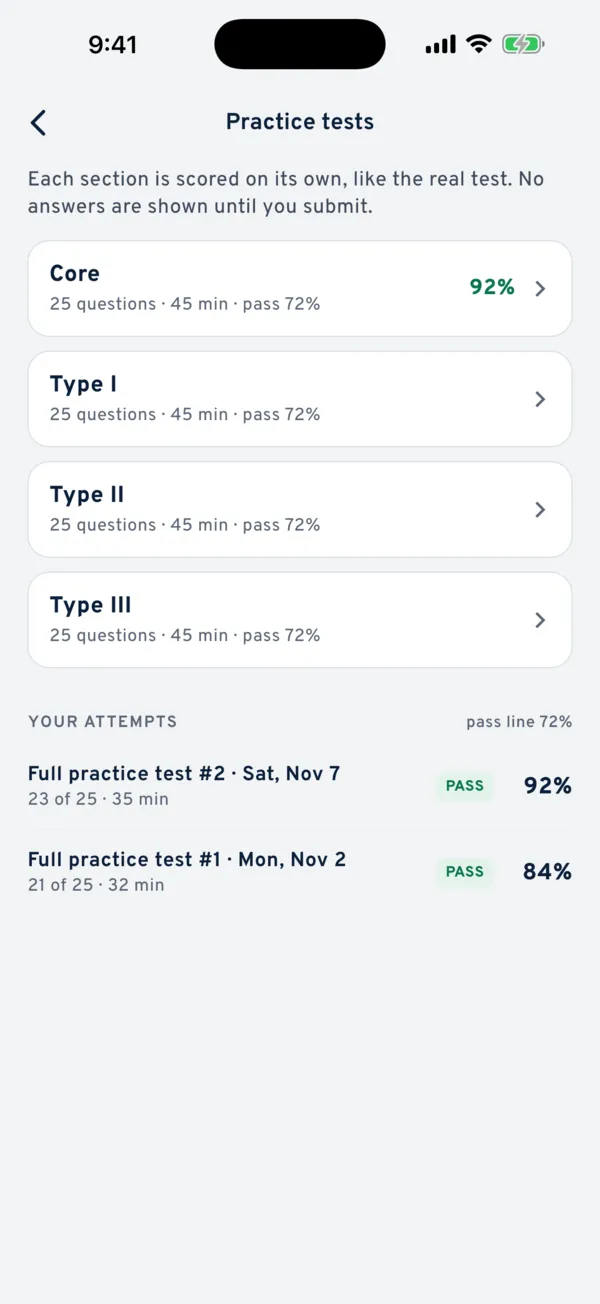
Practice questions written from the official sources, full practice tests in the real format and a plan that ends on your test date. Free to start.
Keep reading
- Topic explainer · EPA 608
 Refrigerant Leak Repair Rules: Thresholds, Rates and DeadlinesEPA leak repair kicks in at 20% for commercial refrigeration, 30% for industrial process and 10% for comfort cooling, with 30 days to repair. Who it covers in 2026.
- Topic explainer · EPA 608
 Refrigerant Evacuation Levels: The EPA 608 Recovery ChartRequired recovery vacuum levels by appliance type and charge size from 40 CFR 82.156, plus the 90% and 80% small appliance rule and the 0 psig exceptions.
- Exam guide · EPA 608
 Lost Your EPA 608 Card? How to Get a ReplacementEPA can't replace a lost 608 card. Your certifying organization can, and if it closed, ESCO Institute or Ferris State can with proof. Here are the four steps.
- Exam guide · EPA 608
 How to Take the EPA 608 Exam: Online or In Person, and CostEPA lists 87 approved 608 certifying programs, 15 with online testing. How proctored online and in-person exams work, what they cost and how to book one.