EPA 608 guideFree practice test
EPA 608 practice test
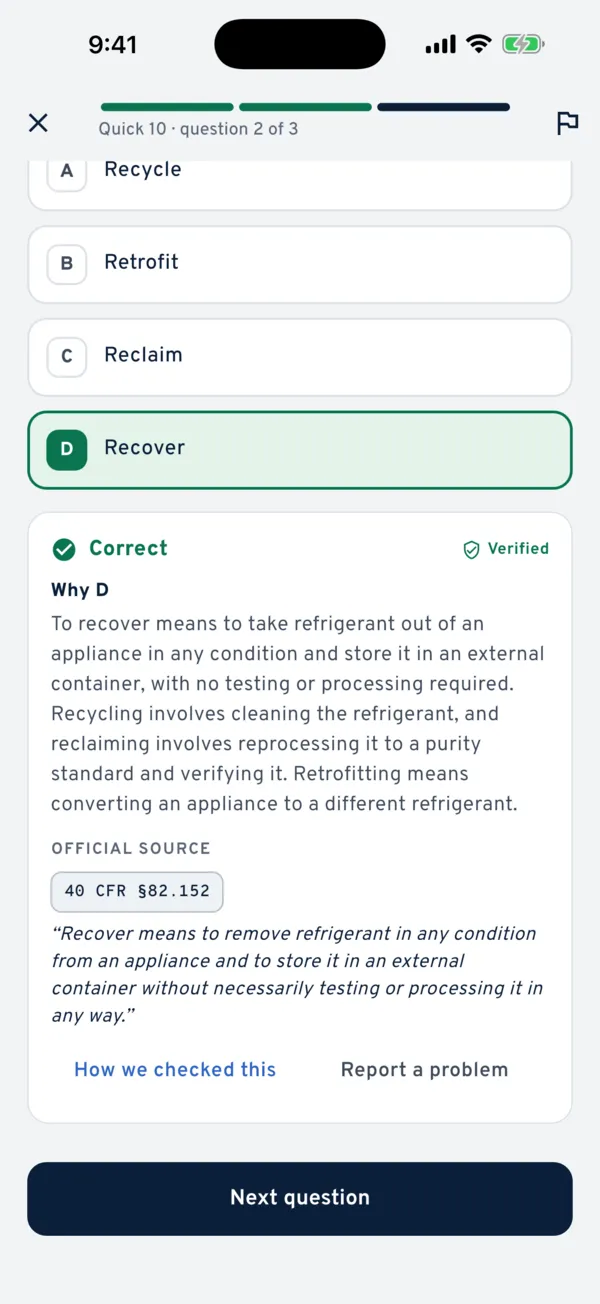
15 free EPA 608 questions from the 1,069 in Clinched, chosen to match how the real test is weighted. Pick an answer to see the explanation and the official text it comes from. Nothing to sign up for.
-
Question 1 of 15Recovery equipment certification
A technician is recovering refrigerant from a medium-pressure appliance with a full charge of 350 pounds. The recovery machine was manufactured in 2018. To what level must the technician evacuate the appliance?
Correct answer A. 15 inches of Hg vacuum
Medium-pressure appliances with a full charge of 200 pounds or more must be evacuated to 15 inches of Hg vacuum when the recovery equipment was made on or after November 15, 1993. The 4-inch level applies only to equipment made before that date. The 10-inch level is for medium-pressure systems under 200 pounds, and 25 mm Hg absolute is the low-pressure requirement.
Official source 40 CFR §82.156Table 1—Required Levels of Evacuation for Appliances [Except for small appliances, MVACs, and MVAC-like appliances]
40 CFR §82.156“Using recovery and/or recycling equipment manufactured or imported before November 15, 1993 | Using recovery and/or recycling equipment manufactured or imported on or after November 15, 1993” -
Question 2 of 15Ozone depletion
Phytoplankton form the foundation of aquatic food webs. What have scientists demonstrated about the effect of ozone depletion on phytoplankton?
Correct answer B. Production is directly reduced by increased UVB
Scientists have shown a direct reduction in phytoplankton production caused by the increased UVB that comes with ozone depletion. UVB also affects their orientation and movement, which lowers their survival. Because phytoplankton are the base of aquatic food webs, this harm can have consequences for the wider marine food chain. More sunlight does not help them, and the upper water layer where they live is not shielded from UVB.
Official source EPA, Health and Environmental Effects of Ozone Layer DepletionScientists have demonstrated a direct reduction in phytoplankton production due to ozone depletion-related increases in UVB.
-
Question 3 of 15Substitutes and oils
A customer asks a technician to remove the R-12 from an older system and simply charge in a substitute refrigerant with no other changes. Which statement about substitute refrigerants is accurate?
Correct answer D. There are no true drop-in replacements for CFC refrigerants.
The Section 608 material on substitute refrigerants stresses that there are no true drop-in replacements. Switching refrigerants generally calls for other changes, such as checking lubricant compatibility. No single substitute, including R-134a, is a drop-in, and no charge-size rule creates drop-in status.
Official source EPA, Section 608 Test TopicsAbsence of "drop-in" replacements
-
Question 4 of 15Small appliance recovery requirements
Under the Section 608 rules, what is the largest factory refrigerant charge an appliance can have and still be classified as a small appliance?
Correct answer D. 5 pounds
A small appliance is one that is fully manufactured, charged and hermetically sealed in a factory with five pounds or less of refrigerant. The 15-, 50- and 200-pound figures are thresholds from other rules: system-dependent recovery equipment, leak repair, and the Table 1 evacuation levels.
Official source 40 CFR §82.152Small appliance means any appliance that is fully manufactured, charged, and hermetically sealed in a factory with five (5) pounds or less of refrigerant
-
Question 5 of 15Small appliance recovery techniques
An apprentice tells a technician that only man-made chemicals such as refrigerants can be toxic. Which EPA statement corrects the apprentice?
Correct answer B. Water and oxygen can have toxic effects in extreme quantities
EPA notes that toxic effects have been seen for common substances such as water, table salt, oxygen and carbon dioxide in extreme quantities. Toxicity depends on the amount, not on whether a substance is man-made. Toxicity is not limited to chlorine-containing or flammable substances.
Official source EPA SNAP, Refrigerant SafetyToxic effects have been observed for such common substances as water, table salt, oxygen, and carbon dioxide in extreme quantities.
-
Question 6 of 15Small appliance disposal
A landfill operator accepts a window air conditioner that no longer holds a charge and uses a signed statement as verification. What information must the signed statement include?
Correct answer A. Name and address of the recoverer and the date of recovery
A signed statement used by the final processor must include the name and address of the person who recovered the refrigerant and the date the refrigerant was recovered. The rule does not require the recovery machine serial number, refrigerant weight or appliance model number. A certification number is not required either, because people recovering refrigerant from small appliances for disposal do not have to be certified technicians.
Official source 40 CFR §82.155If using a signed statement, it must include the name and address of the person who recovered the refrigerant and the date the refrigerant was recovered.
-
Question 7 of 15Small appliance recovery techniques
A technician tells a coworker that R-12 vented from a small appliance harms only the ozone layer. Which additional effect of released CFCs does EPA describe?
Correct answer C. CFCs persist for a long time as greenhouse gases
EPA explains that the same high stability that lets CFCs carry chlorine up to the stratosphere also gives them long atmospheric lifetimes. Because they last so long, they keep acting as greenhouse gases. CFCs are stable, so they do not break down quickly, and EPA says nothing about them forming acid rain or turning into HFCs.
Official source EPA SNAP, Refrigerant SafetyThe high stability of CFCs enables them to deliver ozone-depleting chlorine to the stratosphere. The same stability prolongs their atmospheric lifetimes, and thus their persistence as greenhouse gases.
-
Question 8 of 15Leak repair records
On a 70-pound R-22 system, a technician replaces a leaking service valve and also changes the filter drier. How must the service record describe this work?
Correct answer D. It must list each part serviced and the type of work done on each part
The record must identify the parts of the appliance that were serviced or repaired and the type of work performed on each part. Both the valve and the filter drier must therefore be listed, along with what was done to each. Labor hours and part or serial numbers are not what the rule requires, and listing only the leaking part leaves out other work performed.
Official source 40 CFR §82.157(iii) The part(s) of the appliance being maintained, serviced, repaired, or disposed;
40 CFR §82.157“(iv) The type of maintenance, service, repair, or disposal performed for each part;” -
Question 9 of 15Leak detection and recovery techniques
A technician reads 70 psig on a high-pressure system and needs the absolute pressure in psia. What is the absolute pressure?
Correct answer C. 84.7 psia
Converting gauge pressure to absolute pressure means adding 14.7. So 70 psig plus 14.7 equals 84.7 psia. Subtracting 14.7 gives 55.3, which is wrong. Leaving the reading unchanged ignores atmospheric pressure. Adding 29.9 confuses psi with inches of mercury.
Official source EPA, Section 608 Test TopicsPressure-temperature relationships of common high-pressure refrigerants [may use standard temperature-pressure chart--be aware of need to add 14.7 to translate pounds per square inch gauge (psig) to pounds per square inch absolute (psia)]
-
Question 10 of 15Leak repair
A replacement component needed to repair a leaking 150-pound R-22 supermarket system is not available within 30 days. No industrial process shutdown is required. What is the maximum time allowed, counted from the date the appliance exceeded the leak rate?
Correct answer C. 180 days
When parts are unavailable, repairs may continue until 30 days after the parts are delivered. This extension cannot exceed 180 days from the date the appliance exceeded the leak rate. The 270-day limit applies only when an industrial process shutdown is required. 120 days is the shutdown repair period, and 365 days matches the retrofit timeline.
Official source 40 CFR §82.157Additional time is permitted up to 30 days after receiving delivery of the necessary components, not to exceed 180 days (or 270 days if an industrial process shutdown is required) from the date the appliance exceeded the applicable leak rate.
-
Question 11 of 15High-pressure evacuation requirements
Besides removal of certain components, a repair is also major if it uncovers an opening of a certain flow area for a certain time. Which pair matches the definition?
Correct answer B. More than 4 square inches for more than 15 minutes
A repair is major when it uncovers an opening of more than four square inches of flow area for more than 15 minutes. Swapping the two numbers or using other figures does not match the definition. The 15 in the rule is minutes, not square inches.
Official source 40 CFR §82.152any maintenance, service, or repair that involves uncovering an opening of more than four (4) square inches of “flow area” for more than 15 minutes.
-
Question 12 of 15Leak repair for chillers
A 300-pound R-11 chiller classified as industrial process refrigeration exceeded its trigger rate. What leak inspection schedule applies afterward?
Correct answer C. Once per calendar year until one year stays below the applicable rate
Industrial process refrigeration appliances with a full charge of at least 50 but less than 500 pounds need a leak inspection once per calendar year. Inspections continue until leak rate calculations show the appliance has not exceeded the applicable rate for one year. The quarterly schedule applies only to commercial and industrial process appliances of 500 pounds or more.
Official source 40 CFR §82.157(ii) For commercial refrigeration and industrial process refrigeration appliances with a full charge of 50 or more pounds but less than 500 pounds, leak inspections must be conducted once per calendar year until the owner or operator can demonstrate through the leak rate calculations required under paragraph (b) of this section that the appliance has not leaked in excess of the applicable leak rate for one year.
-
Question 13 of 15Low-pressure evacuation and pressurization
A technician has just reached the required recovery vacuum on a low-pressure chiller. What should the technician do next?
Correct answer D. Wait a few minutes to see if the pressure rises
After reaching the required vacuum, the technician should wait a few minutes and watch for a pressure rise. A rise means liquid refrigerant is still in the system or in the oil, so more recovery is needed. Opening at once or breaking the vacuum right away could release that remaining refrigerant.
Official source EPA, Section 608 Test TopicsNeed to wait a few minutes after reaching required recovery vacuum to see if system pressure rises (indicating that there is still liquid refrigerant in the system or in the oil)
-
Question 14 of 15Leak testing, recovery and recharging
An engineer is planning ventilation for a room where a flammable substitute refrigerant will be handled and looks up its lower and upper flammability limits. How does EPA say these limits are used?
Correct answer D. To set guidelines for safe handling, including ventilation
The flammability limits define the range of concentrations in which a substance can burn in air. EPA says they establish safe-handling guidelines, specifically for assessing ventilation requirements. Chronic exposure limits are based on toxicity, and leak test pressure and purge operation are unrelated to flammability limits.
Official source EPA SNAP, Refrigerant SafetyThese limits therefore define the range of concentrations in which the substance is flammable in air and establish guidelines for safe handling, specifically in assessing ventilation requirements for the handling of gases and vapors.
-
Question 15 of 15Low-pressure evacuation and pressurization
A technician will make a non-major repair on an R-123 chiller. The owner plans to have the chiller evacuated to the atmosphere after the repair is completed. What evacuation is required before the chiller is opened?
Correct answer B. Evacuate it to 25 mm Hg absolute
The 0 psig allowance applies only when the repair is non-major and the appliance will not be evacuated to the atmosphere afterward. Because this chiller will be evacuated to the atmosphere, the allowance is lost and the full Table 1 level of 25 mm Hg absolute applies. The 5 psig figure is only for oil changes. The lowest-attainable level is only for leaking components.
Official source 40 CFR §82.156(1) If evacuation of the appliance to the atmosphere is not to be performed after completion of the maintenance, service, or repair, and if the maintenance, service, or repair is not major as defined at § 82.152, the appliance must:
40 CFR §82.156“Low-pressure appliance | 25 mm Hg absolute | 25 mm Hg absolute.”
Want the other 1,054?
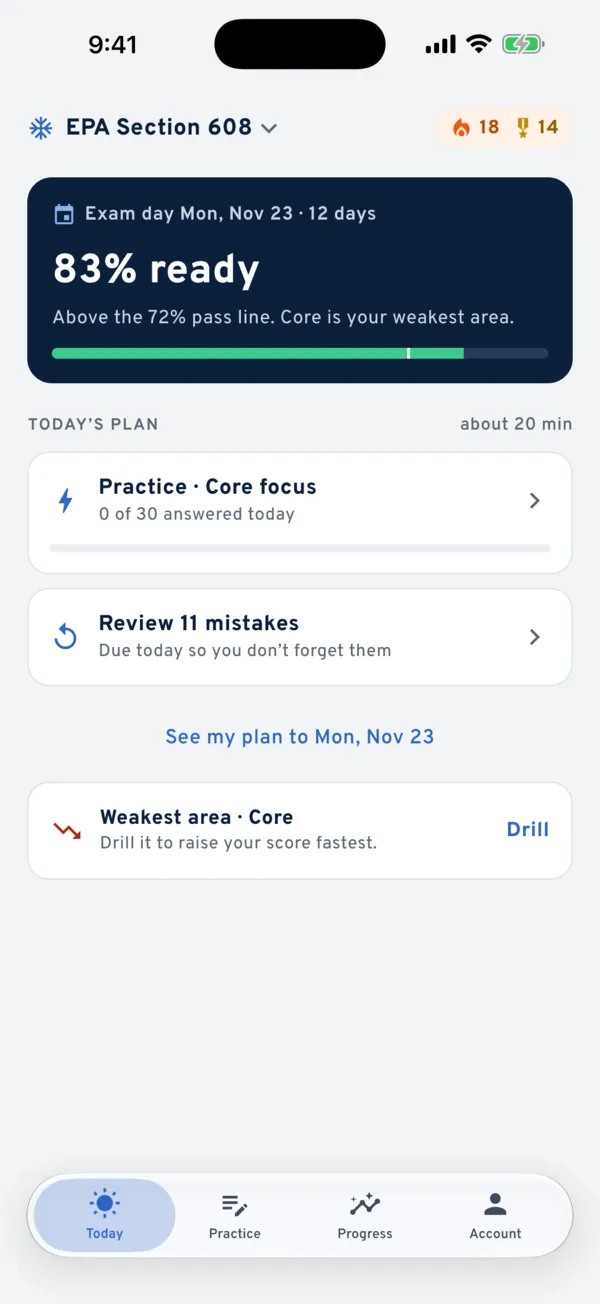
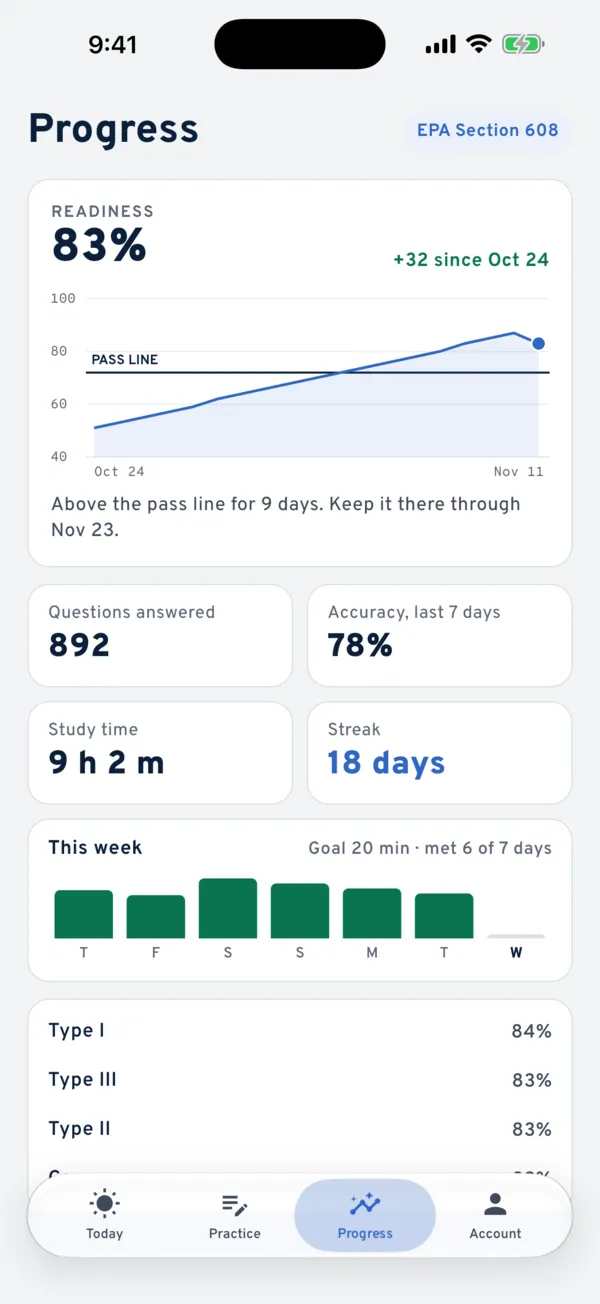
Clinched has every EPA 608 question in this format, with full practice tests that match the real one, a readiness score by area and a plan to your test date. Free to start with 10 questions a day.
Read the EPA 608 guide or see how we write and check every question.
Free on the App Store
Your exam, in your pocket.
20 exams ready with questions written from the official sources, timed practice tests in the real format and a readiness score with a pass line.
On your computer?
Scan with your iPhone camera to get Clinched practice in the app.