

Refrigerant Evacuation Levels: The EPA 608 Recovery Chart
Short answer
With recovery equipment made on or after November 15, 1993, you must reach 0 inches of mercury vacuum on very high pressure appliances and high pressure appliances under 200 pounds, 10 inches on high pressure 200 pounds and up or medium pressure under 200 pounds, 15 inches on medium pressure 200 pounds and up, and 25 mm Hg absolute on low pressure appliances. Small appliances need 90% recovery with a working compressor, 80% without one, or a 4-inch vacuum.
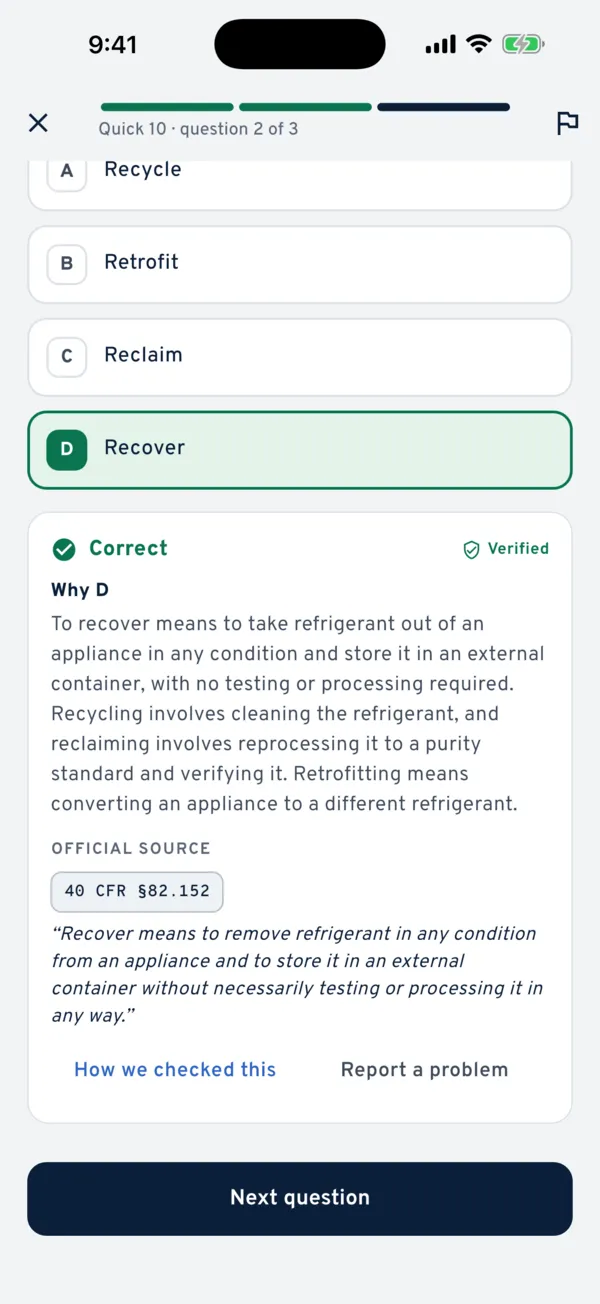
Before you open or dispose of a Type II or Type III appliance, you have to recover the refrigerant, including all the liquid, down to the level in Table 1 of 40 CFR 82.156, using certified recovery equipment.1 The required level depends on three things, namely the pressure class of the refrigerant, whether the charge is under or over 200 pounds, and whether your recovery machine was made before or after November 15, 1993. It’s the most tested table on Type II and Type III, and EPA lists “recovery requirements for disposal, repairs, and appliance size” as a topic for both.3
The required evacuation levels
Levels are in inches of mercury vacuum, measured against standard atmospheric pressure of 29.9 inches Hg, except for low pressure appliances, which use millimeters of mercury absolute.1
| Appliance | Equipment made before Nov 15, 1993 | Equipment made on or after Nov 15, 1993 |
|---|---|---|
| Very high pressure | 0 | 0 |
| High pressure, under 200 lb | 0 | 0 |
| High pressure, 200 lb or more | 4 | 10 |
| Medium pressure, under 200 lb | 4 | 10 |
| Medium pressure, 200 lb or more | 4 | 15 |
| Low pressure | 25 mm Hg absolute | 25 mm Hg absolute |
All figures come from Table 1 in 40 CFR 82.156.1 The charge size refers to the appliance, or to the isolated component if you are only opening part of the system.1
A couple of quick conversions help. “0 inches” means you pulled the system down to atmospheric pressure (0 psig). 25 mm Hg absolute is about 1 inch of mercury absolute, which works out to roughly 29 inches of vacuum on a compound gauge.
Which refrigerants fall in which row
The pressure classes are defined by the refrigerant’s liquid saturation pressure at 104°F.2
| Class | Pressure at 104°F | Examples in the rule |
|---|---|---|
| Very high | Above 355 psia, or critical temperature below 104°F | R-13, R-23, R-503, R-508A, R-508B |
| High | 170 to 355 psia | R-22, R-407A, R-407C, R-410A, R-502 |
| Medium | 45 to 170 psia | R-114, R-124, R-12, R-134a, R-500 |
| Low | Below 45 psia | R-11, R-123, R-113, R-245fa |
The test often hides the pressure class inside a refrigerant name. If a question gives you a 250-pound R-134a chiller and newer recovery equipment, you need to know R-134a is medium pressure and the answer is 15 inches.
Small appliances
Small appliances (factory-sealed with 5 pounds or less) use percentages instead of vacuum levels.12
| Recovery equipment | Compressor working | Compressor not working |
|---|---|---|
| Made before Nov 15, 1993 | 80% | 80% |
| Made on or after Nov 15, 1993 | 90% | 80% |
The alternative for any small appliance is to evacuate it to 4 inches of mercury vacuum.1 The lower number for a dead compressor reflects how much harder it is to pull refrigerant out of the oil without the compressor running. In practice you can help by heating and tapping the compressor to release trapped refrigerant.
System-dependent (passive) recovery is allowed on small appliances. It’s barred on any appliance with more than 15 pounds of refrigerant unless the recovery unit is permanently attached as a pump-out unit.1
Car AC and off-road equipment
Motor vehicle air conditioners fall under Section 609, not 608. When recovering for disposal of an MVAC or an MVAC-like appliance (off-road equipment cab AC with 20 pounds or less), you either follow the Section 609 rules or pull the system down to 102 mm of mercury vacuum or lower.12
When you don’t need the full level
Minor repairs
If the system won’t be vented to the atmosphere after the work and the repair isn’t “major,” you can open it at a lower standard.1 Medium, high and very high pressure appliances must be evacuated to no higher than 0 psig. Low pressure appliances must be pressurized to no higher than 0 psig before opening.1
A major repair is one that removes the compressor, condenser, evaporator or an auxiliary heat exchange coil, or that uncovers an opening of more than 4 square inches of flow area for more than 15 minutes.2 Swapping a contactor isn’t a refrigerant repair at all. Replacing a TXV in place usually isn’t major, and replacing a compressor always is.
How to pressurize a low pressure chiller before opening it
For low pressure systems there’s a detail about how you raise the pressure. If the refrigerant boils at or below 85°F at atmospheric pressure, you may not use methods like nitrogen that require purging afterward. If it boils above 85°F, use heat first, and you may use nitrogen only to make up the rest of the way to atmospheric pressure.1
Oil changes
For an oil change, the appliance (or a system receiver you drain the oil into) can be evacuated or pressurized to no higher than 5 psig before opening.1
Leaking systems
If a leak makes the Table 1 level impossible, or reaching it would badly contaminate the recovered refrigerant, you isolate leaking parts from non-leaking parts where you can. Non-leaking parts still go to the Table 1 level. Leaking parts go as low as you can get without contaminating the refrigerant, but never higher than 0 psig.1
Doing it right on the job
- Identify the pressure class and the full charge before you hook up
- Check the manufacture date on your recovery machine
- Recover liquid first when the charge is large, then switch to vapor
- Isolate the part to be serviced into a system receiver when the design allows it
- Verify the required level on your gauge before you open the system
- Record refrigerant recovered when disposing of an appliance with more than 5 and under 50 lb
The verification step isn’t optional. The rule requires the technician to verify that the applicable level has been reached in the appliance or the part before it is opened.1 And when you dispose of an appliance with more than 5 and less than 50 pounds, you must keep records for three years showing the company, the appliance location, the date, the refrigerant type and the monthly totals recovered and sent for reclamation.1
Recovery isn’t the same as dehydration. The levels in this table tell you how far to go before you open a system. Pulling a deep vacuum measured in microns before charging is a separate step to remove moisture and noncondensables, and the Core section tests it separately.
Studying the table
Don’t try to memorize six rows as six random numbers. Learn the pattern. Newer equipment pulls deeper. High pressure systems under 200 pounds and very high pressure systems are always 0. Medium pressure systems are the only ones that reach 15 inches. Low pressure is the only row in millimeters.
Then quiz yourself backward, starting from the refrigerant and charge and working out the number. That’s how the questions are written. The refrigerant leak repair rules cover the other big set of Type II numbers, and the EPA 608 exam guide explains how each section is scored.
Questions people ask
What vacuum level is required to recover refrigerant from an R-410A system?
R-410A is a high pressure refrigerant. With recovery equipment made on or after November 15, 1993, you must pull an appliance (or isolated component) with less than 200 pounds of charge down to 0 inches of mercury vacuum, and one with 200 pounds or more down to 10 inches of mercury vacuum.
How much refrigerant must be recovered from a small appliance?
With recovery equipment made on or after November 15, 1993, recover 90% of the charge if the appliance's compressor works or 80% if it doesn't. With older equipment the requirement is 80%. Either way, pulling the appliance down to 4 inches of mercury vacuum also satisfies the rule.
What evacuation level must you reach before disposing of a low pressure appliance?
Before you dispose of or open a low pressure appliance such as an R-123 chiller, it must be evacuated to 25 mm Hg absolute, roughly 29 inches of mercury vacuum, regardless of when the recovery equipment was made. For non-major repairs that don't vent the system, you may instead pressurize it to no more than 0 psig before opening.
Does the evacuation level depend on when the recovery machine was made?
Yes. The table in 40 CFR 82.156 has separate columns for recovery and recycling equipment manufactured or imported before November 15, 1993 and on or after that date, and the newer equipment must pull deeper vacuums for medium and high pressure appliances.
Sources
- 40 CFR 82.156 Proper evacuation of refrigerant from appliancesElectronic Code of Federal Regulations
- 40 CFR 82.152 DefinitionsElectronic Code of Federal Regulations
- Section 608 Technician Certification Test TopicsU.S. Environmental Protection Agency
ClinchedEPA 608
Pass EPA 608 on the first try.
Practice questions written from the official sources, full practice tests in the real format and a plan that ends on your test date. Free to start.
Keep reading
- Topic explainer · EPA 608
 Refrigerant Leak Repair Rules: Thresholds, Rates and DeadlinesEPA leak repair kicks in at 20% for commercial refrigeration, 30% for industrial process and 10% for comfort cooling, with 30 days to repair. Who it covers in 2026.
- Exam guide · EPA 608
 Lost Your EPA 608 Card? How to Get a ReplacementEPA can't replace a lost 608 card. Your certifying organization can, and if it closed, ESCO Institute or Ferris State can with proof. Here are the four steps.
- Exam guide · EPA 608
 How to Take the EPA 608 Exam: Online or In Person, and CostEPA lists 87 approved 608 certifying programs, 15 with online testing. How proctored online and in-person exams work, what they cost and how to book one.
- Exam guide · EPA 608EPA 608 Type I vs Type II vs Type III: Which Do You Need?Type I covers factory-sealed appliances with 5 lb or less, Type II covers high pressure AC and refrigeration, Type III covers chillers. Here's how to choose.