NCLEX-PN guideFree practice test
NCLEX-PN practice test
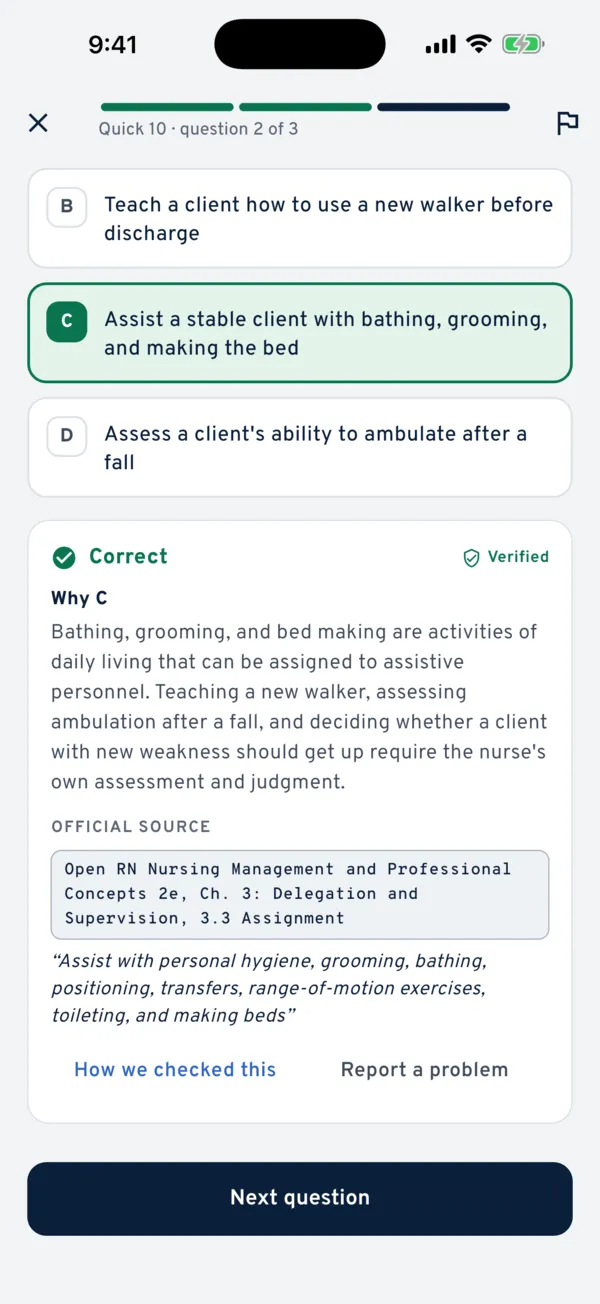
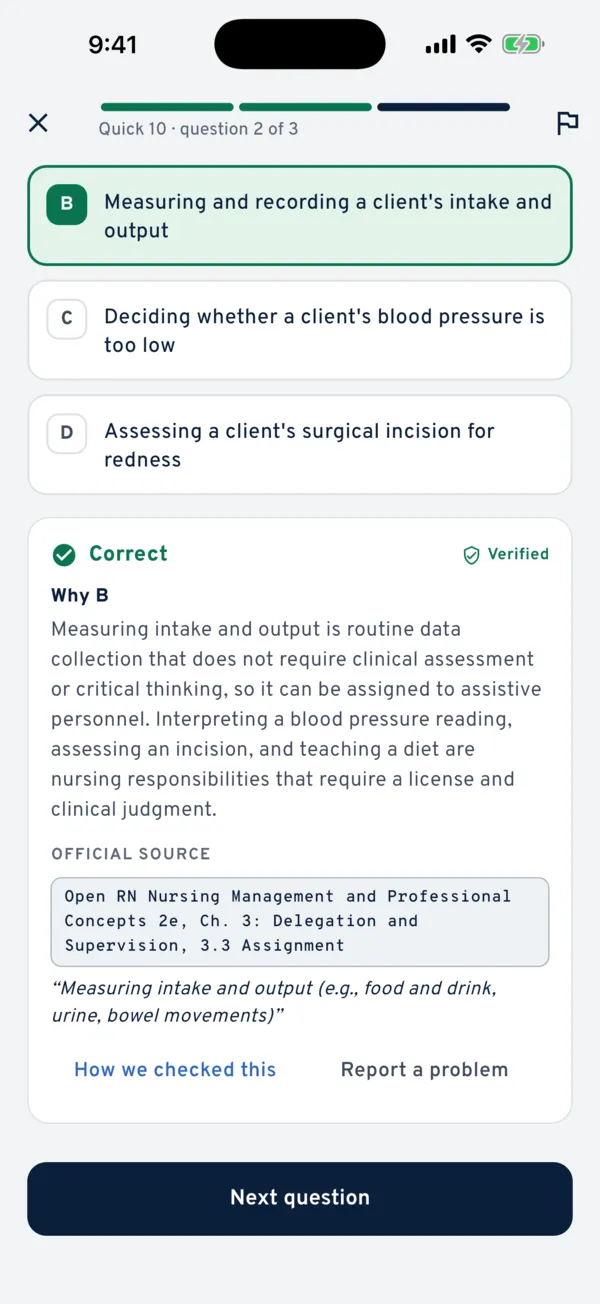
15 free NCLEX-PN questions from the 589 in Clinched, chosen to match how the real test is weighted. Pick an answer to see the explanation and the official text it comes from. Nothing to sign up for.
-
Question 1 of 15Basic Care and Comfort
A client with chronic obstructive pulmonary disease and depression has stayed in bed for 2 days. The client tells the practical nurse, "I'm too tired to get up and walk." Which factor should the nurse identify as contributing to this client's immobility?
Correct answer A. The client's fatigue
Diseases that cause fatigue, such as COPD and depression, affect a client's desire and ability to move, so this client's tiredness is the factor limiting mobility. A fracture, a neurological disorder, or a musculoskeletal disorder can also impair mobility, but none of these is part of this client's situation, so they do not explain why the client is staying in bed.
Official source Open RN Nursing Fundamentals 2e, Part XIII: Mobility, 13.2 Basic ConceptsDiseases that cause fatigue, such as heart failure, chronic obstructive pulmonary disease, and depression, or conditions that cause pain also affect the client's desire or ability to move.
-
Question 2 of 15Coordinated Care
Two assistive personnel (AP) are arguing loudly at the nurses' station about how a client's room should be set up. Which approach by the practical nurse is most likely to de-escalate the conflict?
Correct answer B. Focus the discussion on how the two of them can solve the problem together
Conflict de-escalates when attention is focused on solving the problem and emotions and the sense of threat decrease, so steering the conversation toward a shared solution is the best move. Declaring a winner keeps the focus on who is right, and bringing other staff in to take sides is a condition that makes conflict escalate. Ordering them not to speak to each other leaves the problem unsolved.
Official source Open RN Nursing Management and Professional Concepts 2e, Ch. 7: Collaboration Within the Interprofessional Team, 7.7 Conflict ResolutionAttention is focused on solving the problem.
Open RN Nursing Management and Professional Concepts 2e, Ch. 7: Collaboration Within the Interprofessional Team, 7.7 Conflict Resolution“There is a decrease in emotion and perceived threat.” -
Question 3 of 15Coordinated Care
The practical nurse is assigned to care for an older client who takes a sedative at bedtime and uses a walker at home. Which action should the nurse take?
Correct answer B. Assess the client's fall risk and implement fall precautions.
Assessing every client for fall risk and putting fall precautions in place is expected nursing care, and failing to do it can be viewed as negligence if the client falls. Bed rest is not a substitute for a fall-risk assessment and can cause other harm, calling falls unavoidable ignores precautions that prevent them, and a blanket alarm order for all clients does not assess this client's actual risk.
Official source Open RN Nursing Fundamentals 2e, Part I: Scope of Practice, Legal & Ethical ConsiderationsFor example, all clients should be assessed for fall risk and appropriate fall precautions implemented.
-
Question 4 of 15Health Promotion and Maintenance
A client in labor is told the fetus is in a breech position. Which statement by the client indicates understanding of the teaching?
Correct answer A. "This position can make my labor longer and I may need a cesarean birth."
Fetal malpresentation causes difficult and prolonged labor with higher rates of cesarean section deliveries, so the client who says labor may be longer and may end in a cesarean birth understands the teaching. The head presents in most labors, not a breech position, and in a breech position the head does not come first. A long, difficult labor can be linked to lower Apgar scores in the newborn, so it does not mean the baby will have no problems.
Official source Open RN Nursing Health Promotion, Ch. 10: LABOR & DELIVERY CARE, 10.7 Complications Associated With LaborFetal malpresentation causes difficult and prolonged labor with higher rates of cesarean section deliveries.
-
Question 5 of 15Health Promotion and Maintenance
The practical nurse is reinforcing diet teaching with a client who has diabetes. Which statement by the client indicates understanding of portion control?
Correct answer B. "I will measure my portions so I can manage my blood sugar and keep my weight healthy."
Portion control means learning appropriate portion sizes, which helps manage blood sugar levels and maintain a healthy weight, so measuring portions is the response that shows the teaching worked. Believing that healthy food choices make the amount eaten unimportant, that only sweets need measuring, or that skipping meals is a good way to lower blood sugar all miss the point that the size of every portion affects blood sugar and weight.
Official source Open RN Nursing Health Promotion, Ch. 3: Healthy Diets, 3.6 Spotlight ApplicationPortion control: Learn about appropriate portion sizes to help manage blood sugar levels and maintain a healthy weight.
-
Question 6 of 15Physiological Adaptation
A client gave birth 30 minutes ago. The practical nurse finds the uterus soft and boggy at the level of the umbilicus, with a steady trickle of bright red blood. When reporting to the RN using the Four Ts, which category should the nurse use?
Correct answer C. Tone, because the uterus is not contracting after birth
In the Four Ts of postpartum hemorrhage, Tone refers to uterine atony, a uterus that stays soft instead of contracting, which is what a boggy fundus with heavy bleeding shows. Trauma covers lacerations or uterine rupture, Tissue covers retained placenta, clots or placenta accreta, and Thrombin covers a clotting-factor disorder, none of which fit a soft, boggy uterus.
Official source Open RN Nursing Health Promotion, Ch. 19: High-risk Perinatal Client Care, 19.3 HemorrhageTone: Uterine atony
-
Question 7 of 15Physiological Adaptation
A client with a peptic ulcer caused by H. pylori has been prescribed a proton pump inhibitor and antibiotics. Which statement by the client indicates that the teaching has been effective?
Correct answer B. "I will take the antibiotics along with the acid-reducing medicine to get rid of the bacteria."
When an ulcer is caused by H. pylori, treatment is a proton pump inhibitor given together with antibiotics to eradicate the bacteria, so taking both as prescribed shows the teaching worked. The acid-reducing medicine alone does not clear the infection, ibuprofen is a digestive irritant that can cause ulcers, and stopping the medicines when the pain settles does not finish treating the ulcer.
Official source Open RN Health Alterations, Chapter 11 Gastrointestinal System Alterations, 11.10 Peptic Ulcer DiseaseIf PUD was caused by the presence of H. pylori, treatment consists of prescriptions of a PPI with antibiotics to eradicate the bacteria.
-
Question 8 of 15Psychosocial Integrity
The practical nurse is caring for a client with schizophrenia. Which finding should the nurse document as disorganized speech?
Correct answer B. The client's sentences shift from one topic to another with no logical connection.
Disorganized speech in schizophrenia includes frequent derailment or incoherence, so speech that jumps between unconnected topics is documented as disorganized speech. Sitting motionless and unresponsive describes catatonia, a grossly disorganized or catatonic behavior, and a flat face is a negative symptom of diminished emotional expression. A belief that the television is sending personal messages is a delusion, not a speech problem.
Official source Open RN Nursing: Mental Health and Community Concepts 2e, Ch. 11: Thought Disorders, 11.3 SchizophreniaDisorganized speech (i.e., frequent derailment or incoherence)
Open RN Nursing: Mental Health and Community Concepts 2e, Ch. 11: Thought Disorders, 11.3 Schizophrenia“Grossly disorganized or catatonic behavior. (Catatonia is a state of unresponsiveness.)” -
Question 9 of 15Psychosocial Integrity
The practical nurse is reinforcing teaching with a client who is starting a second-generation antipsychotic. Which statement by the client indicates understanding of the teaching?
Correct answer C. "This drug usually causes fewer side effects because it blocks serotonin as well as dopamine."
Second-generation antipsychotics block selective dopamine D2 receptors as well as serotonin, so they generally have fewer adverse effects and are better tolerated than first-generation antipsychotics. The statements that the drug has no side effects, blocks every dopamine receptor, or that older drugs are better tolerated do not match how these medications work.
Official source Open RN Nursing: Mental Health and Community Concepts 2e, Ch. 11: Thought Disordersthis class of medication has fewer adverse effects because they block selective dopamine D2 receptors as well as serotonin. For this reason, they are generally better tolerated than first-generation antipsychotics.
-
Question 10 of 15Pharmacological Therapies
The practical nurse is monitoring a client receiving a vancomycin infusion. The client reports chest tightness, and the nurse observes wheezing and a new rash over the face and neck. Which action should the nurse take first?
Correct answer C. Stop the infusion
Stopping the infusion is the first action because reactions usually stop promptly once the drug is stopped, and the nurse then reports to the RN and provider. Slowing the rate or finishing the infusion leaves the client exposed to a reaction that can include wheezing and hypotension, and an infusion reaction is not the same as a permanent allergy, so telling the client the drug can never be given again is inaccurate.
Official source FDA label, Vancomycin (Warnings and Precautions)Stop the infusion if a reaction occurs because this usually results in prompt cessation of these reactions.
-
Question 11 of 15Pharmacological Therapies
The practical nurse is reinforcing teaching for a client who is starting morphine for cancer pain. Which statement by the client indicates that the teaching was effective?
Correct answer B. "I may feel sleepy or dizzy, and this medicine can cause constipation."
Sedation, light-headedness, dizziness, hypotension, and constipation are listed adverse effects of morphine, so the client who expects drowsiness, dizziness, and constipation understands the teaching. Opioids slow the bowel rather than speed it up, they lower blood pressure rather than raise it, and dizziness and sedation make driving unsafe.
Official source Open RN Nursing Pharmacology 2e, Chapter 10 Analgesics & Musculoskeletal System, 10.7 OPIOID ANALGESICS AND ANTAGONISTSAdverse effects include respiratory depression, hypotension, light-headedness, dizziness, sedation, constipation, nausea, vomiting, and sweating.
-
Question 12 of 15Reduction of Risk Potential
A client who has been taking furosemide for heart failure has a rising serum creatinine and a falling glomerular filtration rate (GFR). Which action should the practical nurse take?
Correct answer A. Report the worsening kidney function values to the RN and primary health care provider.
Diuretics can injure the kidneys, and worsening serum creatinine and GFR are abnormal kidney function values that must be assessed and reported promptly so the medication can be reviewed. Recording the values as expected, waiting for the next routine draw, or pushing fluids all delay that report.
Official source Open RN Nursing Pharmacology 2e, Chapter 6 Cardiovascular & Renal Systems, 6.4 APPLYING THE NURSING PROCESS TO ADMINISTERING CARDIOVASCULAR AND RENAL MEDICATIONSIn addition, a nurse must appropriately assess and report abnormal kidney function laboratory values such as worsening serum creatinine and glomerular filtration rates (GFR).
Open RN Nursing Pharmacology 2e, Chapter 6 Cardiovascular & Renal Systems, 6.4 APPLYING THE NURSING PROCESS TO ADMINISTERING CARDIOVASCULAR AND RENAL MEDICATIONS“For example, diuretics can injury the kidneys.” -
Question 13 of 15Reduction of Risk Potential
The practical nurse is auscultating the heart sounds of a client admitted with shortness of breath. At the apex, the nurse hears the first heart sound, S1, described as “lub.” Which valve closures produce this sound?
Correct answer A. Closure of the mitral and tricuspid valves
S1, the “lub” sound, is made when the atrioventricular valves (mitral and tricuspid) close at the start of systole. The aortic and pulmonic valves are the semilunar valves, and their closure produces S2, not S1. Pairing one atrioventricular valve with one semilunar valve describes no heart sound at all.
Official source Open RN Health Alterations, Chapter 5 Cardiovascular Alterations, 5.3 General Cardiovascular System AssessmentS1 is the first heart sound, often described as “lub,” and corresponds to the closure of the atrioventricular valves (mitral and tricuspid valves).
-
Question 14 of 15Safety and Infection Prevention and Control
The practical nurse is caring for a client who has soft wrist restraints in place. Which statement by the nurse indicates correct understanding of required restraint documentation?
Correct answer A. I record the reason, alternatives tried, type, removal criteria, care given, and date and time.
Documentation for a client in restraints includes the reason for the restraint, alternative measures tried, the type of restraint applied, the behavioral criteria for removal, range-of-motion and cares while in restraints, and the date and time the restraint is applied or removed. Recording only the start and stop times, charting once per shift, or documenting family agreement instead of the reason leaves out required information.
Official source Open RN Nursing Fundamentals 2e, Part V: Safety, 5.7 Restraintsrequirements for documentation of the reason for the restraint, alternative measures tried, type of restraint applied, behavioral criteria for removal of restraint, range of motion and cares while in restraints, and the date and time the restraint is applied or removed.
-
Question 15 of 15Safety and Infection Prevention and Control
The practical nurse reinforces teaching with a client who has impaired vision and fell at home last week. Which statement by the client indicates understanding?
Correct answer B. "I put my glasses on before I get out of bed and keep them within reach at night."
Clients with impaired vision, or clients who need glasses but are not wearing them, are at higher fall risk because they recognize hazards in the environment less well, so putting glasses on before standing and keeping them within reach is the safe choice. Taking the glasses off to protect them, wearing them only for reading, and keeping the room dark all leave the client unable to see hazards while walking.
Official source Open RN Nursing Fundamentals 2e, Part V: Safety, 5.6 Preventing FallsClients with impaired vision or those who require glasses but who are not wearing them are at a higher fall risk because of their decreased recognition of an environmental hazard.
Want the other 574?
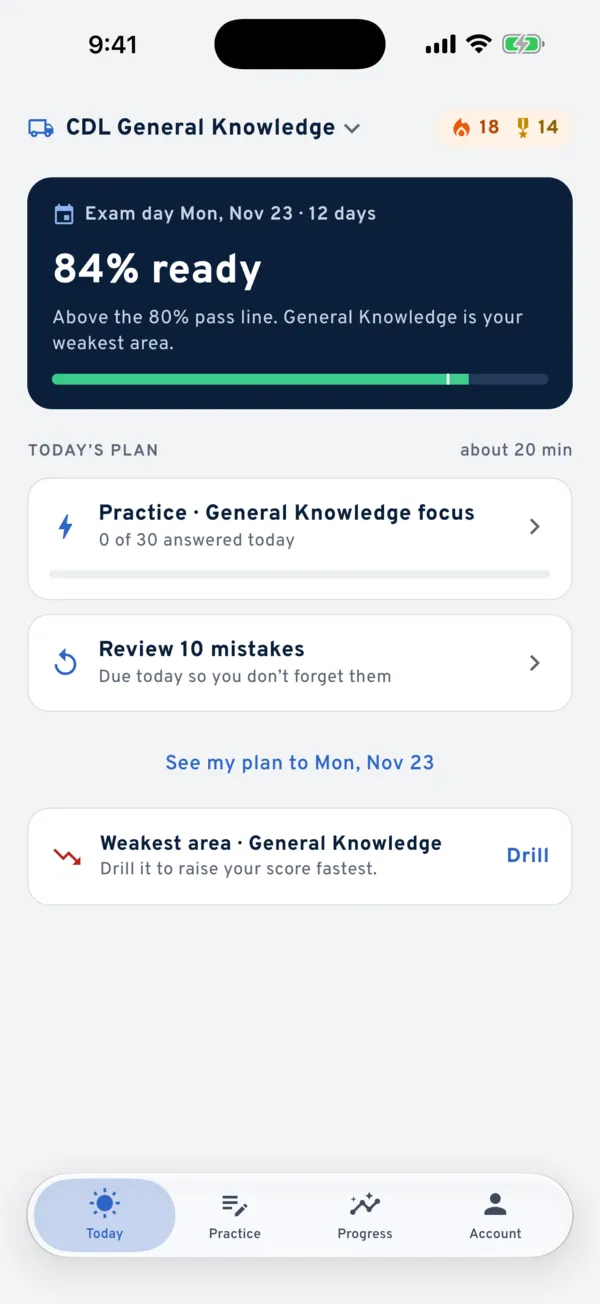
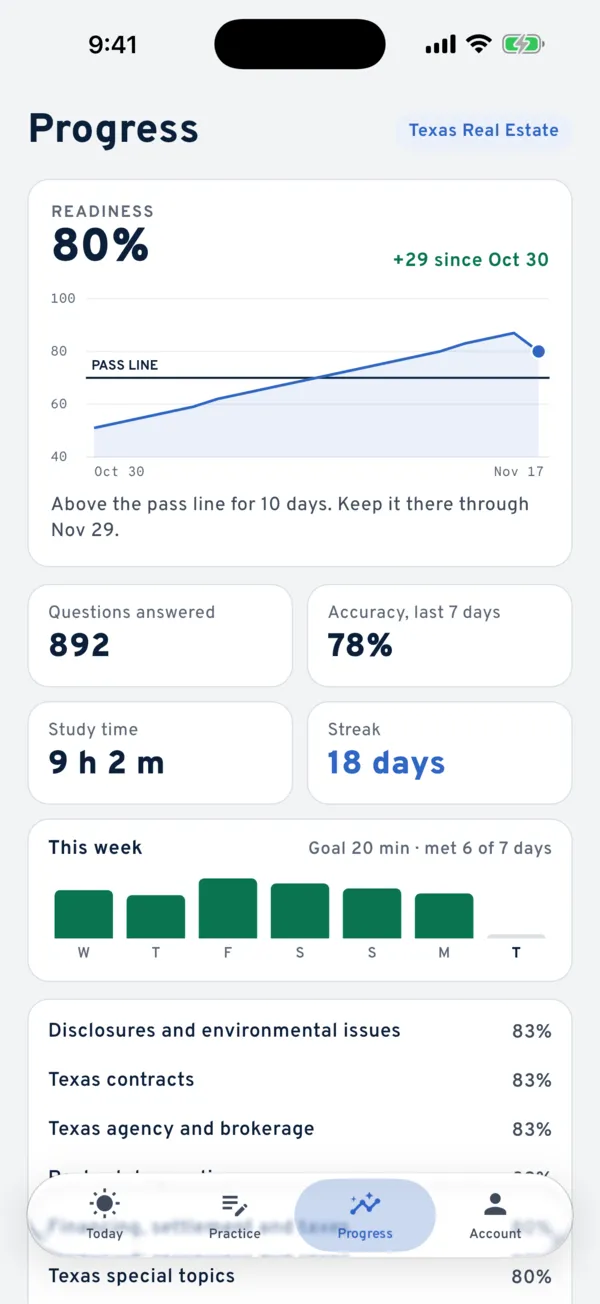
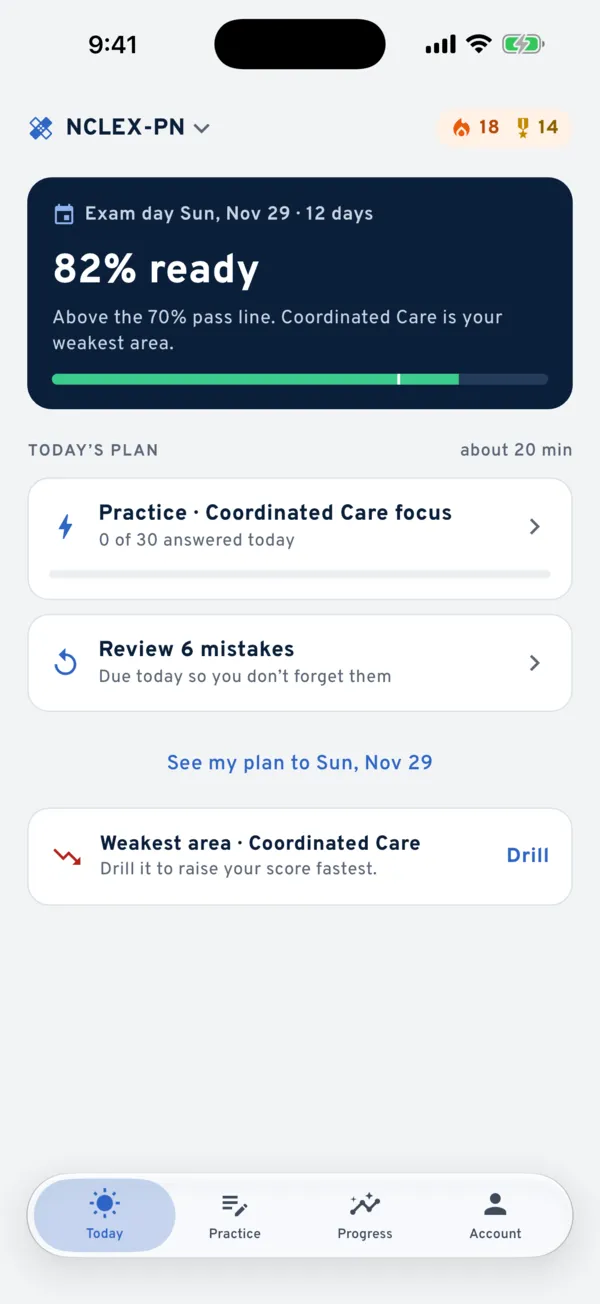
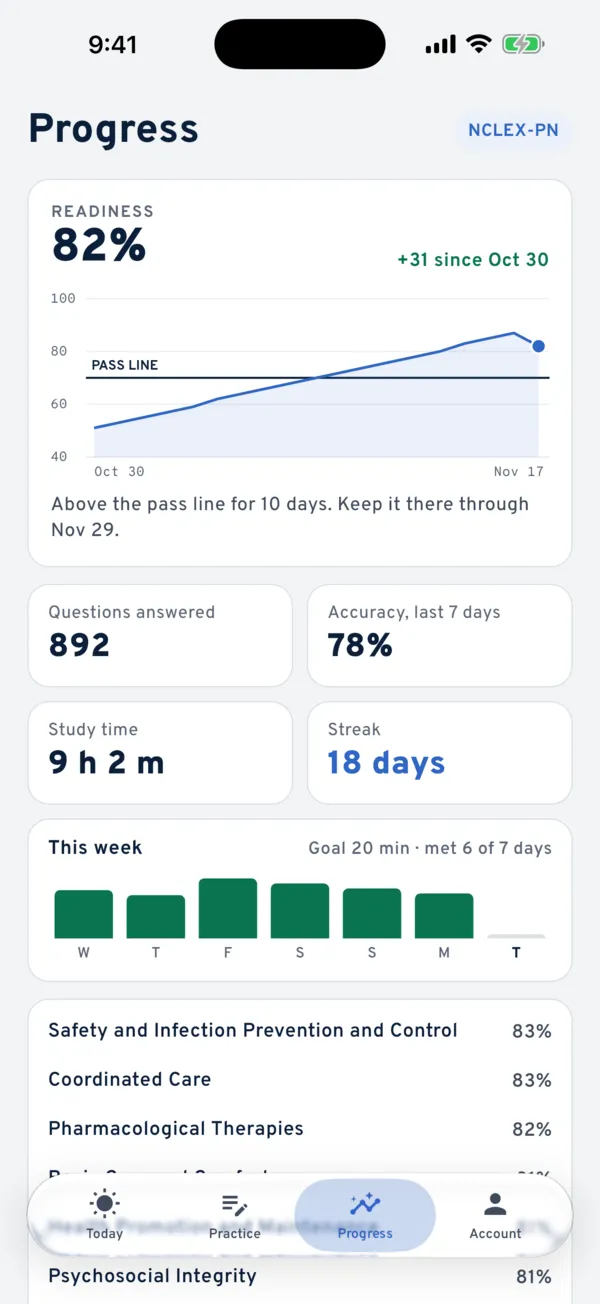
Clinched has every NCLEX-PN question in this format, with full practice tests that match the real one, a readiness score by area and a plan to your test date. Free to start with 10 questions a day.
Read the NCLEX-PN guide or see how we write and check every question.
Free on the App Store
Your exam, in your pocket.
20 exams ready with questions written from the official sources, timed practice tests in the real format and a readiness score with a pass line.
On your computer?
Scan with your iPhone camera to get Clinched practice in the app.