

Topic explainerNCLEX-RNNCLEX-PN
How the NCLEX Shuts Off: The 3 Rules That End Your Exam
Short answer
The NCLEX stops when one of three rules is met. Most exams end once the computer is 95% certain you're above or below the passing standard, which can happen any time after the minimum 85 items. Otherwise the exam runs to 150 items or until the 5 hour limit, and your final ability estimate decides the result.
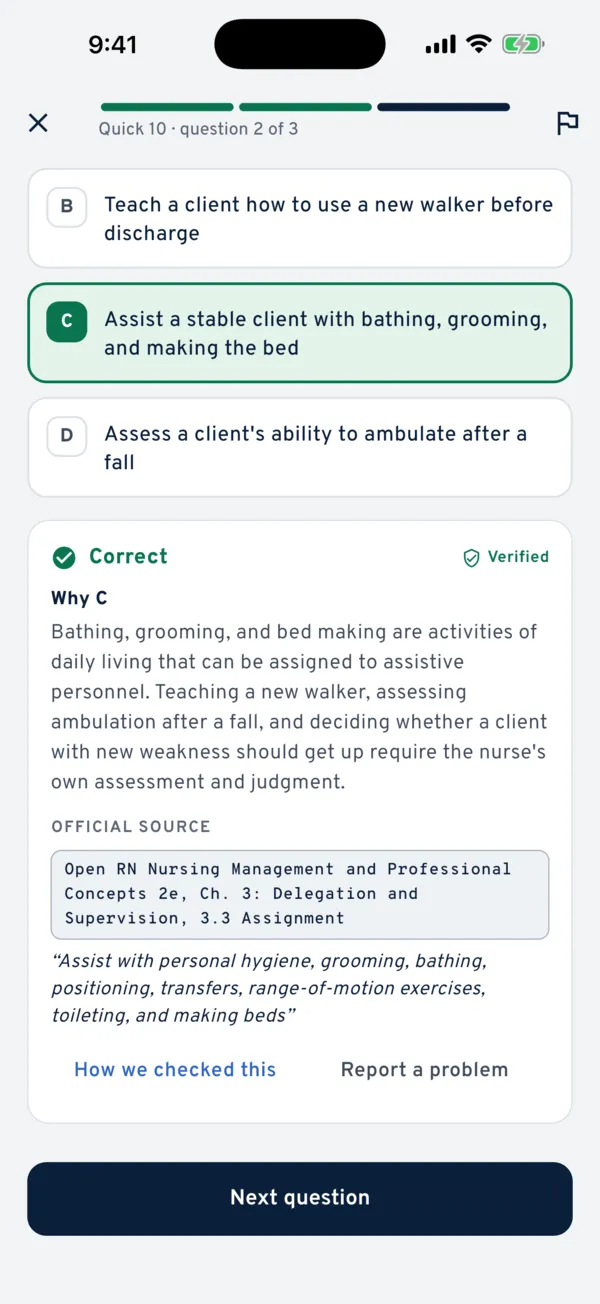
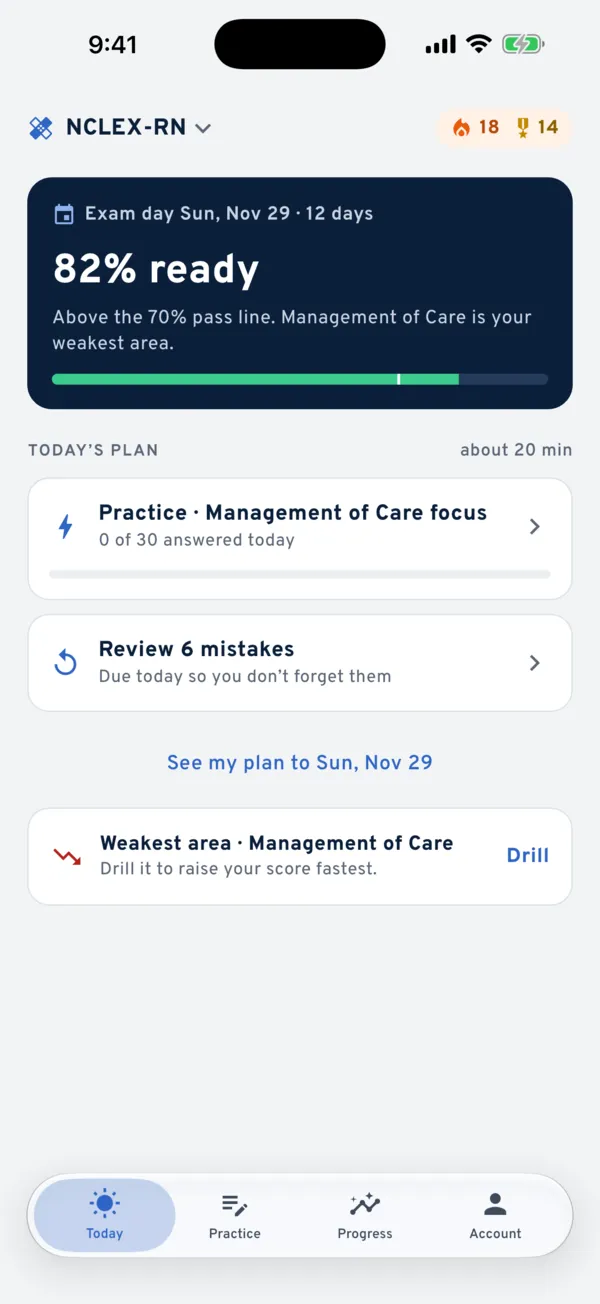
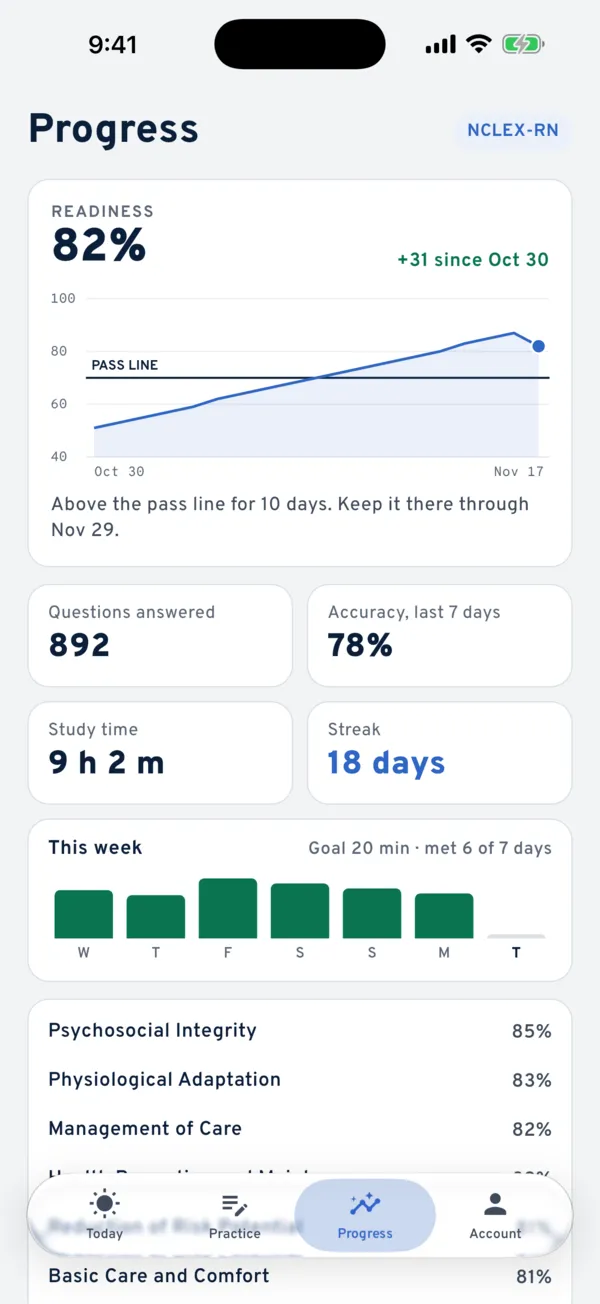
The NCLEX doesn’t end when you finish a set number of questions. It ends when the computer has enough evidence to make a pass or fail decision, and NCSBN uses exactly three rules to decide that moment.1 The rules are the same for the NCLEX-RN and the NCLEX-PN. Both exams run 85 to 150 items with a five hour limit.3
How the adaptive engine decides
The NCLEX is a computerized adaptive test (CAT). Every scored item in the pool has a known difficulty level, set by trying it out first as an unscored pretest item on a large group of candidates.1 After each of your answers, the computer recalculates an estimate of your ability based on everything you’ve answered so far, then picks the next item to match that estimate while keeping the test plan percentages on track.1
The goal is to give you items you have roughly an even chance of getting right. That’s why the exam feels hard to almost everyone. A candidate well above the passing standard gets hard items, and a candidate below it gets easier ones. Feeling like you missed half the questions is normal and tells you very little.
Alongside your ability estimate, the computer tracks how precise that estimate is. Early on, the margin of error is wide. Each answer narrows it. The exam can end once that band of uncertainty sits entirely above or entirely below the passing standard.
The passing standard itself is fixed in advance by the NCSBN Board of Directors. It’s 0.00 logits for the RN exam and minus 0.18 logits for the PN exam, both in effect through March 31, 2029.4 A logit is a unit on the ability scale, not a percentage, which is why NCLEX results never come with a score.
The three stopping rules
Rule 1. The 95% confidence rule
This is how most candidates finish.1 Once you’ve answered the minimum number of items, the computer stops as soon as it is 95% certain your ability is clearly above or clearly below the passing standard.1
The minimum for RN candidates is 85 items. That includes 15 unscored pretest items and three clinical judgment case studies of six items each.1 The test can’t stop before 85, no matter how well or badly you’re doing. Every candidate sees all three case studies.
Rule 2. The maximum length rule
If your ability stays close to the passing standard, the 95% band never clears the line, and the computer keeps going until you reach 150 items.1 At 150 it drops the confidence requirement and looks only at your final ability estimate.1
- At or above the passing standard, you pass.
- Below it, you fail.
A 150 item exam means you were close. It doesn’t mean you were failing, and NCSBN states that candidates can pass or fail regardless of exam length.1
Rule 3. The run out of time rule
The five hours include the introductory screens and every break, scheduled or not.3 If the clock runs out before you reach 150 items, the computer hasn’t made a 95% decision, so a separate rule applies.1
- If you’ve answered fewer than the minimum 85 items, the result is a fail.
- If you’ve answered at least 85, the computer scores your final ability estimate from all completed items. At or above the standard is a pass.1
The first bullet is the one that hurts people. Running out of time before 85 is an automatic fail regardless of how well you were doing.
Why exam length tells you so little
NCSBN is direct about this. The number of items alone doesn’t determine or reveal a pass or fail result.2 A candidate can pass or fail at any length.1
| What happened | What it means |
|---|---|
| Stopped at 85 | 95% certain you’re clearly above or clearly below the standard |
| Stopped between 86 and 149 | It took more items, but the 95% decision was reached |
| Ran to 150 | You stayed near the line, final ability estimate decided |
| Time ran out after 85 | Final ability estimate decided |
| Time ran out before 85 | Fail |
The candidate who fails at 85 had an ability estimate far enough below the standard that the computer didn’t need more evidence.2 The candidate who passes at 85 had the opposite. From inside the exam, those two experiences feel nearly identical.
The difficulty of your last few items doesn’t tell you much either. You can’t see item difficulty values, pretest items mixed in look exactly like scored ones, and every candidate’s items are pitched near their own ability.1
What the 2025 numbers show
NCSBN publishes how long real exams ran. For first time, US educated NCLEX-RN candidates in 2025, the figures were these.6
| 2025, first time US educated RN candidates | Result |
|---|---|
| Average exam length | 103 items |
| Stopped at the minimum 85 items | 59.1% |
| Went to the maximum 150 items | 20.5% |
| Average testing time | 2 hours 14 minutes |
| Used the full 5 hours | 0.5% |
| Passed | 86.7% |
So a majority stop at 85, about one in five goes the full 150, and almost nobody runs out the clock. With 86.7% of that group passing, most people who stopped at 85 passed, but that tells you nothing about your own exam. A candidate clearly below the standard also stops at 85, by the same 95% rule.1
Things that don’t change when the exam stops
You can’t skip items or go back. The computer won’t let you move on until you answer, and once you click Next, that answer is final.2 So there’s no strategy of leaving hard items for later.
The three case studies are always part of your exam. They count independently of the content area items because a case study can span several categories.1 If you want to know how those items are built, read NGN case studies explained.
Pretest items don’t count, but you can’t tell which ones they are, so treat every item as scored.1
What to do after the screen goes blank
When the exam ends you’ll see a short survey. Answer it, raise your hand and check out. Test center staff can’t see your result.3
Your board releases official results, usually within six weeks, and the timing varies by board.3 If your board participates in Quick Results, you can see an unofficial result through your Pearson VUE account two business days after the test for $7.95.5 Your card is charged only if a result is available.5
Forums trade tricks for guessing your result early. None of them come from NCSBN, which says only nursing regulatory bodies can release NCLEX results.3 Quick Results is the official shortcut, and it takes two business days.
If you fail, your board sends a Candidate Performance Report showing how many items you answered and how you performed across the test plan areas.3 You can retest after at least 45 test-free days, up to eight times a year, unless your board sets tighter limits.3
How to train for an adaptive exam
Because CAT stops when it’s confident, the goal is to stay clearly above the standard across every content area, not to hit a target percentage.
- Practice in full length timed blocks so 150 items in five hours feels routine.
- Take untimed review seriously. For every miss, write why the right answer fits that specific client.
- Work case studies every week, since you’ll see three no matter what.
- Track your weakest test plan category and keep it from dragging your estimate down.
Clinched has NCLEX-RN and NCLEX-PN courses with client situations tied to their sources and full practice tests.
Questions people ask
If the NCLEX shuts off at 85 questions, did I pass?
Not necessarily. At 85 items the computer stops if it is 95% certain your ability is clearly above or clearly below the passing standard, so a minimum length exam can be a pass or a fail. NCSBN says the number of items alone doesn't reveal your result.
What happens if I get all 150 questions on the NCLEX?
Reaching 150 items means your ability estimate stayed close to the passing standard. At that point the computer ignores the 95% confidence rule and passes you if your final ability estimate is at or above the standard. Candidates pass and fail at every length, including 150.
What happens if I run out of time on the NCLEX?
If you haven't answered the minimum 85 items when the 5 hours run out, you fail. If you have, the computer scores you on your final ability estimate from every item you completed, and you pass if it's at or above the passing standard.
Sources
- 2026 NCLEX-RN Test PlanNational Council of State Boards of Nursing
- NCLEX FAQsNational Council of State Boards of Nursing
- NCLEX Examination Candidate Bulletin (April 2026)National Council of State Boards of Nursing
- Passing StandardNational Council of State Boards of Nursing
- Quick ResultsNational Council of State Boards of Nursing
- 2025 NCLEX Examination StatisticsNational Council of State Boards of Nursing
ClinchedNCLEX-RN
Pass NCLEX-RN on the first try.
Practice questions written from the official sources, full practice tests in the real format and a plan that ends on your test date. Free to start.
Keep reading
- Topic explainer · NCLEX-RN · NCLEX-PN
 NGN Case Studies Explained: NCLEX Clinical Judgment ItemsEvery NCLEX has 3 case studies of 6 items, one per clinical judgment step, plus stand-alone items. How they're built, how partial credit works, how to answer them.
- Exam guide · NCLEX-PN · NCLEX-RN
 NCLEX-PN vs NCLEX-RN: Format, Content and Pass Rates ComparedThe NCLEX-PN and NCLEX-RN share 85 to 150 items, 5 hours and a $200 fee. They differ in content weights, scope and passing standard. Side by side for 2026.
- Topic explainer · NCLEX-PN
 NCLEX-PN Test Plan 2026: Categories, Percentages and ChangesThe 2026 NCLEX-PN test plan has 8 content areas, from Coordinated Care (18 to 24%) to Health Promotion (6 to 12%). What changed April 1, 2026 and how to use it.