

Private Pilot Certificate: Steps, Hours and What It Costs
Short answer
To earn a private pilot certificate for airplanes you get a medical certificate and a student pilot certificate, log at least 40 hours of flight time under 14 CFR 61.109, pass the PAR knowledge test (about $175 at PSI) and pass a practical test with an examiner. The FAA says the average is about 75 hours, so most of your cost is aircraft rental and instructor time for those hours, plus the examiner's fee.
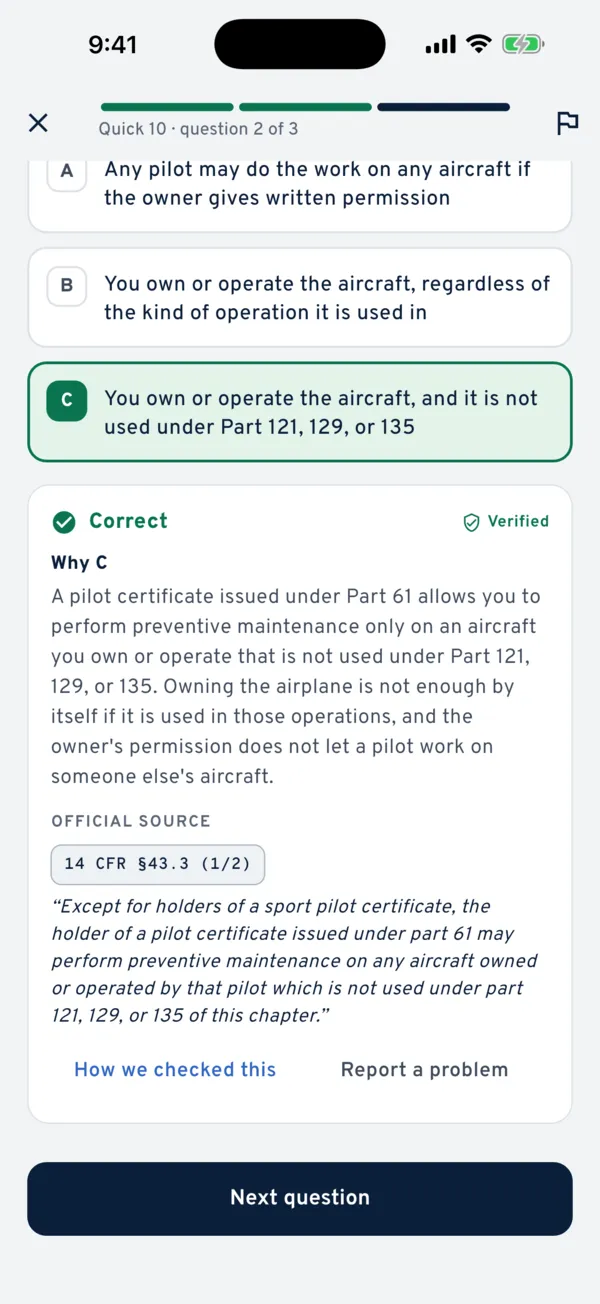
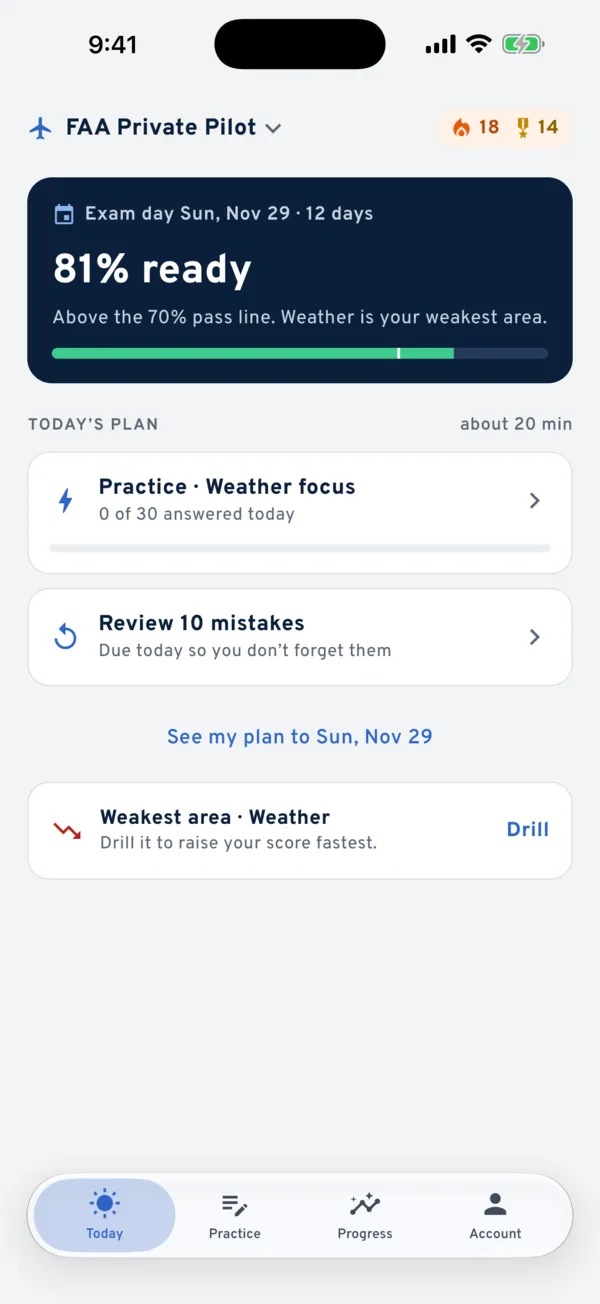
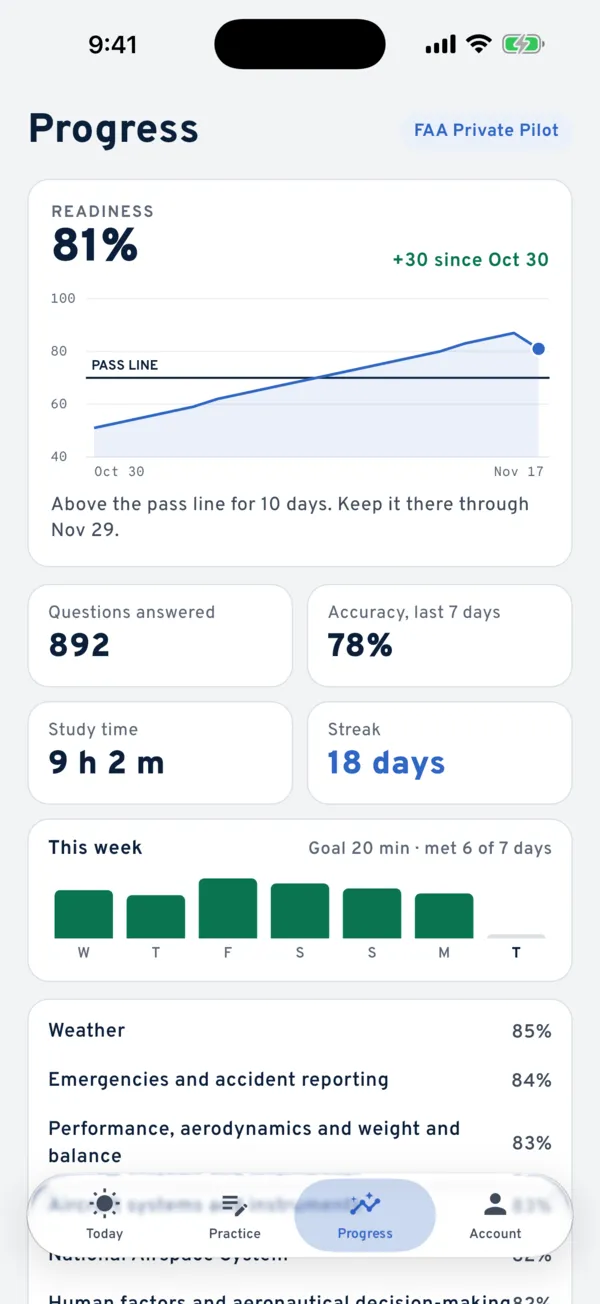
A private pilot certificate for airplanes comes down to four hurdles set by 14 CFR Part 61. You need a medical certificate, a student pilot certificate, at least 40 hours of logged flight time with specific training, and two tests, the PAR knowledge test and the practical test.1 The FAA says the U.S. average is about 75 hours of flight time, not 40, and most of the cost comes from those hours.3
The steps in order
- Get a medical certificateApply online in MedXPress, then see an Aviation Medical Examiner (AME) within 60 days. A third-class medical covers private pilot flying.
- Apply for a student pilot certificateApply through IACRA with your instructor or a school. It takes about three weeks by mail and you need it before your first solo.
- Train to soloDual lessons with an instructor, then solo flights once your instructor endorses your logbook for that make and model.
- Pass the knowledge testThe PAR test at a PSI center, with an instructor endorsement. Do it partway through training.
- Finish the required experienceCross-country, night and instrument training, solo cross-countries, and 3 hours of checkride prep within the 2 calendar months before the test.
- Pass the practical testAn oral exam and a flight with an FAA inspector or a designated pilot examiner, graded against the private pilot ACS.
- Fly on a temporary certificateThe examiner issues it the day you pass. The permanent card follows by mail.
Each step has rules worth knowing before you spend money.
Medical certificate
You start the medical by filling out an application in MedXPress, then you have 60 days to complete the exam with an AME before the application disappears.5 Part 61 requires at least a third-class medical when you exercise student pilot or private pilot privileges, other than under BasicMed.1 If you’re under 40 on the exam date, a third-class medical lasts until the end of the 60th month after the exam. At 40 or older it lasts until the end of the 24th month.1
The FAA tells applicants with past or current medical conditions or medications to research them in the Guide for Aviation Medical Examiners before the appointment, and to bring the right records. Missing paperwork can delay the certificate.5 That’s the main reason many instructors suggest getting the medical before you buy a block of lessons.
Student pilot certificate
You don’t need a student pilot certificate to take flying lessons. You need it before you fly solo.2 To be eligible you must be at least 16 and able to read, speak and understand English.2 You apply through IACRA or on paper with FAA Form 8710-1, through an FSDO, an examiner, a Part 141 school’s certification representative or a flight instructor. Expect it in about three weeks.2 Student pilot certificates issued after April 1, 2016 don’t expire.2
Flight experience
For an airplane single-engine rating, §61.109 sets the minimum at 40 hours of flight time, including at least 20 hours of flight training from an authorized instructor and 10 hours of solo.1 Inside those totals you need, at minimum, the following.1
- 3 hours of cross-country flight training
- 3 hours of night flight training, including one cross-country of over 100 nautical miles and 10 takeoffs and full stop landings
- 3 hours of training on flying solely by reference to instruments
- 3 hours of checkride preparation with an instructor within the 2 calendar months before the month of the test
- 5 hours of solo cross-country, including one solo flight of 150 nautical miles total with full stop landings at three points and one leg of more than 50 nautical miles
- 3 solo takeoffs and full stop landings at an airport with an operating control tower
The FAA’s own figure for the average student is about 75 hours.3 Weather, scheduling gaps and how often you fly all push that number around. Flying two or three times a week tends to cost less in total than flying twice a month, because less time goes to relearning.
The two tests
The knowledge test can be taken at 15, with an instructor endorsement or a pilot school graduation certificate.7 A passing result is valid for 24 calendar months before your practical test.1 Details on format and booking are in the private pilot written test guide.
For the practical test you must be at least 17,1 hold at least a third-class medical,1 and have your instructor’s endorsement that you’re prepared.1 The examiner tests you against the Private Pilot ACS, with an oral portion and a flight.8 You bring an airworthy airplane and its documents, plus your application, test report, logbook, medical and student pilot certificate.4
What you actually pay for
The FAA doesn’t publish an average total cost, and rates vary widely by region and aircraft. What it does publish is which pieces are free and which aren’t.
| Item | What the FAA or PSI says |
|---|---|
| Student pilot certificate | No charge through an FSDO. An examiner, school or instructor processing it may charge a reasonable fee.2 |
| Medical exam | Done by a private AME, who sets the fee. Third-class covers private pilot privileges.5 1 |
| Knowledge test | PSI prices FAA knowledge tests at $175 plus applicable tax.6 |
| Flight training | Aircraft rental and instructor time for every hour you log, at least 40 and about 75 on average.1 3 |
| Practical test | Free with an FAA inspector. A designated pilot examiner charges a fee, since the FAA doesn’t pay examiners.4 |
| Pilot certificate | The FAA doesn’t charge to issue the original certificate.4 |
Building your own estimate
Flight training is the big number, so build it from your school’s actual rates. Split your hours into dual, where you pay for the airplane and the instructor, and solo, where you pay only for the airplane. Then add ground instruction, the written test, the examiner’s fee and the airplane for the checkride.
Here’s the math with round numbers made up purely to show the method. They are not averages. Say a trainer rents for $200 an hour and an instructor bills $80 an hour. Sixty hours of dual cost 60 times $280, or $16,800. Fifteen hours of solo cost 15 times $200, or $3,000. That’s $19,800 for 75 hours before ground school, the written, the examiner and the checkride airplane. Swap in your school’s real rates and your own realistic hour estimate, and you’ll have a number you can plan around.
Saving money without cutting corners
- Pass the written early and once. A retest means another fee and, under §61.49, more instruction and a new endorsement.1
- Fly often. Consistent lessons lose less to review than lessons spread out over months.
- Study on the ground. An hour with the books costs nothing next to an hour in the airplane spent learning what you could have read.
- Get the medical first. Finding a medical issue after 20 hours of training is an expensive surprise.
If the written is your next step, the 30 day private pilot written study plan lays out what to study each week. Clinched has a Private Pilot course with practice questions that quote their FAA source.
Questions people ask
How many hours does it take to get a private pilot license?
The legal minimum for an airplane single-engine rating under 14 CFR 61.109 is 40 hours, with at least 20 hours of instruction and 10 hours of solo. The FAA says the U.S. average is about 75 hours, so plan your budget around more than the minimum.
How much does the private pilot checkride cost?
There's no charge if an FAA inspector gives the test. Most applicants test with an FAA-designated pilot examiner, who sets their own fee because the FAA doesn't pay them. Ask examiners near you for a quote, and budget for the airplane rental during the test too.
Do I need a medical certificate to start flight lessons?
Not for dual lessons with an instructor. You need at least a third-class medical certificate before you fly solo in an airplane. Many students get the medical first anyway, so a disqualifying condition shows up before they've paid for hours of training.
Does the FAA charge for the private pilot certificate?
No. The FAA doesn't charge to issue an original pilot certificate. The student pilot certificate is also free if you apply through an FAA Flight Standards District Office, though an examiner, school or instructor who processes it may charge a reasonable fee.
Sources
- 14 CFR Part 61, Certification: Pilots, Flight Instructors, and Ground InstructorseCFR, National Archives
- Student Pilot's Certificate RequirementsFederal Aviation Administration
- What are the hourly requirements in becoming a pilot?Federal Aviation Administration
- Recreational Pilot and Private Pilot Practical TestsFederal Aviation Administration
- How do I get a Medical CertificateFederal Aviation Administration
- FAA Testing Programs (voucher pricing)PSI Services
- FAA Airman Knowledge Testing Matrix, revised September 25, 2026Federal Aviation Administration
- Private Pilot for Airplane Category Airman Certification Standards (FAA-S-ACS-6C)Federal Aviation Administration
ClinchedFAA Private Pilot
Pass FAA Private Pilot on the first try.
Practice questions written from the official sources, full practice tests in the real format and a plan that ends on your test date. Free to start.
Keep reading
- Study plan · FAA Private Pilot
 A 30 Day Study Plan for the Private Pilot Written TestA 30 day plan for the FAA private pilot written (PAR), with 60 scored questions, 120 minutes and a 70% pass mark. What to study, which FAA books, when to book.
- Exam guide · Series 63, 65 and 66
 Series 65 vs Series 66: Which One Should You Take?The Series 65 has 130 scored questions and stands alone. The Series 66 has 100 and only counts with a Series 7. How to choose based on your job and where you work.
- Exam guide · SIE · Series 7
 SIE vs Series 7: How the Two FINRA Exams Fit TogetherThe SIE has 75 scored questions and needs no sponsor. The Series 7 has 125 and needs a firm. How they differ in content, cost and difficulty, and which comes first.