FAA Private Pilot guideFree practice test
FAA Private Pilot practice test
15 free FAA Private Pilot questions from the 884 in Clinched, chosen to match how the real test is weighted. Pick an answer to see the explanation and the official text it comes from. Nothing to sign up for.
-
Question 1 of 15Airworthiness
What is your responsibility as pilot in command regarding the operating limitations in the FAA-approved flight manual, markings, and placards for your airplane?
Correct answer B. You must comply with them
The operating limitations in the approved flight manual, markings, and placards are regulatory requirements, and the pilot must comply with them. They are not suggestions that a pilot may set aside when the flight seems safe, and an owner cannot authorize exceeding them.
Official source FAA-H-8083-25C, p. 9-2 (PDF page 232)Title 14 of the Code of Federal Regulations (14 CFR) part 91 requires that pilots comply with the operating limitations specified in the approved flight manuals, markings, and placards.
-
Question 2 of 15Airworthiness
You defer an inoperative item under the maintenance deferral provisions that apply to your non-turbine airplane. Which statement about deactivating the item is correct?
Correct answer C. Complex deactivation tasks require a certificated and appropriately rated maintenance person
Deactivation can be as simple as the pilot positioning a circuit breaker to OFF, but complex tasks such as rendering instruments or equipment totally inoperable require a certificated and appropriately rated maintenance person. In every case the item must be placarded INOPERATIVE.
Official source FAA-H-8083-25C, p. 9-10 (PDF page 240)The deactivation may be a process as simple as the pilot positioning a circuit breaker to the OFF position or as complex as rendering instruments or equipment totally inoperable. Complex maintenance tasks require a certificated and appropriately rated maintenance person to perform the deactivation. In all cases, the item or equipment must be placarded INOPERATIVE.
-
Question 3 of 15Airworthiness
What does the red line on an airspeed indicator mark?
Correct answer C. Never-exceed speed, beyond which structural damage could occur
The red line is the never-exceed speed, the airspeed limit beyond which structural damage could occur. Maximum flap extended speed is the top of the white arc, and maximum structural cruising speed is the top of the green arc and the bottom of the yellow arc.
Official source FAA-H-8083-25C, p. 9-2 (PDF page 232)A red line on the ASI shows the airspeed limit beyond which structural damage could occur. This is called the never-exceed speed (VNE).
-
Question 4 of 15Airport operations
While following another aircraft as instructed by the tower, you lose sight of it in haze. What should you do?
Correct answer C. Notify the controller promptly that visual contact is lost
When you have been told to follow another aircraft, you should promptly notify the controller if visual contact with it is lost or cannot be maintained, so the instruction can be changed. Continuing on the assumption that ATC is keeping the aircraft apart gives up the separation you accepted, and waiting until after landing leaves the controller unaware while the conflict still exists.
Official source AIM 4-4-15When a pilot has been told to follow another aircraft or to provide visual separation from it, the pilot should promptly notify the controller if visual contact with the other aircraft is lost or cannot be maintained
-
Question 5 of 15Emergencies and accident reporting
You are setting up for a forced landing and want to reduce the chance of a post-crash fire by deactivating the electrical system. When should the battery master switch be turned off?
Correct answer A. Before touchdown, but not until you no longer need electrical power for vital systems
Deactivating the electrical system before touchdown does reduce the likelihood of a post-crash fire, but the master switch should stay on as long as you still need electrical power for vital airplane systems. Switching it off at the very start of the checklist costs you radios and other systems while you still need them. Leaving it on until after touchdown gives up the fire-risk benefit you were after.
Official source FAA-H-8083-3C, p. 18-4 (PDF page 353)Deactivation of the airplane’s electrical system before touchdown reduces the likelihood of a post-crash fire. However, the battery master switch should not be turned off until the pilot no longer has any need for electrical power to operate vital airplane systems.
-
Question 6 of 15Human factors and aeronautical decision-making
While using cabin heat, you develop a headache and feel dizzy and drowsy. You suspect carbon monoxide. What should you do?
Correct answer A. Shut off the heater, open fresh-air vents and windows, and use oxygen if available.
Carbon monoxide symptoms call for immediate corrective action: turn off the heater, open fresh-air vents and windows, and use supplemental oxygen if it is available. Ventilating the cabin without shutting off the heater leaves the source of the carbon monoxide active, and simply shutting off the heater does not clear the gas already in your blood or in the cabin.
Official source FAA-H-8083-25C, p. 17-12 (PDF page 434)Any time a pilot smells exhaust odor, or any time these symptoms are experienced, immediate corrective action should be taken including turning off the heater, opening fresh air vents and windows, and using supplemental oxygen, if available.
-
Question 7 of 15National Airspace System
You plan to fly into an airport that has no operating control tower but is surrounded by Class E airspace that begins at the surface. What must exist for that airport to qualify for the Class E surface area?
Correct answer C. Weather reporting and communications with aircraft down to the runway
A Class E surface area is normally established at an airport without an operating control tower, and it qualifies only if the airport has weather observation and reporting capability and communications capability exists with aircraft down to the runway surface. An operating control tower is normally associated with Class B, C, or D airspace, not with a Class E surface area. The communications requirement is about capability to reach aircraft at the runway, not about having a flight service station on the field.
Official source AIM 3-2-6To qualify for a Class E surface area, the airport must have weather observation and reporting capability, and communications capability must exist with aircraft down to the runway surface.
-
Question 8 of 15Navigation systems and radar services
A VORTAC provides VOR azimuth, TACAN azimuth, and TACAN distance at one site. Which statement correctly describes the TACAN portion of the facility?
Correct answer B. It is a pulse system operating in the UHF band and requires TACAN airborne equipment
TACAN is a pulse system that works in the UHF band, and using it requires TACAN airborne equipment; it does not operate through conventional VOR equipment. Calling it a VHF continuous-wave system describes the VOR side of the facility, not TACAN. Getting the band right but expecting a standard VOR receiver to pick up TACAN distance is the other common slip.
Official source AIM 1-1-6 to 1-1-7TACAN is a pulse system and operates in the Ultrahigh Frequency (UHF) band of frequencies. Its use requires TACAN airborne equipment and does not operate through conventional VOR equipment.
-
Question 9 of 15Night operations
At night, the flashing anticollision lights on your airplane reflect off haze ahead and make it hard to see outside. What may you do?
Correct answer A. Turn them off when conditions make it safer
An airplane with an anticollision light system must have those lights lighted, but the pilot in command may turn them off when operating conditions make it in the interest of safety, and glare that destroys your night vision is exactly that situation. The equipment rule is not absolute, and the remedy is not to shut off the position lights, which must stay on from sunset to sunrise.
Official source 14 CFR §91.209However, the anticollision lights need not be lighted when the pilot-in-command determines that, because of operating conditions, it would be in the interest of safety to turn the lights off.
-
Question 10 of 15Performance, aerodynamics and weight and balance
You recover from a stall, then abruptly raise the nose before the angle of attack has been reduced enough. What is most likely to result?
Correct answer A. A secondary stall, because the critical angle of attack is exceeded again
A secondary stall occurs after recovery from a preceding stall when the pilot does not sufficiently reduce the angle of attack, either by pulling the nose up abruptly or by trying to break the stall with power alone. Power does not lower the angle of attack, so the wing can exceed the critical angle a second time; nose-up pitch by itself does not create the yaw that a spin requires.
Official source FAA-H-8083-3C, p. 5-18 (PDF page 123)Note that this stall may occur after any stall when the pilot does not sufficiently reduce the AOA by lowering the pitch attitude or attempts to break the stall by using power only.
-
Question 11 of 15Preflight, taxi, takeoff and landing
During a simulated emergency landing, you are higher than expected as you approach the selected field. What happens if you dive at the field to get down quickly?
Correct answer C. The airplane arrives with too much speed to permit a safe landing
Diving trades altitude for airspeed, so you reach the edge of the field with too much speed to permit a safe landing; too much speed is just as dangerous as too little. Arriving short is what happens when you are too slow, which is the opposite error. Extra speed does not stretch the glide to the field, and changing gliding speed makes it impossible to judge gliding distance and the landing spot.
Official source FAA-H-8083-3C, p. 9-28 (PDF page 199)Eagerness to get down is one of the most common faults of inexperienced pilots during simulated emergency landings. They forget about speed and arrive at the edge of the field with too much speed to permit a safe landing.
-
Question 12 of 15Pilot qualifications
You want to act as pilot in command as a student pilot without holding an FAA medical certificate. What must you have?
Correct answer A. A valid U.S. driver's license and meet the BasicMed conditions
A student pilot certificate holder may act as pilot in command without a medical certificate if they hold a valid U.S. driver's license, meet the BasicMed requirements of § 61.23(c)(3), and the operation meets the BasicMed conditions. A third-class medical certificate is another way to qualify, but this question asks about operating without one. A driver's license alone is not enough; the BasicMed conditions must also be met.
Official source 14 CFR §61.89The holder of a student pilot certificate may act as pilot in command of an aircraft without holding a medical certificate issued under part 67 of this chapter provided the student pilot holds a valid U.S. driver's license, meets the requirements of § 61.23(c)(3)
-
Question 13 of 15Aircraft systems and instruments
What is pressure altitude?
Correct answer B. The altitude indicated when the altimeter setting window is adjusted to 29.92 inHg
Pressure altitude is what the altimeter shows when the setting window is set to the standard 29.92 inHg, which puts the instrument at the theoretical standard datum plane. Setting the window to the current local altimeter setting gives indicated altitude, and the distance above the terrain is absolute altitude.
Official source FAA-H-8083-25C, p. 8-7 (PDF page 209)Pressure altitude—the altitude indicated when the altimeter setting window (barometric scale) is adjusted to 29.92 "Hg. This is the altitude above the standard datum plane, which is a theoretical plane where air pressure (corrected to 15 °C) equals 29.92 "Hg.
-
Question 14 of 15Weather
A microburst is the most severe type of wind shear. Which set of characteristics describes a typical microburst?
Correct answer B. A downdraft less than 2.5 miles across, about 1,000 feet deep, lasting 5 to 15 minutes
A microburst is a small-scale, intense downdraft: typically less than 2.5 miles in horizontal diameter, with a nominal depth of about 1,000 feet, and a lifespan of only about 5 to 15 minutes. It is short-lived but violent, with downdrafts up to 6,000 feet per minute and headwind losses of 30 to 90 knots. Making it a large, slow-moving wind event, or stretching its life to half an hour or more, turns a brief burst into something it is not.
Official source FAA-H-8083-28B, p. 22-8 (PDF page 263)A typical microburst has a horizontal diameter of less than 2.5 mi and a nominal depth of 1,000 ft.
FAA-H-8083-28B, p. 22-8 (PDF page 263)“The lifespan of a microburst is about 5–15 minutes, during which time it can produce downdrafts of up to 6,000 fpm; increasing headwind and headwind losses of 30–90 kt, seriously degrading performance.” -
Question 15 of 15Cross-country planning and navigation
You are preparing for a cross-country flight in a rented airplane. What does preflight action require you to do before departure?
Correct answer B. Become familiar with all available information concerning the planned flight
Preflight action directs you to become familiar with all available information concerning a planned flight before departure, and NOTAMs are specifically part of that information. Checking only weather while disregarding other available information is incomplete, and filing a VFR flight plan is not required at all, so neither option satisfies the requirement.
Official source AIM 5-1-314 CFR § 91.103, Preflight Action directs pilots to become familiar with all available information concerning a planned flight prior to departure, including NOTAMs.
Want the other 869?
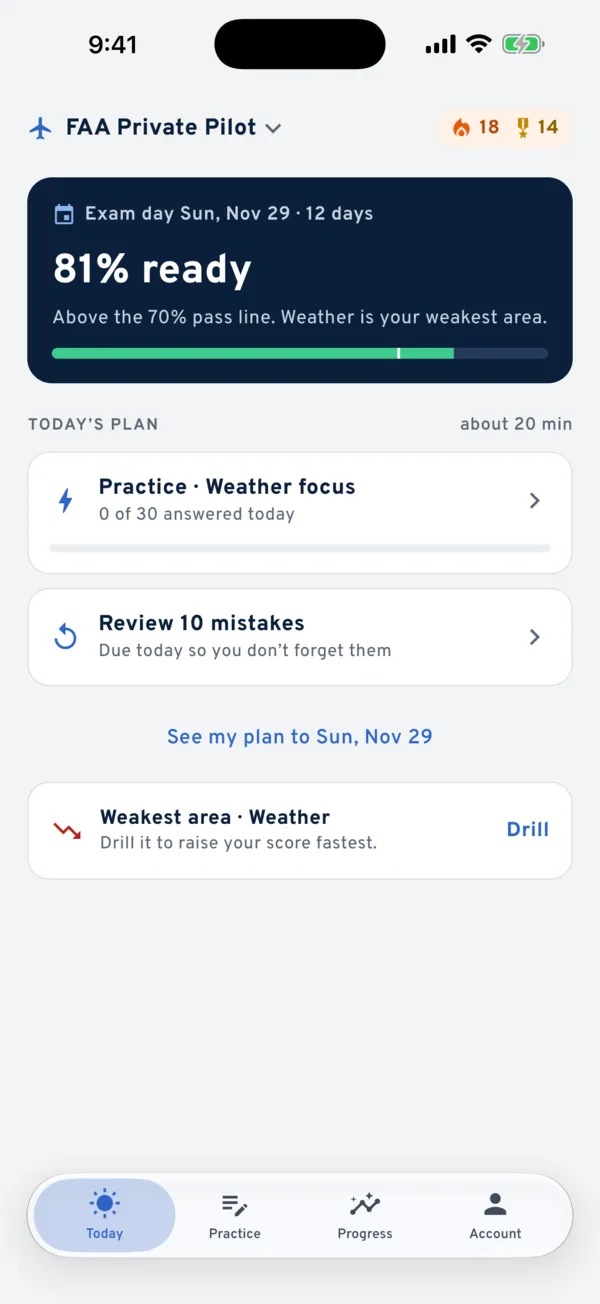
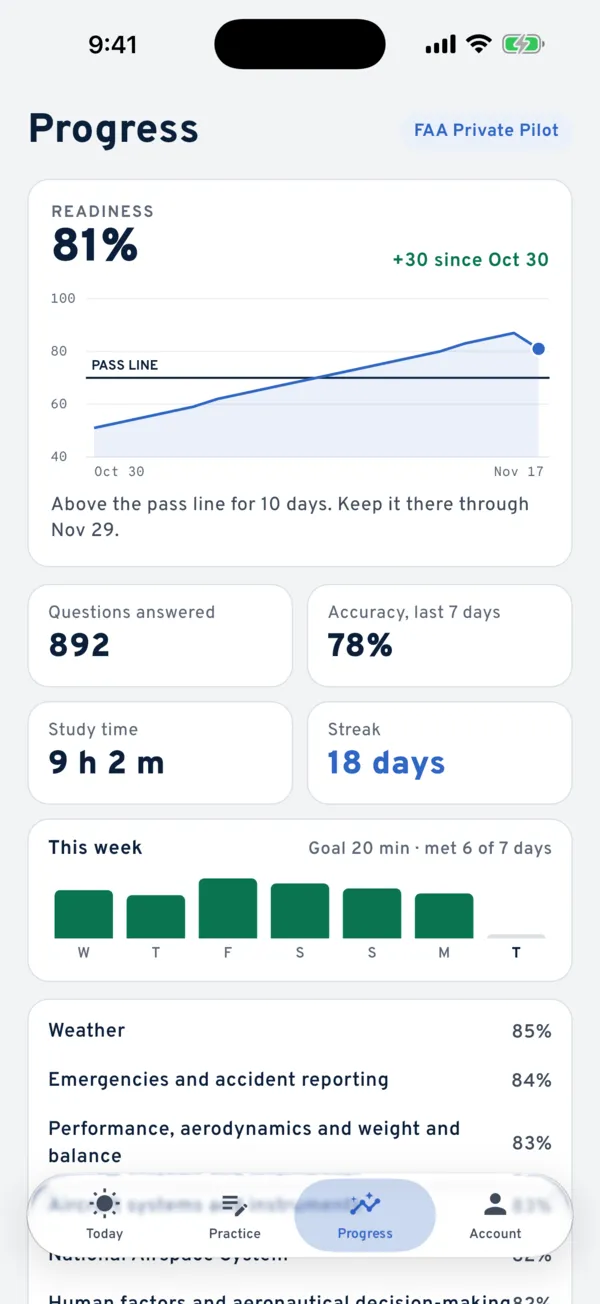
Clinched has every FAA Private Pilot question in this format, with full practice tests that match the real one, a readiness score by area and a plan to your test date. Free to start with 10 questions a day.
Read the FAA Private Pilot guide or see how we write and check every question.
Free on the App Store
Your exam, in your pocket.
20 exams ready with questions written from the official sources, timed practice tests in the real format and a readiness score with a pass line.
On your computer?
Scan with your iPhone camera to get Clinched practice in the app.