

CNA Skills Test Checklist: What Evaluators Actually Score
Short answer
On the CNA skills test you perform 3 to 5 randomly chosen skills in about 30 to 40 minutes while a registered nurse checks each step against a list. Prometric and Credentia score five skills and you must pass all five. Handwashing is always tested, and missing one critical step fails that skill even if everything else was right.
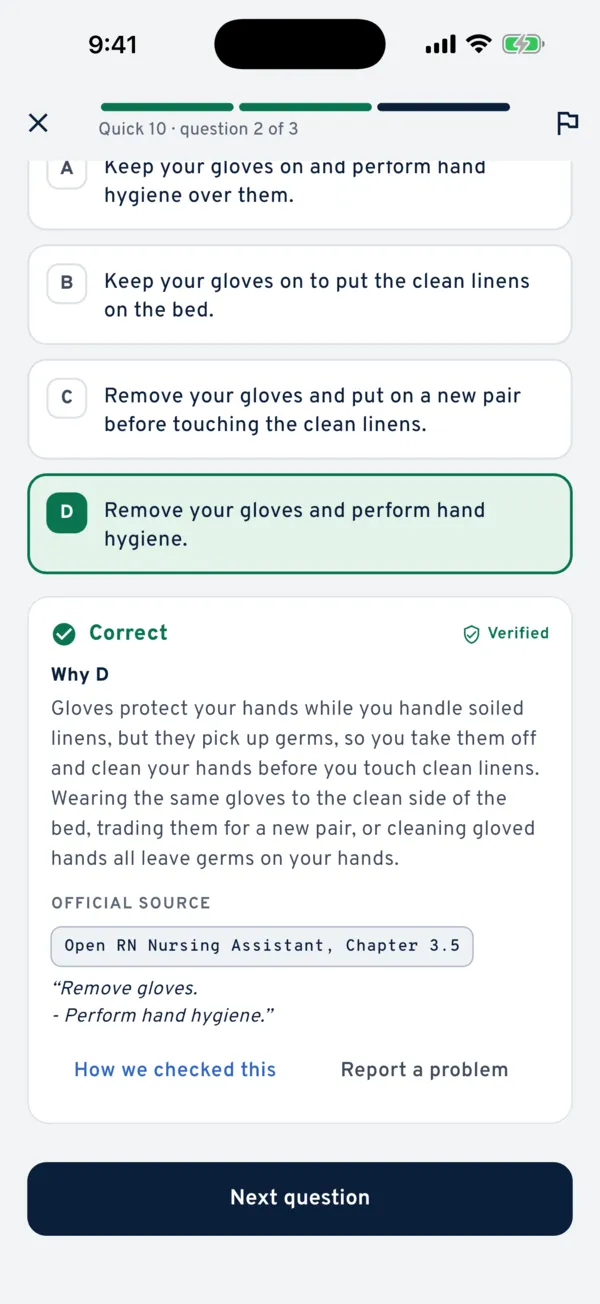
The CNA skills test is a timed demonstration where you perform 3 to 5 randomly chosen nurse aide skills on a person or manikin while a registered nurse checks each step against a printed list. Federal rules require the skills to be drawn at random from a pool that includes every personal care skill taught in training, and the evaluator must be a registered nurse with at least a year of experience caring for elderly or chronically ill people.1 Each state picks a vendor to run it, and the vendors score it differently. Know your vendor before you practice.
How each vendor builds your test
Prometric (Texas, Florida, New York) scores five skills. You perform three assigned skills and you’re scored on two more the whole time, handwashing and indirect care.2 Indirect care means the way you treat the resident during every skill except handwashing, such as greeting them, explaining care, asking about their comfort, protecting privacy and keeping them safe.3 The time limit runs from 31 to 40 minutes depending on your skills, and you must pass all five.2
Credentia delivers the National Nurse Aide Assessment Program (NNAAP) skills evaluation. You get five skills. Handwashing is always one, one is always a measurement skill such as blood pressure, pulse, respirations, urine output or weight, and the rest are random.4 In California you have 30 minutes for all five, with a warning when 5 minutes remain.4
D&S Diversified Technologies (Headmaster) in California assigns three or four tasks in 30 minutes.6 Your first task is always one of four mandatory ones with handwashing built in, which are bedpan use with output measurement, female catheter care, putting on a gown and gloves to empty a drainage bag, and female perineal care.6 Catheter care and perineal care are done on a manikin. Everything else uses a live actor.6
The full skill lists are public. Credentia’s California list has 23 skills. Two are marked state specific (electronic and manual blood pressure), and the electronic one isn’t tested in California.5 Prometric’s Texas list has 20, from ambulating with a gait belt to passive range of motion and a pivot transfer to a wheelchair.7 Print your vendor’s list. That list is your study guide.
How a skill is scored
Every skill is broken into steps. On the Credentia and D&S lists, some steps are printed in bold. Credentia calls them Critical Element Steps. Miss one, or do it wrong, and you fail that skill.4 Doing only the critical steps doesn’t pass you either. You still need enough of the remaining steps to meet the cut score for that skill.4 D&S spells out its standard. You must perform every critical step and at least 80% of the non-key steps on each task.6
Prometric describes it a little differently. You aren’t required to be perfect, but each skill has checkpoints and the evaluator compares what you do against them.2
Three scoring rules catch more people than any single skill.
- You have to do it, not describe it. Steps that are only spoken or simulated don’t count with D&S.6 Prometric doesn’t let you talk your way through a skill, and if a skill needs water you use water.2 Handwashing is the one place Credentia relaxes this. After your first full handwash, you can tell the evaluator when you’d wash instead of doing it each time.4
- Order matters only where the list says so. D&S steps aren’t order dependent unless the step says BEFORE or AFTER.6 With Credentia, if you correct an order-dependent step, you have to say when it should have been done or you get no credit for the fix.4
- Corrections end when the skill ends. You can correct a step during the skill by telling the evaluator and then doing it. Once you start a new skill, the earlier one is closed.24 With Prometric, a correction isn’t allowed if a safety problem already happened.2
The handwashing steps evaluators look for
Handwashing is the one skill everyone performs, so it’s the one you can’t afford to fumble. Credentia’s California list spells out the steps.5
- Greet and identifyAddress the client by name and introduce yourself.
- Wet and soapTurn on the water, wet hands and wrists thoroughly, and apply soap.
- Lather for 20 secondsRub all surfaces of wrists, hands and fingers with friction for at least 20 seconds, keeping hands lower than elbows and fingertips down.
- Clean the nailsRub fingertips against the palm of the opposite hand.
- RinseRinse wrists, hands and fingers, still keeping hands lower than elbows and fingertips down.
- Dry from the fingertipsUse clean, dry paper towels from fingertips toward wrists, then throw them away.
- Turn off the faucetUse a clean, dry paper towel (or a knee or foot control) and throw it away. Never touch the inside of the sink.
Never touching the sink and keeping fingertips pointed down are the steps people drop when they’re nervous. Practice until your hands do it without you.
Indirect care, the skill you perform the whole time
Prometric scores indirect care across all your skills, and it’s where good hands-on candidates lose points. Prometric’s own checkpoints ask whether you greet the resident by name and introduce yourself, explain care before and during it, ask about preferences and comfort, use standard precautions, and protect the resident’s rights and safety.3
The specific behaviors are concrete. Knock or announce yourself before entering. Don’t call a resident “honey” or anything other than their name. Close the privacy curtain for skills like the bedpan, and keep them covered. At the end of a skill, leave the call light within reach and the bed in its low position.3 For bathing-type skills like catheter care, foot care and perineal care, the evaluator listens for you to ask the resident whether the water temperature is comfortable.3
Gloves are part of this too. Prometric requires them for the bedpan, catheter care, emptying a drainage bag, mouth care and perineal care. You won’t lose points for wearing gloves when they aren’t required, but you’re always graded on taking them off without contaminating yourself.2
A practice checklist for the weeks before your test
Use this with a partner who reads your vendor’s skill steps aloud and marks every miss. Run each skill at least twice in the final week.
- Print your vendor's current skills list and mark every bold or critical step
- Practice handwashing until the 20 second lather and fingertips-down position are automatic
- Say the resident's name, introduce yourself and explain the task at the start of every skill
- Pull the privacy curtain for any skill that exposes the body
- Ask about comfort, and about water temperature for any washing skill
- Count pulse and respirations against a watch with a second hand for the full time your list requires
- Read a graduated cylinder at eye level and write the number on the recording form
- Finish every skill with the call light in reach and the bed low
- Take gloves off without touching the outside with bare skin
- Time a full mock test against your vendor's limit
Measurement skills deserve extra reps. Credentia gives you a recording sheet for the number, and you only get full credit if your measurement is accurate.4 D&S also uses a recording form you fill in during the skill.6
If you fail the skills test
Your score report is your study plan. Credentia’s report lists each of your five skills as Satisfactory or Unsatisfactory, and a failed skill shows the numbers of the steps you missed. Look those step numbers up in the skills list and drill them.8 You need Satisfactory on all five to pass.8
Retakes count against your attempts, so don’t rebook the next morning on nerves. Go back to the checklist, run the failed skill ten times with a partner, then run a full timed mock test. For attempt limits, deadlines and fees by state, see who runs the CNA exam in each state and what it costs, and for the written part and the full test day picture, read our CNA exam guide.
Clinched has a CNA course for the written test, with every question tied to an official source. Confirm your state’s current rules with your registry before test day.
Questions people ask
How many skills are on the CNA skills test?
Prometric (used in Texas, Florida and New York) and Credentia's NNAAP score five skills. Handwashing is always one of them. D&S Diversified Technologies (Headmaster) in California assigns three or four tasks instead. You must pass every skill you're given.
What is a critical element step on the CNA skills test?
It's a step, printed in bold in the Credentia and D&S skills lists, that you must perform correctly to pass the skill. Missing one fails that skill even if you did everything else right. Getting only the critical steps right isn't enough either, since you also need enough of the other steps to meet the passing standard.
Can you fix a mistake during the CNA skills test?
Yes, while you're still on that skill. Tell the evaluator you're making a correction and then actually perform the step. Once you start the next skill, you can't go back to fix an earlier one.
How long is the CNA skills test?
Prometric allows 31 to 40 minutes depending on the skills you draw. Credentia's California NNAAP and D&S in California both allow 30 minutes. Your instruction card or the evaluator tells you the exact limit before you start.
Sources
- 42 CFR Part 483 Subpart D, Requirements for nurse aide training and competency evaluation programsElectronic Code of Federal Regulations
- New York State Nurse Aide Candidate Information BulletinPrometric
- Indirect Care BehaviorsPrometric
- The Skills Evaluation, California HandbookCredentia
- Skills listing, California HandbookCredentia
- California Nurse Aide Candidate Handbook (October 2026)D&S Diversified Technologies (Headmaster)
- Texas Certified Nurse Aide Candidate Information BulletinPrometric
- Exam Results, California HandbookCredentia
ClinchedCNA Exam
Pass CNA Exam on the first try.
Practice questions written from the official sources, full practice tests in the real format and a plan that ends on your test date. Free to start.
Keep reading
- Exam guide · CNA Exam
 How Much Is the CNA Exam? Cost and Test Vendor by StateWho gives the CNA exam in California, Texas, Florida, New York and Illinois, what each part costs ($85 to $155), and the retake limits and deadlines in each state.
- Topic explainer · Food Protection Manager
 ServSafe Manager vs Other Food Protection Manager ExamsServSafe Manager, NRFSP, Learn2Serve and Always Food Safe compared on questions, time, passing score, proctoring, retakes and how long the certificate lasts.
- Topic explainer · Phlebotomy Technician · NHA CCMA
 Order of Draw for Phlebotomy Exams: Tubes, Colors and WhyThe venous order of draw is blood cultures, citrate, serum, heparin, EDTA, then fluoride. Learn the capillary order, the discard tube rule and why it matters.