CNA Exam guideFree practice test
CNA Exam practice test
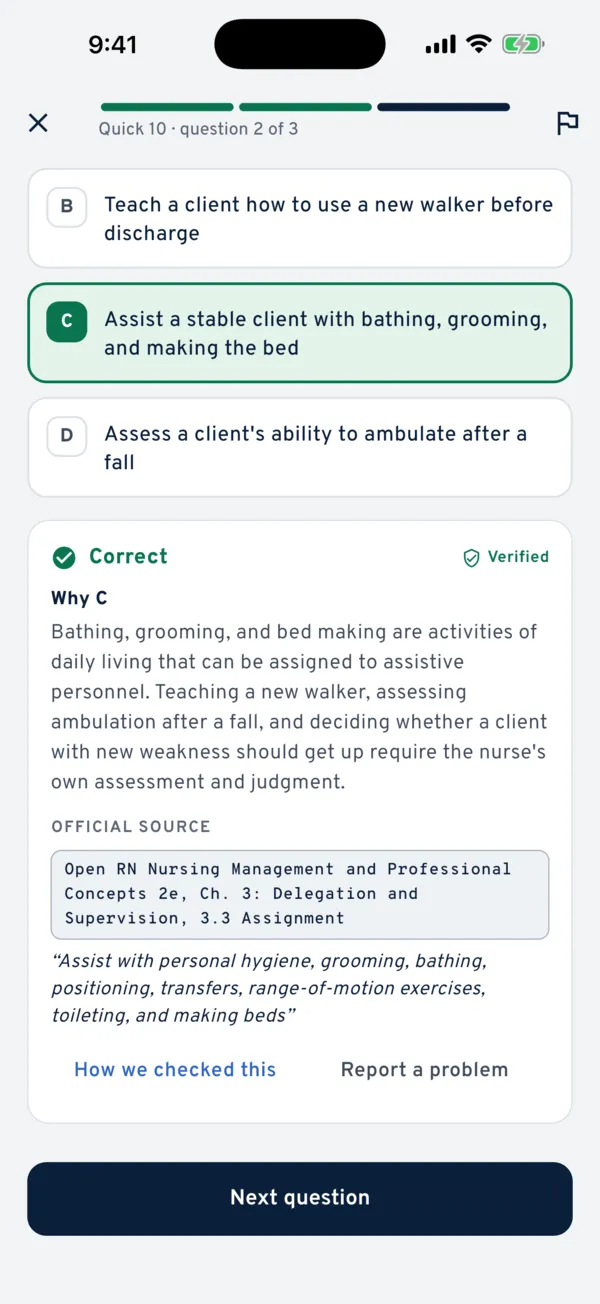
15 free CNA Exam questions from the 635 in Clinched, chosen to match how the real test is weighted. Pick an answer to see the explanation and the official text it comes from. Nothing to sign up for.
-
Question 1 of 15Activities of daily living
You are taking a resident down the hallway in a shower chair to the shower room. What should you do?
Correct answer D. Cover the resident with a bath blanket and put socks or shoes on their feet.
A bath blanket tucked behind the back and under the legs keeps the resident covered on the way to the shower, and socks or shoes protect the feet from injury. Moving fast still leaves the resident exposed in a public hallway, a towel over the shoulders only leaves the legs and feet bare, and a resident may not be able to hold a blanket closed themselves.
Official source Open RN Nursing Assistant, Chapter 5.6Bath blankets should be placed over the resident, paying attention to tucking the blanket behind the resident’s back and underneath their legs to keep any skin from showing. Residents should also wear shoes or socks to prevent any skin injuries to feet.
-
Question 2 of 15Activities of daily living
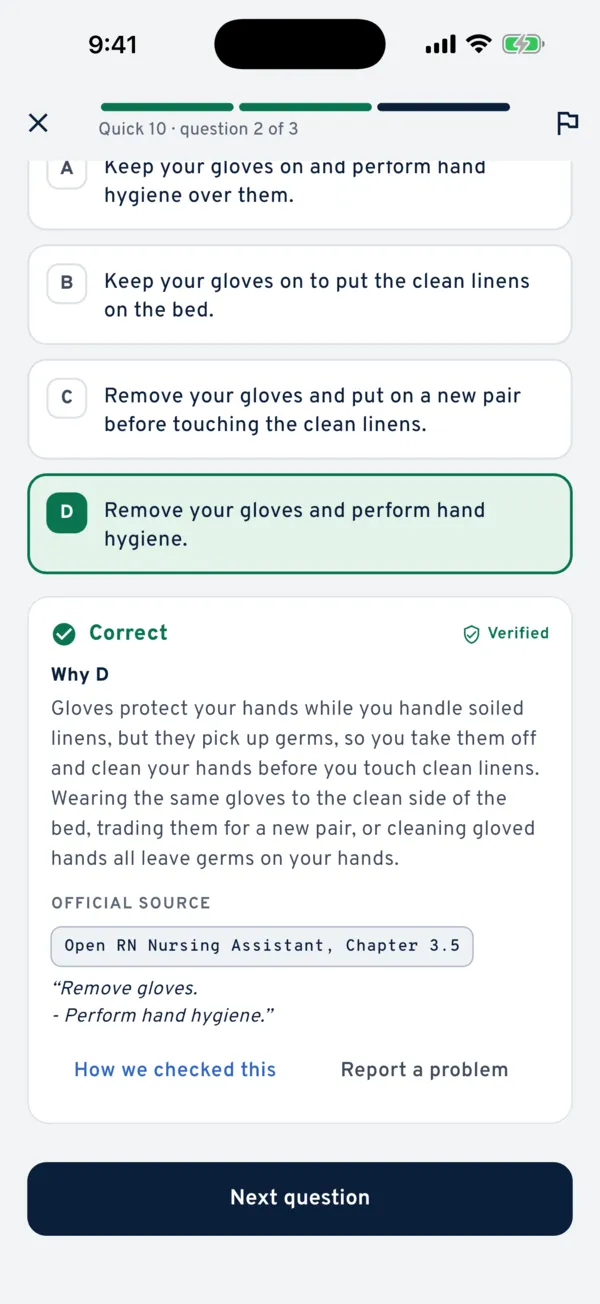
You have just emptied a resident's urinary drainage bag and removed your gloves. What should you do next?
Correct answer C. Perform hand hygiene.
Hand hygiene is done both before and after emptying a drainage bag, even when you wore gloves and even when the gloves look clean. Gloves do not replace hand hygiene, and going to the next resident or pulling on fresh gloves carries germs from the bag and the urine to that resident.
Official source Open RN Nursing Assistant, Chapter 5.25Perform hand hygiene.
Open RN Nursing Assistant, Chapter 5.25“Remove the gloves, turning them inside out.” -
Question 3 of 15Activities of daily living
You are giving nail care to a resident whose hands and nails look clean. When should you put on gloves?
Correct answer A. Put on gloves before cleaning under the nails, and keep them on while applying lotion.
Gloves are worn for the whole procedure because you touch debris under the nails and rub lotion into the skin, and you cannot tell by looking whether hands carry germs. Waiting until you trim or waiting until you see dirt or blood leaves your bare hands on the parts of care that soil them. Soaking first does not make gloves unnecessary.
Official source Open RN Nursing Assistant, Chapter 5.15Put on gloves.
Open RN Nursing Assistant, Chapter 5.15“Offer lotion. If applying lotion, wear gloves.” -
Question 4 of 15Activities of daily living
You are going to help collect a urine specimen from a resident. What should you do before the urine is collected?
Correct answer C. Ask the nurse to label the specimen cup.
The nurse labels the specimen cup before you collect the urine, so the cup is ready and correctly identified from the start. Writing the label yourself afterward, or later still after handing the cup to the nurse, puts the label on after the sample is already in the cup. The resident does not label their own specimen cup.
Official source Open RN Nursing Assistant, Chapter 5.8Ask the nurse to label a specimen cup before collecting urine.
-
Question 5 of 15Communication
A resident who has been complaining of pain does not follow your instructions for turning in bed. What should you do?
Correct answer D. Report the resident's pain to the nurse.
Pain makes it hard for a resident to hear and remember what you say, and pain medicine can also change how well a resident understands and responds. The pain itself is the barrier, so you tell the nurse, who decides how to help the resident get comfortable. Talking louder, slowing down your words, or leaving written steps does not ease the pain and keeps the nurse from acting on it.
Official source Open RN Nursing Assistant, Chapter 1.2For example, if a patient is in pain, they are less likely to hear and remember what was said. If the patient is receiving pain medication, be aware these medications may alter their comprehension and response.
-
Question 6 of 15Data collection and reporting
A resident tells you, "My stomach hurts." Which entry correctly documents what the resident said?
Correct answer C. The resident stated, "My stomach hurts."
What the resident tells you is subjective data, so you write their exact words in quotation marks. Putting the complaint into your own words, describing something you observed instead, or adding your own judgment about how mild the pain was changes or replaces what the resident actually said.
Official source Open RN Nursing Assistant, Chapter 7.3For this reason, when documenting subjective data, write exactly what the client said in quotations. For example, a nursing assistant might document: The client stated, “My stomach hurts.”
-
Question 7 of 15Emotional and mental health needs
A resident with dementia suddenly yells at you and tries to hit you during morning care. What should you do first?
Correct answer A. Look for a cause such as pain, being tired, or too much noise.
Aggression in dementia is a symptom of the disease, not something the resident does on purpose. First, think about what is behind the behavior, such as pain or infection, being tired or hungry, too much noise, or instructions that confused the resident, and address that cause. Scolding, rushing, or holding the resident still does not remove the cause.
Official source Open RN Nursing Assistant, Chapter 10.5Aggression can be caused by many factors including physical discomfort, environmental factors, and poor communication. If a person with dementia becomes aggressive, consider what might be contributing to the change in behavior and address it.
-
Question 8 of 15Member of the health care team
You are caring for a resident you have never cared for before. You want to give care the same way the other staff do. What should you do?
Correct answer D. Follow the resident's care plan.
The care plan is the shared plan for the resident, so following it means every aide and nurse gives care the same way, shift after shift. Copying another aide, using only what you learned in class, or following the family's wishes instead can leave out steps this resident needs.
Official source Open RN Nursing Assistant, Chapter 2.4Nursing interventions are implemented or delegated with supervision according to the care plan to assure continuity of care across multiple nurses and health professionals caring for the patient.
-
Question 9 of 15Infection control
You are assigned to care for a resident who is suspected of having tuberculosis. Which protection should you wear when you enter the room?
Correct answer D. A fit-tested N95 respirator.
Tuberculosis spreads through the air, so a fit-tested N95 or higher respirator is worn for airborne precautions. A surgical mask does not filter out the small airborne particles, and gloves, a gown and a face shield protect against contact and splashes, not against germs you breathe in.
Official source CDC, Transmission-Based PrecautionsUse personal protective equipment (PPE) appropriately, including a fit-tested NIOSH-approved N95 or higher level respirator for healthcare personnel.
-
Question 10 of 15Legal and ethical behavior
You see a coworker grab a resident's arm roughly and yell in the resident's face. What should you do?
Correct answer D. Report what you saw to the nurse right away.
Residents have the right to be free from abuse, so what you saw is reported to the nurse at once. You do not need proof that the resident was hurt before you report, and questioning the coworker yourself can make things worse. Putting the report on the resident is not your place, because you are the one who saw it.
Official source Open RN Nursing Assistant, Chapter 2.2Be free from discrimination, restraints, abuse, and neglect
-
Question 11 of 15Residents' rights
A resident tells you their watch is missing from the nightstand. What should you do?
Correct answer B. Tell the nurse right away that the watch is missing.
Residents' property must be protected from loss and theft, so a missing item is reported to the nurse at once. Blaming the resident, waiting to see if the watch appears, or searching other residents' rooms yourself does not protect property and invades other residents' privacy.
Official source 42 CFR §483.10(h)The facility shall exercise reasonable care for the protection of the resident's property from loss or theft.
-
Question 12 of 15Spiritual and cultural needs
A resident tells you, "I pray every morning before breakfast." What should you do?
Correct answer B. Respect the resident's beliefs and keep your own beliefs to yourself.
You support each resident's own spiritual and religious beliefs, and your beliefs are not part of their care. Sharing your faith, saying prayer is not part of the routine, or inviting the resident to your own place of worship all push your beliefs onto the resident instead of respecting theirs.
Official source Open RN Nursing Fundamentals, Chapter 18.4The nurse should respect and listen to the client’s expression of beliefs and not impose their own beliefs on the client.
-
Question 13 of 15Safety and emergencies
A resident tells you he has chest pain, feels sick to his stomach, and feels like he might faint. What should you do?
Correct answer D. Report the chest pain and the other symptoms to the nurse right away.
Nausea, vomiting, fainting and an irregular heartbeat can come along with a heart attack, so the whole picture goes to the nurse immediately. Reporting only the chest pain hides signs the nurse needs, and resting him or handing him a basin delays emergency care.
Official source Open RN Nursing Assistant, Chapter 3.2Patients may also have associated symptoms like difficulty catching their breath referred to as shortness of breath (SOB), sweating, anxiety, irregular heartbeats, nausea, vomiting, or fainting.
Open RN Nursing Assistant, Chapter 3.2“Symptoms should be immediately reported to the nurse for emergency assessment and treatment to preserve as much of the heart as possible.” -
Question 14 of 15Self-care, independence and restorative care
A resident needs help with morning care but can still brush their teeth and dress, though slowly. What should you do?
Correct answer A. Encourage the resident to do as much as they can.
Residents keep more strength and function when they do as much of their own care as they can, so you encourage them and help only where needed. Doing the care for them because it is quicker or to keep them from tiring, or handing it to family, takes away the activity that prevents decline from immobility.
Official source Open RN Nursing Assistant, Chapter 9.4Promoting clients’ independence in completing their ADLs and encouraging activity as tolerated can help prevent all these complications of immobility.
-
Question 15 of 15Therapeutic and technical procedures
A resident in regular socks wants to move from the bed to a chair. What should you do?
Correct answer B. Put nonskid footwear on the resident first.
Regular socks slide on the floor, so check that the resident is wearing nonskid footwear before any transfer. Using a gait belt, keeping the feet flat, or holding your shoulders does not fix the slippery footing under the resident's feet.
Official source Open RN Nursing Assistant, Chapter 8.4Check that the resident is wearing nonskid footwear before transferring.
Want the other 620?
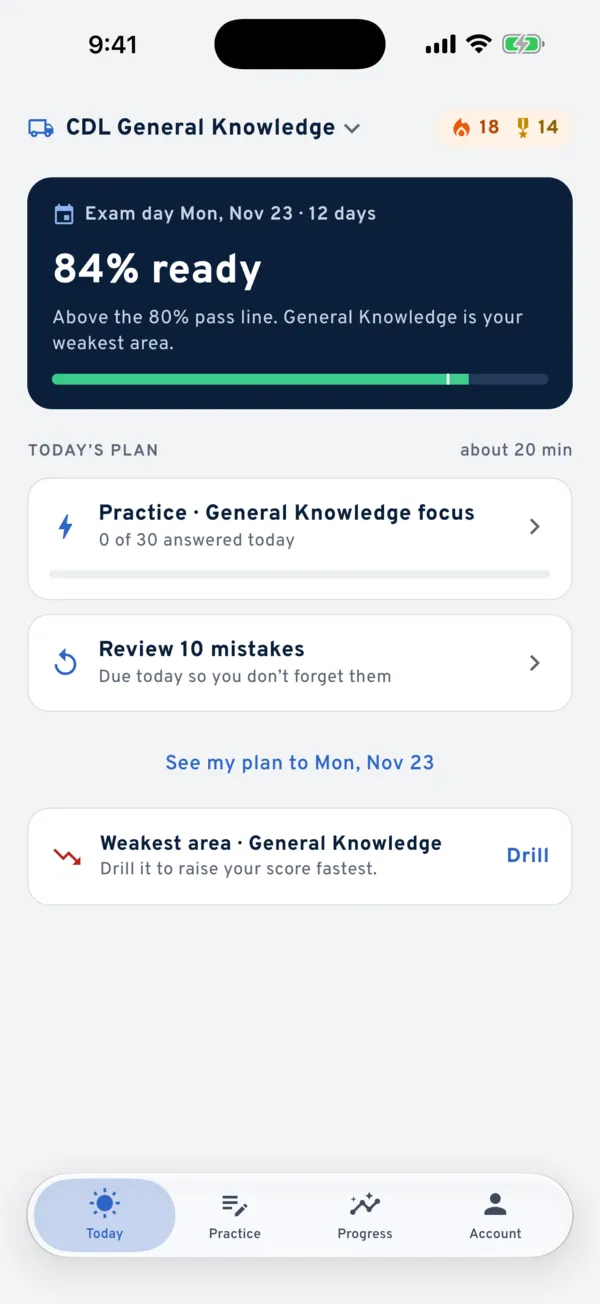
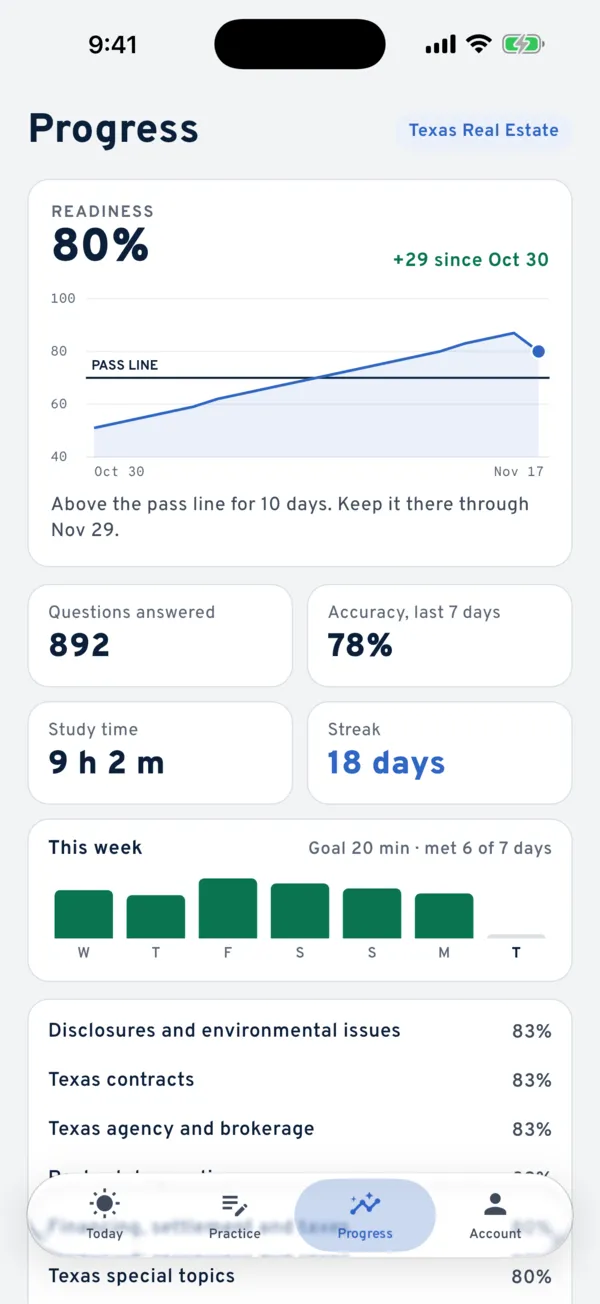
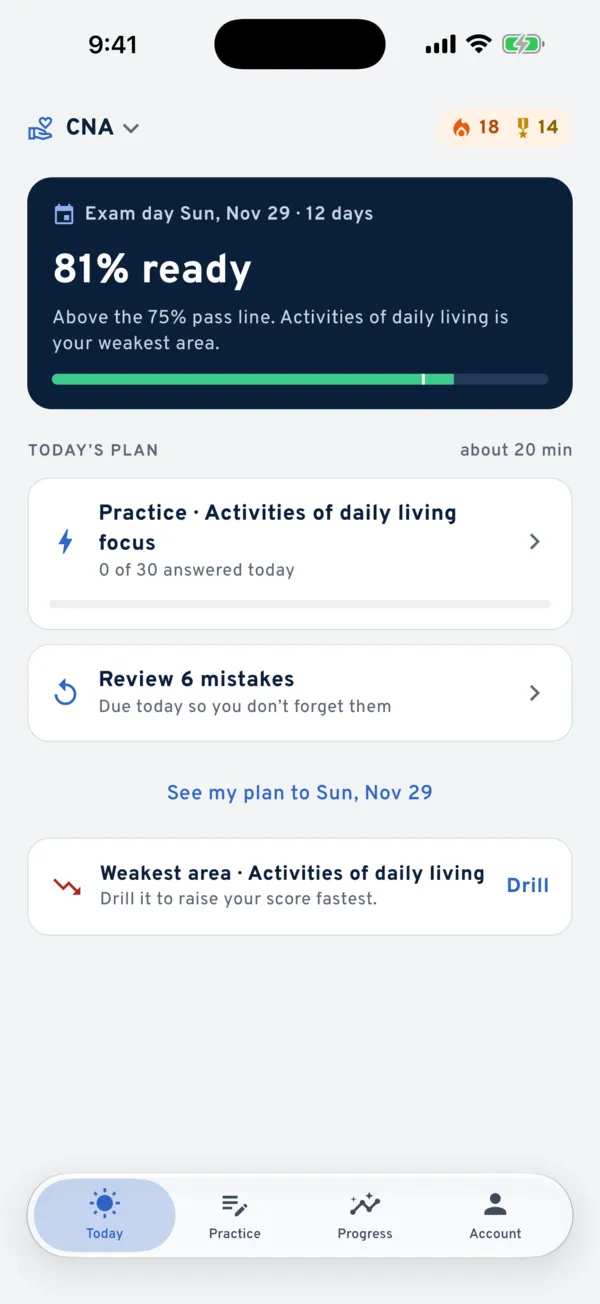
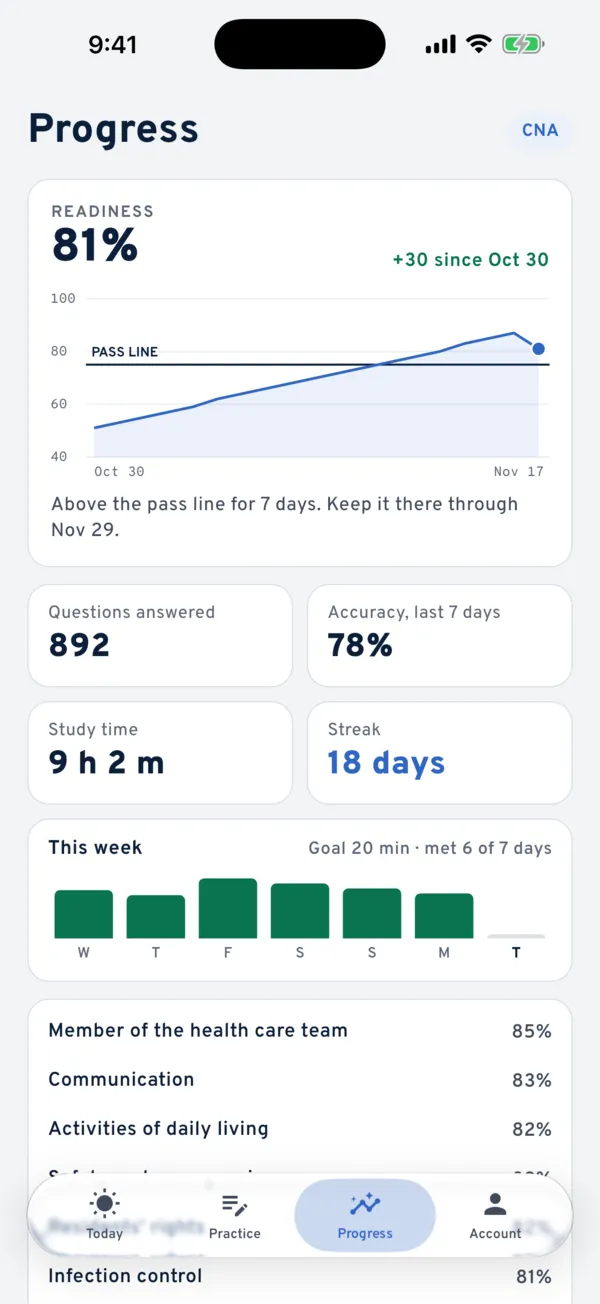
Clinched has every CNA Exam question in this format, with full practice tests that match the real one, a readiness score by area and a plan to your test date. Free to start with 10 questions a day.
Read the CNA Exam guide or see how we write and check every question.
Free on the App Store
Your exam, in your pocket.
20 exams ready with questions written from the official sources, timed practice tests in the real format and a readiness score with a pass line.
On your computer?
Scan with your iPhone camera to get Clinched practice in the app.