NHA CCMA guideFree practice test
NHA CCMA practice test
15 free NHA CCMA questions from the 284 in Clinched, chosen to match how the real test is weighted. Pick an answer to see the explanation and the official text it comes from. Nothing to sign up for.
-
Question 1 of 15Anatomy and physiology
A patient reports abdominal pain, and you document its location using the four-quadrant method. Where do the dividing lines intersect?
Correct answer A. At the umbilicus
The four-quadrant method uses one horizontal and one vertical line that cross at the patient's umbilicus, which is why it is the simpler approach used in medicine. A line below the ribs and one above the pelvis belong to the nine-region method, and lines dropped from the clavicles are the vertical lines of that same more detailed method.
Official source OpenStax Anatomy and Physiology (1e), 1.6 Anatomical TerminologyThe simpler quadrants approach, which is more commonly used in medicine, subdivides the cavity with one horizontal and one vertical line that intersect at the patient’s umbilicus (navel).
-
Question 2 of 15Anatomy and physiology
A patient in the clinic asks you what an artery does. Which statement about arteries is correct?
Correct answer D. They carry blood away from the heart.
An artery is a blood vessel that conducts blood away from the heart, and its thick wall is built to withstand the high pressure of blood ejected from the heart. Gas exchange occurs in the capillaries, not in arteries. Saying arteries carry blood toward the heart or carry blood at low pressure reverses the direction of flow and the pressure they handle.
Official source OpenStax Anatomy and Physiology (1e), 20.1 Structure and Function of Blood VesselsAn artery is a blood vessel that conducts blood away from the heart.
OpenStax Anatomy and Physiology (1e), 20.1 Structure and Function of Blood Vessels“All arteries have relatively thick walls that can withstand the high pressure of blood ejected from the heart.” -
Question 3 of 15Anatomy and physiology
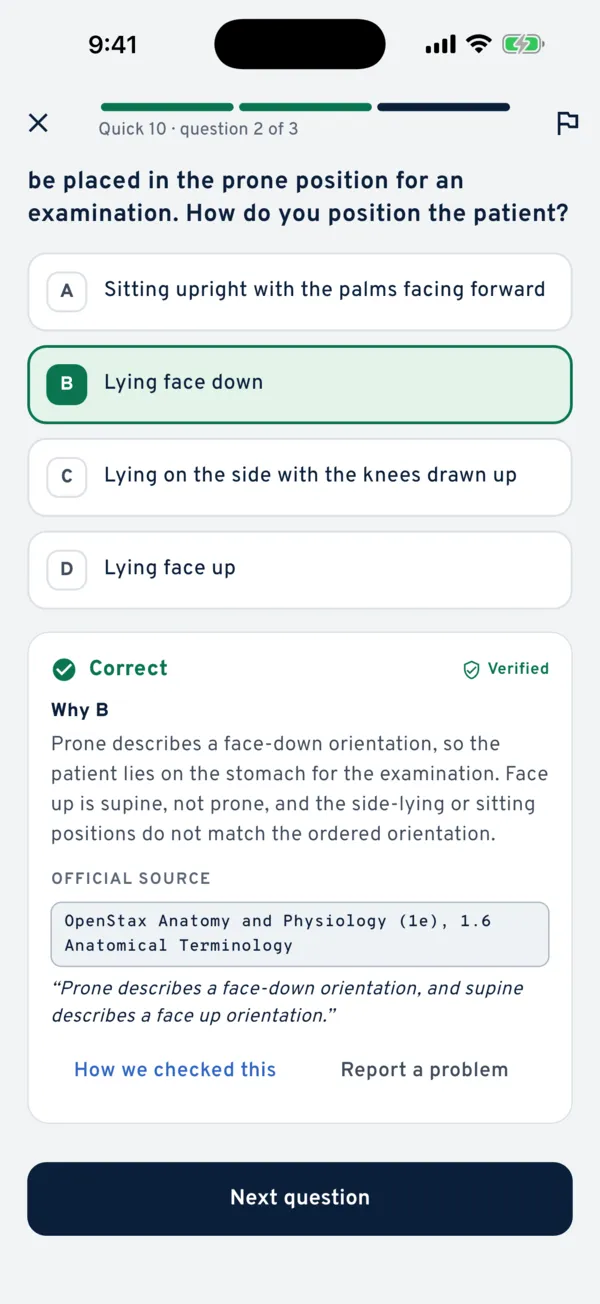
The provider's order says the patient should be placed in the prone position for an examination. How do you position the patient?
Correct answer D. Lying face down
Prone describes a face-down orientation, so the patient lies on the stomach for the examination. Face up is supine, not prone, and the side-lying or sitting positions do not match the ordered orientation.
Official source OpenStax Anatomy and Physiology (1e), 1.6 Anatomical TerminologyProne describes a face-down orientation, and supine describes a face up orientation.
-
Question 4 of 15Anatomy and physiology
A patient asks you what happens inside an artery when the smooth muscle in its wall contracts and the vessel narrows. What do you tell the patient?
Correct answer B. Blood flow decreases and blood pressure rises.
When the smooth muscle in the tunica media contracts, the lumen gets narrower, so less blood moves through the vessel and the pressure inside rises. The idea that the contracting wall squeezes blood forward faster is wrong, because a narrowed lumen resists flow rather than driving it. Vasodilation is the opposite response: the lumen widens, flow increases, and pressure drops.
Official source OpenStax Anatomy and Physiology (1e), 20.1 Structure and Function of Blood VesselsSpecifically in arteries, vasoconstriction decreases blood flow as the smooth muscle in the walls of the tunica media contracts, making the lumen narrower and increasing blood pressure.
-
Question 5 of 15Anatomy and physiology
You are helping a patient with a range-of-motion exercise and ask them to bend the elbow so the hand moves toward the shoulder. Which movement are you asking the patient to perform?
Correct answer D. Flexion
Flexion decreases the angle between the bones and bends the joint, which is what happens when the elbow bends and the hand comes toward the shoulder. Extension is the opposite movement that straightens the joint. Hyperextension and hyperflexion mean excessive movement beyond the joint's normal range, not the ordinary bending you requested.
Official source OpenStax Anatomy and Physiology (1e), 9.5 Types of Body MovementsIn the limbs, flexion decreases the angle between the bones (bending of the joint), while extension increases the angle and straightens the joint.
-
Question 6 of 15Communication and customer service
While you are on the phone, a provider gives you a new order for a patient. What do you do before you carry it out?
Correct answer D. Repeat the order back to the provider to confirm it.
Repeating a new order back to the provider confirms that you heard it correctly before you act on it. A careful written note does not prove you heard the order accurately, waiting for a written copy delays care that the provider has already ordered, and a coworker listening in is not the same as confirming the order with the provider.
Official source Open RN Nursing Fundamentals 2e, 2.4 Communicating With Health Care Team MembersR: “I am repeating back the order to confirm that you are ordering a STAT CBC and an increase of her Vicodin to 10/325 mg.”
-
Question 7 of 15EKG and cardiovascular testing
A patient says their heart sometimes feels like it skips a beat and asks what the EKG will show. Which finding does the EKG recording provide?
Correct answer C. Whether the rhythm of the heartbeat is steady or irregular
An EKG records the heart's electrical signals, and the provider uses that recording to see whether the rhythm of the heartbeat is steady or irregular. The heart rate is one thing the tracing shows, but it is not the only thing, so limiting the test to speed misses the rhythm information. The amount of blood pumped and the pressure inside the chambers are not measured by the electrical recording.
Official source MedlinePlus Medical Tests: ElectrocardiogramWhether the rhythm of your heartbeat is steady or irregular
-
Question 8 of 15Foundational knowledge
During intake, a patient lists only the prescription medications she currently takes. What else should you ask her about?
Correct answer A. Any prescribed, over-the-counter, herbal, or supplement products taken in the past month
A complete medication history covers prescribed, over-the-counter, herbal, and supplement substances taken in the past month, because some drugs stay in the body a long time and can interact with new medications. Asking only about past-month prescriptions, only about daily OTC products, or only about the past year leaves out products that can still cause interactions.
Official source Open RN Nursing Pharmacology, 1.8 Medication TypesIt is also important to note any substances that are prescribed, over-the-counter, or herbal that have been taken in the past month, as some medications have a long half-life and still be in the body with the potential to interact with new medications.
-
Question 9 of 15General patient care
You sustain a needlestick while giving an injection to a patient with no known bloodborne infection. What should you do?
Correct answer A. Report it immediately and follow agency exposure policy.
A needlestick can transmit blood-borne pathogens, so every needlestick injury is reported immediately according to agency policy for appropriate follow-up. Asking the provider to decide, delaying the report until the end of the shift, or waiting for symptoms all postpone the required reporting and follow-up.
Official source Open RN Nursing Skills 2e, 18.3 Evidence-Based Practices for InjectionsNeedlestick injuries can result in the transmission of blood-borne pathogens and should always be reported according to agency policy for appropriate follow-up.
-
Question 10 of 15Infection control and safety
You are following the CDC's item-by-item PPE removal sequence. After a patient care task, which item should you remove first?
Correct answer C. Gloves
In the CDC's item-by-item removal sequence, gloves are removed first because their outside is contaminated; next come goggles or face shield, then the gown, and the mask or respirator is removed last. Only a respirator, if worn, stays on until you have left the patient room and closed the door.
Official source CDC: Sequence for Putting On and Removing PPE1. GLOVES • Outside of gloves are contaminated!
CDC: Sequence for Putting On and Removing PPE“Remove all PPE before exiting the patient room except a respirator, if worn. Remove the respirator after leaving the patient room and closing the door.” -
Question 11 of 15Point-of-care testing and laboratory procedures
You are about to check a patient's blood glucose with the clinic's bedside glucometer. What must you confirm before you begin the test?
Correct answer C. That the glucometer has been calibrated per agency policy
Before a blood glucose test you read the manufacturer's instructions and agency policy and make sure the glucometer has been calibrated as policy requires, because devices and sites differ. Fasting status matters for interpreting the reading but is not a requirement to test, ketones are checked when a glucose result is high rather than beforehand, and a venous sample is not routinely needed to confirm a bedside result.
Official source Open RN Nursing Skills 2e, 19.2 Blood Glucose MonitoringPrior to performing a blood glucose test, read the manufacturer’s instructions and agency policy because they may vary across devices and sites. Ensure the glucometer has been calibrated per agency policy.
-
Question 12 of 15Medical law and ethics
A patient arrives for their first visit at your clinic and is seen by the provider that day. When must the clinic provide the Notice of Privacy Practices?
Correct answer D. No later than the date of the first service delivery
A clinic with a direct treatment relationship must give the Notice of Privacy Practices no later than the date of the first service delivery, including service delivered electronically. Waiting until a later visit, giving it only on request, or waiting a year does not meet that timing requirement.
Official source 45 CFR §164.520No later than the date of the first service delivery, including service delivered electronically, to such individual after the compliance date for the covered health care provider; or
-
Question 13 of 15Patient care coordination and education
A patient at your clinic asks you to explain the difference between a living will and a durable power of attorney for health care. Which statement should you give?
Correct answer B. A living will states which treatments the patient wants if dying or permanently unconscious.
A living will spells out the treatments a patient does or does not want if they are dying or permanently unconscious, such as breathing machines, resuscitation, or tube feeding. The document that names a trusted person to make health decisions when the patient cannot is the durable power of attorney for health care, so the options that give that job to a living will are mixing up the two papers.
Official source MedlinePlus: Advance Directives (NLM summary)A living will tells which treatments you want if you are dying or permanently unconscious. You can accept or refuse medical care.
-
Question 14 of 15Phlebotomy
A patient scheduled for a blood draw tells you she had a mastectomy on her left side several years ago and the incision healed well. Which arm do you use for the venipuncture?
Correct answer A. The right arm
A history of mastectomy is one of the conditions that restricts venipuncture in the affected extremity, so you draw from the other arm. How long ago the surgery was, using a smaller needle, or moving below the scar does not remove that restriction.
Official source Open RN Nursing Skills 2e, 23.2 Blood Collection & IV Therapy BasicsFor example, patients who have a history of lumpectomy or mastectomy, an arteriovenous fistula, or current lymphedema often have restrictions that prohibit venipuncture into the affected extremity.
-
Question 15 of 15Patient intake and vital signs
You take an oral temperature of 98.6°F on a patient, then take a tympanic temperature and get 99.4°F. How do you interpret these two readings?
Correct answer D. The tympanic reading is normally 0.5–1°F higher than the oral reading.
A tympanic reading is typically 0.3–0.6°C (0.5–1°F) higher than an oral reading, because the tympanic membrane shares the artery that perfuses the hypothalamus. A difference in that range is expected, so it is not evidence of fever and does not mean a value is wrong. Waiting for the two routes to match, or expecting the ear reading to be lower, misreads a normal finding.
Official source Open RN Nursing Skills 2e, 1.3 Vital SignsThe tympanic temperature is typically 0.3 – 0.6°C or 0.5 – 1°F higher than an oral temperature.
Want the other 269?
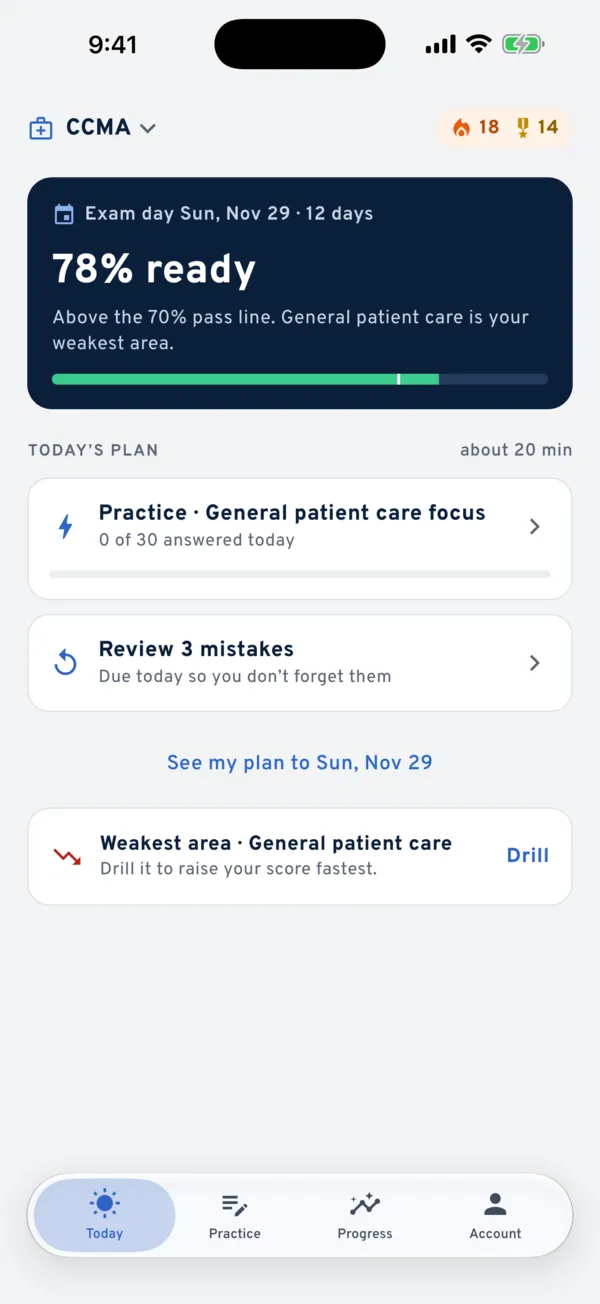
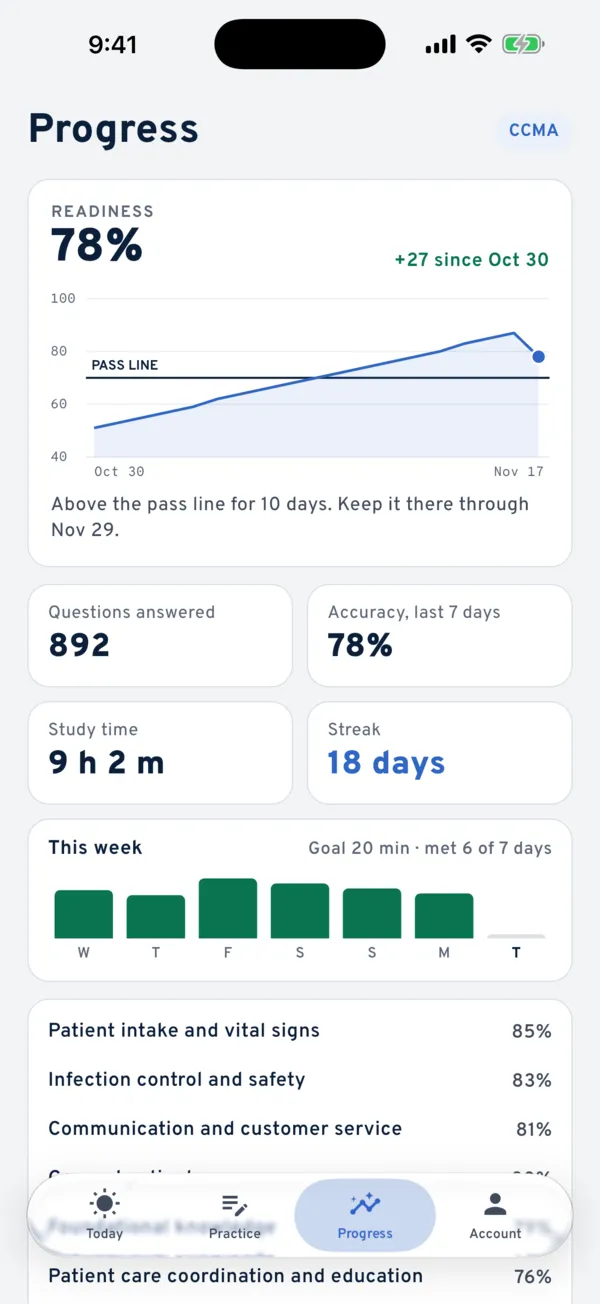
Clinched has every NHA CCMA question in this format, with full practice tests that match the real one, a readiness score by area and a plan to your test date. Free to start with 10 questions a day.
Read the NHA CCMA guide or see how we write and check every question.
Free on the App Store
Your exam, in your pocket.
20 exams ready with questions written from the official sources, timed practice tests in the real format and a readiness score with a pass line.
On your computer?
Scan with your iPhone camera to get Clinched practice in the app.