

CCMA vs CMA vs RMA: Which Medical Assistant Exam Fits You
Short answer
The CCMA (NHA) is open to graduates of most accredited or state-recognized programs and to people with a year of supervised work, with 150 scored questions in 3 hours. The CMA (AAMA) mostly requires a CAAHEP or ABHES accredited program and has 200 questions in four 40-minute segments for $125 to $250. The RMA (AMT) has 200 to 230 questions in 2 hours for $150, and it also accepts 3 years of work experience.
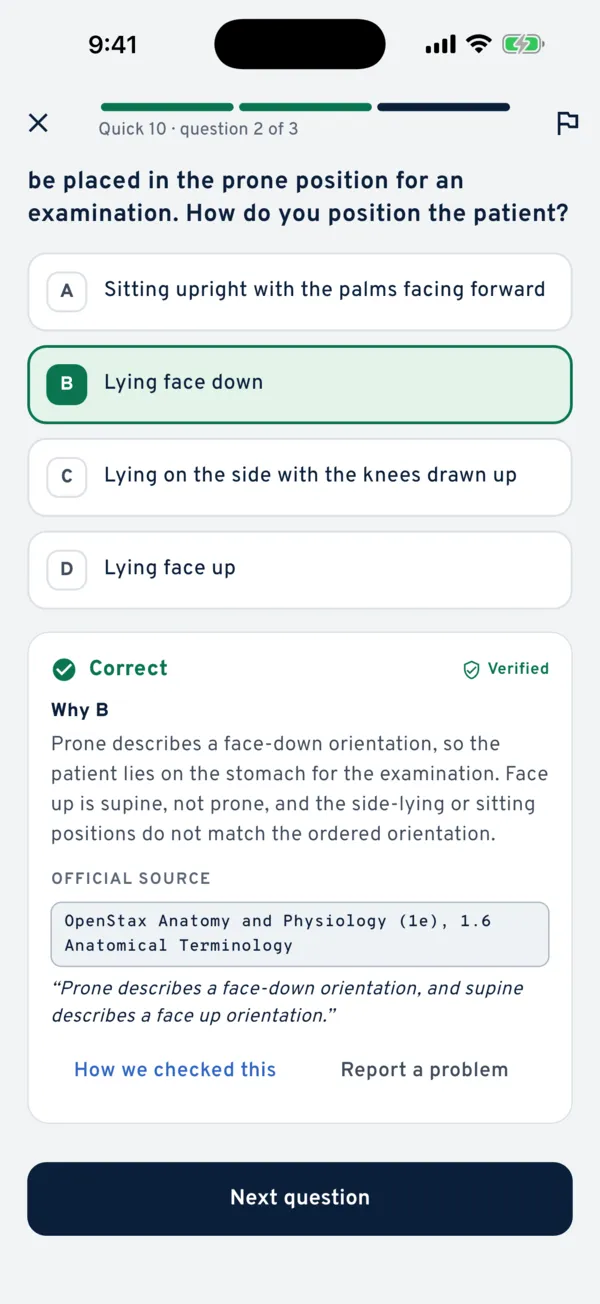
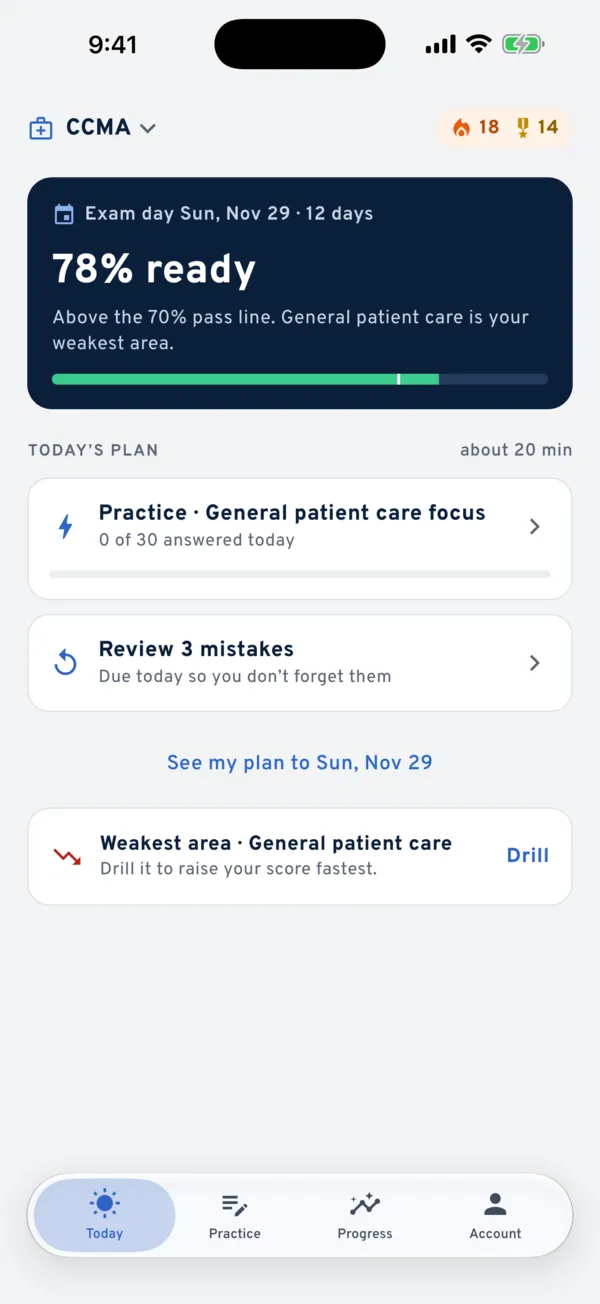
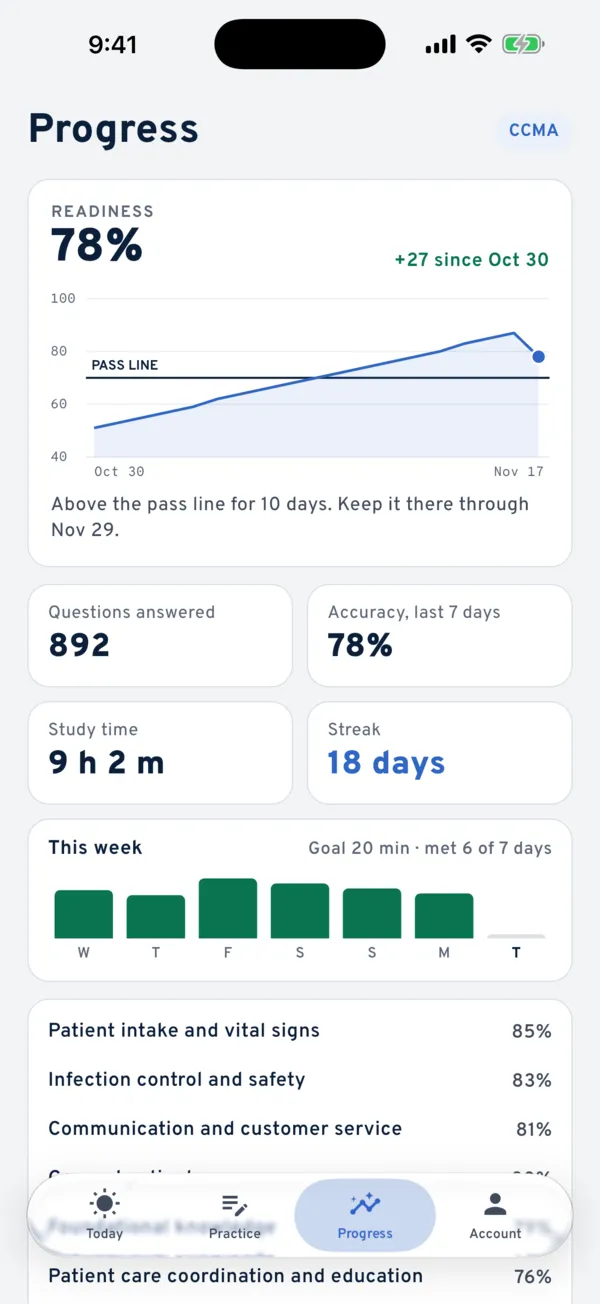
All three are national certifications for medical assistants, and each sponsor is accredited by the National Commission for Certifying Agencies.148 The real differences are who’s allowed to sit, how long the exam is, and what it costs to keep the credential. Here’s how the NHA CCMA, the AAMA CMA and the AMT RMA line up as of November 2026.
The three exams side by side
| CCMA (NHA) | CMA (AAMA) | RMA (AMT) | |
|---|---|---|---|
| Questions | 150 scored + 30 pretest | 200 | 200 to 230 |
| Time | 3 hours | Four 40-minute segments | 2 hours |
| Passing score | 390 on a 200 to 500 scale | Set by the AAMA board, 200 to 800 scale | 70 on a 0 to 100 scale |
| Exam fee | Listed in NHA’s store, per attempt | $125 members, $250 nonmembers | $150, includes first annual fee |
| Testing | School, PSI center or live remote | PSI center or live remote | Pearson VUE center or school site |
| Retakes | 30 days apart, 3 attempts, then 1 year | 6 attempts in 12 months, no wait | 45 days apart, 4 attempts total |
| Renewal | 2 years, 10 CE credits | 60 months, 60 CEUs or the exam | Annual fee plus CCP points |
Sources for each row are cited in the sections below.
Who can sit for each exam
CCMA. You need a high school diploma or equivalent plus one of two pathways. The first is a medical assistant training program from an accredited or state-recognized provider finished within the last 5 years (registered apprenticeships, military training and approved employer programs also count). The second is supervised work in the field, either 1 year in the last 3 or 2 years in the last 5.1 California residents using the work route need 2 years of medical assistant work in the 5 years before the exam.1 Schools with an NHA agreement can let students test before the externship, with 90 days to finish it afterward.1
CMA (AAMA). The main route is being a student or graduate of a medical assisting program accredited by the Commission on Accreditation of Allied Health Education Programs (CAAHEP) or the Accrediting Bureau of Health Education Schools (ABHES).5 Completing students can register once their classroom coursework is done, and the program director has to verify completion, practicum included, before the credential is awarded.5 There’s also a route for medical assisting educators with at least 1,000 hours of teaching, and an alternative pathway for graduates of postsecondary programs or apprenticeships that meet AAMA’s criteria.5 Work experience alone doesn’t qualify.
RMA (AMT). AMT accepts a graduate of an accredited medical assistant program within the past 4 years, with at least 720 hours of instruction including a 160-hour externship.7 It also accepts a hybrid education and work program, formal military medical training, instructors, and people who have worked as a medical assistant for at least 3 years within the past 7.7
The practical upshot is that the CMA (AAMA) depends on what program you attended. The CCMA and RMA both have a work-experience door, but the RMA’s asks for more years.
What each exam tests
All three cover clinical, administrative and general knowledge, in different proportions.
The CCMA is the most clinical. Clinical Patient Care has 84 of its 150 scored items, which covers intake and vitals, general patient care, infection control, point of care testing, phlebotomy and EKGs.2 The rest is split among foundational knowledge, anatomy, care coordination, administrative work, communication, and law and ethics.2
The CMA (AAMA) content outline in use until mid-2027 puts 59% of questions in clinical competency, 21% in general topics such as legal and ethical issues and communication, and 20% in administrative work like billing, coding and scheduling.4 AAMA has released a new outline for exams taken on or after July 2027, which shifts the mix to 65% clinical, 20% general and 15% administrative.4 If you test in 2027, check your date against the outline.
The RMA outline is built around three areas, with 31% general medical assisting, 14% administrative and 55% clinical.7 AMT links that outline from its RMA page.
Time per question differs a lot. The CCMA gives 3 hours for 180 questions, about a minute each.2 The RMA gives 2 hours for 200 to 230.8 The CMA splits 200 questions into four 40-minute segments, with optional breaks of 5, 10 and 5 minutes between them.4
Cost and keeping it current
Exam fees first. AAMA charges $125 for members and $250 for nonmembers, and CAAHEP or ABHES students and graduates who apply within 12 months of graduating pay $125.5 AMT charges $150 for the RMA, which covers the application, the exam and your first annual fee.7 NHA lists the CCMA fee in its online store and charges it for each attempt.1 If you’re in a program, ask your school before paying for anything, since some schools register their students for the exam.
Renewal is where the costs separate over time.
- CCMA. Every 2 years you need 10 continuing education credits and a fee.1 Outside NHA One the fee is $195, plus $65 for each additional NHA certification.3
- CMA (AAMA). Every 60 months you need 60 continuing education units, at least 30 of them AAMA CEUs, or you pass the exam again. The recertification fee is $80 for members and $160 for nonmembers.6
- RMA. AMT bills an annual fee and asks you to earn points in its Certification Continuation Program (CCP).8 Check AMT’s renewal page for the current amounts.
Retake rules matter if things go badly. NHA makes you wait 30 days between the first three attempts, then one year per extra attempt.1 AAMA has no waiting period but caps you at six attempts in any 12-month period, each with a new application and fee.4 AMT requires 45 days between attempts and allows four attempts in total per certification.8
Official pass rates
AAMA reported a 69% pass rate for first-time CMA candidates from July 2024 to April 2025, across 2,680 first-time exams.4 AMT reported a 71% pass rate for the RMA in 2025, with 8,223 people examined, and 58,548 RMAs currently certified.8 The AAMA number counts first attempts only and the AMT number counts everyone examined, so they aren’t an apples-to-apples comparison. NHA’s public pages don’t show a current CCMA pass rate, so there’s no official number to set beside these.
How to pick one
Start with your program. If it’s CAAHEP or ABHES accredited, all three are open to you, and the CMA (AAMA) is the one your program was built around. If it isn’t, the CMA is likely off the table unless the alternative pathway fits, and the choice is between the CCMA and the RMA.
Then look at job postings in your area. Employers usually name the credentials they accept. Medical assistant rules are set state by state, and NHA tells candidates to check the requirements where they plan to work.1
Last, think about what you’ll be doing. If your job leans clinical, with blood draws, injections and EKGs, the CCMA’s weighting matches that work, and its phlebotomy items reward the same skills covered in our order of draw guide. The CCMA exam guide has the full test plan and retake rules, and the CCMA study plan maps it to eight weeks.
Questions people ask
Is a CCMA the same as a CMA?
No. The CCMA is the Certified Clinical Medical Assistant credential from the National Healthcareer Association (NHA). The CMA (AAMA) is the Certified Medical Assistant credential from the American Association of Medical Assistants. They are separate exams with different eligibility rules, fees and renewal cycles, and both are accredited by the National Commission for Certifying Agencies.
Can I take the CMA (AAMA) exam without going to an accredited program?
Mostly no. The main route is being a student or graduate of a medical assisting program accredited by CAAHEP or ABHES. AAMA also has an educator route and an alternative pathway for graduates of postsecondary programs or apprenticeships that meet its criteria, reviewed case by case.
Which medical assistant exam is easiest?
No official source ranks them by difficulty, and the published pass rates measure different groups, so they can't be compared directly. AAMA reported a 69% first-time pass rate for the CMA from July 2024 to April 2025, and AMT reported a 71% pass rate for the RMA in 2025. Pick the exam your program and local employers recognize, then prepare for its content outline.
Sources
- NHA Candidate HandbookNational Healthcareer Association
- Test Plan for the CCMA Exam (2022 job analysis)National Healthcareer Association
- How do I keep my NHA certification current?NHA Help Center
- CMA (AAMA) CertificationAmerican Association of Medical Assistants
- Eligibility Requirements for the CMA (AAMA) ExamAmerican Association of Medical Assistants
- Recertify Your CMA (AAMA) CertificationAmerican Association of Medical Assistants
- Registered Medical Assistant (RMA)American Medical Technologists
- AMT Candidate Handbook (April 2026)American Medical Technologists
ClinchedNHA CCMA
Pass NHA CCMA on the first try.
Practice questions written from the official sources, full practice tests in the real format and a plan that ends on your test date. Free to start.
Keep reading
- Topic explainer · Phlebotomy Technician · NHA CCMA
 Order of Draw for Phlebotomy Exams: Tubes, Colors and WhyThe venous order of draw is blood cultures, citrate, serum, heparin, EDTA, then fluoride. Learn the capillary order, the discard tube rule and why it matters.
- Study plan · NHA CCMA
 CCMA Exam Study Plan: 8 Weeks Built on the NHA Test PlanAn 8-week CCMA study plan weighted by NHA's test plan. Clinical Patient Care is 84 of 150 scored items, so here's how to split your hours, practice and review.
- After the exam · SIE · Series 7
 Which Securities Licenses Do You Need, and in What Order?Most brokers need the SIE, Series 7 and Series 63. Advisers need the Series 65. Dual reps add the Series 66. The order, costs and sponsor rules for each license.