

Exam guideCDL General Knowledge
How to Get a CDL Permit: Steps, Tests, Fees and ELDT
Short answer
To get a commercial learner's permit (CLP) you must be at least 18, hold a regular license from the same state, pass a DOT medical exam if you'll drive interstate, and score at least 80% on the general knowledge test plus any other knowledge tests your vehicle needs. You then hold the CLP for at least 14 days and finish entry-level driver training before the Class A or B skills test. Fees vary by state, from a $10 application fee in New York to a $25 CLP fee in Texas.
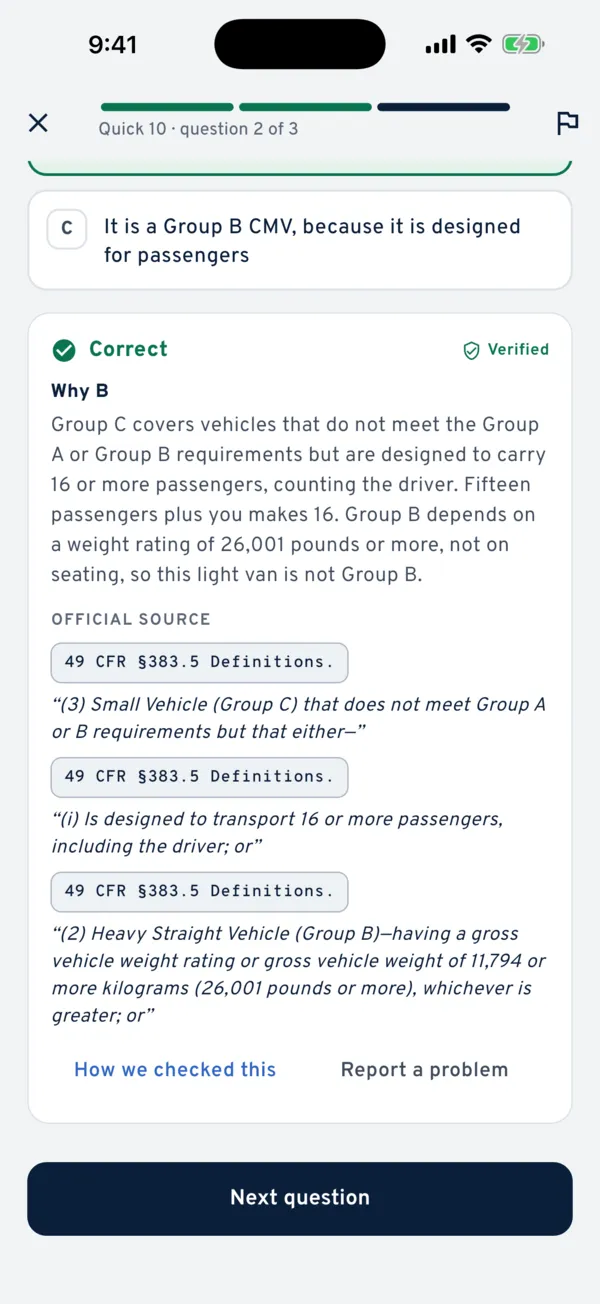
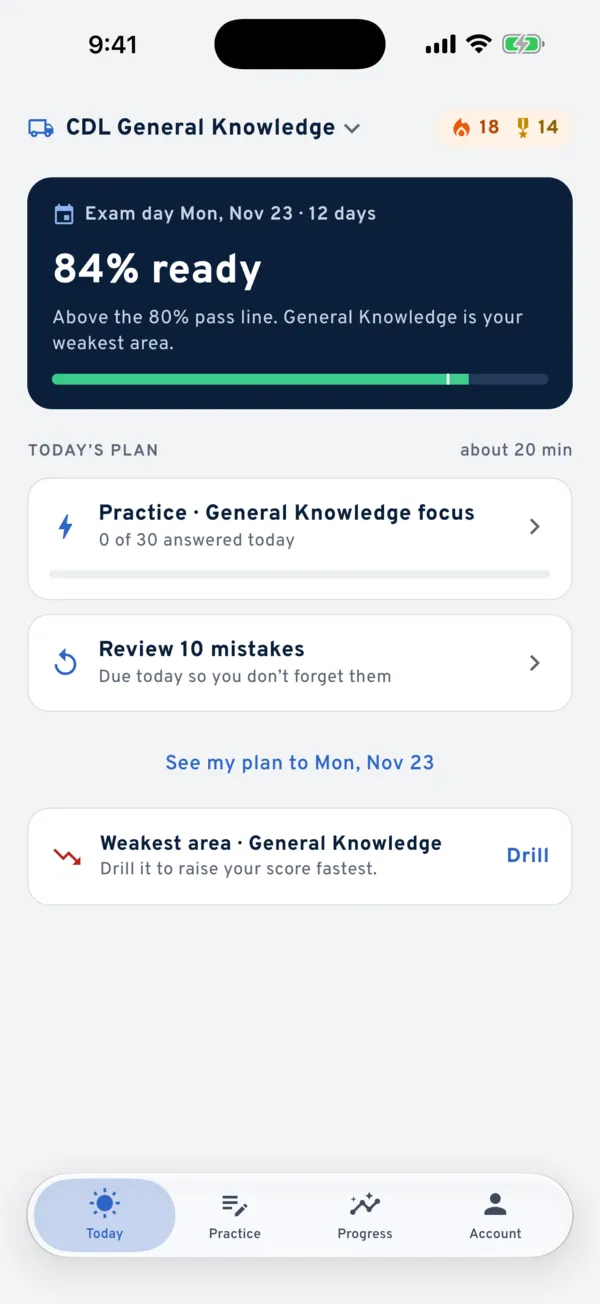
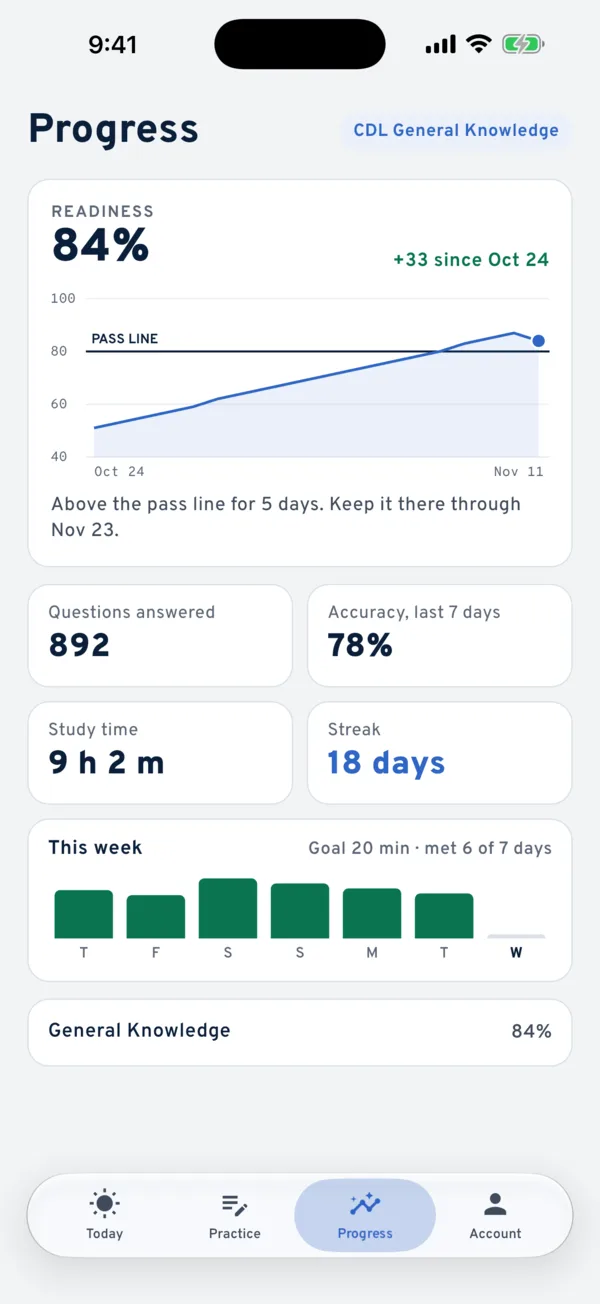
Getting a commercial learner’s permit (CLP) takes one trip to your state licensing office if you show up prepared, and three or four trips if you don’t. Federal rules in 49 CFR 383.71 list what every state must check before it issues a CLP, so the core steps are the same everywhere.1 The fees, attempt limits and paperwork details are where states differ.
Step by step, from regular license to CLP
- Pick your class and endorsementsClass A for combinations over 26,000 pounds with a trailer over 10,000 pounds, Class B for heavy single vehicles, Class C for 16 or more passengers or placarded HazMat in a smaller vehicle.
- Get a DOT medical examRequired if you'll drive in non-excepted interstate commerce. The examiner must be on FMCSA's National Registry.
- Gather your documentsYour current license, proof of citizenship or permanent residence, proof of state residence and your Social Security number.
- Study the CDL manualSections 1 to 3 for general knowledge, plus the sections for combination vehicles, air brakes and any endorsement you want.
- Apply and test at the licensing officePay the fees and pass each knowledge test with at least 80%.
- Get your CLPDrive only with a qualified CDL holder beside you, and no HazMat.
1. Pick your class
The class depends on the vehicle you’ll drive, using its weight rating, not the weight of what it’s carrying. Group A covers combinations with a gross combination weight rating of 26,001 pounds or more where the towed unit is rated over 10,000 pounds. Group B covers single vehicles rated at 26,001 pounds or more. Group C covers smaller vehicles that carry 16 or more people including the driver, or that haul placarded hazardous materials.1
If a trucking job is the goal, most carriers want a Class A. A Class A also lets you drive Class B and C vehicles as long as you hold the endorsements those vehicles need, so it’s the safer choice if you’re not sure.1
2. The DOT medical exam
You’ll certify on your application which type of commerce you’ll drive in. If you check non-excepted interstate, which covers most over-the-road jobs, you need a medical exam from an examiner listed on the National Registry of Certified Medical Examiners.3 A standard medical certificate lasts up to 24 months, and some conditions shorten it to 12.3 Since June 23, 2025, FMCSA sends the examiner’s results to your state electronically instead of the state relying on the paper card you bring in.1
Age matters here too. You can get a CLP at 18, but you must be 21 to drive a commercial vehicle in interstate commerce.13
3. Documents and background checks
The state must see proof of US citizenship or lawful permanent residence (a US passport, certified birth certificate, naturalization certificate or green card), proof that you live in the state, and a list of every state where you’ve held any license in the past 10 years.1 It also verifies your name, date of birth and Social Security number with the Social Security Administration.1 Since November 18, 2024, it checks FMCSA’s Drug and Alcohol Clearinghouse too, and a driver whom the Clearinghouse shows as prohibited from driving can’t get a CLP.1
Non-domiciled permits, issued to people whose home isn’t a US state, now follow stricter rules. Under current federal rules, applicants must show qualifying lawful immigration status at every transaction (required since March 16, 2026), apply in person, and get a permit or license that’s valid for no more than a year.1 New York’s DMV currently says it can’t accept CLP applications from anyone who isn’t a US citizen or lawful permanent resident.4
4. The knowledge tests
Everyone takes the general knowledge test. Class A adds combination vehicles. If your vehicle has air brakes, you take the air brakes test, and failing it puts an air brake restriction on your permit.1 You can also add a passenger, school bus or tank vehicle endorsement to a CLP by passing that knowledge test. No other endorsements are allowed on a permit.1 Each test needs at least 80% correct.1
Our CDL general knowledge guide has a four-week study plan, and the air brakes and combination vehicles guide covers the two add-on tests most Class A applicants take.
What it costs and how many tries you get
States set their own fees and attempt limits. Here are four large ones.
| State | Fees | Attempts and timing |
|---|---|---|
| California | Nonrefundable application fee, valid 12 months | 3 attempts per required knowledge test. CLP valid 180 days, renewable once within 1 year of applying6 |
| Texas | $25 CLP fee, paid before testing | Texas Commercial Rules exam first, then general knowledge. Application void after 3 failed attempts or 90 days, whichever comes first5 |
| New York | $10 application fee covers all written tests taken together, $5 for each test added later, $40 road test fee | Tests only at DMV offices. You need a New York driver license first4 |
| Pennsylvania | Fees paid with forms DL-31CD and DL-11CD | A Knowledge Test Authorization allows 3 tries and is valid 1 year. You have 1 year to pass every knowledge and skills test7 |
Texas also gives CDL and CLP knowledge tests only in English since June 1, 2026, and bars interpreters.5 The medical exam is extra in every state, and the price is set by the clinic, not the state.
Driving on a CLP
The CLP lets you drive a commercial vehicle on public roads for training, under conditions set in 49 CFR 383.25.1
- A CDL holder with the right class and endorsements must be in the front seat beside you at all times, or directly behind you on a bus.
- You must carry the regular license from the same state that issued the CLP.
- You can’t haul hazardous materials, even if the supervising driver has the HazMat endorsement.
- With a passenger or school bus endorsement on the CLP you can’t carry passengers other than examiners, inspectors, other trainees and your supervisor. With a tank endorsement you may only drive empty, purged tanks.
The permit can last no more than one year from first issue without retaking the knowledge tests.1 Some states issue it for less.
Entry-level driver training
Entry-level driver training (ELDT) became mandatory on February 7, 2022. You need it before your first Class A or Class B skills test, before an upgrade from B to A, and before the skills test for a first passenger or school bus endorsement. For HazMat, the training comes before the knowledge test.2 Anyone who held the CDL or endorsement before February 7, 2022 is exempt for that credential.2
ELDT has two parts. Theory covers the classroom topics and ends with a written assessment where you need at least 80% overall. Behind-the-wheel training covers range maneuvers and public road driving.2 Federal rules set no minimum hours for either part. The instructor has to cover every topic and document that you can perform each skill.2 California adds a state requirement of at least 15 hours of behind-the-wheel training, reported on form DL 1236 before the CDL is issued.6
The training must come from a provider listed on FMCSA’s Training Provider Registry, and the provider has until midnight of the second business day after you finish to upload your completion.2 Your state won’t schedule the skills test until it sees that record.1 Except for HazMat, you have one year from finishing the first part to finish the other.2
From CLP to CDL
Federal rules bar you from the skills test for the first 14 days after your CLP is issued.1 Pennsylvania sets its own minimum of 15 days.7 The skills test then runs in a fixed order. Pre-trip inspection comes first, then basic vehicle control, then the road test, and failing one segment ends the test that day.1 Our post on the CDL pre-trip vs the knowledge test explains how each one is scored.
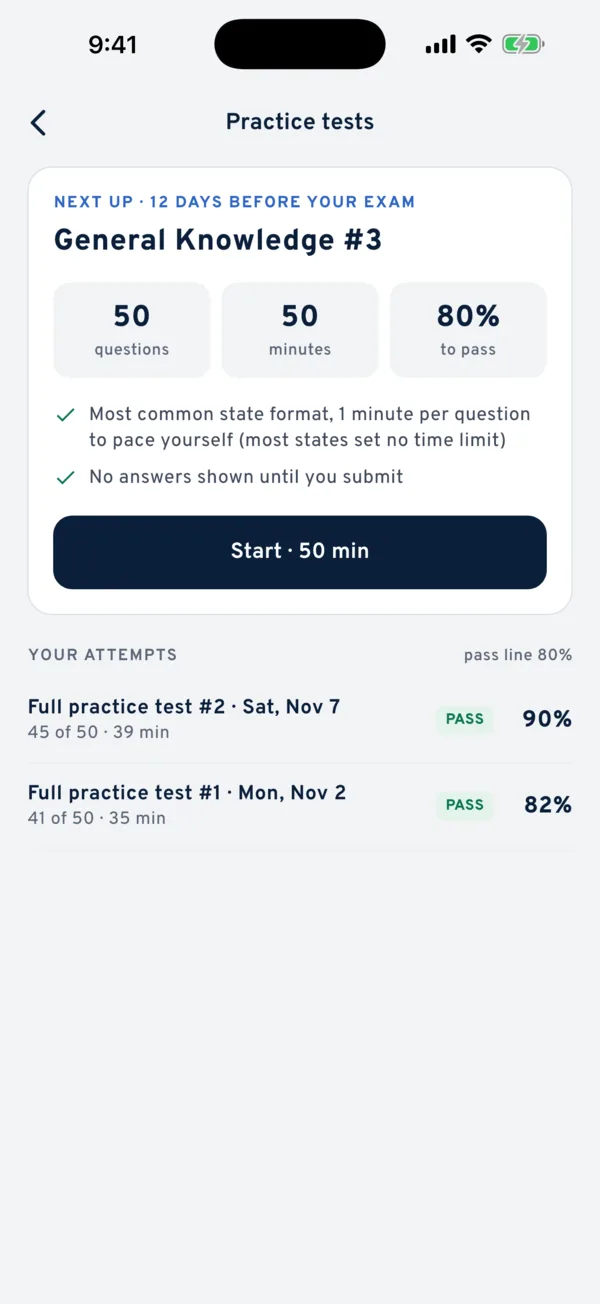
Plan your timeline around the permit’s expiration date. Passed skills segments only count during the first issue of your CLP. If it expires and you renew, all three segments start over.1 Clinched has a CDL general knowledge course with practice tests in the format most states use.
Questions people ask
Do I need ELDT before getting my CDL permit?
No. Federal entry-level driver training must be finished before your first Class A or B skills test, or before the HazMat knowledge test, but you can get the commercial learner's permit first. Many people do ELDT theory and behind-the-wheel training while they hold the permit.
How much does a CDL permit cost?
It depends on the state. New York charges a $10 application fee that covers all written tests taken at the same time, plus $40 later for the road test. Texas charges $25 for the CLP, paid before testing. Add the cost of the DOT medical exam, which is set by the clinic.
How old do you have to be to get a CDL permit?
Federal rules set 18 as the minimum age for a commercial learner's permit. At 18 you can drive commercial vehicles only within your state. You must be at least 21 to drive a commercial vehicle across state lines.
Sources
- 49 CFR Part 383, Commercial Driver's License StandardseCFR, National Archives
- 49 CFR Part 380 Subpart F, Entry-Level Driver Training RequirementseCFR, National Archives
- 49 CFR Part 391, Qualifications of DriverseCFR, National Archives
- Get a Commercial Driver License (CDL)New York State DMV
- How do I apply for a Commercial Driver License?Texas Department of Public Safety
- Commercial Driver Licenses (CDL)California DMV
- Commercial Driver License (CDL) Learner's Permit FAQsPennsylvania Department of Transportation
ClinchedCDL General Knowledge
Pass CDL General Knowledge on the first try.
Practice questions written from the official sources, full practice tests in the real format and a plan that ends on your test date. Free to start.
Keep reading
- Topic explainer · CDL General Knowledge · CDL Air Brakes and Combination
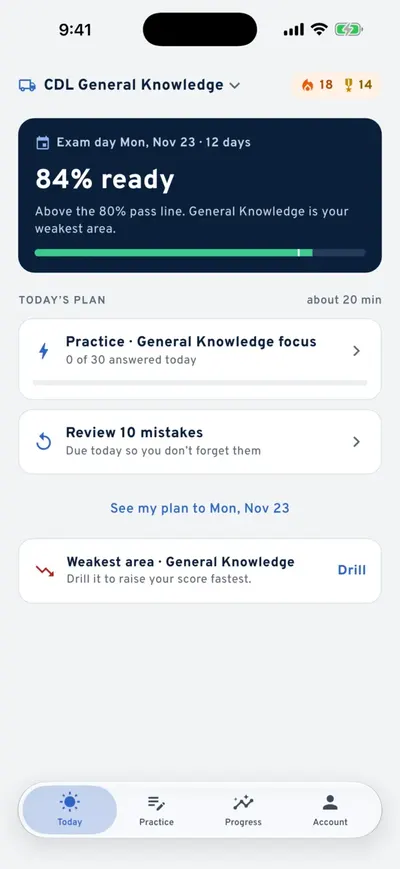 CDL Pre-Trip Inspection vs the CDL Knowledge TestThe CDL knowledge test is a written exam you pass for your permit. The pre-trip inspection is the first part of the skills test. How each one works and is scored.
- Exam guide · Series 63, 65 and 66
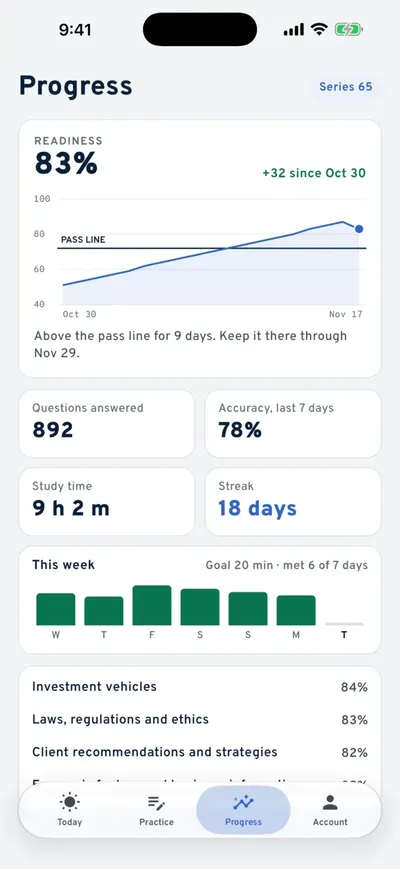 Series 65 vs Series 66: Which One Should You Take?The Series 65 has 130 scored questions and stands alone. The Series 66 has 100 and only counts with a Series 7. How to choose based on your job and where you work.
- Exam guide · SIE · Series 7
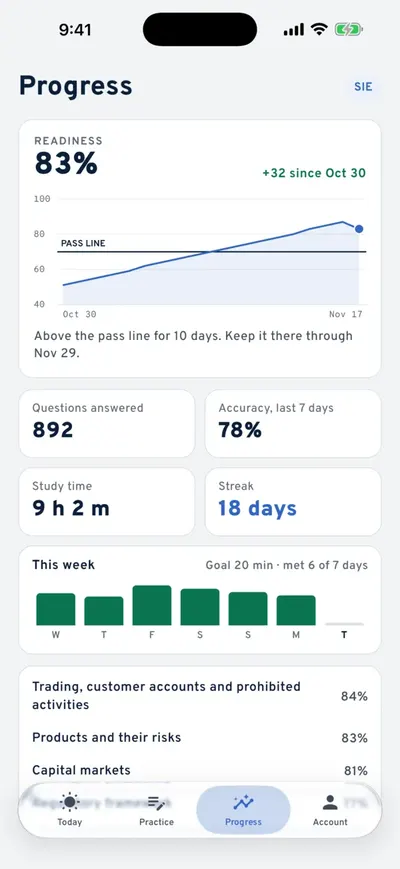 SIE vs Series 7: How the Two FINRA Exams Fit TogetherThe SIE has 75 scored questions and needs no sponsor. The Series 7 has 125 and needs a firm. How they differ in content, cost and difficulty, and which comes first.