CDL General Knowledge guideFree practice test
CDL General Knowledge practice test
15 free CDL General Knowledge questions from the 938 in Clinched, chosen to match how the real test is weighted. Pick an answer to see the explanation and the official text it comes from. Nothing to sign up for.
-
Question 1 of 15Emergencies, ABS and skids
You slow gently for a red light in a truck with ABS. When does the ABS actually start working?
Correct answer C. When a wheel is about to lock from braking too hard
In normal braking, an ABS truck stops just like a truck without it. The system steps in only when hard braking is about to lock a wheel. It does not work on every brake application, and it is not triggered by a certain speed.
Official source CDL Manual (AAMVA model, March 2025), Section 2.18.8 Safety Reminders -
Question 2 of 15Seeing and communicating
You are approaching a tight right turn in a tractor-trailer and will need to go very slowly to make it. How should you handle your speed?
Correct answer A. Begin braking early and slow down gradually
Most car drivers do not realize how slowly a big rig has to take a tight turn. Start braking early and lose speed gradually, which gives the drivers behind you time to react. Late, firm braking can surprise them, and carrying speed into a tight turn is unsafe.
Official source CDL Manual (AAMVA model, March 2025), Section 2.5.1 Signal Your Intentions -
Question 3 of 15Speed and space
This morning your loaded van trailer cleared a low overpass. You are now returning on the same road with the trailer empty. What should you do?
Correct answer B. Recheck clearance, since an empty van rides higher than a loaded one
A cargo van's height changes with its weight. An empty van sits higher than a loaded one, so clearing the overpass while loaded does not prove you can clear it when empty. If you are not sure you can make it, go slowly or take another route.
Official source CDL Manual (AAMVA model, March 2025), Section 2.7.4 Space OverheadCDL Manual (AAMVA model, March 2025), Section 2.7.4 Space Overhead“” -
Question 4 of 15Cargo, weight and securement
Your truck carries reflective triangles as its warning devices for a stopped vehicle. How many must it carry at minimum?
Correct answer B. Three bidirectional reflective triangles
Federal rules require three bidirectional reflective triangles. Two is not enough. Six is the minimum number of fusees for a truck that uses fusees instead of triangles.
Official source 49 CFR §393.95 Emergency equipment on all power units.(1) Three bidirectional emergency reflective triangles that conform to the requirements of Federal Motor Vehicle Safety Standard No. 125, § 571.125 of this title; or
49 CFR §393.95 Emergency equipment on all power units.“(2) At least 6 fusees.” -
Question 5 of 15CDL rules, tests and disqualifications
You drive in a type of commerce that requires a certified medical status on your driving record. Which document do you send to your state driver licensing agency to get that status?
Correct answer A. A current medical examiner's certificate
Certified medical status is based on your current medical examiner's certificate, and you send it to the state licensing agency. Logbook pages are records of your hours of service, not proof that you are medically fit. An employer's inspection report covers vehicles, not the driver's health.
Official source CDL Manual (AAMVA model, March 2025), Section 1.2 Medical Documentation -
Question 6 of 15Alcohol, drugs, fatigue and hours of service
Which three things determine your blood alcohol concentration (BAC)?
Correct answer A. How much you drink, how fast, and your weight
Your BAC depends on the amount of alcohol you take in, how quickly you drink it, and how much you weigh. Choosing beer over liquor does not help, because standard servings carry the same alcohol. Mood, height and the time of day are not among the factors that set BAC.
Official source CDL Manual (AAMVA model, March 2025), Section 2.22.1 Alcohol and Driving -
Question 7 of 15Vehicle inspection
During one shift you drove two different straight trucks for your company. What should you do with the after-trip inspection at the end of the day?
Correct answer A. Inspect both trucks and report problems so the carrier can schedule repairs
An after-trip inspection is done on every vehicle you operated during the trip, day or tour of duty. You may need to write up a vehicle condition report listing any defects. That report tells the motor carrier when a vehicle needs repairs. Checking only one truck leaves the other truck's defects unreported.
Official source CDL Manual (AAMVA model, March 2025), Section 2.1.2 Types of Vehicle InspectionCDL Manual (AAMVA model, March 2025), Section 2.1.2 Types of Vehicle Inspection“” -
Question 8 of 15Driving rules and hazmat basics
You are pulled over while driving a placarded load, and you do not have a hazardous materials endorsement. What will happen?
Correct answer B. You are cited and not allowed to drive the truck
Driving a vehicle that needs placards without the hazardous materials endorsement is a crime. If you are stopped, you will get a citation and you will not be allowed to keep driving the truck. You are personally responsible, so a warning or a citation against only your employer is not the outcome.
Official source CDL Manual (AAMVA model, March 2025), Section 2.23.3 Lists of Regulated Products -
Question 9 of 15Night, fog, winter and heat
During which period do many heavy vehicle crashes happen?
Correct answer A. Between midnight and 6 a.m.
Many heavy vehicle crashes happen between midnight and 6 a.m. These are hours when most people would normally be asleep. The morning and evening blocks are not the high-risk window named for fatigue.
Official source CDL Manual (AAMVA model, March 2025), Section 2.11.2 Driver Factors -
Question 10 of 15Vehicle control and shifting
It is raining hard as the light turns green, and you are first in line in a loaded truck. How should you pull away?
Correct answer C. Speed up very slowly so the drive wheels keep their grip
On slick pavement, adding power slowly helps the drive wheels keep their grip. Too much power can spin the drive wheels, and you could lose control. Rushing through the intersection or giving full throttle does exactly that.
Official source CDL Manual (AAMVA model, March 2025), Section 2.2.1 Accelerating -
Question 11 of 15Hazards, distraction and road rage
You are taking a freeway exit that goes downhill and curves at the same time. When should you get your speed down?
Correct answer B. Before you reach the curved part of the ramp
A downhill exit makes it harder to slow down, and braking while you turn is dangerous. So you finish slowing before the ramp starts to curve. Braking in the curve combines braking and turning, and waiting until after the curve means you take it too fast.
Official source CDL Manual (AAMVA model, March 2025), Section 2.8.2 Hazardous RoadsCDL Manual (AAMVA model, March 2025), Section 2.8.2 Hazardous Roads“” -
Question 12 of 15Railroad crossings and mountain driving
You see a "Maximum Safe Speed" sign at the top of a downgrade. How should you treat the speed shown on it?
Correct answer B. Never go faster than the speed shown on the sign.
The speed on a posted limit or "Maximum Safe Speed" sign is a ceiling you must not go above. Your safe speed may be even lower depending on weight, the grade and the weather. Being empty or having a dry road does not give you permission to exceed it.
Official source CDL Manual (AAMVA model, March 2025), Section 2.16.1 Select a "Safe" Speed -
Question 13 of 15Crashes and fires
Your load of hazardous materials catches fire, and you are not sure which extinguisher is safe to use on it. What should you do?
Correct answer A. Wait for the firefighters to deal with it
When you don't know the right agent, and especially with hazardous materials, the safe choice is to leave the fire to trained firefighters. The wrong agent can make a fire worse. An A:B:C unit does not cover every class, such as metal fires, and water spreads fuel fires and conducts electricity.
Official source CDL Manual (AAMVA model, March 2025), Section 2.21.3 Fire Fighting -
Question 14 of 15Night, fog, winter and heat
You are traveling at 55 mph when glare blinds you for 2 seconds. About how far does your truck travel before you can see again?
Correct answer B. Over half the length of a football field
At 55 mph, a truck covers more than half a football field in 2 seconds. That is well over 100 feet of road you cannot see. That is much farther than one rig length, but far short of two full fields.
Official source CDL Manual (AAMVA model, March 2025), Section 2.11.2 Driver Factors -
Question 15 of 15Driving rules and hazmat basics
You are pulling a sealed van trailer, and the shipper has ordered you not to open it. How do the federal cargo inspection rules apply to the freight inside?
Correct answer A. You are not required to inspect the freight inside
The en-route cargo inspection rules do not apply to a sealed vehicle when you have been ordered not to open it. This exception also covers loads packed so that inspection is impractical. The 50-mile and 3-hour/150-mile checks are the normal rules, and they do not apply here.
Official source 49 CFR §392.9 Inspection of cargo, cargo securement devices and systems.(4) The rules in this paragraph (b) do not apply to the driver of a sealed commercial motor vehicle who has been ordered not to open it to inspect its cargo
Want the other 923?
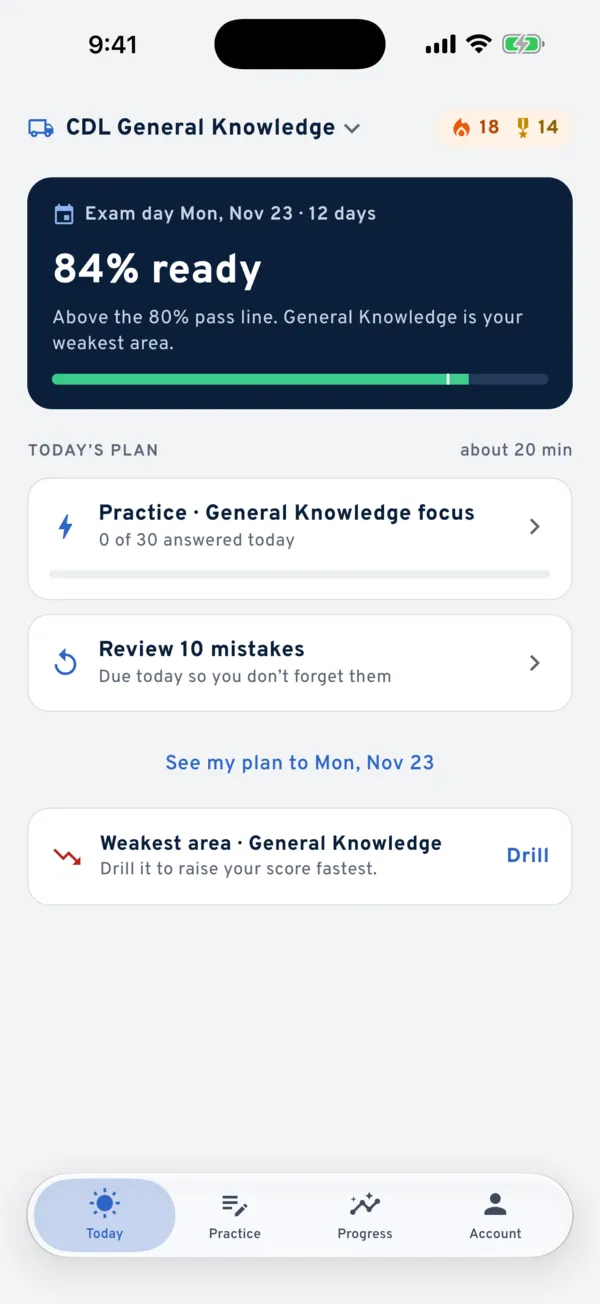
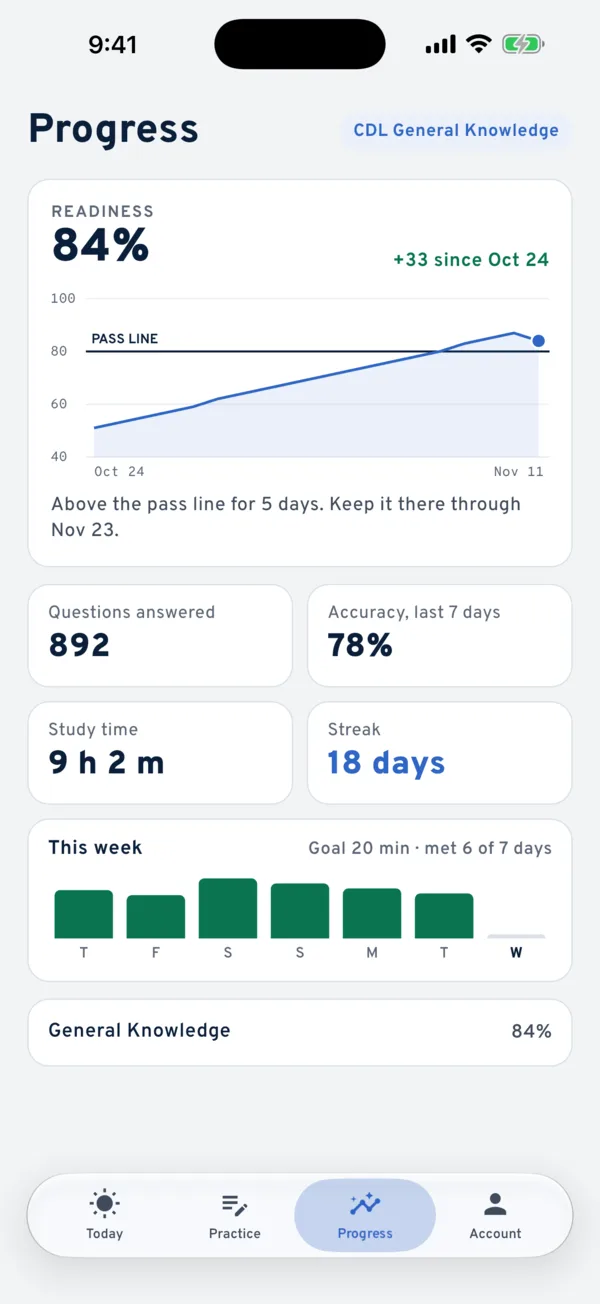
Clinched has every CDL General Knowledge question in this format, with full practice tests that match the real one, a readiness score by area and a plan to your test date. Free to start with 10 questions a day.
Read the CDL General Knowledge guide or see how we write and check every question.
Free on the App Store
Your exam, in your pocket.
20 exams ready with questions written from the official sources, timed practice tests in the real format and a readiness score with a pass line.
On your computer?
Scan with your iPhone camera to get Clinched practice in the app.