Life and Health Insurance guideFree practice test
Life and Health Insurance practice test
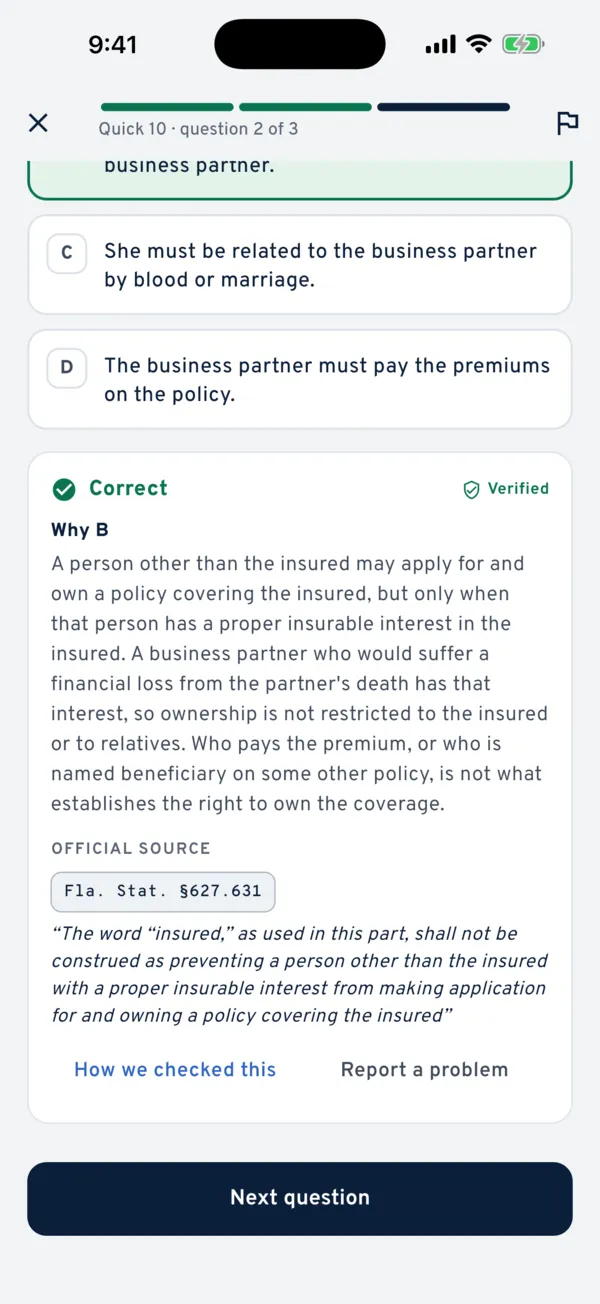
15 free Life and Health Insurance questions from the 557 in Clinched, chosen to match how the real test is weighted. Pick an answer to see the explanation and the official text it comes from. Nothing to sign up for.
-
Question 1 of 15Coordination, taxes and dependents
A life insurance policy is owned by someone other than the person whose life is insured. Who is entitled to exercise the policy's ownership rights?
Correct answer D. The policyowner
When a policy is owned by a person other than the insured, that owner is entitled to the indemnities, benefits and rights provided in the policy. The insured's estate has no claim merely because the insured's life is covered, and a beneficiary receives proceeds only as the owner's designation provides.
Official source Fla. Stat. §627.631a person other than the insured with a proper insurable interest from making application for and owning a policy covering the insured or from being entitled under such a policy to any indemnities, benefits, and rights provided therein.
-
Question 2 of 15Health policy provisions
An insured dies under a policy that provides a loss-of-life benefit, and no beneficiary designation is in effect at the time of payment. Who receives the benefit?
Correct answer A. The insured's estate.
Loss-of-life benefits follow the beneficiary designation in effect at the time of payment, and when no designation is in effect the benefit is paid to the insured's estate. The insurer does not select a relative on its own, and no preference is given to a child or to whoever covered the funeral costs.
Official source Fla. Stat. §627.614Loss-of-life benefits are payable in accordance with the beneficiary designation in effect at the time of payment. If none is then in effect, the benefits will be paid to the insured’s estate.
-
Question 3 of 15Medicare and Social Security
A client joins a Medicare Advantage plan that includes Medicare drug coverage. How is the client's drug coverage usually paid for?
Correct answer D. It comes with the plan, and the member pays no separate Part D premium.
A Medicare Advantage plan that includes Part D provides drug coverage as part of the plan, so the member pays no separate Part D premium; the plan may still charge its own premium. A stand-alone Part D plan and a separate Part D premium belong to people who get drug coverage outside such a plan. Medigap is supplemental coverage for Original Medicare, not the source of drug coverage in a Medicare Advantage plan.
Official source CMS, Medicare & You 2027, p. 11 (part 1/2)Most plans include Medicare drug coverage (Part D), so you don’t have a separate Part D premium.
CMS, Medicare & You 2027, p. 12“Most plans include Part D and you don’t need to join a separate Medicare drug plan.” -
Question 4 of 15Health coverage types
A newly insured employee expects the health plan to pay every medical bill in full. How does health insurance generally work?
Correct answer B. The insured usually pays a share of the cost of covered care.
Health insurance helps pay for care but does not cover all of the cost; the insured typically pays a portion through copays, coinsurance or a deductible. Paying premiums does not make the plan responsible for the entire bill, and staying in the network or being enrolled for a year does not remove the insured's share.
Official source CDI, Health Insurance guide (2023), p. 1 (part 1/2)But it does not pay all costs. Usually, you have to pay a share of the costs.
-
Question 5 of 15Health coverage types
An employee's spouse was not covered under the group health plan on the day before the employee's termination. The spouse now asks to continue coverage. How is the spouse classified for continuation coverage?
Correct answer A. Not a qualified beneficiary, because the spouse was not covered before the event.
A qualified beneficiary must have been covered under the group health plan on the day before the qualifying event, as the covered employee, spouse, former spouse or dependent child. A spouse who had no coverage at that point does not become a qualified beneficiary just because the employee terminates. Termination is a qualifying event, but it only gives continuation rights to people who were already covered, and no retroactive enrollment is required.
Official source DOL EBSA, An Employee's Guide to Health Benefits Under COBRA, p. 8A qualified beneficiary is an employee who, on the day before a qualifying event occurred, was covered by a group health plan by being a covered employee or a covered employee’s spouse, former spouse, or dependent child.
-
Question 6 of 15Health applications and underwriting
A person with Original Medicare also has an employer group health plan that pays after Medicare, and that plan is ending. What right does the person have for Medigap?
Correct answer B. A guaranteed issue right to buy a Medigap policy.
A guaranteed issue right exists when a person has Original Medicare and an employer group health plan, including retiree, COBRA or union coverage, that pays after Medicare and is ending. The right does not depend on a Medicare Advantage plan ending, the insurer cannot price it on health history, and a person with COBRA may buy a Medigap policy right away rather than waiting for that coverage to end.
Official source CMS, Choosing a Medigap Policy (Pub. 02110), p. 19 (part 1/2)You have Original Medicare and an employer group health plan (including retiree, COBRA, or union coverage) that pays after Medicare pays, and that plan is ending.
-
Question 7 of 15Health applications and underwriting
An applicant receives an outline of coverage for a health policy. What does the outline state about its own effect?
Correct answer A. It is a summary of the policy, and the policy must be consulted for the governing provisions.
The outline of coverage must state that it is a summary of the policy issued or applied for and that the policy should be consulted to determine the governing contractual provisions. It is not the contract, so its wording does not override the policy, and it neither binds coverage temporarily nor serves as a delivery receipt.
Official source Texas Insurance Code §1201.108(5) a statement that: (A) the outline is a summary of the policy issued or applied for; and (B) the policy should be consulted to determine governing contractual provisions;
-
Question 8 of 15Life applications and delivery
A licensed insurance agent sells life insurance for several insurers and asks whether the anti-money laundering rule requires the agent to set up a separate AML program. What is the rule?
Correct answer A. The agent is not required to maintain a separate anti-money laundering program.
Insurance agents and brokers are not required to have separate anti-money laundering programs under the rule; instead, each insurance company brings its agents and brokers into the company's own program. The other choices describe compliance duties that belong to the insurer, or a federal registration requirement that the rule does not impose on producers.
Official source FinCEN, FAQs: Anti-Money Laundering Program and SAR Requirements for Insurance Companies, part 4Insurance agents and brokers are not required by the final rule to have separate anti-money laundering programs.
-
Question 9 of 15Life applications and delivery
An applicant wants to buy life insurance on a close relative for whom the applicant feels deep affection but provides no financial support. Which statement describes the insurable interest requirement?
Correct answer A. A close blood or legal relationship plus a substantial interest based on love and affection is enough.
Insurable interest in another person's life includes a close relationship by blood or by law combined with a substantial interest arising from love and affection, so financial dependency is not required. Support obligations and living arrangements are not the test, and a relative in another household can still be insured.
Official source Fla. Stat. §627.404 (part 1/3)An individual has an insurable interest in the life, body, and health of another person to whom the individual is closely related by blood or by law and in whom the individual has a substantial interest engendered by love and affection.
-
Question 10 of 15Life policy provisions and options
A client who owns a 20-year term life policy asks whether the policy can be borrowed against. How do policy loans apply to term life insurance?
Correct answer A. Term policies are not required to provide loans because they build no cash value.
The policy loan rules apply to policies that have cash values, and a term policy is not required to comply with them because it accumulates no cash value to borrow against. A term policy also does not support a loan as large as the face amount or a loan limited to one annual premium.
Official source Texas Insurance Code §1101.009The following policies are not required to comply with this section: (1) a term life insurance policy;
-
Question 11 of 15Life policy provisions and options
A policyowner's monthly premium is due but unpaid when the insured dies 20 days later, still inside the grace period. How does the insurer settle the claim?
Correct answer D. It pays the death benefit less the overdue premium.
The policy remains in force throughout the grace period, so a death during that period is covered; the insurer may deduct the overdue premium from the settlement. The claim is not lost for late payment, and the insurer does not waive the unpaid premium or limit the payout to a premium refund.
Official source Texas Insurance Code §1101.005provide that if an insured dies during a grace period the overdue premium will be deducted from any settlement made under the policy
-
Question 12 of 15Life taxes, retirement and group plans
A worker dies, and the surviving spouse wants Social Security's one-time lump-sum death payment. Within what period must the survivor apply?
Correct answer A. Within 2 years of the death.
Survivors must apply for the one-time lump-sum death payment within 2 years of the date of the worker's death. The payment is not made automatically, so the shorter periods listed do not match the rule and a survivor who never applies does not receive it. The payment is a single fixed sum made to a spouse or child who meets the requirements.
Official source SSA, Survivors Benefits (Pub. 05-10084), p. 7Survivors must apply for this payment within 2 years of the date of your death.
-
Question 13 of 15Life taxes, retirement and group plans
An employee has contributed part of her pay to her employer's retirement plan for three years and now leaves the company. How do the vesting rules treat her own contributions and the earnings on them?
Correct answer C. She is vested in them immediately and cannot forfeit them.
An employee is immediately vested in her own contributions and the earnings on them, so those amounts are hers and cannot be forfeited. Vesting schedules such as the five-year cliff or the seven-year graduated schedule apply to employer contributions, not to the employee's own money, and the earnings on her contributions follow the contributions themselves.
Official source DOL EBSA, What You Should Know About Your Retirement Plan, p. 10 (part 2/2)You immediately vest in your own contributions and the earnings on them. This means you have earned the right to these amounts without the risk of forfeiting them.
-
Question 14 of 15Life insurance types and annuities
A client asks whether a term life policy must be renewed every year. Which period can a term policy be written to cover?
Correct answer A. A specified period, such as one year, 5, 10 or 20 years, or to a stated age.
A term policy runs for a period selected when it is bought: it may be a single year, a stated number of years such as 5, 10 or 20, or a period ending at a stated age. It is not limited to yearly renewal, it does not last for life, and no 30-year minimum applies. Cash value belongs to permanent policies, not to term coverage.
Official source CDI, Life Insurance and Annuities guide (2023), p. 1 (part 1/2)Term Policies provide life insurance for a specified period of time. This period could be as short as one year or provide coverage for a specific number of years such as 5, 10, 20 years or to a specified age.
-
Question 15 of 15Life insurance types and annuities
An annuitant starts receiving income payments from a deferred annuity that is not in an IRA or a 401(k) plan. How is the taxable portion of each payment taxed?
Correct answer D. As ordinary income.
The taxable part of an annuity income payment is ordinary income, not capital gain. Tax deferral postpones the tax but does not eliminate it, and the payment is not a tax-free return of the entire premium deposit.
Official source CDI, Annuities: What Seniors Need to Know (2025), p. 3 (part 2/2)Income payments are taxed as regular income, not as capital gains.
Want the other 542?
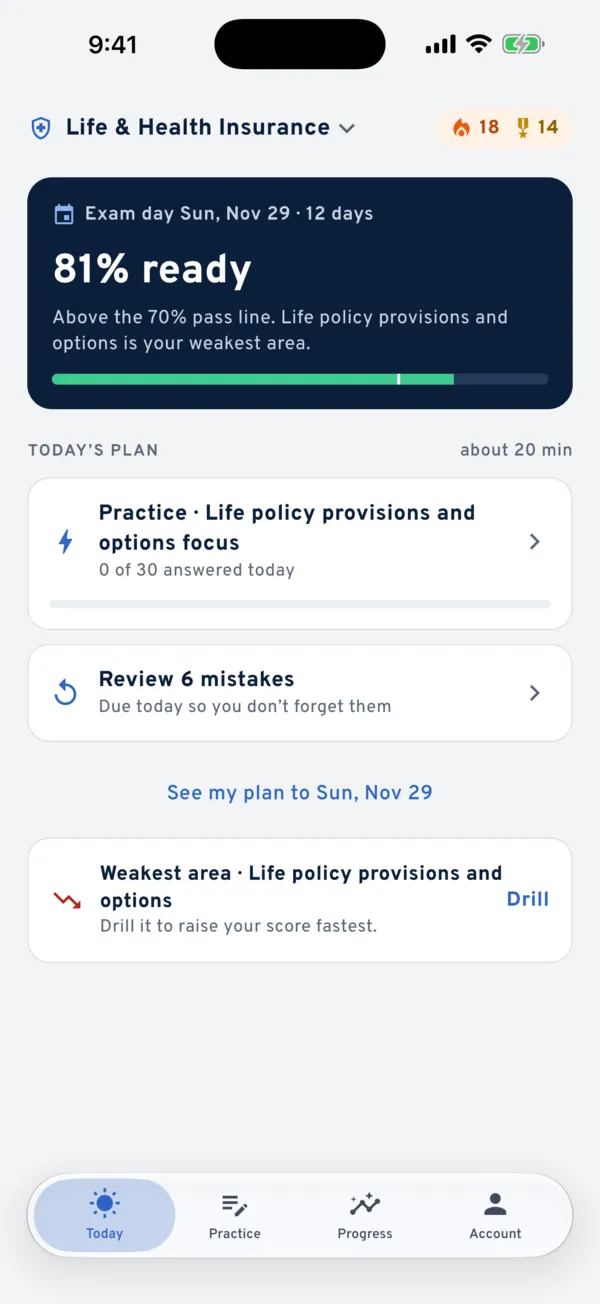
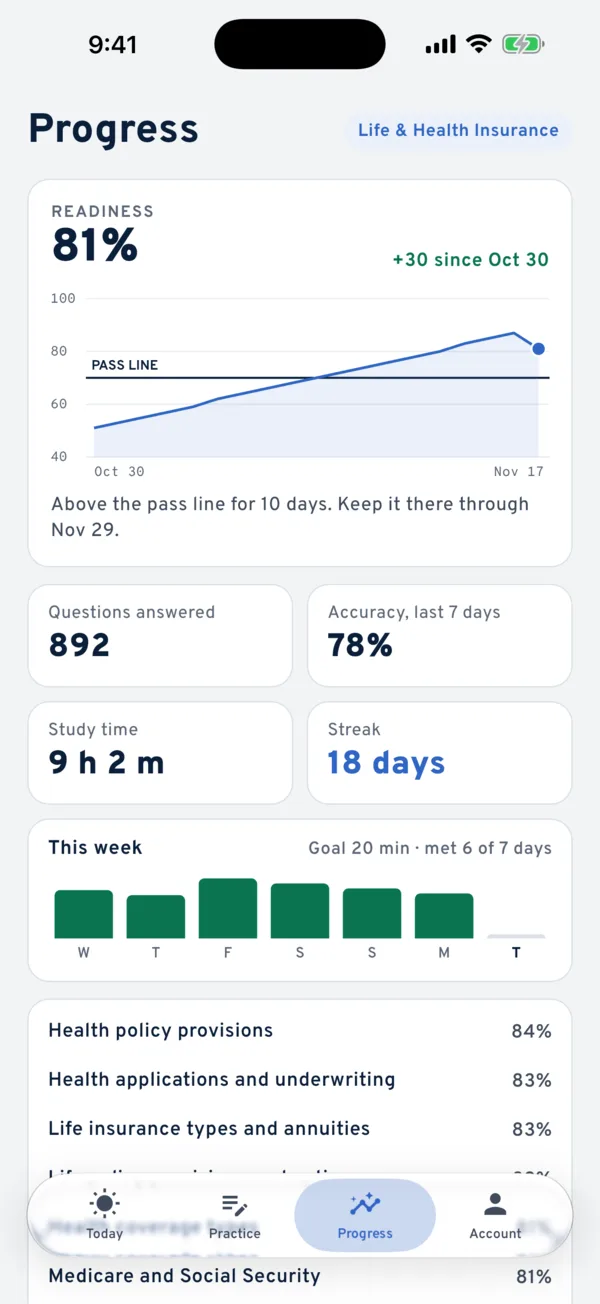
Clinched has every Life and Health Insurance question in this format, with full practice tests that match the real one, a readiness score by area and a plan to your test date. Free to start with 10 questions a day.
Read the Life and Health Insurance guide or see how we write and check every question.
Free on the App Store
Your exam, in your pocket.
20 exams ready with questions written from the official sources, timed practice tests in the real format and a readiness score with a pass line.
On your computer?
Scan with your iPhone camera to get Clinched practice in the app.