

How the Citizenship Interview Works, Step by Step
Short answer
At the naturalization interview a USCIS officer puts you under oath, reviews your Form N-400 with you, and gives the English and civics tests unless you're exempt. You leave with Form N-652 marked granted, continued or denied. If you fail a test, you're retested on that part 60 to 90 days later, and you aren't a citizen until you take the Oath of Allegiance.
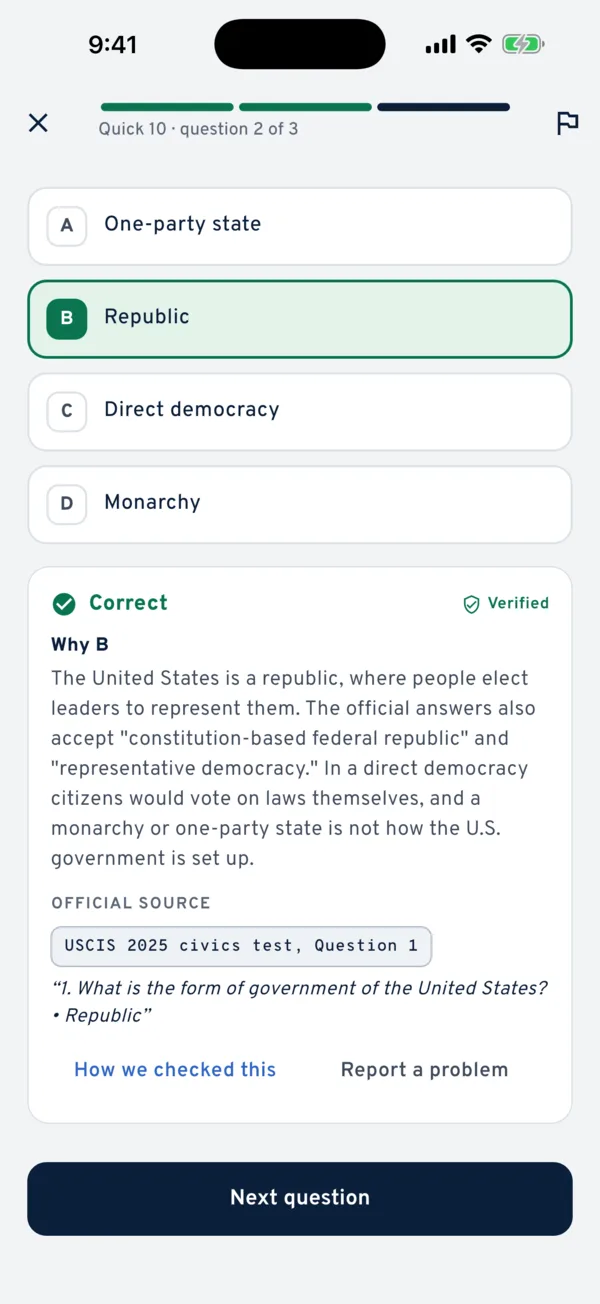
The naturalization interview is a sworn conversation about your Form N-400 with the English and civics tests folded into it. A USCIS officer confirms the facts in your application, judges your spoken English from how you answer, gives the reading, writing and civics tests, and hands you a written result before you leave.234 Here is the order things usually happen in, and what the officer is actually checking at each point.
Before the interview
You don’t book the interview. After you file, USCIS sends a receipt notice, schedules you for biometrics (fingerprints and a photo), and then mails an appointment notice for the interview once the background work is done.1 The receipt notice for a properly filed N-400 also extends your green card for 2 years from its expiration date, which matters if your card runs out while you wait.5
The interview normally happens at the USCIS field office with jurisdiction over where you lived when you filed. If you move, the case may be transferred and you’d get a new notice from the new office.2 Report at the date and time on your notice and bring it with you.1 Bring your green card, a photo ID, your passports, and anything the notice lists. If you sent copies of court records or tax transcripts with your application, bring the originals too.
What happens in the room, in order
- Check in and waitYou pass building security, check in at the window with your notice, and wait to be called by name.
- The oathThe officer introduces themselves, explains the purpose of the interview, and places you under oath before asking anything else.
- Review of your N-400The officer goes through your application, confirms answers, and asks about anything that changed since you filed.
- Speaking testThere is no separate speaking test. Your answers during the review are how the officer decides whether you speak and understand English.
- Reading and writingYou read one of three sentences aloud, then write one of three sentences the officer dictates. Each test stops once you get one right.
- Civics testThe officer asks questions from the official list. On the 2025 test it stops at 12 correct or 9 incorrect.
- Your resultYou get Form N-652 with the outcome before you leave.
The oath at the start is a real oath. From that point, a false answer is a false statement under oath.2 The reading, writing and civics steps follow the USCIS Policy Manual, and the officer gives them unless you qualify for an exception.3
What the officer asks about
The officer’s questions have to cover every naturalization requirement, and they focus on your application, your documents and anything found during background checks.2 According to USCIS guidance, the topics usually include these.2
- Biographical details, including marriages and any military service
- When and how you became a permanent resident
- Trips outside the United States since then
- Your English and civics knowledge
- Loyalty to the United States and attachment to the Constitution
- Memberships in certain organizations
- Your willingness to take the Oath of Allegiance
Before you meet, the officer reviews your A-file, which can include how you got your green card, earlier applications, and any criminal or enforcement records.2 Your answers should match what’s already there. If something in your history is complicated, a lawyer can help you prepare before the interview, not during it.
How strict the English part is
The standard is “ordinary usage.” You can ask for words to be repeated or rephrased, and you can make some errors in pronunciation, spelling and grammar and still pass.3 You don’t need to understand every word in the N-400. You need to understand and respond meaningfully to questions about your eligibility.3 On writing, spelling and punctuation errors only count against you if the officer can’t understand the sentence.3
If you don’t understand enough English to be put under oath or answer the eligibility questions, you fail the speaking part. The officer still gives you the reading, writing and civics tests anyway.3
Lawyers and interpreters
You can bring an attorney or an accredited representative, who must file Form G-28.5 The representative can advise you on points of law but can’t answer questions the officer asks you. If your representative doesn’t come and you don’t want to go ahead alone, the officer must reschedule.2
Interpreters are only for people who are eligible to use one, such as applicants who qualify for an age-based English exception. You bring and pay for the interpreter yourself. They must translate word for word without adding opinions, and USCIS prefers someone with no stake in the case. The officer can disqualify an interpreter who compromises the interview.2
The three possible results
At the end, the officer gives you Form N-652, Naturalization Interview Results.3 It shows one of three outcomes.1
| Result | What it means | What happens next |
|---|---|---|
| Granted | You met every requirement | You’re scheduled for the oath ceremony |
| Continued | USCIS needs more evidence, or you failed part of the test | You respond to a request for evidence or return for a retest |
| Denied | The record shows you’re not eligible | You can request a hearing |
If the officer needs documents, you’ll get a written request for evidence, and USCIS generally gives 30 days to respond.4 If you failed any part of the English or civics test, you return 60 to 90 days after the first interview and are retested only on the part you failed.3 Fail that part a second time and the application is denied.3 USCIS has 120 days from the first interview to make a decision.4 If you miss the re-examination and USCIS didn’t get a timely or reasonable request to reschedule, the officer should deny the application.4
The oath ceremony
Approval doesn’t make you a citizen. You become one when you take the Oath of Allegiance at a ceremony.6 Some offices can fit you into a ceremony the same day as your interview. If not, USCIS mails Form N-445 with the date, time and place.6
Answer the questionnaire on Form N-445 before you arrive, because an officer reviews your answers at check-in. You hand in your green card at check-in too.6 After the oath you receive your Certificate of Naturalization. Check the spelling and dates on it before you leave the building.1 You’ll also get a passport application and a voter registration form, and USCIS notes that new citizens generally need to wait at least ten days before updating their Social Security record.6
What changed in 2025
The civics test is the biggest change, and it depends on your filing date. Applications filed on or after October 20, 2025 get a test of up to 20 questions from a list of 128.3 Our post on the 2025 and 2008 civics tests compares the two.
USCIS also announced other steps in 2025. Officers got guidance on assessing good moral character that looks for positive contributions to American society rather than just an absence of bad conduct. USCIS said it is resuming neighborhood investigations and applying stricter review to medical disability exceptions.7 In practice, expect detailed questions about your work, taxes and community ties, and make sure your N-400 answers are complete.
For the test itself, including fees, study plans and exceptions, start with our U.S. citizenship test guide.
Questions people ask
Can I bring a lawyer to my citizenship interview?
Yes. An attorney or accredited representative can attend if they file Form G-28 with USCIS. They can advise you on points of law, but they can't answer questions the officer directs to you. If your representative doesn't show up, you can ask to reschedule instead of going ahead alone.
What if I don't understand a question during the interview?
Ask the officer to repeat it or say it another way. USCIS guidance tells officers to repeat and rephrase questions until they are satisfied you either understand or can't understand English. Small grammar and pronunciation mistakes are allowed.
Do I become a citizen at the end of the interview?
No. Approval at the interview makes you eligible, but you become a citizen only when you take the Oath of Allegiance at a naturalization ceremony. Some offices hold the ceremony the same day. Otherwise USCIS mails Form N-445 with your ceremony date.
What happens if I fail the civics test at the interview?
Your case is continued, not denied. USCIS schedules a second examination 60 to 90 days after the first and retests only the part you failed. If you fail that same part again, the application is denied.
Sources
- 10 Steps to NaturalizationU.S. Citizenship and Immigration Services
- Policy Manual, Volume 12, Part B, Chapter 3, Naturalization InterviewU.S. Citizenship and Immigration Services
- Policy Manual, Volume 12, Part E, Chapter 2, English and Civics TestingU.S. Citizenship and Immigration Services
- Policy Manual, Volume 12, Part B, Chapter 4, Results of the Naturalization ExaminationU.S. Citizenship and Immigration Services
- N-400, Application for NaturalizationU.S. Citizenship and Immigration Services
- Naturalization CeremoniesU.S. Citizenship and Immigration Services
- USCIS Unveils First Changes to Naturalization Test in Multi-Step Overhaul of American Citizenship StandardsU.S. Citizenship and Immigration Services
ClinchedU.S. Citizenship Test
Pass U.S. Citizenship Test on the first try.
Practice questions written from the official sources, full practice tests in the real format and a plan that ends on your test date. Free to start.
Keep reading
- Topic explainer · U.S. Citizenship Test
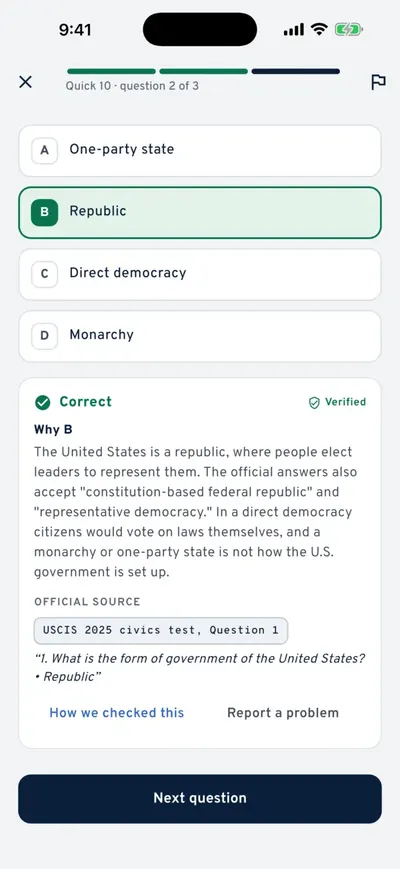 65/20 Civics Questions and Other Citizenship Test ExemptionsWho qualifies for the 65/20, 50/20 and 55/15 rules and the N-648 medical exception, the 20 starred 2025 civics questions, and how to pass with 6 of 10 correct.
- Topic explainer · U.S. Citizenship Test
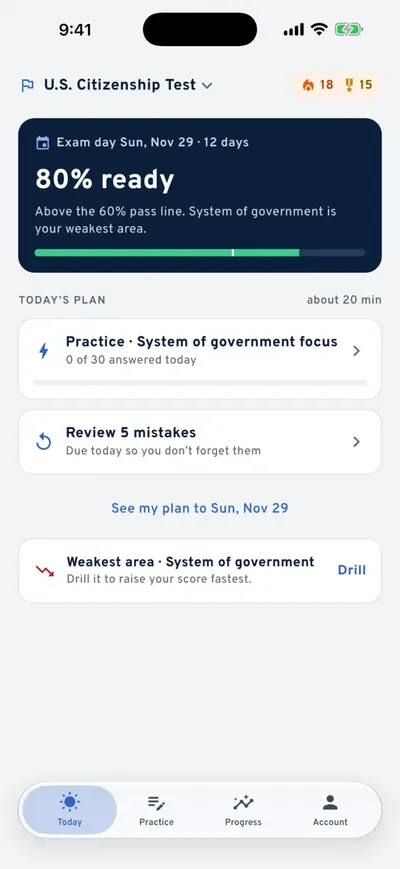 2025 vs 2008 Civics Test: What Changed and Which One You TakeThe 2025 civics test asks up to 20 of 128 questions and needs 12 right. The 2008 test asks up to 10 of 100 and needs 6. Your N-400 filing date decides which.
- Test day
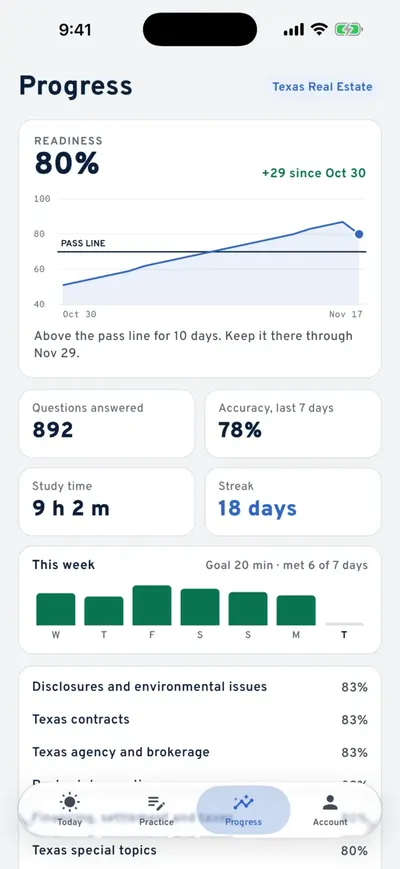 What to Expect at a Pearson VUE or PSI Test CenterCheck-in, ID, palm vein scans, lockers, breaks and the new Pearson VUE water bottle rule, plus OnVUE online proctoring rules, from the providers' own pages.