Food Handler guideFree practice test
Food Handler practice test
15 free Food Handler questions from the 579 in Clinched, chosen to match how the real test is weighted. Pick an answer to see the explanation and the official text it comes from. Nothing to sign up for.
-
Question 1 of 15Cross-contamination
You are prepping raw chicken and raw fish for dinner service. What should you do with the cutting boards?
Correct answer B. Use a separate cutting board for each type.
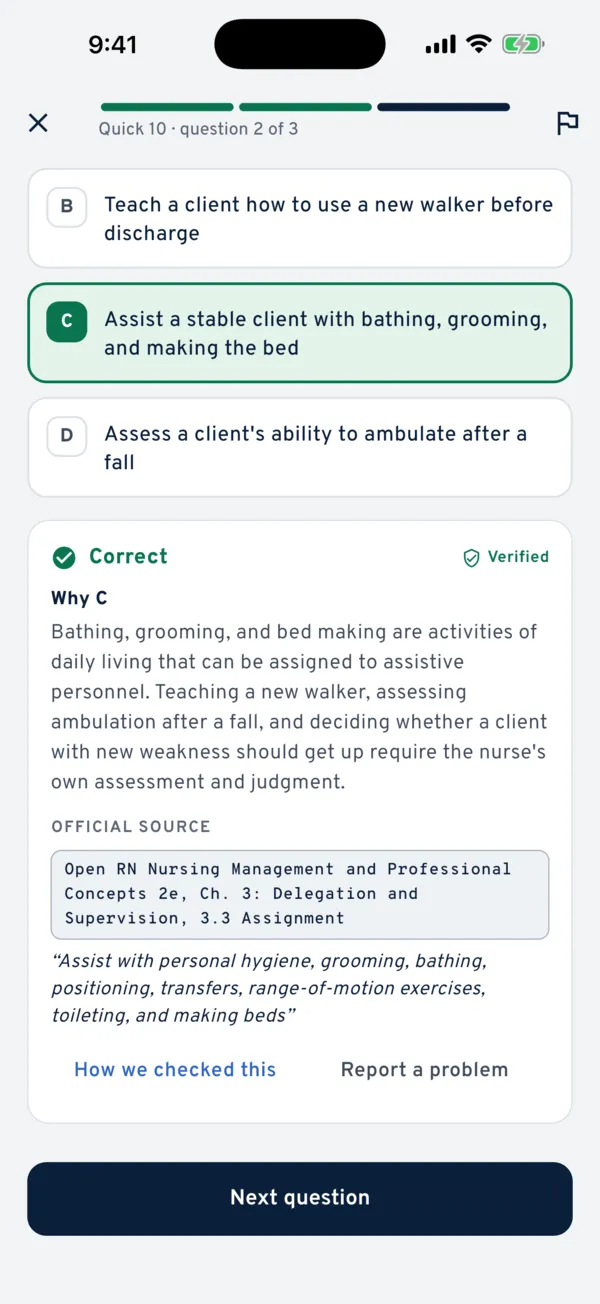
Different types of raw animal food, such as poultry and fish, must be kept apart by using separate equipment or by arranging the food so one type cannot contaminate another. A quick wipe or a hot-water rinse does not clean and sanitize the board, so the second food still picks up juices from the first. Both foods being raw does not make them the same food.
Official source FDA Food Code 2022, §3-302.11 Packaged and Unpackaged Food - Separation, Packaging, andseparating types of raw animal FOODS from each other such as beef, FISH, lamb, pork, and POULTRY during storage, preparation, holding, and display by: (a) Using separate EQUIPMENT for each type
-
Question 2 of 15Bare-hand contact
A cook is tossing raw chicken pieces in seasoned flour with bare hands. What should the cook do instead?
Correct answer D. Use tongs or gloves to minimize bare hand and arm contact with the raw chicken.
Food employees must minimize bare hand and arm contact with exposed food that is not ready-to-eat, so tongs, gloves or another utensil should be used for the raw chicken. The strict no-bare-hands rule is for ready-to-eat food, but that does not mean raw food can be handled freely. Cooking the chicken later and washing hands after the task do not reduce contact while the chicken is being handled.
Official source FDA Food Code 2022, §3-301.11 Preventing Contamination from HandsFOOD EMPLOYEES shall minimize bare hand and arm contact with exposed FOOD that is not in a READY-TO-EAT form.
-
Question 3 of 15Preventing contamination
A cook has just plated a salad topped with walnuts. The next order is for a customer with a tree nut allergy. What should the cook do?
Correct answer C. Wash hands and use clean, sanitized cutting boards and utensils.
Walnuts are tree nuts, which are a major food allergen, so the cook must prevent allergen cross-contact by washing hands and cleaning and sanitizing the board and utensils before making the allergy order. A dry wipe leaves nut protein on the board, walnuts are a major allergen, and removing nuts from a finished dish does not make it safe.
Official source FDA Food Code 2022, §1-201.10 Definitions: "Major Food Allergen"tree nuts (such as almonds, pecans, or walnuts), wheat, peanuts, soybeans and sesame;
-
Question 4 of 15Cross-contamination
Between orders, a cook wipes a cutting board with a damp cloth until it looks clean, then slices a ready-to-eat sandwich on it. What should the cook have done?
Correct answer D. Washed, rinsed, and sanitized the board before using it.
Food may only touch equipment and utensils that have been cleaned and then sanitized, so a board that merely looks clean is not enough for a ready-to-eat sandwich. A dry wipe or a hot-water rinse does not sanitize the surface, and flipping the board does not make the other side a cleaned and sanitized surface.
Official source FDA Food Code 2022, §3-304.11 Food Contact with Equipment and UtensilsFOOD shall only contact surfaces of: (A) EQUIPMENT and UTENSILS that are cleaned as specified under Part 4-6 of this Code and SANITIZED as specified under Part 4-7 of this Code; P
-
Question 5 of 15Bare-hand contact
You need to move sliced ready-to-eat turkey from the slicer into a container, and the box of single-use gloves is empty. What should you use?
Correct answer A. Tongs, deli tissue, or a spatula.
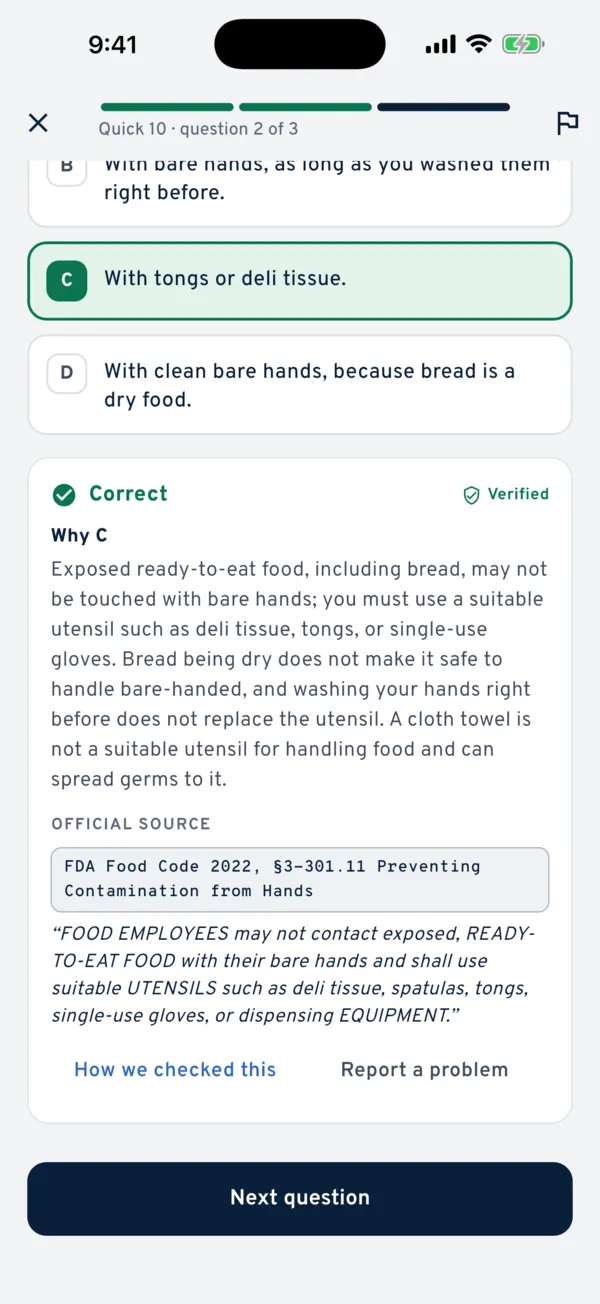
Deli tissue, spatulas, tongs, single-use gloves, and dispensing equipment are all suitable utensils for handling ready-to-eat food, so tongs or a spatula work when gloves are gone. Clean bare hands are still bare hands, sanitizer does not make bare-hand contact allowed, and a wiping cloth is for wiping surfaces, not for handling food.
Official source FDA Food Code 2022, §3-301.11 Preventing Contamination from HandsFOOD EMPLOYEES may not contact exposed, READY-TO-EAT FOOD with their bare hands and shall use suitable UTENSILS such as deli tissue, spatulas, tongs, single-use gloves, or dispensing EQUIPMENT.
-
Question 6 of 15Chemicals and toxic materials
You are stocking a shelf above the sandwich prep table with a case of sanitizer. What should you do?
Correct answer A. Move the sanitizer so it is not above the prep table.
Chemicals may not be located in an area above food, equipment, utensils, linens, or single-service items, because a spill or leak would drip down onto them. A tight lid or a freshly cleaned table does not change where the sanitizer is sitting, and the top shelf is the worst place for it.
Official source FDA Food Code 2022, §7-201.11 Separation(B) Locating the POISONOUS OR TOXIC MATERIALS in an area that is not above FOOD, EQUIPMENT, UTENSILS, LINENS, and SINGLE-SERVICE or SINGLE- USE ARTICLES.
-
Question 7 of 15Chemicals and toxic materials
You pick up a spray bottle of sanitizer and see that the label has faded until you cannot read it. What should you do before using the bottle?
Correct answer C. Relabel it with the common name of the sanitizer before using it.
A working container taken from a bulk supply has to be clearly identified with the common name of what is inside, so a faded or missing label means you relabel it before use. Knowing the contents in your head does not identify the bottle for anyone else, and waiting until the end of the shift leaves an unlabeled chemical in use. Pouring it into another unmarked container makes the problem worse, not better.
Official source FDA Food Code 2022, §7-102.11 Common NameWorking containers used for storing POISONOUS OR TOXIC MATERIALS such as cleaners and SANITIZERS taken from bulk supplies shall be clearly and individually identified with the common name of the material.
-
Question 8 of 15Storing clean items, cloths and linens
You have just sanitized a stack of sheet pans. They are still wet, but water is draining off them, and the next order needs a pan. What should you do?
Correct answer C. Let the pan drain well, then use it.
Equipment that has been cleaned and sanitized may be air-dried or used after adequate draining before it touches food. A pan that has drained well can go back into service. It may not be dried with a cloth, it should not be rinsed after sanitizing, and using it while water is still dripping is not adequate draining.
Official source FDA Food Code 2022, §4-901.11 Equipment and Utensils, Air-Drying RequiredShall be air-dried or used after adequate draining as specified in the first paragraph of 40 CFR 180.940 Tolerance exemptions for active and inert ingredients for use in antimicrobial formulations (food-contact surface SANITIZING solutions), before contact with FOOD
-
Question 9 of 15When and how to clean
You have just washed a stack of hotel pans in the first sink of a three-compartment sink. What do you do next?
Correct answer C. Rinse them in a separate sink of clean water
In a three-compartment sink, washed items go into a distinct, separate water rinse before they are sanitized. Going straight from the wash sink to the sanitizer carries soap and food into the sanitizer, and drying before sanitizing means the items are sanitized last, after they have already been handled.
Official source FDA Food Code 2022, §4-603.16 Rinsing Procedures(A) Use of a distinct, separate water rinse after washing and before SANITIZING if using: (1) A 3-compartment sink,
-
Question 10 of 15Handwashing
You need to wash your hands, and the three-compartment sink next to you is empty. Where should you wash them?
Correct answer B. In the handwashing sink.
Hands may only be washed in a handwashing sink or an approved automatic handwashing facility. Sinks used for food preparation or for washing equipment and utensils are not allowed, even when they are empty and look clean, and neither is a service sink or mop-water sink. Rinsing out a prep sink does not turn it into a handwashing sink.
Official source FDA Food Code 2022, §2-301.15 Where to WashFOOD EMPLOYEES shall clean their hands in a HANDWASHING SINK or APPROVED automatic handwashing facility and may not clean their hands in a sink used for FOOD preparation or WAREWASHING, or in a service sink or a curbed cleaning facility used for the disposal of mop water and similar liquid waste.
-
Question 11 of 15Personal hygiene basics
When you clean up vomit or diarrhea, what must be protected from exposure to the vomit or feces?
Correct answer D. Employees, consumers, food, and surfaces
Cleanup must protect employees, consumers, food, and surfaces from the vomit or feces. The written procedures must spell out actions that protect all four; focusing only on food, people, or the dining area leaves the rest exposed.
Official source FDA Food Code 2022, §2-501.11 Clean-up of Vomiting and Diarrheal EventsThe procedures shall address the specific actions EMPLOYEES must take to minimize the spread of contamination and the exposure of EMPLOYEES, consumers, FOOD, and surfaces to vomitus or fecal matter.
-
Question 12 of 15Storage and display
A cook fills a working container with breading and sets it on the floor beside the prep table. What should she do instead?
Correct answer D. Put it on case lot handling equipment or at least 6 inches (15 cm) above the floor
A working container may be stored less than 6 inches (15 cm) above the floor only on case lot handling equipment; otherwise it must be at least 6 inches up. A lid does not make the floor an acceptable storage spot, and the rush does not change the rule. A shelf only 2 inches up is still below the minimum.
Official source FDA Food Code 2022, §3-305.11 Food Storage(B) FOOD in packages and working containers may be stored less than 15 cm (6 inches) above the floor on case lot handling EQUIPMENT as specified under § 4-204.122.
-
Question 13 of 15Receiving deliveries
You find a torn bag of rice in dry storage with rice spilling out. What should you do?
Correct answer B. Throw the bag away and tell the person in charge.
A package that is open or torn exposes the food to potential contaminants, so that food cannot be used. Dirt you can see is not the test, and removing the top layer leaves rice that was still exposed. Cooking later does not make food safe once it has been exposed to contaminants.
Official source FDA Food Code 2022, §3-202.15 Package IntegrityFOOD packages shall be in good condition and protect the integrity of the contents so that the FOOD is not exposed to ADULTERATION or potential contaminants.
-
Question 14 of 15Thawing and cooling
You thaw a frozen chicken breast in the microwave so it can be cooked to order. What should you do next?
Correct answer A. Cook it right away in the oven or on the grill.
Food thawed in a microwave must go straight into conventional cooking equipment and be cooked with no interruption in the process. Putting it in the cooler or leaving it on the table breaks that chain and lets the food sit in the danger zone. Hot holding is not cooking, so it does not satisfy the rule either.
Official source FDA Food Code 2022, §3-501.13 Thawing(2) Thawed in a microwave oven and immediately transferred to conventional cooking EQUIPMENT, with no interruption in the process Pf
-
Question 15 of 15Cooking and reheating
You are microwaving a raw chicken breast for an order. What must you do while it cooks?
Correct answer D. Rotate or stir it midway, keep it covered, and bring all parts to 165°F (74°C).
A microwave heats unevenly, so raw animal food must be rotated or stirred during cooking, kept covered to hold in surface moisture, and heated to at least 165°F (74°C) in all parts. Leaving it uncovered or judging doneness by how the outside looks does not show that every part got hot. 145°F (63°C) is the temperature for whole cuts such as steaks and fish, not for food cooked in a microwave.
Official source FDA Food Code 2022, §3-401.12 Microwave CookingRaw animal FOODS cooked in a microwave oven shall be: (A) Rotated or stirred throughout or midway during cooking to compensate for uneven distribution of heat; (B) Covered to retain surface moisture;
FDA Food Code 2022, §3-401.12 Microwave Cooking“(C) Heated to a temperature of at least 74oC (165oF) in all parts of the FOOD;P and (D) Allowed to stand covered for 2 minutes after cooking to obtain temperature equilibrium.”
Want the other 564?
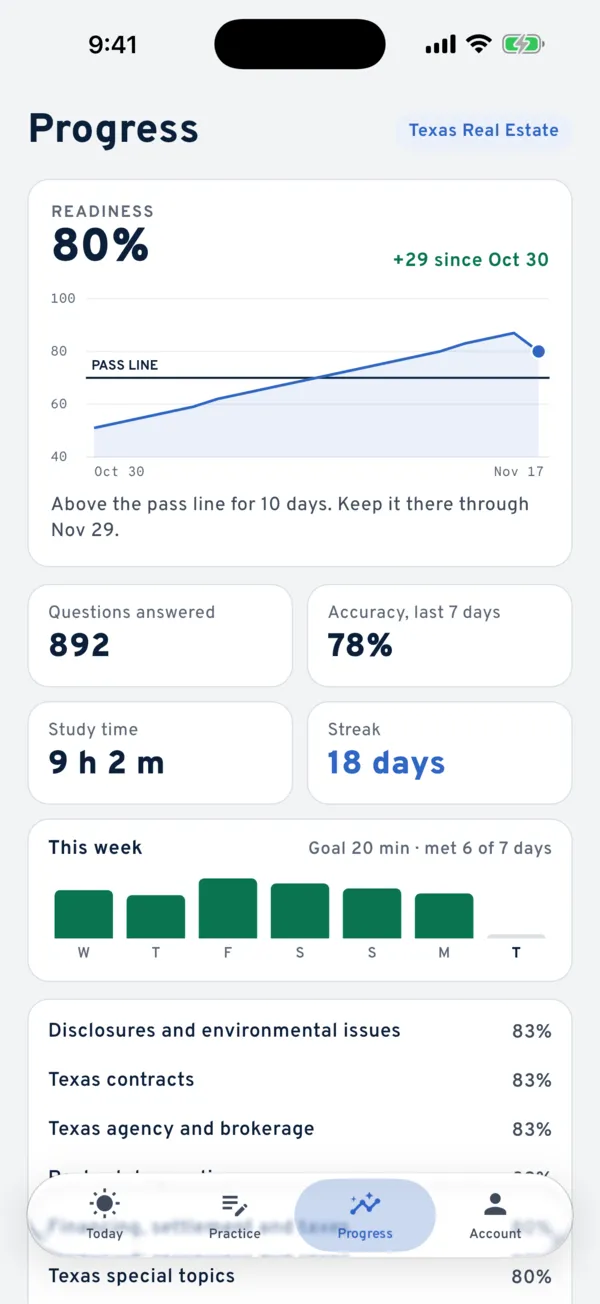
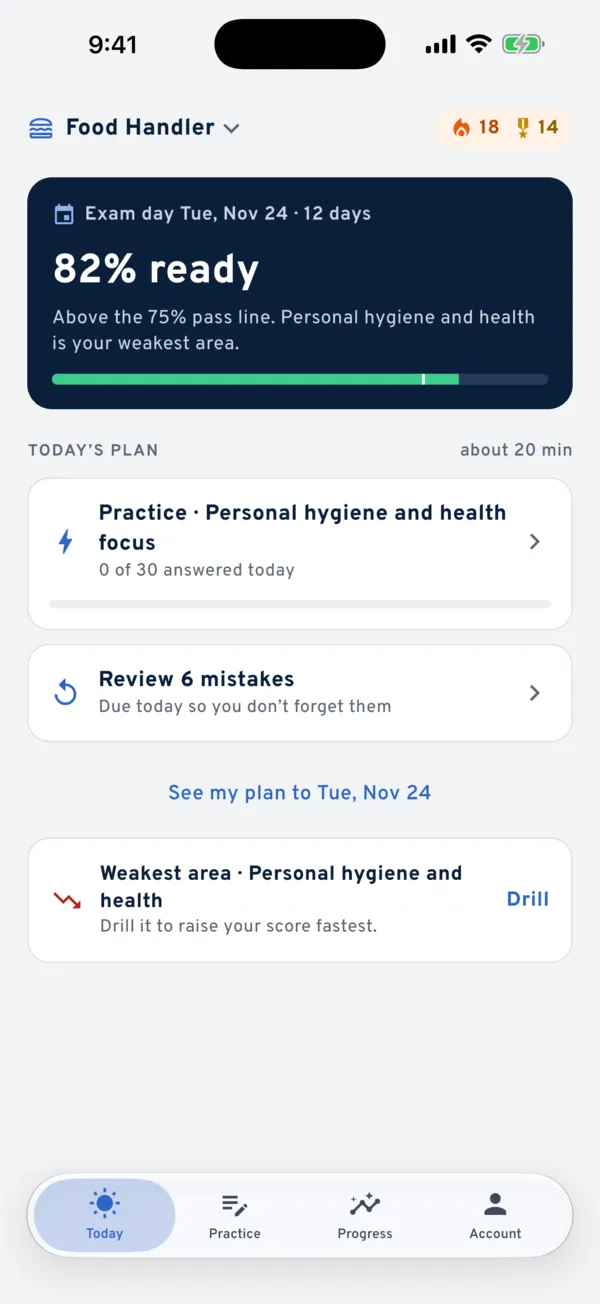
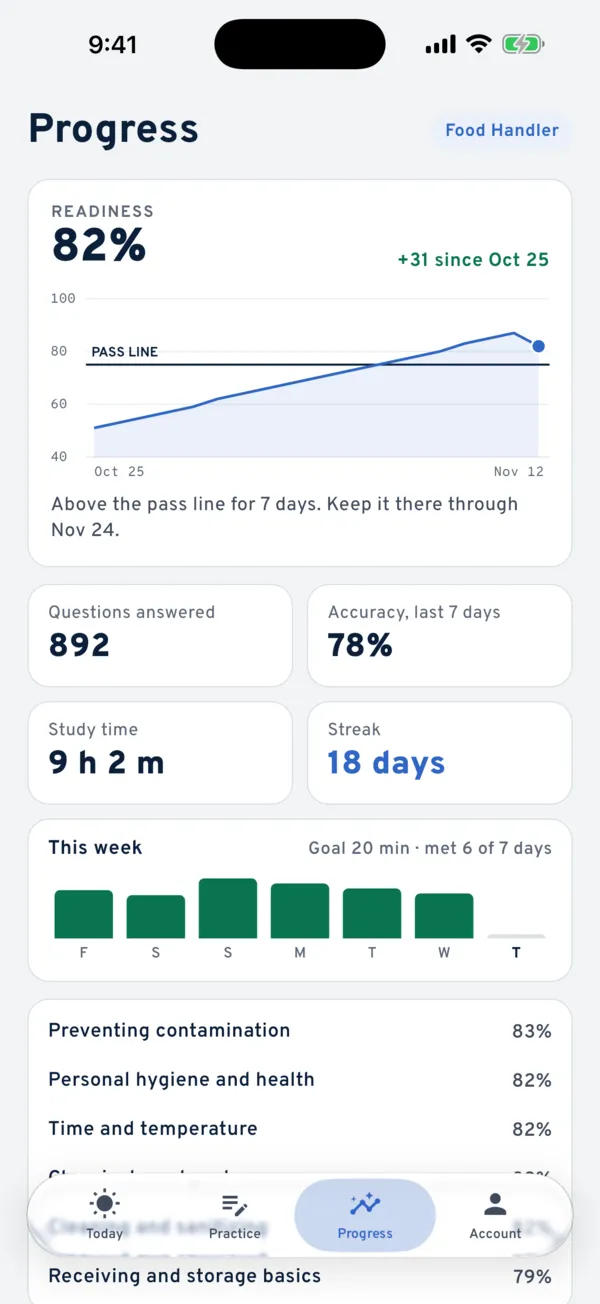
Clinched has every Food Handler question in this format, with full practice tests that match the real one, a readiness score by area and a plan to your test date. Free to start with 10 questions a day.
Read the Food Handler guide or see how we write and check every question.
Free on the App Store
Your exam, in your pocket.
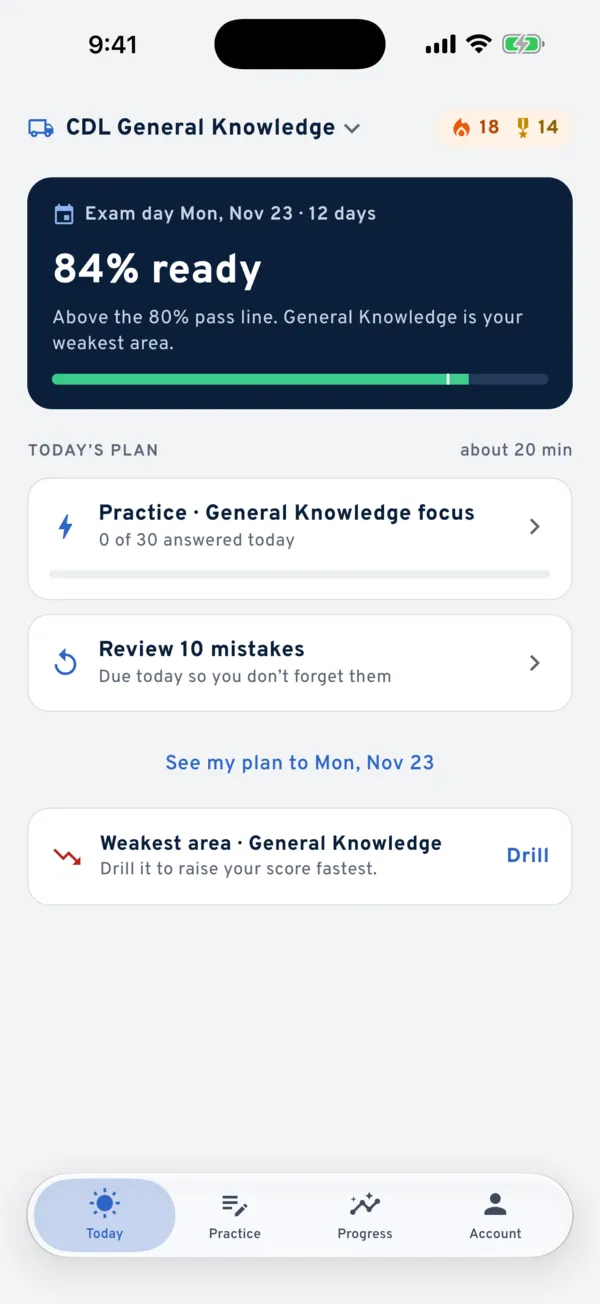
20 exams ready with questions written from the official sources, timed practice tests in the real format and a readiness score with a pass line.
On your computer?
Scan with your iPhone camera to get Clinched practice in the app.