

ASVAB AFQT Score by Branch: The Minimum to Enlist
Short answer
The Army, Air Force and Marine Corps require an AFQT score of at least 31 with a high school diploma, and the Air Force and Marines require 50 if you have a GED. The Coast Guard lists 32 for active duty enlisted applicants. Federal law adds a floor of 31 for anyone without a high school diploma, and individual jobs set their own higher line scores.
The AFQT score most people need to enlist is 31. That’s the published minimum for the Army, the Air Force and the Marine Corps if you have a high school diploma, and the Coast Guard sets its floor one point higher at 32.2345 A GED changes the math. The Air Force and Marine Corps both ask GED holders for 50.34
Below is each branch’s number, where it comes from, and why the minimum is a bad target.
Minimum AFQT for each branch
| Branch | With a high school diploma | With a GED | Official source |
|---|---|---|---|
| Army | 31 | Not listed on goarmy.com | goarmy.com |
| Air Force | 31 | 50 | airforce.com |
| Marine Corps | 31 | 50 | marines.com |
| Coast Guard | 32 (active duty enlisted) | Not listed separately | gocoastguard.com |
| Navy | Not confirmed | Not confirmed | Ask a Navy recruiter |
| Space Force | Not published | Not published | spaceforce.com |
The Army’s page puts it plainly. Your AFQT “determines your eligibility to join and requires a score of at least 31 to enlist.”2 The Air Force says high school seniors or graduates need a 31 and GED holders need a 50.3 The Marine Corps uses the same pair, 31 or 50 for a GED or nontraditional diploma.4 The Coast Guard’s eligibility table lists a minimum ASVAB AFQT of 32 for active duty enlisted applicants and accepts a high school diploma or equivalent.5
Two gaps are worth being honest about. The Space Force’s recruiting site asks for “a qualifying ASVAB score” without printing a number.6 And we couldn’t load a current Navy page that states its minimum, so we’re not repeating the figures that circulate on prep sites. A Navy recruiter can tell you the number that applies to your education credential this month.
Every branch can adjust these numbers to meet recruiting needs, and a recruiter is the final word. Treat this table as a starting point and confirm it before you test.
What an AFQT percentile actually means
The AFQT is calculated from four subtests, Arithmetic Reasoning, Mathematics Knowledge, Word Knowledge and Paragraph Comprehension.1 The Air Force notes that Word Knowledge and Paragraph Comprehension are first added together into a Verbal Expression (VE) score.3
It’s reported as a percentile from 1 to 99, not a percent correct. A score of 31 means you did as well as or better than 31% of a nationally representative sample of 18 to 23 year olds who took the ASVAB in a 1997 norming study.1 Because it’s a percentile against that fixed group, the same score means the same thing whether you took the computer version or the paper one.8
The services sort AFQT scores into categories, and those categories drive policy more than the raw percentile does.
| Category | AFQT range |
|---|---|
| I | 93 to 99 |
| II | 65 to 92 |
| IIIA | 50 to 64 |
| IIIB | 31 to 49 |
| IVA | 21 to 30 |
| IVB | 16 to 20 |
| IVC | 10 to 15 |
| V | 1 to 9 |
Ranges are from the official ASVAB site.1 Notice where 31 sits. It’s the bottom of Category IIIB, which is why so many branches use it as the floor.
Why GED holders need a higher score
Part of the answer is federal law. Under 10 U.S.C. 520(b), a person who isn’t a high school graduate can’t be accepted for enlistment unless their AFQT is at or above the 31st percentile.7 That’s the legal floor. Branches decide on top of it how to treat alternative credentials like the GED.
The same section caps Category IV enlistments. People scoring from the 10th up to the 31st percentile can’t exceed 4% of a service’s new active duty enlistees in a fiscal year. The Secretary of Defense can raise that limit to as much as 20% for a service on request, with notice to the Armed Services committees within 30 days. The 4% cap and the waiver authority were added by the National Defense Authorization Act signed December 22, 2023 (Public Law 118-31). Before that, the statutory cap was 20%.7
Branches then add their own policy on top. The Air Force and Marine Corps set 50 for GED holders, which is the bottom of Category IIIA.34 If you’re still deciding between finishing a diploma and taking the GED, look at the GED test guide alongside your ASVAB plan. For the Air Force or the Marines, the GED route means you need 19 more percentile points.
Why 31 is the wrong goal
Clearing the AFQT minimum gets you in the door. It doesn’t pick your job. Each branch builds line scores (composites) from different combinations of all ten subtests, and each job has its own cutoffs.23 The Air Force, for example, groups its jobs under Mechanical, Administrative, General and Electronics scores, each built from a different set of subtests.3 An applicant with a 33 AFQT can qualify to enlist and still find most of the jobs they wanted are out of reach.
A higher AFQT also opens doors. The official ASVAB site notes that applicants who score in Category IIIA or higher, meaning 50 or above, may qualify for enlistment incentives.1
The Army offers a path if you fall short. With an AFQT of at least 21, you may qualify for the academic track of the Future Soldier Preparatory Course, a 90-day program that teaches the ASVAB subjects and gives you chances to retest. If you’re already between 31 and 49, a 30-day version gives you one chance to improve, and you may be able to pick a new job with the higher score.2
Raising your AFQT before a retest
The retest waits are the same for every branch. After your first ASVAB you wait one calendar month, then another calendar month for a second retest, then six months between every retest after that.8 The Army also warns that your most recent score is the one that counts, not your highest.2 A rushed retest can cost you points.
So use the wait. Only four subtests feed the AFQT, which makes this a focused job. Start with your standard scores on those four. A standard score of 50 is about the middle of the national sample, and about 16% of people score 60 or higher, so a subtest in the low 40s is where your easiest points are.1 Calculators aren’t allowed on any version, so the math work happens on paper.8
- Find your weakest of the fourCompare your standard scores for Arithmetic Reasoning, Mathematics Knowledge, Word Knowledge and Paragraph Comprehension and start with the lowest.
- Rebuild hand math firstDrill fractions, percentages, ratios and basic algebra on paper until they're automatic.
- Read every day for the verbal halfWord Knowledge and Paragraph Comprehension together form your Verbal Expression score. Daily reading plus a running vocabulary list moves both.
- Take timed practice testsPractice the way the computer version runs, answering each question for real and never going back. Retest only when your practice AFQT is clearly above your last official one.
Our ASVAB guide has a full six-week plan and the official time limits for every subtest. If you live far from a testing site, the PiCAT guide explains the at-home option, which is open only if you’ve never taken the ASVAB. Clinched is building an ASVAB course, and you can tap “Notify me” in the app to hear when it’s ready.
Questions people ask
What is the lowest ASVAB score you can get into the military with?
For most applicants it's an AFQT of 31, the published minimum for the Army, Air Force and Marine Corps with a high school diploma. The Coast Guard lists 32. Federal law also bars anyone without a high school diploma from enlisting below 31, and the Air Force and Marines ask GED holders for 50.
Is a 50 a good ASVAB score?
An AFQT of 50 means you scored as well as or better than half of a national sample of 18 to 23 year olds. It clears every published branch minimum, including the 50 the Air Force and Marine Corps require with a GED, and it puts you in Category IIIA, the level where applicants may qualify for enlistment incentives.
Is the AFQT the same as my ASVAB score?
The AFQT is one score calculated from four ASVAB subtests, Arithmetic Reasoning, Mathematics Knowledge, Word Knowledge and Paragraph Comprehension. It decides whether you can enlist. Your other subtest scores feed the line scores that decide which jobs you qualify for, so two people with the same AFQT can have very different job options.
Sources
- Understanding ASVAB ScoresOfficial Site of the ASVAB (Department of Defense)
- Entrance Test (ASVAB)U.S. Army
- Armed Services Vocational Aptitude Battery (ASVAB) TestU.S. Air Force
- Requirements to Become a MarineU.S. Marine Corps
- Eligibility RequirementsU.S. Coast Guard
- Get StartedU.S. Space Force
- 10 U.S.C. 520, Limitation on enlistment and induction of persons whose score on the Armed Forces Qualification Test is below a prescribed levelOffice of the Law Revision Counsel, U.S. House of Representatives
- Frequently Asked QuestionsOfficial Site of the ASVAB (Department of Defense)
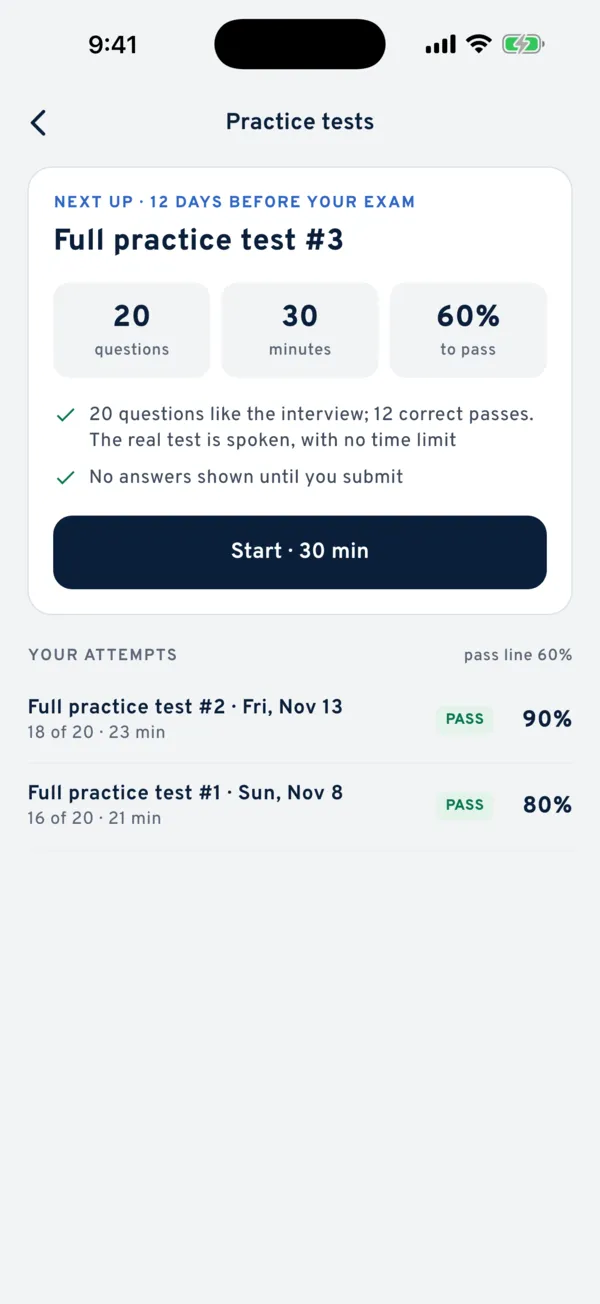
ClinchedASVAB
Pass ASVAB on the first try.
Practice questions written from the official sources, full practice tests in the real format and a plan that ends on your test date. Free to start.
Keep reading
- Test day · ASVAB
 PiCAT Explained: The At-Home ASVAB and the Verification TestThe PiCAT is the ASVAB at home. Your recruiter's code lasts 30 days, you get 48 hours to finish, and a 25 to 30 minute Verification Test follows within 45 days.
- Exam guide · Series 63, 65 and 66
 Series 65 vs Series 66: Which One Should You Take?The Series 65 has 130 scored questions and stands alone. The Series 66 has 100 and only counts with a Series 7. How to choose based on your job and where you work.
- Exam guide · SIE · Series 7
 SIE vs Series 7: How the Two FINRA Exams Fit TogetherThe SIE has 75 scored questions and needs no sponsor. The Series 7 has 125 and needs a firm. How they differ in content, cost and difficulty, and which comes first.