Food Protection Manager guideFree practice test
Food Protection Manager practice test
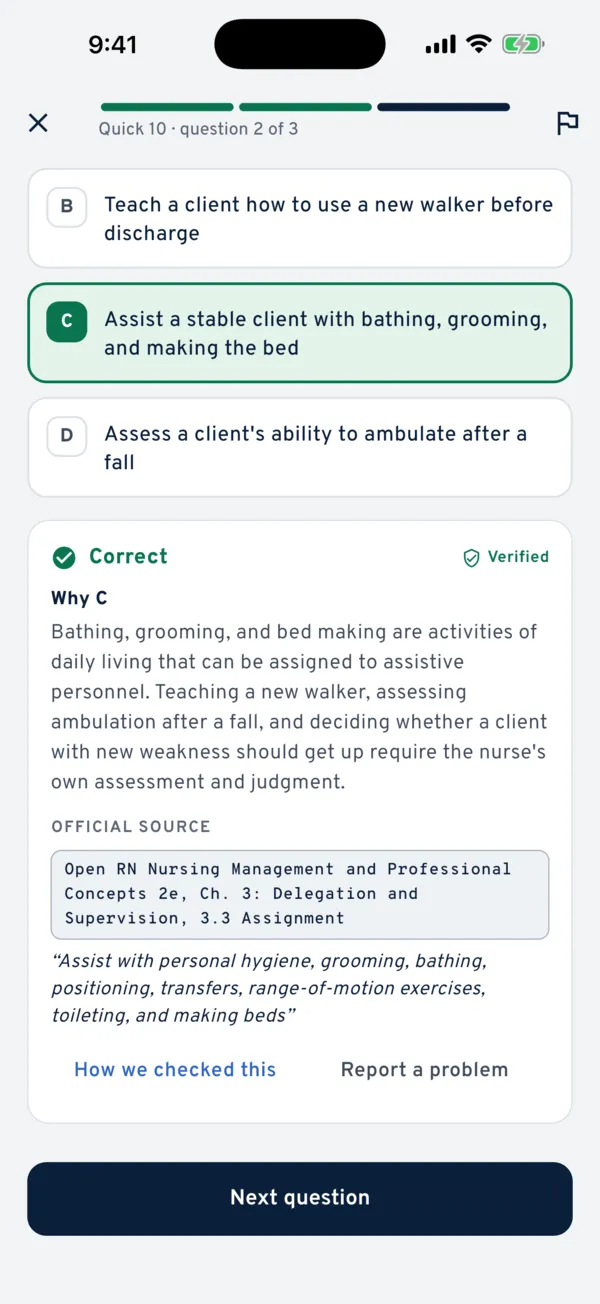
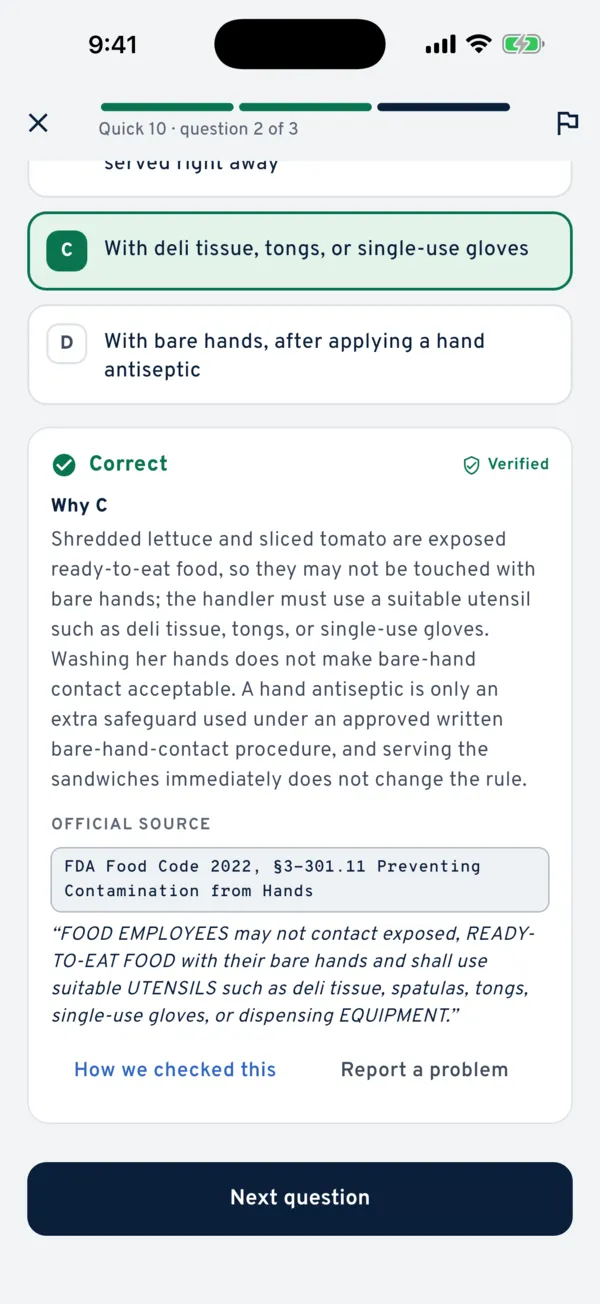
15 free Food Protection Manager questions from the 1,405 in Clinched, chosen to match how the real test is weighted. Pick an answer to see the explanation and the official text it comes from. Nothing to sign up for.
-
Question 1 of 15Cross-contamination
A food handler's cut-resistant glove has a rough, absorbent outer surface, and he needs to portion ready-to-eat salad for a buffet. What should he do?
Correct answer C. Cover it with a smooth, nonabsorbent glove or a single-use glove.
When a cut-resistant glove is not smooth and nonabsorbent, it may still be used with ready-to-eat food if it is covered with a smooth, durable, nonabsorbent glove or a single-use glove, so the barrier that touches the food is the safe one. Washing and drying does not change the absorbent outer surface. A single-use glove worn underneath leaves the porous glove touching the salad, and working fast or chilling the salad afterward does not undo contamination.
Official source FDA Food Code 2022, §3-304.15 Gloves, Use Limitationor if the slash-resistant gloves are covered with a SMOOTH, durable, nonabsorbent glove, or a SINGLE-USE glove.
-
Question 2 of 15Chemicals and toxic materials
A food handler is mixing a bucket of sanitizer from a concentrate for the dish area. How must the chemical be applied?
Correct answer D. So that it does not create a hazard to employees or other people.
Poisonous or toxic materials must be applied so that a hazard to employees or other persons is not constituted. Keeping chemicals off food is part of the rule, but it is not the whole rule; people handling and working around the chemical must also be protected. Mixing stronger than the label directs violates the manufacturer's use directions, and there is no requirement that the person in charge apply chemicals.
Official source FDA Food Code 2022, §7-202.12 Conditions of UseApplied so that: (1) A HAZARD to EMPLOYEES or other PERSONS is not constituted, P and (2) Contamination including toxic residues due to drip, drain, fog, splash or spray on FOOD, EQUIPMENT, UTENSILS, LINENS, and SINGLE- SERVICE and SINGLE-USE ARTICLES is prevented
-
Question 3 of 15Storing clean items, cloths and linens
Your establishment has no mechanical clothes dryer. Laundered wiping cloths are hanging to dry beside a shelf of clean table linens, and water is dripping onto the linens. A coworker says this is fine because the linens never touch food directly.
Correct answer B. The cloths must be dried where they cannot contaminate the linens.
Wiping cloths that are air-dried must be dried in a location and in a manner that prevents contamination of linens, as well as food, equipment, utensils, and single-service and single-use articles. Whether linens touch food directly, how high the shelf is, or a later washing does not change the requirement that the drying cloths must not contaminate them.
Official source FDA Food Code 2022, §4-901.12 Wiping Cloths, Air-Drying Locationsshall be air-dried in a location and in a manner that prevents contamination of FOOD, EQUIPMENT, UTENSILS, LINENS, and SINGLE-SERVICE and SINGLE-USE ARTICLES and the wiping cloths.
-
Question 4 of 15Handwashing sinks and toilets
Your restaurant is inside a shopping mall. The mall's rear loading door is propped wide open all day, and you can see flies coming through it into the corridor outside your kitchen. What should you do?
Correct answer D. Ask mall management to have that opening kept closed or protected by screens, air curtains, or other effective means.
When a food establishment opens into a larger structure such as a mall, airport or office building, the outer openings of that larger structure must also be protected against insects and rodents. Since the loading door is propped open and flies are entering, the mall management needs to close it or protect the opening with screens, air curtains, or other effective means. Who owns the common area does not change that requirement, and your own closed door does not protect the building's open opening. Fly strips and bait stations deal with pests already inside rather than keeping them out, and a posted reminder does not protect the opening.
Official source FDA Food Code 2022, §6-202.15 Outer Openings, Protecteddoes not apply if a food establishment opens into a larger structure, such as a mall, airport, or office building, or into an attached structure, such as a porch, and the outer openings from the larger or attached structure are protected against the entry of insects and rodents.
-
Question 5 of 15Water, plumbing, sewage and garbage
A manager buys smaller trash cans for the cook line because the crew empties them every couple of hours, but they now overflow between emptying. What does the requirement for refuse receptacles say about this?
Correct answer A. The receptacles must be large enough to hold the refuse that accumulates
Receptacles must have sufficient capacity to hold the refuse that accumulates, so cans that overflow between emptying are too small. Emptying more often does not make an overflowing receptacle acceptable, and a tight-fitting lid or plastic liner does not change the volume the receptacle can hold.
Official source FDA Food Code 2022, §5-501.16 Storage Areas, Rooms, and Receptacles, Capacity andAn inside storage room and area and outside storage area and enclosure, and receptacles shall be of sufficient capacity to hold REFUSE, recyclables, and returnables that accumulate.
-
Question 6 of 15Foodborne illness and hazards
A prep cook is about to chop romaine lettuce for the salad station. What should she do with the lettuce first to help protect customers from EHEC?
Correct answer B. Rinse the leaves under clean, running water.
Washing raw fruits and vegetables under clean, running water is one of the steps that helps protect people from EHEC, so the lettuce should be rinsed under running water before it is cut. Chemical sanitizer is for food-contact surfaces and equipment, not a replacement for washing produce. Wiping with a dry cloth does not wash the surface, and standing water in a bowl just collects the soil and bacteria that are rinsed off.
Official source FDA Bad Bug Book (2nd ed.), Enterohemorrhagic Escherichia coli (EHEC)Cooking ground beef well; washing raw fruits and vegetables under clean, running water; and not drinking unpasteurized (“raw”) milk or eating certain cheeses made from it are some of the things you can do to help protect yourself.
-
Question 7 of 15Foodborne illness and hazards
A nearby dairy offers to supply your cafe with fresh raw milk from its own herd. The owner says the animals are healthy and the barn is spotless. What should you do?
Correct answer D. Do not serve it; unpasteurized milk has been linked to EHEC outbreaks.
EHEC outbreaks have been traced to unpasteurized milk, and not drinking raw milk is one of the steps that protects people. A healthy herd and a clean barn do not guarantee the milk is free of harmful bacteria. Testing before delivery does not make raw milk an acceptable product to serve, and keeping milk cold only slows bacterial growth; it does not make the milk safe.
Official source FDA Bad Bug Book (2nd ed.), Enterohemorrhagic Escherichia coli (EHEC)EHEC outbreaks have been traced to many kinds of foods; for example, ground meats, unpasteurized (“raw”) milk, unpasteurized fruit juice, lettuce, spinach, sprouts, and, more recently, commercially manufactured frozen cookie dough.
-
Question 8 of 15Active managerial control and HACCP
A food handler mixes sanitizer far stronger than the label states, wipes down a prep table with it, and lets the table air dry. Why is the over-strength solution a problem?
Correct answer A. Residues of the sanitizer can remain on the table and contaminate food.
A sanitizer mixed well above the allowed concentration can be harmful because residues of the material stay on the surface and can end up in food. The concern is the leftover chemical, not contact time or the solution losing its killing power. Sanitizers are approved for food-contact surfaces such as prep tables when they are used at the proper concentration, so that is not the issue here.
Official source FDA Food Code 2022, Annex 4, The HACCP PrinciplesLarge concentrations of sanitizer in excess of the CFR requirements can be harmful because residues of the materials remain.
-
Question 9 of 15The person in charge
All of your cooks completed handwashing training last month. During the lunch rush, you see two of them leave the restroom and walk back to the line without washing their hands. What must you do as the person in charge?
Correct answer A. Make sure they wash their hands and routinely monitor handwashing.
The person in charge must ensure employees are effectively cleaning their hands by routinely monitoring their handwashing, so you must correct the failure now and keep monitoring. Training last month does not replace that daily oversight. A sign is a reminder, not monitoring, and waiting for the next training day leaves the problem unaddressed during service.
Official source FDA Food Code 2022, §2-103.11 Person in ChargeEMPLOYEES are effectively cleaning their hands, by routinely monitoring the EMPLOYEES' handwashing; Pf
-
Question 10 of 15Nails, jewelry, clothing, eating and hair
A food handler with artificial fingernails is assigned to the salad bar, where she plates ready-to-eat salads for customers. What does the rule require?
Correct answer D. She must wear intact gloves in good repair.
A food employee may not wear artificial fingernails while working with exposed food unless she wears intact gloves in good repair. Plating ready-to-eat salads at the salad bar is working with exposed food, so intact gloves are required. Whether the work happens at the front counter or in the kitchen does not change the rule, and short, clean nails or frequent handwashing do not replace the glove requirement.
Official source FDA Food Code 2022, §2-302.11 MaintenanceUnless wearing intact gloves in good repair, a FOOD EMPLOYEE may not wear fingernail polish or artificial fingernails when working with exposed FOOD.
-
Question 11 of 15Handwashing
A food handler has just finished wiping down tables and is about to portion cooked rice into bowls for the buffet line. What must she do before she starts?
Correct answer B. Wash her hands, because she is about to work with exposed food.
Hands must be cleaned immediately before starting food preparation, which includes working with exposed food like the cooked rice, along with clean equipment and unwrapped single-service items. The requirement is not limited to raw meat. Rinsing in sanitizer is not handwashing, and sanitizer is not meant for skin. Gloves do not replace handwashing, because hands must be washed before gloves are put on for a food task.
Official source FDA Food Code 2022, §2-301.14 When to WashFOOD EMPLOYEES shall clean their hands and exposed portions of their arms as specified under § 2-301.12 immediately before engaging in FOOD preparation including working with exposed FOOD, clean EQUIPMENT and UTENSILS
FDA Food Code 2022, §2-301.14 When to Wash“(H) Before donning gloves to initiate a task that involves working with FOOD; P” -
Question 12 of 15Approved sources
Your menu describes the salmon as "wild-caught Alaskan salmon." You are going to serve farm-raised Atlantic salmon from today's delivery. What should you do?
Correct answer C. Rewrite the menu to identify the salmon as farm-raised Atlantic salmon.
Food must be honestly presented, so the menu has to describe what you actually serve. Leaving the description as it is misrepresents the fish, and adding "wild-caught style" still misleads customers about how it was produced. Serving it silently is also dishonest, even though it is still salmon.
Official source FDA Food Code 2022, §3-101.11 Safe, Unadulterated, and Honestly PresentedFOOD shall be safe, unADULTERATED, and, as specified under § 3-601.12, honestly presented.
-
Question 13 of 15Receiving deliveries
You are checking in a delivery of shucked oysters. The tag on one container is faded so the dealer's name and certification number cannot be read, but the invoice clearly lists the supplier. What should you do?
Correct answer D. Reject the container because the tag is not legible.
Each molluscan shellfish package or container must bear a legible tag or label, so a tag that can no longer be read fails the requirement and the container should be rejected. An invoice naming the supplier does not replace a legible tag, and adding the name yourself does not make the original tag legible. Cooking the oysters later does not fix a container that arrived without readable identification.
Official source FDA Food Code 2022, §3-202.18 Molluscan Shellfish, Packaging and IdentificationMOLLUSCAN SHELLFISH shall be obtained in nonreturnable packages or containers which bear a legible tag or label that identifies the: Pf (1) Source
-
Question 14 of 15Thawing and cooling
A food handler is thawing frozen cooked shrimp, a ready-to-eat food, under running water at 70°F (21°C). What limit applies to the shrimp as it thaws?
Correct answer A. Thawed portions must stay at 41°F (5°C) or below.
Ready-to-eat food thawed under running water must not rise above 41°F (5°C) at any point, because there is no later cooking step to destroy bacteria. The 4-hour allowance belongs to raw animal food that will be cooked. The 70°F figure is a limit on the water, not permission for the food to warm up, and being submerged is already a condition of the running-water method, not a higher temperature allowance.
Official source FDA Food Code 2022, §3-501.13 Thawing(3) For a period of time that does not allow thawed portions of READY-TO-EAT FOOD to rise above 5oC (41oF) Pf, or
-
Question 15 of 15Time as a public health control
You manage the kitchen of a nursing home. The cook wants to leave raw shell eggs on the counter through the breakfast rush and use the 4-hour time rule instead of keeping them cold. What should you tell the cook?
Correct answer D. No; you may not use time instead of temperature control for raw eggs when you serve a highly susceptible population.
An establishment that serves a highly susceptible population, such as a nursing home, may not use time as the public health control for raw eggs, so the eggs must stay under temperature control. Marking the container does not make it allowed, and neither the 4-hour nor the 6-hour limit can be used for raw eggs in this setting. Cooking the eggs to 145°F later does not change the rule for holding them.
Official source FDA Food Code 2022, §3-501.19 Time as a Public Health Control(D) A FOOD ESTABLISHMENT that serves a HIGHLY SUSCEPTIBLE POPULATION may not use time as specified under ¶¶ (A), (B) or (C) of this section as the public health control for raw EGGS.
Want the other 1,390?
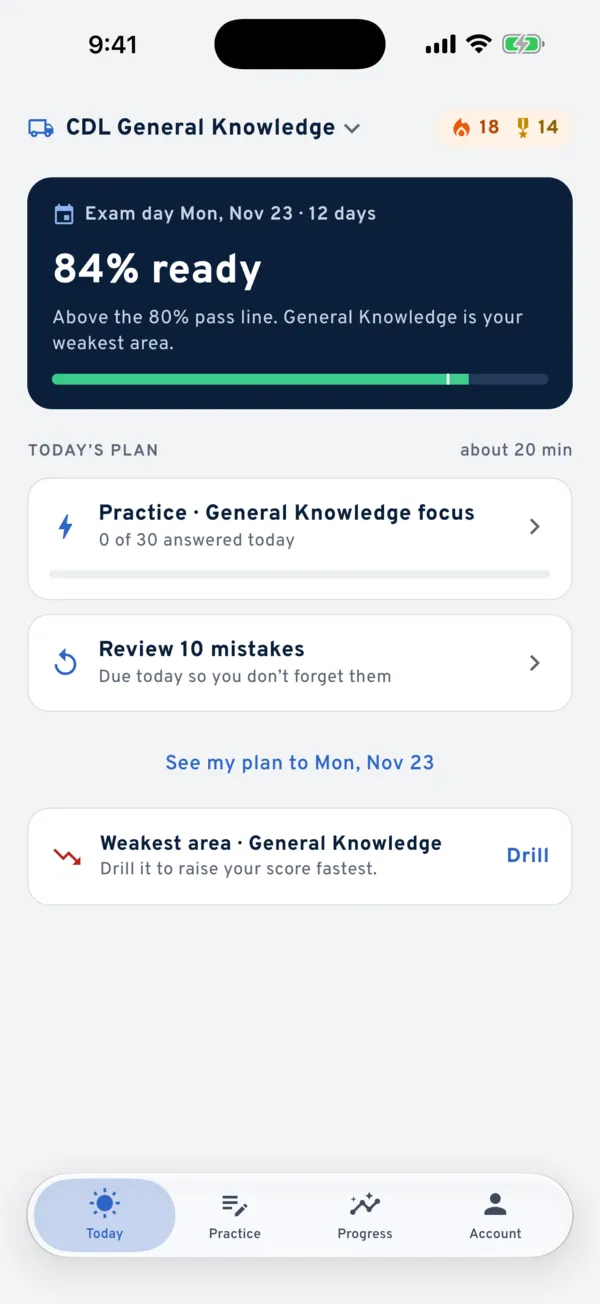
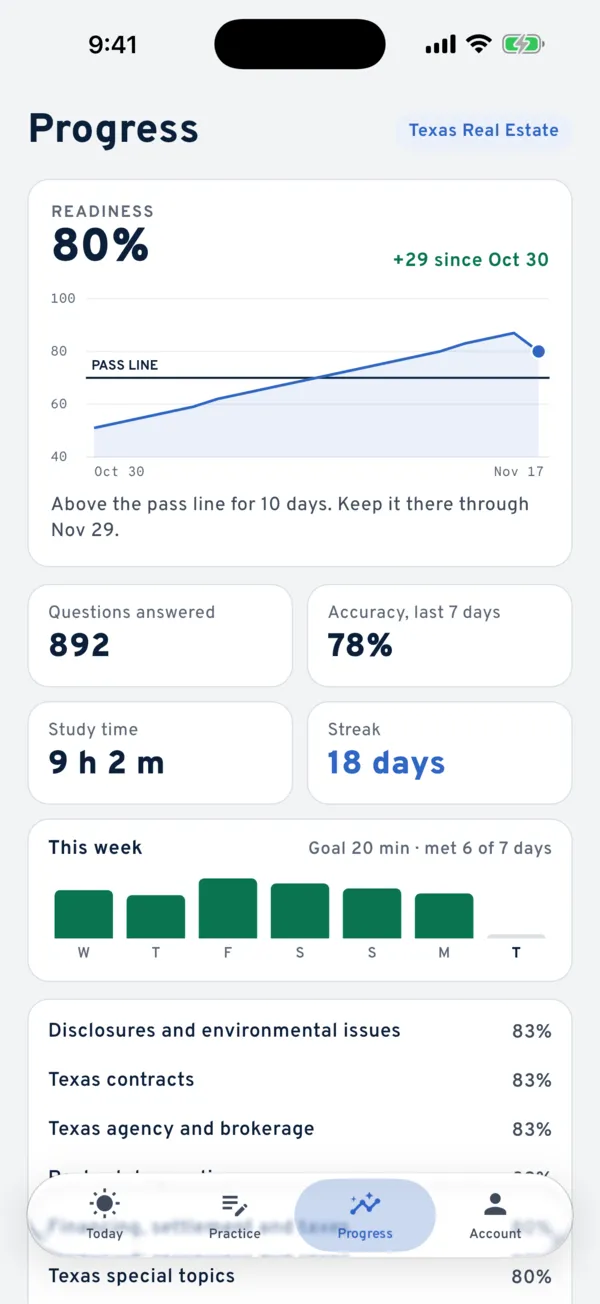
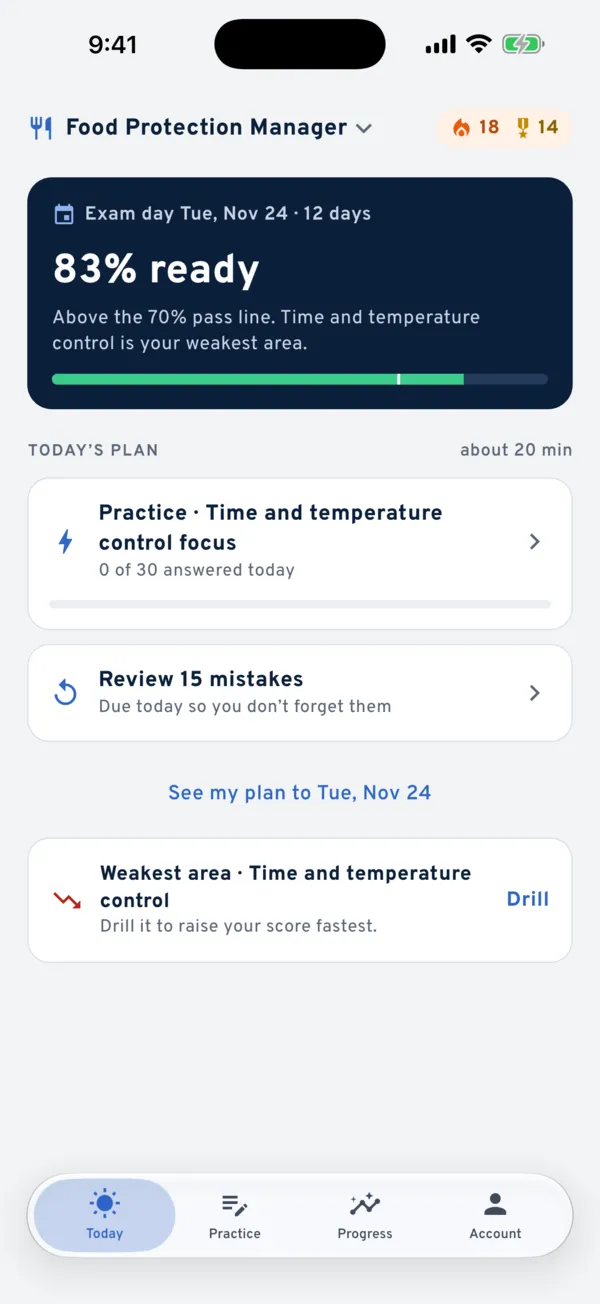
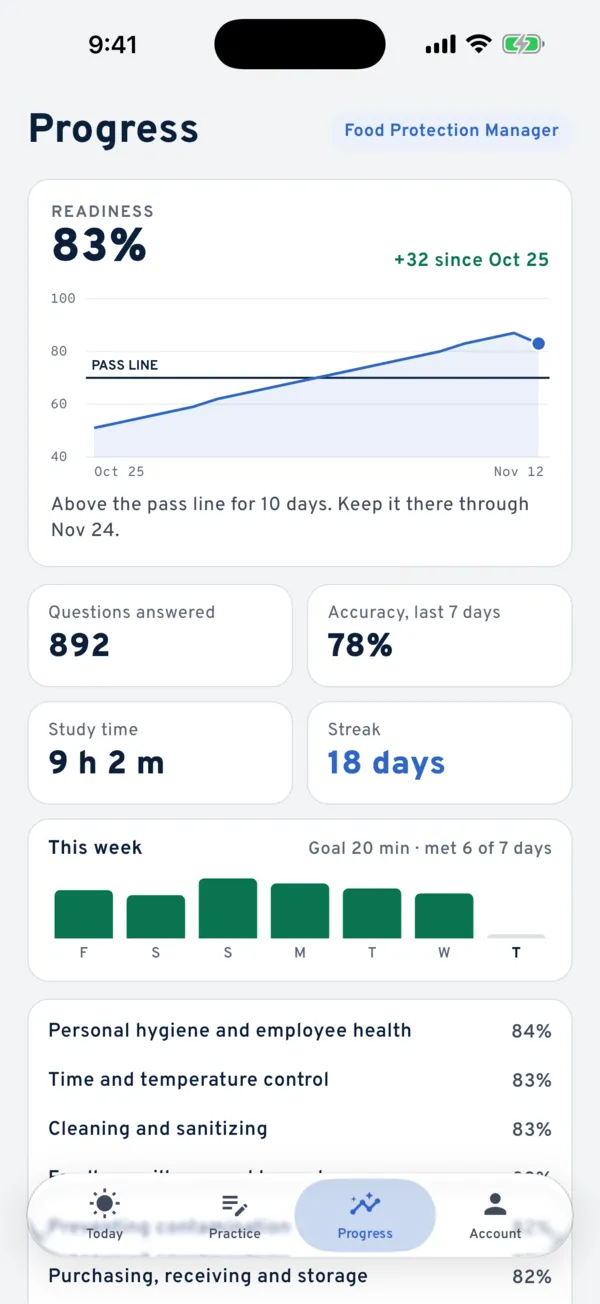
Clinched has every Food Protection Manager question in this format, with full practice tests that match the real one, a readiness score by area and a plan to your test date. Free to start with 10 questions a day.
Read the Food Protection Manager guide or see how we write and check every question.
Free on the App Store
Your exam, in your pocket.
20 exams ready with questions written from the official sources, timed practice tests in the real format and a readiness score with a pass line.
On your computer?
Scan with your iPhone camera to get Clinched practice in the app.