CDL Endorsements guideFree practice test
CDL Endorsements practice test
15 free CDL Endorsements questions from the 977 in Clinched, chosen to match how the real test is weighted. Pick an answer to see the explanation and the official text it comes from. Nothing to sign up for.
-
Question 1 of 15Shipping papers, marking and placards
You have just delivered a hazardous waste shipment to a treatment facility. What must you do with the manifest?
Correct answer B. Keep your copy, signed and dated by everyone, including the receiver
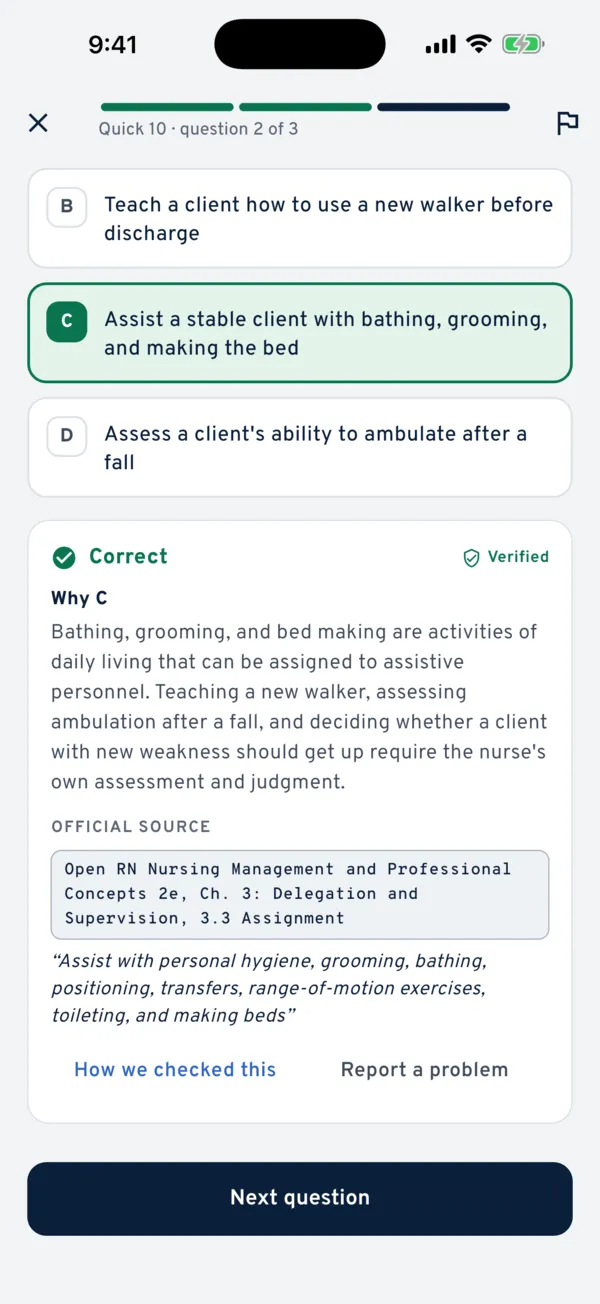
After delivery you keep your own copy of the manifest. It must carry every required signature and date, including those of the person who received the waste. A copy without the receiver's signature is incomplete. Handing over all copies would leave you with no record of the delivery.
Official source CDL Manual (AAMVA model, March 2025), Section 9.3.9 Hazardous Waste Manifest -
Question 2 of 15Loading, unloading and segregation
You are loading drums of a Class 3 flammable liquid into your trailer, and a dock worker lights a cigarette next to the truck. What does the rule say about smoking here?
Correct answer B. Nobody may smoke on or around the vehicle during loading
Smoking on or about the vehicle is forbidden while you load or unload Class 1, Class 3, Class 4, Class 5 or Division 2.1 materials. You must also take extreme care to keep anyone nearby from smoking or carrying a lighted cigarette. Flammable vapors can collect around the truck, so a lit cigarette nearby is a real ignition source. Shutting the engine off or closing the doors does not make it legal.
Official source 49 CFR §177.834 General requirements.(c) No smoking while loading or unloading. Smoking on or about any motor vehicle while loading or unloading any Class 1 (explosive), Class 3 (flammable liquid), Class 4 (flammable solid), Class 5 (oxidizing), or Division 2.1 (flammable gas) materials is forbidden.
49 CFR §177.834 General requirements.“to keep fire away and to prevent persons in the vicinity from smoking, lighting matches, or carrying any flame or lighted cigar, pipe, or cigarette.” -
Question 3 of 15Emergencies and the ERG
You have parked your leaking hazmat truck and secured the area. Where should you wait for responders?
Correct answer A. Upwind, and away from truck stops and cafes
Wait upwind so vapors blow away from you. Stay away from roadside rests, truck stops, cafes, and other businesses where people gather. Standing downwind puts you in the path of the fumes, and going into a business brings danger to the people there.
Official source CDL Manual (AAMVA model, March 2025), Section 9.7.3 Fires -
Question 4 of 15Loading, unloading and evacuation
The last student has just climbed the steps at a roadside stop. At what point may you start moving the bus?
Correct answer B. After every student is seated and facing forward
Do not move the bus until all students are in their seats and facing the front. A student who is still standing or walking can fall when the bus starts. Being inside the door or walking down the aisle is not the same as being seated.
Official source CDL Manual (AAMVA model, March 2025), Section 10.2.2 Loading Procedures -
Question 5 of 15Railroad crossings and special safety
You are assigned a school bus with hydraulic brakes and a GVWR of 12,000 lbs. It was built in July 1998. Did federal rules require it to have ABS?
Correct answer C. No, the hydraulic rule began March 1, 1999
Hydraulically braked buses of 10,000 lbs GVWR or more need ABS only if built on or after March 1, 1999, so a July 1998 bus was not covered. The March 1, 1998 date applies to air-brake vehicles, not hydraulic ones. The weight limit matters, but so does the build date, and this bus was built too early.
Official source CDL Manual (AAMVA model, March 2025), Section 10.6.1 Vehicles Required to Have Antilock -
Question 6 of 15Danger zones and mirrors
You are adjusting the crossover mirrors before your route. How should the mirror's view of the ground in front of the bus line up with what you can see directly through the windshield?
Correct answer C. The two views should overlap
The mirror should cover the ground from the bumper outward far enough that it overlaps the area you can see directly. Any gap between the two views, even a small one, is a place where a child could stand unseen. Lining them up exactly edge to edge leaves no margin, so overlap is what you want.
Official source CDL Manual (AAMVA model, March 2025), Section 10.1.5 Outside Left and Right Side Crossover -
Question 7 of 15Driving tank vehicles safely
You are slowing for traffic in a partly loaded smooth bore tanker and feel the liquid shove the truck forward. Why is this shove stronger than in a baffled tank?
Correct answer B. Nothing inside breaks up the flow
Smooth bore (un-baffled) tanks have nothing inside to slow the flow of the liquid. The liquid moves freely front to back, so the forward-and-back surge is very strong. Food liquids are not described as heavier than fuels. The tank in this question is only partly loaded, and the surge comes from the lack of baffles, not from how full the tank is.
Official source CDL Manual (AAMVA model, March 2025), Section 8.2.5 Un-baffled Tanks -
Question 8 of 15Inspecting tank vehicles
You are taking out a tanker for a new customer. What should you do about emergency equipment before the trip?
Correct answer B. Learn what is required, and confirm it is aboard and working
Find out which emergency equipment your vehicle must carry. Then confirm it is on board and that it works. Whatever the last driver left may be incomplete, and the check applies to every tank vehicle, not only hazmat loads.
Official source CDL Manual (AAMVA model, March 2025), Section 8.1.3 Special Equipment -
Question 9 of 15Driving tank vehicles safely
You are hauling a half load in a baffled tank. Which kind of liquid movement are the baffles mainly there to control?
Correct answer B. Front-to-back surge
Baffles slow the liquid as it rushes toward the front or rear when you brake or accelerate. They do much less to stop the load from shifting sideways. Room for heat expansion is handled by outage, not by baffles.
Official source CDL Manual (AAMVA model, March 2025), Section 8.2.4 Baffled Tanks -
Question 10 of 15Pulling doubles and triples
You are told to drive your doubles very smoothly. Which two dangers does smooth driving help you avoid?
Correct answer B. Rollover and jackknife
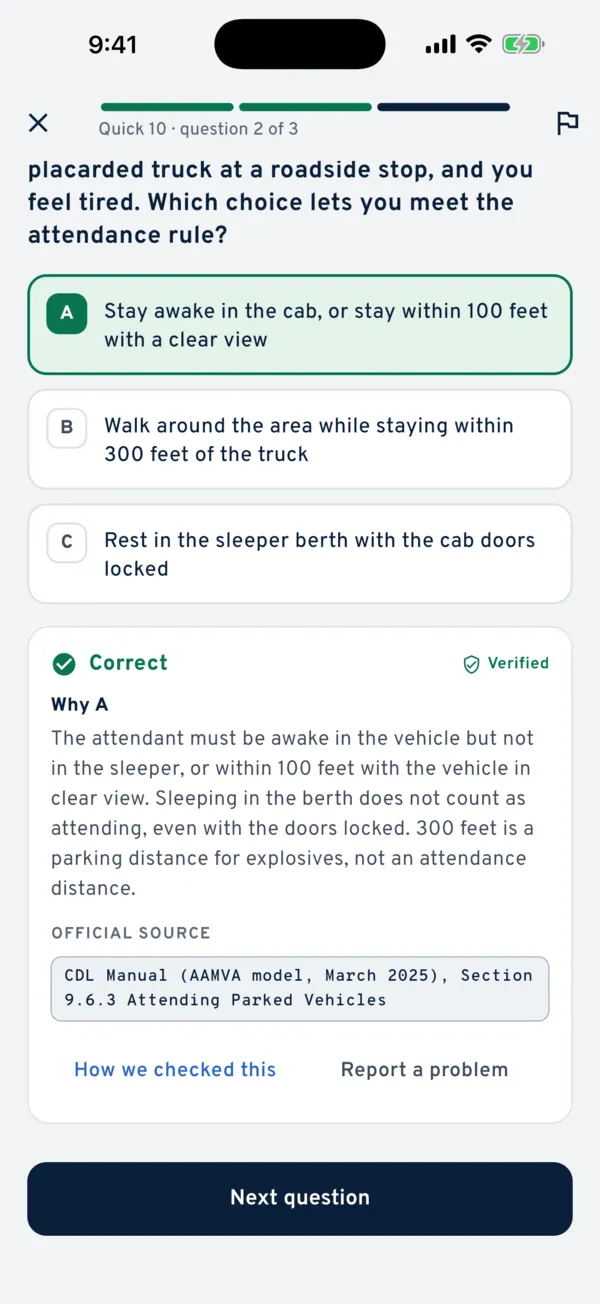
Doubles and triples need very smooth driving so they do not roll over or jackknife. Brake fade, tire heat, engine overspeed and clutch wear are real issues, but they are not the reason for driving smoothly.
Official source CDL Manual (AAMVA model, March 2025), Section 7.1.4 Look Far Ahead -
Question 11 of 15Coupling, inspection and air brake check
You are about to hook up two semitrailers, and one is loaded much heavier than the other. Where should the heavier trailer go?
Correct answer C. Right behind the tractor, in the first position
The heavier trailer goes up front, right behind the tractor, and the lighter one goes at the back. This order gives the safest handling on the road. Being under the legal weight limit does not change where the heavier trailer belongs.
Official source CDL Manual (AAMVA model, March 2025), Section 7.2.1 Coupling Twin Trailers -
Question 12 of 15Coupling, inspection and air brake check
You are fanning the brakes to test the tractor protection valve. The manufacturer's specified range is the usual one. The gauge now reads 15 psi and the air supply knob is still in. What does this mean?
Correct answer B. The valve failed the test and needs repair
The trailer air supply control (tractor protection valve control) should pop out when pressure falls into the manufacturer's specified range, usually 20 to 45 psi. If it is still in at 15 psi, the valve is not working properly. A bad valve could let an air hose or trailer brake leak drain all the air from the tractor.
Official source CDL Manual (AAMVA model, March 2025), Section 7.4.1 Additional Air Brake ChecksCDL Manual (AAMVA model, March 2025), Section 7.4.1 Additional Air Brake Checks“” -
Question 13 of 15On the road and prohibited practices
At a railroad crossing, a flagman is directing traffic and waves you forward. What should you do in your bus?
Correct answer C. Slow down and check carefully for other vehicles
When a flagman or police officer is directing traffic, a bus is not required to stop. You must still slow down and look carefully for other vehicles. Holding your speed ignores the duty to slow and check.
Official source CDL Manual (AAMVA model, March 2025), Section 4.3.5 Railroad-highway Crossing/ StopsCDL Manual (AAMVA model, March 2025), Section 4.3.5 Railroad-highway Crossing/ Stops“” -
Question 14 of 15Bus inspection and loading
A shipper offers you a box of small-arms ammunition labeled ORM-D. What do the bus rules say?
Correct answer A. It is one of the items a bus is allowed to carry
Small-arms ammunition labeled ORM-D is specifically allowed on buses. Explosives are generally kept out of the passenger area, but small-arms ammunition is the named exception. ORM-D items are not banned outright.
Official source CDL Manual (AAMVA model, March 2025), Section 4.2.2 Forbidden Hazardous MaterialsCDL Manual (AAMVA model, March 2025), Section 4.2.2 Forbidden Hazardous Materials“” -
Question 15 of 15Bus inspection and loading
You are driving a charter group and stop for lunch. Some riders come back 30 minutes early and want to wait on the bus. What should you do?
Correct answer B. Keep them off until departure time to help guard against theft or vandalism
A charter driver should hold riders off the bus until it is time to leave. Letting people aboard early, often while you are away, opens the door to theft and damage. Having riders on board does not protect the bus, and a smoother boarding is not a reason to break this practice.
Official source CDL Manual (AAMVA model, March 2025), Section 4.2.4 At Your Destination
Want the other 962?
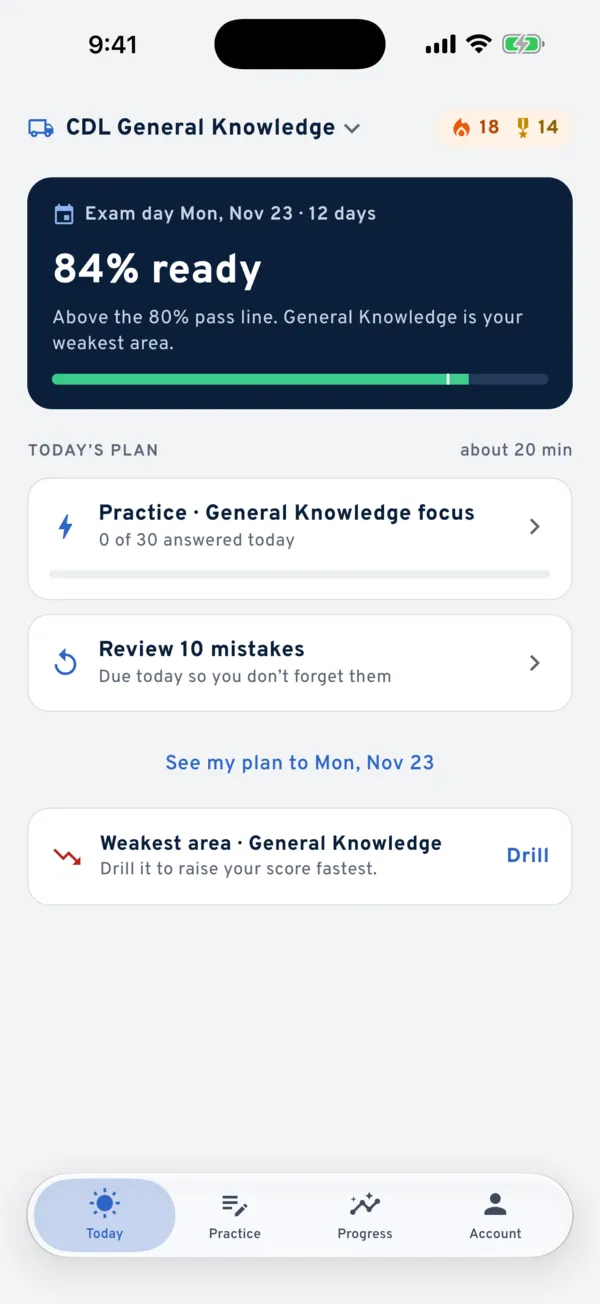
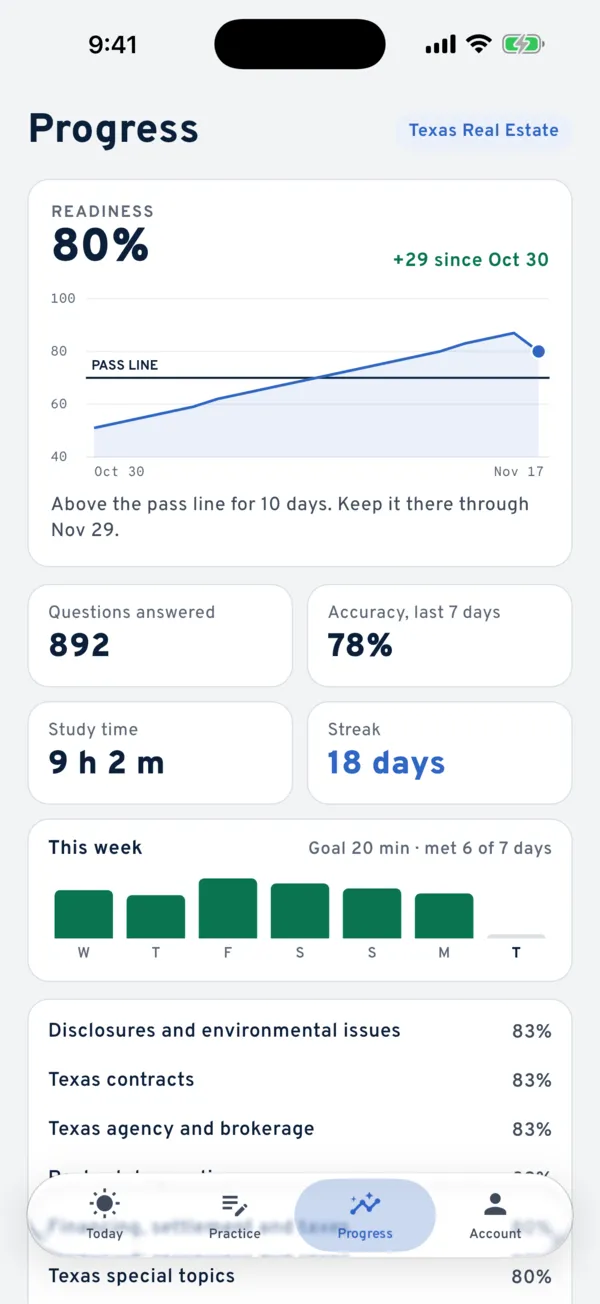
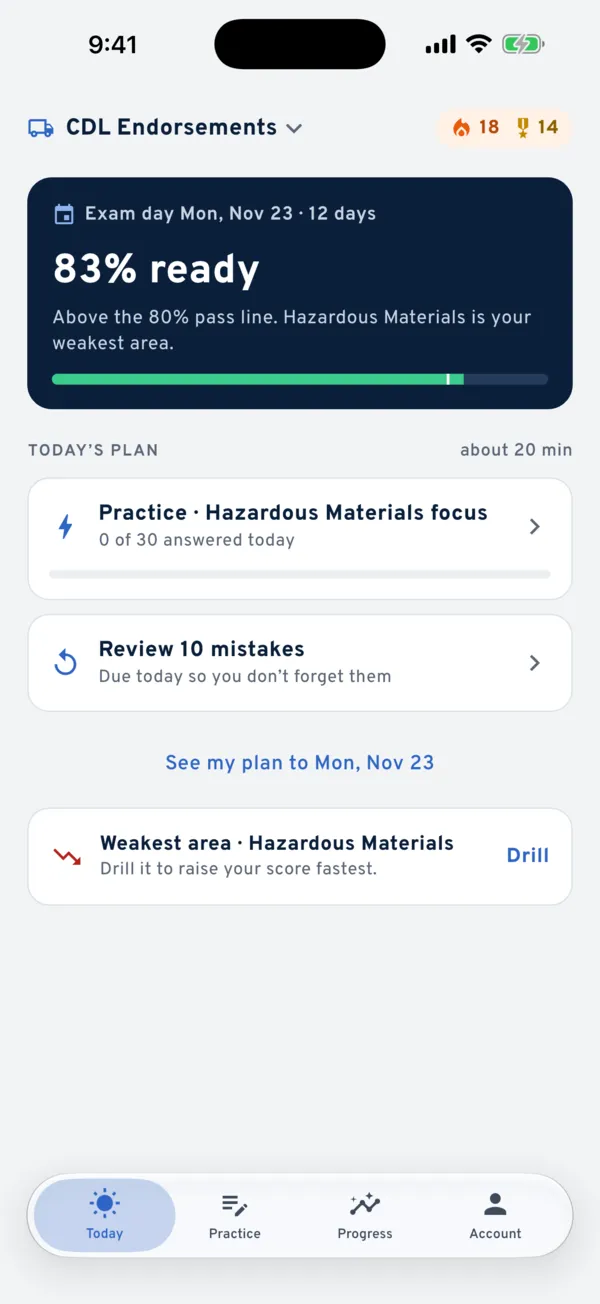
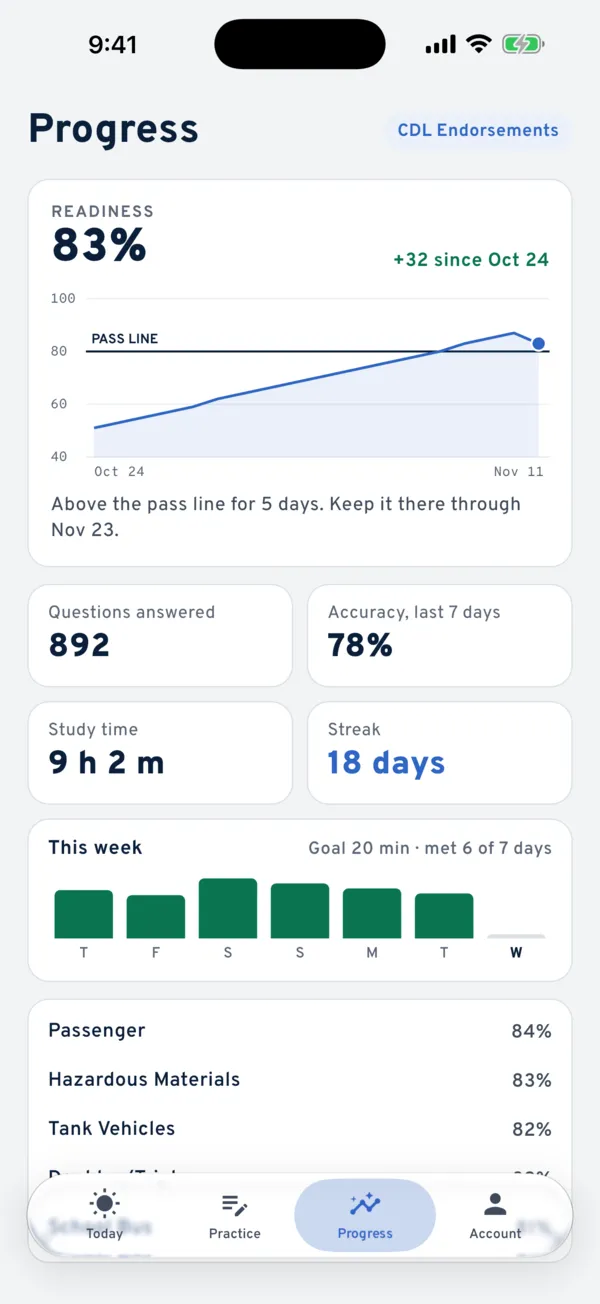
Clinched has every CDL Endorsements question in this format, with full practice tests that match the real one, a readiness score by area and a plan to your test date. Free to start with 10 questions a day.
Read the CDL Endorsements guide or see how we write and check every question.
Free on the App Store
Your exam, in your pocket.
20 exams ready with questions written from the official sources, timed practice tests in the real format and a readiness score with a pass line.
On your computer?
Scan with your iPhone camera to get Clinched practice in the app.